What if the clearest repair explanation matters more than a shop’s search ranking? When your transmission is slipping, shifting hard, or making an unfamiliar noise, it’s natural to want a confident answer before approving repairs. Finding the best transmission shop Douglas County drivers can feel confident choosing starts with asking how the shop will identify the problem and explain the options.
A useful diagnosis should connect the findings to your vehicle’s symptoms, clarify what’s known and what still needs checking, and explain the proposed repair in language you understand. You should also be able to ask whether the shop works on your vehicle’s transmission type and how it will keep you informed as decisions come up. Those details make it easier to compare shops on more than broad claims.
This guide offers practical questions to ask before choosing a transmission shop. You’ll learn what to look for in a diagnosis, how to compare repair options, and what clear communication should sound like, so you can make a choice that fits your vehicle and needs.
Key Takeaways
- Compare the best transmission shop Douglas County options by how clearly they explain their findings, services, and recommendations, not by search ranking alone.
- A transmission symptom can have more than one possible cause, so ask what the diagnosis supports and what may still need to be checked.
- Transmission service, diagnosis, and repair address different needs; the right next step depends on your vehicle and the inspection findings.
- Before choosing a shop, ask whether it handles your vehicle’s transmission and how it will explain repair choices and findings.
- Use a simple checklist to compare local shops, then consider whether their service scope and communication fit your needs.
How to Choose a Transmission Shop in Douglas County
To compare shops, focus on three things: whether they can explain how they’ll investigate your concern, whether their listed services fit your vehicle, and whether their recommendations are clear. Search rankings can help you find local options, but they can’t confirm that a shop handles your vehicle’s transmission or can address the specific symptom you’re experiencing.
Use the questions below as a checklist, not as a way to declare one shop objectively best. A recommendation should follow an inspection and diagnostic findings. Until the vehicle is checked, a symptom can point to more than one possibility, and a responsible explanation should make that uncertainty clear.
What should a transmission shop be able to explain?
Describe what you notice, such as a delayed shift, slipping, or an unusual noise. Ask what the shop would need to learn next and how it would distinguish a possible transmission concern from an issue elsewhere in the drivetrain. You don’t need a firm diagnosis over the phone. Look for a clear explanation of what is known, what remains uncertain, and why inspection or testing is needed.
If a shop mentions technician credentials, ask which credential applies to the work being discussed. The Automotive Service Excellence (ASE) certification reference explains the organization behind the credential, which can help you understand what to ask about without treating a credential as a substitute for a clear diagnosis.
Does the shop’s service scope match your vehicle?
Check that the shop lists the type of transmission service or repair your vehicle may need, and ask whether it works on your vehicle’s transmission. For a manual vehicle, confirm whether clutch replacement is included in its service scope. If your concern involves a 4×4, ask whether the transfer case or differential may also need attention. These components are separate from the transmission, though symptoms can overlap.
Eagle Transmission & Auto Repair lists transmission diagnostics and repair, manual clutch replacement, differential repair, and 4×4 transfer case service. Its page on Ford truck drivetrain and 4×4 transmission care provides a relevant example of related service scope. Treat any listed service as a starting point: confirm that it applies to your vehicle and concern.
When comparing the best transmission shop Douglas County drivers can choose for their needs, prioritize a shop that can discuss your vehicle, explain the diagnostic questions, and connect its recommendation to inspection findings. Clear answers help you decide what to ask next, without requiring you to approve a repair based on a symptom alone.
What a Useful Transmission Diagnosis Should Tell You
A transmission symptom doesn’t automatically mean the transmission has failed. Delayed shifting, slipping, or a new noise may have several possible causes, including concerns elsewhere in the drivetrain. A useful diagnosis explains what was inspected or tested, what those findings suggest, and what remains uncertain. It connects the recommendation to evidence rather than treating one symptom as a complete answer.
Diagnosis identifies likely causes before a repair is selected. That distinction matters: a repair recommendation should follow the findings, not come from a guess based only on a brief description. As you compare options for the best transmission shop Douglas County, ask how the shop reached its conclusion and what information supports the proposed next step.
What information should you share about the symptoms?
Give the shop a clear account of what the vehicle does and when. Note whether the concern happens during shifting, acceleration, or startup, and mention warning lights, unusual sounds, or changes in how the vehicle moves. Include when you first noticed each symptom and whether it happens consistently or only under certain conditions.
Share relevant vehicle details and any recent repairs or service. You don’t need to name the cause. Specific observations help the person assessing the vehicle ask useful follow up questions without anchoring too quickly on one explanation.
How should a shop explain its findings?
Ask, “What did you find that supports this recommendation?” A clear answer should identify the observations or test results that point toward the proposed repair, explain the components involved in everyday language, and distinguish confirmed findings from possibilities that still need checking.
If a warning light or code is part of the explanation, ask what it indicates and whether additional inspection is needed to identify the underlying cause. A code can provide a clue, but by itself it may not establish which part has failed. The Federal Trade Commission offers general advice on how to choose a repair shop and understand repair recommendations.
Before authorizing work, make sure you understand the proposed next step and whether it addresses a confirmed problem or investigates an unresolved one. For an overview of Eagle Transmission & Auto Repair’s listed transmission services, review the page and confirm that the service applies to your vehicle. If you’d like to discuss a transmission concern with Eagle Transmission & Auto Repair, find the Parker shop on a map.
Compare Transmission Repair Options Without Guessing
“Transmission service,” “diagnosis,” and “repair” describe different purposes. Ask what a recommendation is intended to address, and how the vehicle’s inspection findings support it. The right option depends on the vehicle, the concern, and what testing or inspection shows. A maintenance service shouldn’t be presented as a fix for a symptom unless the findings support that choice.
| Option | Purpose | Question to ask |
|---|---|---|
| Transmission service | Maintenance intended to service the transmission. | What is this service meant to address on my vehicle? |
| Diagnosis | Investigates a symptom and helps identify likely causes. | What was inspected or tested, and what did the findings show? |
| Repair | Addresses an identified fault or damaged component. | Which finding supports this repair, and what components are involved? |
When is transmission service different from transmission repair?
Think of service as maintenance and repair as work directed at a problem identified through inspection or testing. If a vehicle shifts differently, a service may or may not relate to the cause. Ask what the proposed service is intended to do and whether diagnostic findings connect it to the symptom. That keeps the conversation focused on the vehicle’s needs rather than assumptions.
For Eagle Transmission & Auto Repair’s listed transmission services and repair options, review the service information and confirm what applies to your vehicle. You can also read the complete transmission repair guide for more general context.
How do drivetrain concerns change the comparison?
A driving or shifting concern doesn’t establish that the transmission itself is at fault. Depending on the vehicle and symptoms, a manual clutch, transfer case, or differential may also be relevant. These are distinct components with different functions, so ask which system the shop believes is involved and what supports that view. For a 4×4 concern, check whether transfer case service is within the shop’s stated scope.
Some shops may discuss technician credentials as part of their qualifications. ASE describes its role in upholding and promoting high standards, but a credential alone can’t explain what is happening with your vehicle. Ask how the findings connect to the suggested work. That kind of clear, vehicle specific explanation is a practical way to compare options for the best transmission shop Douglas County drivers are considering.
Questions to Ask Before Choosing a Transmission Shop
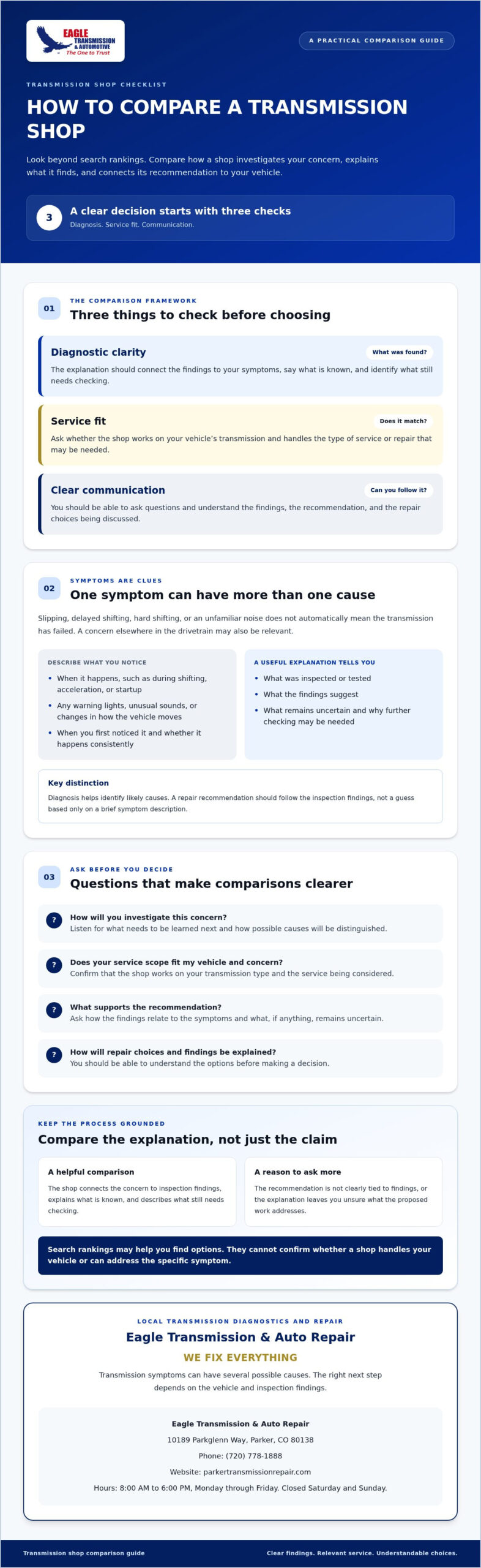
A short conversation can show whether a shop’s answers are specific to your vehicle or mostly broad promotional claims. Use this checklist to compare local options. You’re listening for clear reasoning, relevant service scope, and an explanation you can follow, not a guaranteed diagnosis before the vehicle is inspected.
Questions about diagnosis and recommendations
- What information or testing supports the proposed work? Ask which observations connect the concern to the recommendation.
- What other causes could produce these symptoms? A useful answer separates confirmed findings from possibilities that still need to be checked.
- If the initial findings don’t identify the cause, what would the next step be? This helps clarify how the shop may proceed if the first checks aren’t conclusive.
- What is the repair intended to address? Ask the shop to connect the proposed work to a specific finding or concern.
Questions about the shop and your vehicle
- Do you work on my vehicle’s transmission type? Share the vehicle’s year, make, model, and transmission details if you know them.
- Does your listed service scope cover the concern I described? For a manual vehicle or a 4×4, ask whether related clutch, transfer case, or differential work is within the shop’s stated capabilities.
- How will you explain the findings before I decide how to proceed? Find out whether you’ll receive a plain language explanation of the observations, recommendation, and remaining questions.
- Can you clarify what is confirmed and what is still uncertain? This helps prevent a symptom or warning light from being treated as a complete diagnosis.
Compare the substance of each response. A specific explanation of what the shop can assess and how it will communicate findings is more useful than a general claim of expertise. If an answer uses unfamiliar terms, ask for a simpler explanation. You should be able to describe the recommendation in your own words before deciding on the next step.
These questions can help narrow your options when searching for the best transmission shop Douglas County drivers can choose for their vehicle and concern. Eagle Transmission & Auto Repair lists transmission diagnostics and repair, along with manual clutch replacement, differential repair, and 4×4 transfer case service. To consider the shop as a local option, get directions to Eagle Transmission & Auto Repair.
A Local Next Step for Transmission Repair in Douglas County
Choosing a shop comes down to fit and clarity: confirm that its listed services match your vehicle and concern, ask what supports its diagnosis, and make sure you understand the recommendation before deciding how to proceed. A symptom alone can’t establish which component needs attention, so an inspection and diagnostic findings matter.
Does Eagle Transmission & Auto Repair list services related to your concern?
Eagle Transmission & Auto Repair is a Parker shop that lists transmission diagnostics and repair, transmission service, manual clutch replacement, differential repair, and 4×4 transfer case service. If those systems relate to your concern, you can review the shop’s transmission repair in Douglas County location information. A listed service is a starting point, not a diagnosis or a prediction of which repair your vehicle needs.
Before reaching out, jot down the vehicle’s year, make, and model, along with what you’ve noticed. For example, note whether a shift feels different, when the issue occurs, and whether you’ve observed other changes. Share recent relevant repairs too, without assuming they caused the concern. These details can help the conversation focus on whether the shop’s stated service scope fits your vehicle.
What should you do next?
Ask how the shop will explain its findings and recommendation, and what the next step would be if the cause isn’t clear at first. If you’re comparing the best transmission shop Douglas County drivers might choose, weigh those answers alongside service fit. Clear communication helps you understand what’s known, what remains uncertain, and what you’re being asked to consider.
If your vehicle has a shifting concern or another possible transmission symptom, contact Eagle Transmission & Auto Repair to discuss the vehicle and request directions to the Parker address. Visit parkertransmissionrepair.com or get directions to the shop.
Eagle Transmission & Auto Repair
10189 Parkglenn Way, Parker, CO 80138
Phone: (720) 778-1888
Website: parkertransmissionrepair.com
Hours: 8:00 AM to 6:00 PM, Monday through Friday. Closed Saturday and Sunday.
Choose With Clear Answers, Then Take the Next Step
The best transmission shop Douglas County drivers choose should fit the vehicle and concern, explain what the diagnosis supports, and make repair recommendations understandable. Search rankings can help you find options, but thoughtful questions reveal whether a shop’s services and communication suit your needs.
Before approving work, make sure you understand what was inspected, which findings point to the proposed repair, and what questions remain. The right option may be transmission service, further diagnosis, or repair, depending on the vehicle and findings.
Eagle Transmission & Auto Repair is located in Parker and lists transmission diagnostics and repair, with service coverage in Douglas County. If your vehicle has a shifting concern or another transmission symptom, get directions to Eagle Transmission & Auto Repair for transmission service. Bring your questions and describe what you’ve noticed. A clear conversation is a practical first step toward deciding what your vehicle needs.
Frequently Asked Questions
How do I choose the best transmission shop in Douglas County?
Compare how clearly each shop explains its diagnostic approach, whether its listed services fit your vehicle, and how it connects findings to repair recommendations. Ask what information or testing supports the proposed work and which possible causes remain. Search rankings and broad claims can help you find options, but they can’t confirm a shop is right for your concern. Choose based on relevant service scope and clear answers to your questions.
What should a transmission diagnostic include?
A useful diagnostic discussion should consider your vehicle details and reported symptoms, explain what inspection or testing was performed, and describe what the findings support. Ask which components may be involved, what other causes remain possible, and what the recommended next step is. The exact checks depend on the vehicle and concern, so a shop should explain what applies rather than treating every symptom as the same problem.
Can a shop diagnose a transmission problem from symptoms alone?
No. Symptoms such as slipping, delayed shifts, or unusual sounds can have more than one possible cause, including concerns outside the transmission. Your description helps guide the investigation, but it doesn’t confirm which part has failed. Share when the symptom occurs, when it began, and any relevant recent repairs. A diagnosis should be based on appropriate inspection or testing, with uncertainty explained if the cause isn’t yet clear.
Should I choose a transmission specialist or a general auto repair shop?
Choose a shop whose listed capabilities match your vehicle and concern. Ask whether it works on your transmission type and whether related work, such as manual clutch replacement, differential service, or 4×4 transfer case service, is within its scope. A general auto repair shop may also list transmission diagnostics and repair. The key is confirming the relevant service and getting a clear explanation of findings and recommendations.
Is there a transmission shop near me in Douglas County?
Eagle Transmission & Auto Repair is located in Parker, Colorado, and its supplied business information lists service coverage in Douglas County. The shop lists transmission diagnostics and repair, transmission service, manual clutch replacement, differential repair, and 4×4 transfer case service. Check the shop’s location and confirm that its listed services fit your vehicle and concern. Ask questions about diagnosis and recommendations before deciding how to proceed.