What if your 4WD switch isn’t the real problem? In Parker, Colorado, a 4×4 that won’t engage can leave you stuck in 2WD when snow or mountain roads call for extra traction. A flashing dashboard light, grinding noise, or delayed engagement may point to an electrical fault, a transfer case issue, or another drivetrain problem. Getting the right 4×4 not engaging repair Colorado drivers need starts with identifying the failure, not guessing at a part.
It’s understandable to wonder whether the cause is a simple fuse or a more involved repair. Colorado’s snow, moisture, and road salt can contribute to corrosion in wiring and electrical components, while mechanical parts such as the transfer case and front differential may also be involved. Eagle Transmission & Auto Repair in Parker works on 4×4 transfer cases, differential gears, and electrical 4WD switches. Read on to learn what common symptoms can signal, how electrical and mechanical causes differ, and why a clear diagnosis helps explain the repair options and costs.
Key Takeaways
- A flashing 4WD indicator, grinding noise, or delayed engagement can point to different faults, so symptoms alone cannot identify the failed part.
- Electrical issues such as a faulty switch, wiring problem, or actuator can prevent engagement, while transfer case or differential concerns may also be involved.
- Parker’s winter weather, moisture, and road salt can affect 4WD electrical components, making local driving conditions relevant to diagnosis.
- A careful 4×4 not engaging repair Colorado diagnosis can help distinguish an electrical fault from a mechanical drivetrain problem.
- Learn what 4WD system checks can reveal and which repair options may restore reliable engagement for changing road conditions.
Why Your 4×4 Isn’t Engaging: Identifying the Symptoms
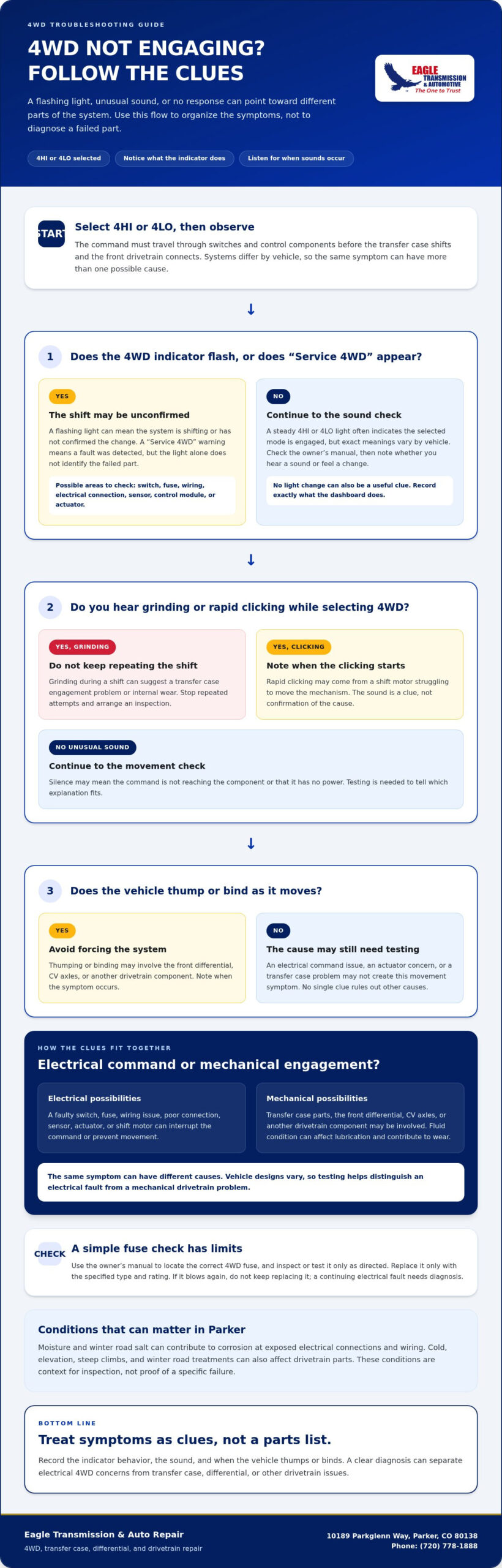
When you select 4HI or 4LO, the command has to travel through switches and control components before the transfer case redirects power and the front drivetrain connects. Depending on the vehicle, an actuator may also engage the front axle. The exact setup varies, but the basic idea is the same: the system must receive the command and complete the mechanical shift. For a general overview, see this explanation of the four-wheel drive system.
Some vehicles use an electronic dial or button, while others have a floor mounted transfer case lever. An electronic system relies on electrical signals and components such as a shift motor. A manual lever moves the transfer case mechanically, though other parts of the drivetrain can still prevent power from reaching the front wheels. If you’re looking into 4×4 not engaging repair Colorado, note what the indicator does, whether you hear a sound, and whether the vehicle’s behavior changes.
Dashboard Warning Lights and Their Meanings
A steady 4HI or 4LO light often indicates the selected mode is engaged, while a flashing indicator may mean the system is shifting or hasn’t confirmed the change. Exact meanings vary by vehicle, so check the owner’s manual. A “Service 4WD” warning signals that the system has detected a fault, but it doesn’t identify the failed part by itself.
The Transfer Case Control Module, or TCCM, manages electronic shift commands and receives information from system components. A faulty switch, damaged wiring, poor electrical connection, or sensor issue can disrupt communication and create confusing warning lights. These electrical “ghosts” can resemble a mechanical failure, so a light alone isn’t enough to diagnose the cause.
Audible Clues: What Your Drivetrain Is Saying
Listen for when the sound occurs, but don’t treat it as a diagnosis. Grinding during a shift can suggest a transfer case engagement problem or internal wear. Rapid clicking may come from a shift motor struggling to move the mechanism, while silence could mean the command isn’t reaching it or it has no power. Thumping or binding as the vehicle moves can involve the front differential, CV axles, or another drivetrain component.
- Grinding: Stop repeated attempts to shift and arrange an inspection.
- Clicking: Note whether it starts as you select 4HI or 4LO.
- Silence: Record whether any dashboard indicator changes.
- Thumping or binding: Avoid forcing the system and note when the symptom occurs.
For related repair information, visit the transmission repair page. In Parker, Colorado, Eagle Transmission & Auto Repair provides drivetrain and differential repair, along with diagnostics for electrical 4WD switches.
Mechanical vs. Electrical: Common Causes of 4WD Failure
A 4WD system can fail because an electrical command never reaches a component, or because a mechanical part can’t complete the shift. The components of a four-wheel-drive system vary by vehicle, so the same symptom can have different causes. In Parker, Colorado, moisture and road salt can also contribute to corrosion at exposed electrical connections, while wear and fluid condition affect mechanical parts.
Look at the pattern, not just the warning light. If the indicator flashes and there’s no shift, a switch, fuse, wiring, actuator, or transfer case shift motor could be involved. If the system shifts but you hear grinding or feel binding, internal transfer case parts or the front differential may need attention. Those clues help guide diagnosis, but testing is needed to identify the fault.
The Role of the 4WD Actuator
The actuator is the bridge between the transfer case’s command and the front axle or hubs, moving the engagement mechanism so the front drivetrain can receive power. Electronic actuators can fail electrically or bind as they wear. In older vacuum operated systems, cracked, loose, or blocked hoses can prevent the actuator from moving. The design differs by vehicle, so don’t assume every 4WD system uses the same setup.
A transfer case shift motor has a separate job: it moves the transfer case into the selected range. Electrical burnout, damaged wiring, or a motor that can’t move the mechanism may stop gear selection. Low or contaminated transfer case fluid is a different issue. It can affect lubrication and contribute to wear, but it doesn’t explain every engagement fault. Check the owner’s manual for the correct inspection and service guidance.
Electrical Gremlins: Fuses, Switches, and Wiring
A fuse is a reasonable first DIY check. Use the owner’s manual to locate the correct 4WD fuse, and inspect or test it only as directed. Replace it only with the specified type and rating. If it blows again, don’t keep replacing it; a continuing electrical fault needs diagnosis. Parker winter road exposure can contribute to corrosion at connectors and wiring harnesses, interrupting the signal between the switch, control module, and actuator.
Grinding or unusual shifting symptoms can overlap with other drivetrain concerns. Eagle Transmission & Auto Repair provides transfer case, differential, and drivetrain repair in Parker. For a separate overview of transmission warning signs, read five signs your transmission needs repair. If your 4WD fault persists or the system makes noise, get directions for an in person drivetrain evaluation.
The Colorado Factor: How Our Environment Strains Your 4×4
Cold, elevation, steep climbs, and winter road treatments can all affect drivetrain parts, but they don’t point to one automatic cause of a 4WD problem. In Parker, Colorado, changes in temperature can make aged rubber vacuum lines less flexible, while moisture, salt, and repeated heavy loads may add stress to different parts of the system. These conditions help explain why 4×4 not engaging repair Colorado can involve more than a failed switch or motor.
Winter Weather and Vacuum System Failure
Some older 4WD systems use vacuum to move an actuator. With age and exposure, rubber lines may stiffen, crack, loosen, or become restricted. A leak can keep the actuator from moving as intended. Moisture inside a line can also freeze in cold weather and interfere with airflow. A morning near -10°F can reveal a weakness that wasn’t obvious in milder conditions, but the temperature alone doesn’t prove a vacuum line is at fault.
Before the first Douglas County snowfall, look for visible cracks, loose connections, or damaged sections of vacuum hose if they’re safely accessible. Don’t pull apart lines or reach beneath an unsupported vehicle. NHTSA also offers practical guidance to prepare your vehicle for winter.
Higher elevation means lower atmospheric pressure, which can affect how vacuum is produced and measured. The actual effect depends on the vehicle’s design and operating conditions, so a 4WD engagement issue at elevation still calls for checking the system rather than assuming altitude is the cause.
Steep Grades and Transfer Case Heat
Climbing a steep grade on I-70, especially with a heavy load, can place added demand on the drivetrain. The transfer case fluid lubricates moving parts and helps manage heat. If the fluid is low, degraded, or contaminated, protection may be reduced. That doesn’t mean every mountain trip damages the transfer case, but following the vehicle’s service guidance and addressing leaks can help support drivetrain longevity.
Eagle Transmission & Auto Repair’s Expert Transfer Case Service page explains related drivetrain care. The shop’s “WE FIX EVERYTHING” motto reflects its broad approach to diagnosis and repair, including transfer cases and differentials.
Winter road treatments such as magnesium chloride can contribute to corrosion on exposed metal and electrical connections. Corrosion may interfere with signals or power in a 4WD system, especially where moisture collects. If a warning or engagement problem appears after winter driving, note when it happens and have the electrical and mechanical causes assessed rather than replacing parts based on the season alone.
Professional 4×4 Diagnostics in Parker: Getting it Right the First Time
A 4WD warning or failed shift doesn’t automatically mean the transfer case is damaged. The cause may be a control signal, wiring fault, actuator, shift motor, fluid concern, or mechanical wear. A useful diagnosis checks how these parts work together instead of treating one code or symptom as a complete answer. That distinction matters for 4×4 not engaging repair Colorado drivers need, especially when a basic engine scan shows no obvious fault.
Beyond the Check Engine Light
A generic code reader may only access engine related information. Depending on the vehicle and scanner, it may not communicate with the Transfer Case Control Module, or TCCM, which manages electronic 4WD functions. A compatible diagnostic scan can reveal module specific faults or communication problems that an engine light reader might miss. Some systems may also store pending codes before a warning appears, but code availability and meaning vary by vehicle.
A code points toward a system or condition, not necessarily a failed part. For example, a communication fault could involve wiring, a connector, the module, or another component. Learn how warning light diagnosis works in this guide to check engine light diagnosis.
From Scan Results to Drivetrain Checks
Electronic information is only one piece of the picture. A complete assessment may include checking visible wiring and connectors, looking for leaks or damage around the transfer case, and inspecting the shift motor and front differential. Fluid condition and level can also matter, though a fluid issue shouldn’t be assumed from a flashing indicator alone.
Testing only with the vehicle raised may not reproduce how the system behaves on the road. A qualified technician may need to verify the selected mode and drivetrain response under appropriate operating conditions. Testing should follow vehicle specific safety procedures, particularly if grinding, binding, or other unusual behavior is present.
Separating the Fault from the Symptom
The diagnostic question is not simply, “Which part has a code?” It’s whether the command reaches the module, whether the system responds, and whether the mechanical components complete the engagement. Comparing scan information with visual findings and operating symptoms helps narrow down the likely failure point. No single code or symptom can confirm the diagnosis on its own.
Eagle Transmission & Auto Repair provides drivetrain, differential, and transfer case repair in Parker, and serves drivers from communities including Castle Rock. For an in person evaluation of a persistent 4WD warning or engagement problem, get directions to Eagle Transmission & Auto Repair.
Trust Eagle Transmission for Your 4×4 Repair in Douglas County
A 4WD problem can involve more than the transfer case. The axle, differential, wiring, switches, and control components all have to work together. For drivers in Parker and Douglas County, identifying which part is affecting engagement is a practical first step toward dependable traction for winter roads and mountain trips.
Eagle Transmission & Auto Repair handles 4×4 transfer case, differential gear, and drivetrain repair, including Ford F-150 and F-250 drivetrain work. If your Ford, Jeep, or Chevrolet has a flashing indicator, unusual drivetrain noise, or trouble shifting into 4WD, the cause needs vehicle specific diagnosis. A symptom alone can’t confirm which component has failed.
Why Experience Matters for 4WD Systems
Modern 4WD and AWD systems can combine mechanical parts with electronic switches, sensors, wiring, and control modules. A warning may come from a communication fault as well as a mechanical concern, so a useful evaluation considers how the system works as a whole. Differential condition matters too. Learn more about expert rear differential repair and how this component fits into drivetrain care.
Eagle Transmission & Auto Repair operates by the motto “WE FIX EVERYTHING,” which reflects its broad approach to diagnosis and repair. Drivers from Aurora, Centennial, and Lone Tree can turn to the Parker shop for related drivetrain and differential service without assuming every 4WD symptom means the transfer case has failed.
Schedule Your 4×4 Inspection
A 4WD system that shifts only partway, makes grinding noises, or binds may not provide the traction you expect. Continuing to operate a vehicle with unresolved grinding or binding could add strain to drivetrain components. Don’t force repeated shifts. Follow the vehicle owner’s manual, and have persistent symptoms assessed before relying on 4WD for icy roads or an off road trip.
Before your next Colorado adventure, note when the problem occurs, which mode you selected, what the dashboard indicator does, and whether you hear a sound. Those details can help guide the evaluation. For 4×4 not engaging repair in Parker, contact Eagle Transmission & Auto Repair to schedule a diagnostic or inspection. Visit parkertransmissionrepair.com to get started.
Get Your 4WD Ready for Colorado Roads
A 4WD system that won’t engage can have an electrical cause, a mechanical fault, or a problem involving both. Dashboard lights and drivetrain sounds offer useful clues, but testing is needed to identify the actual failure point. Colorado’s winter moisture, road treatments, cold, and mountain driving can add stress to components, so don’t rely on a warning light alone to decide what needs repair.
For 4×4 not engaging repair Colorado drivers can turn to Eagle Transmission & Auto Repair for diagnostics and repair involving 4×4 transfer cases, differentials, and the wider drivetrain. The shop serves Parker, Castle Rock, and Centennial. Its motto, WE FIX EVERYTHING, reflects a comprehensive approach to automotive repair.
If your 4WD indicator is flashing, the system is making unusual noises, or engagement feels incomplete, arrange an inspection before relying on it for your next winter drive or mountain trip. Visit parkertransmissionrepair.com to learn about scheduling a 4WD diagnostic. With the right information about the fault, you can make a clearer decision about the next repair and get back to planning your drive.
Frequently Asked Questions
Why is my 4WD light flashing, and can cold weather be the cause?
A flashing 4WD light can mean the system is shifting or hasn’t confirmed that engagement is complete. Cold weather may expose an existing weakness, such as a damaged vacuum line or moisture affecting a vacuum operated component, but the light alone can’t identify the cause. Wiring, a switch, an actuator, a shift motor, or transfer case components may also be involved. A vehicle specific diagnostic check can help narrow down the fault.
Can I drive my truck if the 4×4 is not engaging?
If your truck operates normally in 2WD and has no unusual noise, binding, or other warning signs, you may be able to drive cautiously on suitable roads. Don’t rely on 4WD for conditions that require added traction. If you hear grinding, feel binding, or notice unexpected handling, stop when it’s safe and arrange an inspection. The right next step depends on the vehicle and symptoms, so avoid repeated attempts to engage a system that is making unusual noises.
How much does it cost to fix a 4×4 engagement problem in Colorado?
Repair cost depends on the vehicle, diagnostic findings, parts and labor, and whether the cause is electrical or mechanical. A wiring fault, actuator, shift motor, transfer case, or differential concern can each involve different work. An accurate quote requires inspecting and testing the vehicle. For 4×4 not engaging repair Colorado drivers should start with diagnosis rather than assume a particular part needs replacement. Eagle Transmission & Auto Repair provides drivetrain and transfer case repair in Parker.
Will a bad shift motor cause grinding, and what is the difference between it and an actuator?
A shift motor moves the transfer case mechanism into the selected range. An actuator moves a separate engagement mechanism, such as one connecting the front axle, depending on the vehicle design. A failing shift motor may click or struggle, but grinding can also indicate internal transfer case wear or another drivetrain issue. The sound alone can’t confirm which part has failed. Note when it occurs and have persistent grinding inspected.
Does 4WD diagnosis require a special tool, and how often should transfer case fluid be serviced?
Many 4WD systems require a scanner that can communicate with the transfer case control module, rather than only read engine codes. Diagnostic equipment needs vary by vehicle, and scan results should be considered alongside physical checks. For fluid service, follow the schedule and fluid specifications in your owner’s manual, since requirements differ by vehicle. If you notice a leak, new drivetrain noise, or shifting trouble, arrange an inspection instead of relying on a general interval.
For a flashing 4WD light, unusual drivetrain noise, or an engagement problem, contact Eagle Transmission & Auto Repair to schedule a diagnostic or inspection. Visit parkertransmissionrepair.com to get started.
Eagle Transmission & Auto Repair
10189 Parkglenn Way, Parker, CO 80138
Phone: (720) 778-1888
Website: parkertransmissionrepair.com
Hours: 8:00 AM to 6:00 PM, Monday through Friday. Closed Saturday and Sunday.