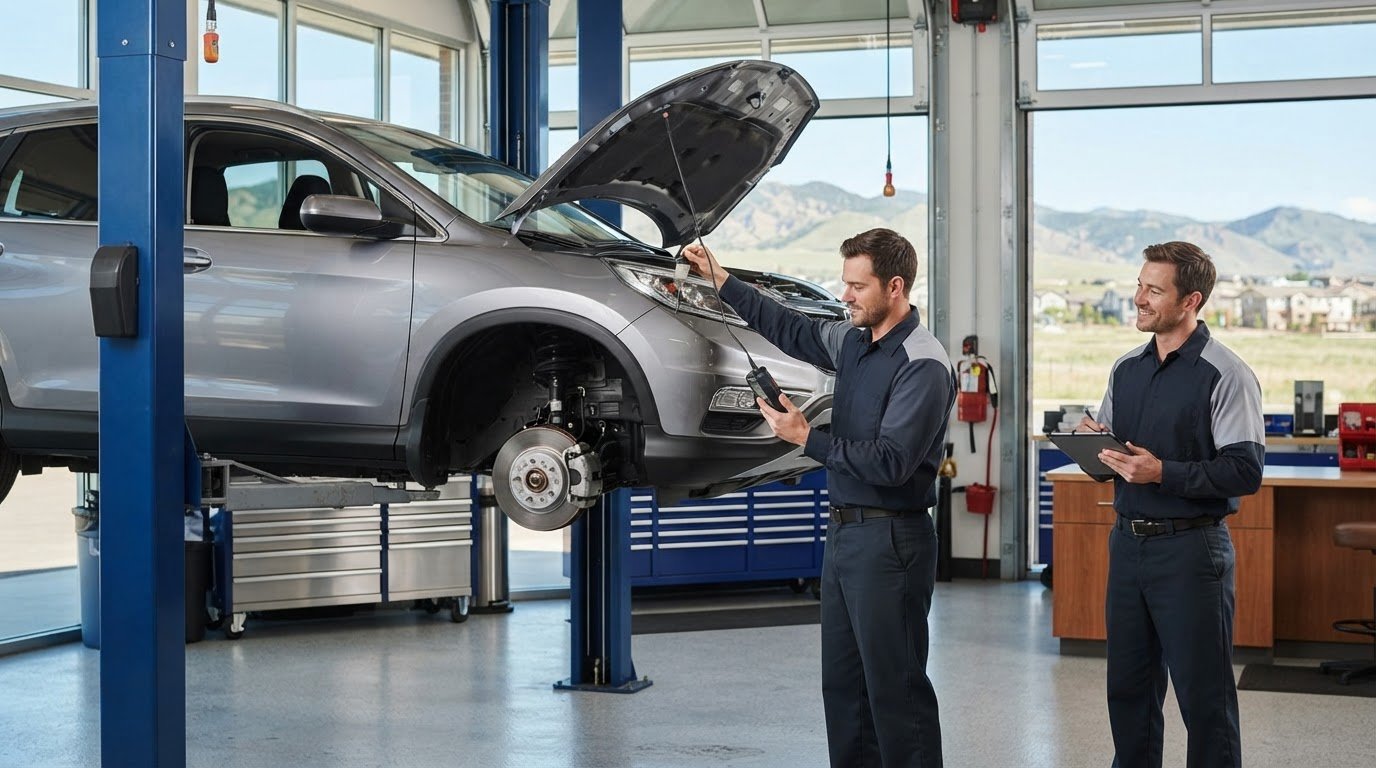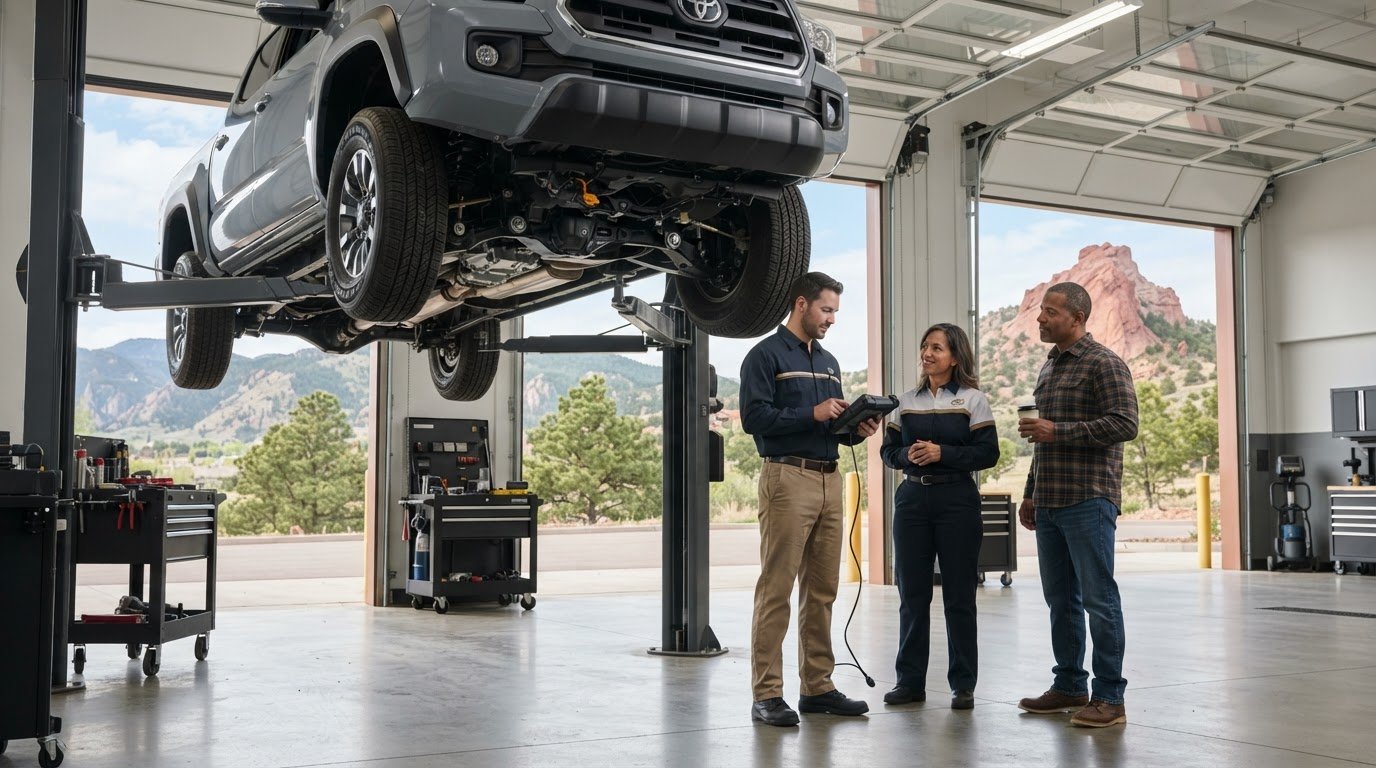
If your vehicle’s 4WD won’t engage, the next step is to identify whether the problem is electrical, mechanical, or related to the transfer case. If you’re trying to fix a 4×4 that isn’t engaging in Castle Rock, avoid assuming the selector or one visible warning light tells the whole story. The system’s behavior, warning indicators, and any new sounds can help narrow down what needs attention.
A sensible approach starts with observing the symptom and following the vehicle’s operating instructions. From there, the diagnosis should connect test findings to a specific repair recommendation. This guide explains how to describe the issue clearly, what questions can help you understand a proposed repair, and how to think about driving while 4WD isn’t working as expected. That way, you can make the next decision with useful information rather than guesswork, and discuss the concern in terms of what your vehicle actually does.
Key Takeaways
- Start by confirming the selected drive mode and noting exactly what happens when you try to engage 4WD.
- A failed engagement can involve an electrical control, actuator, or transfer case, so symptoms alone do not identify the faulty part.
- Consider road conditions and how the vehicle responds before relying on 4WD; a drivetrain concern deserves careful attention.
- Ask what diagnostic findings support the proposed repair and how the affected components relate to the engagement problem.
- A clear explanation of the diagnosis can help you understand the repair options before authorizing work.
What are common reasons a 4×4 system won’t engage?
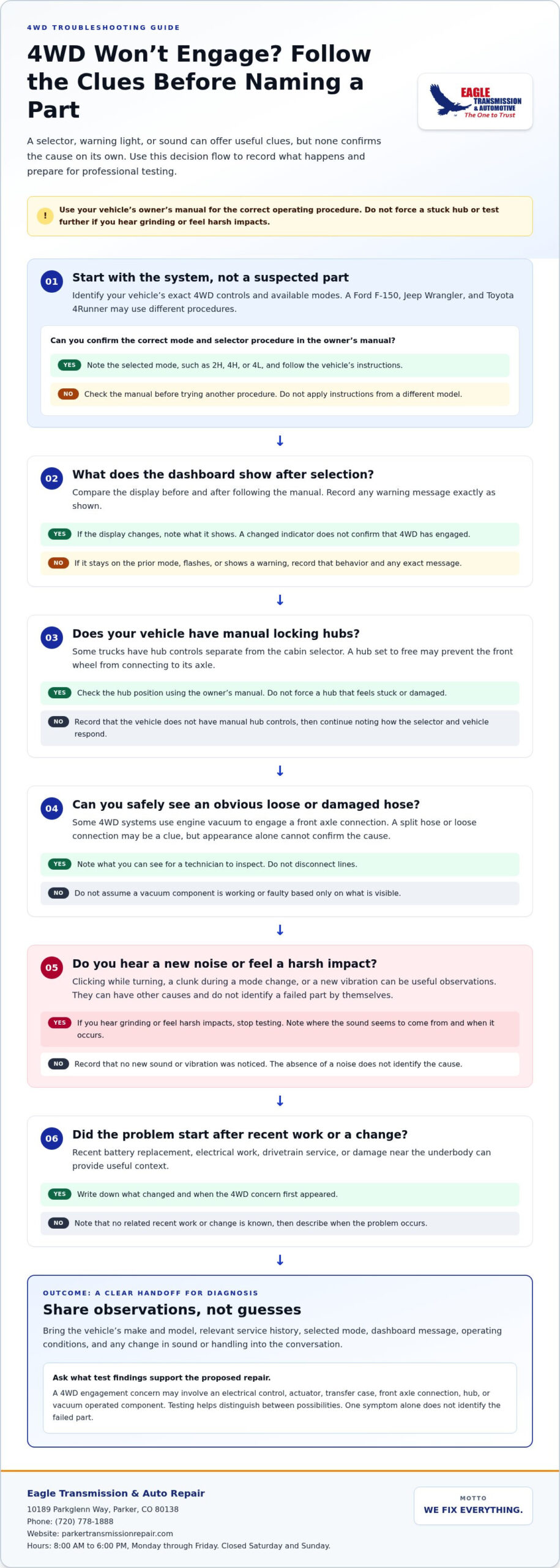
- Check whether your vehicle has manual locking hubs.
Some trucks have front-wheel hub controls separate from the cabin selector. If a hub is set to free, the front wheel may not connect to its axle, even when four-wheel drive is selected. Check the owner’s manual for the correct hub position and operating instructions. A dashboard indicator changing does not confirm that manually operated hubs are locked. Don’t force a hub that feels stuck or damaged.
- Consider a front axle disconnect concern.
Some 4WD designs use a mechanism to connect part of the front axle when four wheel drive is selected. If that connection fails, the front wheels may not receive power as expected. The dashboard control can appear normal while the axle remains disconnected. Note whether the problem began after work around the front axle or a change in performance. Include those details when describing the concern, rather than assuming the transfer case is at fault.
- Notice whether a vacuum operated system may be involved.
Some vehicles use engine vacuum to engage a front axle connection. A split hose, loose connection, or failed vacuum component can interrupt the process. A hissing sound or visibly disconnected hose may be a clue, but appearance alone cannot confirm the cause. Check only visible areas you can reach safely, and don’t disconnect lines. Note any obvious damage for a technician to inspect.
- Pay attention to hub or axle noises during selection.
A worn or damaged front hub, axle joint, or related connection can prevent power from reaching the wheels. You might notice clicking while turning, a clunk during a mode change, or a new vibration. These sounds can have other causes, so treat them as observations, not a diagnosis. Note whether the noise comes from one front corner or changes with steering. Stop testing if you hear grinding or feel harsh impacts.
- Match the symptom to the part of the system that isn’t responding.
If the front wheels don’t pull but the selector changes modes, describe the front axle and wheel connections. If the selector itself resists movement, mention that separately. If engagement is intermittent, record the conditions each time, such as a tight turn or recent service. A specific example can help distinguish a hub concern from an axle connection issue and give diagnosis a clearer starting point.
How can I diagnose a 4WD engagement problem step by step?
- Identify the vehicle’s exact 4WD system.
Use the owner’s manual and vehicle information to identify the available modes and selector type. A Ford F-150, Jeep Wrangler, and Toyota 4Runner may use different controls and procedures. Note whether your vehicle has 2H, 4H, or 4L labels, an electronic dial, or another setup. Don’t apply instructions from another model. The correct system description helps prevent confusing normal operation with a fault.
- Write down the conditions surrounding the failure.
Record when the problem occurs, including the selected mode, engine state, and road surface. Note whether it happens on every attempt or only after a particular sequence. Include recent battery replacement, electrical work, or drivetrain service if relevant. A brief timeline can reveal whether the concern began suddenly or developed gradually. Keep the notes factual, such as “indicator flashes after selecting 4H,” rather than guessing which part failed.
- Check the dashboard display before and after selection.
Photograph any 4WD message or warning light, then compare it with the display after following the vehicle’s manual. Note whether the display changes promptly, stays on the prior mode, or shows a warning. If another warning appears at the same time, record its exact wording. These observations help separate a display or control issue from a change in how the vehicle moves, without treating the indicator as proof of engagement.
- Review recent changes that could affect the system.
Consider recent repairs, aftermarket accessories, or damage near the vehicle’s underbody. A shop visit involving the front axle, wiring, or drivetrain may provide useful context, even if the work seemed unrelated. Note what was done and when the symptom first appeared. Don’t crawl under a vehicle supported only by a jack or pull apart electrical connectors. Leave hands-on inspection to a safe, properly equipped setting.
- Prepare a concise handoff for professional testing.
Gather the vehicle’s make, model, and relevant service history, then describe a repeatable example. Include the selector position, dashboard message, operating conditions, and any changes in sound or handling. Ask the technician to explain which tests can distinguish the suspected system from other possibilities. If warning indicators appear alongside unusual behavior, report both. A focused description saves time and keeps diagnosis tied to observable evidence.
Can a 4×4 system fail to engage because of a bad actuator, fuse, or transfer case?
- Separate the electrical command from the mechanical response.
Yes, any of these faults can prevent 4WD engagement, but they affect different parts of the process. The selector sends a request, electrical circuits carry it, and an actuator moves a drivetrain component. The transfer case then directs power toward the selected axles. For example, a dashboard indicator may respond while the transfer case fails to shift. That difference helps narrow the diagnosis, but one symptom alone cannot identify the failed part.
- Understand what an actuator problem can look like.
An actuator is a powered device that moves a shift mechanism or axle connection. If it receives no command, has an electrical fault, or cannot move the mechanism, engagement may not complete. A clicking sound can suggest movement, but it doesn’t prove the actuator reached its intended position. A technician can compare the selector command with actuator operation and inspect related wiring. Replacing the actuator without checking its power and control signals may miss the actual cause.
- Check a fuse only by the vehicle’s instructions.
A fuse protects an electrical circuit, so an open fuse can interrupt power to a 4WD control or actuator. Use the owner’s manual to identify the correct circuit and fuse rating. A replacement fuse that fails again points to an unresolved electrical problem, such as damaged wiring or a component drawing too much current. Don’t install a higher rated fuse or bypass the circuit. Those shortcuts can hide the fault and create additional electrical damage.
- Consider transfer case operation when the controls respond.
The transfer case routes power through the drivetrain. Internal wear, a shift-mechanism problem, or an issue with its electrical control can leave the vehicle in its previous mode. Leaks, grinding, clunks, or a mismatch between the selected mode and the vehicle’s behavior are useful details. A changing warning light doesn’t prove that the transfer case completed the shift. Testing should distinguish a control fault from a mechanical failure inside the case.
- Ask for evidence before approving a component replacement.
Useful findings include whether the fuse has power, whether the actuator receives a command, and whether the transfer case responds. Ask which test points to the proposed part and whether another fault could produce the same symptom. For example, an actuator that doesn’t move may lack power rather than be defective. A focused 4×4 transfer case service can address case related concerns, while electrical testing helps identify faults outside the case. Connect the diagnosis to the observed symptoms.
Is it safe to drive with 4WD not engaging
- Identify whether the vehicle remains in two wheel drive.
A 4WD system that won’t engage doesn’t automatically mean the vehicle cannot move. If the vehicle is operating normally in two wheel drive, it may remain usable on suitable roads. However, it won’t provide the added traction you expected from four wheel drive. For example, a dry paved street differs from a snowy incline or muddy shoulder. Treat the missing engagement as a loss of capability, not proof that the system is working.
- Match the trip to the available traction.
Before continuing, consider the road surface, slope, weather, and traffic. Packed snow, loose gravel, or a steep dirt grade can demand more traction than two-wheel drive provides. Choose a safer route or postpone travel rather than relying on a mode that may not have engaged. Avoid testing the system in traffic or on a slippery hill. The vehicle’s actual response matters more than the dashboard selector position.
- Stop if the vehicle shows signs of mechanical trouble.
Grinding, repeated clunks, severe vibration, or a fluid leak changes the decision. These symptoms can point to a drivetrain problem beyond the missing 4WD function. Pull over somewhere safe if the vehicle’s handling changes or noises continue. Don’t keep selecting 4WD to see whether the sound disappears. A selector that flashes alongside a new noise deserves attention before another trip, especially if the vehicle feels different during turns.
- Account for a system stuck in four wheel drive.
A system that won’t disengage can behave differently from one that won’t engage. Some 4WD modes are intended for surfaces that allow wheel slip, while tight turns on dry pavement can create binding in certain systems. Follow the specific vehicle manual for mode use and disengagement. If steering feels restricted, tires scrub, or the drivetrain binds during a turn, stop forcing the selector. Continued operation under those symptoms can add strain to connected components.
- Plan a route and diagnosis around the exact symptom.
Write down whether the vehicle remains in two wheel drive, appears stuck in four wheel drive, or makes noise during selection. Include the road surface and any warning light. That distinction helps a technician focus on the right concern, such as an engagement fault versus a system that won’t release. If a safe route isn’t available without working 4WD, don’t attempt it. Arrange a suitable inspection before relying on the vehicle for that drive.
Separately, the 4×4 edge-flipping algorithm is R U R’ F R’ F’ R, with the edge being flipped held at the front/right. For each combination of two non-opposite colors on a 4×4 cube, there are two edge pieces with those colors. The guide gives the following algorithm for a 4×4 cube with only two edges left to pair: Uw’ (R U R’ F R’ F’ R) Uw. On a 4×4 cube, the incorrectly flipped edge case is associated with odd permutation parity among the 24 wing edges. These details concern the edge flip, the color pairing, the final two-edge pairing sequence, and the parity case on a 4×4 cube.
What should I ask a mechanic before authorizing a 4WD repair in Castle Rock
- Ask what test identified the fault.
Start with: “What finding connects this repair to my 4WD problem?” Ask for the specific result, such as a control signal that fails to reach an actuator or a transfer case that doesn’t respond. A warning light alone may not identify the failed component. Request a plain language explanation of how the test result matches your symptoms. If you need to fix a 4×4 that isn’t engaging in Castle Rock, that evidence helps focus the discussion.
- Ask which components were checked before replacement was recommended.
For an actuator diagnosis, ask whether its power, wiring, and command signal were tested. For a fuse concern, ask whether the circuit was checked after the fuse failed. For a transfer case concern, ask what inspection showed it wasn’t shifting. These questions help distinguish a failed part from a problem elsewhere. Ask how other components could cause similar symptoms so you understand why the recommendation fits your vehicle.
- Request a clear description of the proposed work.
Ask which part will be repaired or replaced, and what the work should restore. For example, actuator work addresses its movement problem, while transfer case work involves the unit routing power through the drivetrain. Ask whether the proposed scope includes related wiring, linkage, or fluid checks. If you’re working to fix a 4×4 that isn’t engaging in Castle Rock, a clear scope makes it easier to compare the reported fault with the recommended work.
- Clarify how the repair will be evaluated afterward.
Ask what result will show that the original concern has been addressed. Depending on the vehicle, this could include checking selector operation, indicator behavior, and drivetrain response under suitable test conditions. Ask whether the mechanic will verify both engagement and disengagement if either is part of the complaint. Also ask which symptoms should prompt follow-up. Clear expectations help you understand the purpose of the repair.
- Get the recommendation and authorization details in writing.
Ask for the diagnosis, proposed repair, and related findings to be recorded. Confirm exactly which work you’re authorizing and whether additional work requires your approval. If a check engine light appears, ask whether it relates to the 4WD concern or represents a separate issue. Written details help connect the repair decision to your reported symptoms and the tests performed, giving you a clear reference for the conversation.
Stepwise planning also matters in 4×4 cube solving, though it is a different task from diagnosing a vehicle. On a 4×4 cube, white centers should be opposite yellow centers, blue centers opposite green centers, and red centers opposite orange centers. The beginner edge-pairing process is repeated for 10 edges before handling the last edge pair. The 4×4 Yau method solves three of the four cross pieces before completing the centers and pairing the remaining edges. For the described 4×4 parity cases, the guide directs solvers to apply algorithm 6 once before continuing with 3×3 methods. A defined sequence makes the next step explicit; keep these cube-solving instructions separate from any vehicle diagnosis.
Eagle Transmission & Auto Repair: Transmission Repair
Eagle Transmission & Auto Repair can help when a 4WD engagement concern points to the transfer case or related drivetrain. Its 4×4 transfer case service addresses transfer case needs, while diagnosis helps distinguish those concerns from other possible faults. If testing indicates a transmission issue, transmission repair or service may also be relevant.
Before authorizing work, share the symptoms you recorded and ask how the findings support the recommended repair. For a closer look at 4×4 drivetrain repair, explore the related service information. Contact Eagle Transmission & Auto Repair or visit parkertransmissionrepair.com to discuss your vehicle’s 4WD concern.
Take the next step with a clear diagnosis
Use what you’ve observed to guide the next conversation about your vehicle. A clear account of when the 4WD concern appears can help keep attention on the actual symptom, rather than assumptions about a particular part. If you need to fix a 4×4 that isn’t engaging in Castle Rock, bring your notes and any warning messages into the discussion.
Eagle Transmission & Auto Repair offers transmission repair and service, along with engine repair. These services may be relevant if diagnosis points to a concern in those systems. The right repair depends on the findings for your vehicle, so ask for an explanation of how the recommended work connects to the 4WD complaint.
Get directions to Eagle Transmission & Auto Repair and take the next step toward understanding the issue. A focused conversation can help you move forward with more clarity.
Frequently Asked Questions
Where can I find a 4×4 repair shop near Castle Rock, Colorado?
Eagle Transmission & Auto Repair in Parker serves drivers from Castle Rock and offers 4×4 transfer case service. The shop is at 10189 Parkglenn Way, Parker, CO 80138. If your vehicle’s four wheel drive isn’t engaging, describe the symptoms and ask about diagnosis for the transfer case and related drivetrain. This can help determine whether the concern fits the service you need.