

When your car’s AC runs but the air is warm or only cool, the cause is most often low refrigerant from a leak. A failing compressor, a blocked condenser, an electrical fault or a clogged cabin filter can produce the same symptom. You can rule out a few simple things in your driveway. Finding the real cause means measuring the system, and refrigerant work is regulated by federal law. At Eagle Transmission and Auto Repair in Parker, every job starts with a free diagnostic, so you know what is wrong before you spend anything.
TL;DR
-
Low refrigerant caused by a leak is the most common reason a car’s AC blows warm air.
-
The AC is a closed system. If it has lost refrigerant, it has a leak, and adding more without a repair only delays the problem.
-
Cool but not cold air is often an early sign of a weakening compressor, a dirty condenser or a clogged cabin filter.
-
Servicing refrigerant for pay requires certified technicians and approved equipment under federal rules.
-
We start every job with a free diagnostic, including a road test and computer scan, and we repair only with your approval.
Table of Contents
How a car AC makes cold air
Your AC does not create cold. It moves heat out of the cabin. Refrigerant cycles between gas and liquid, absorbing heat inside the car and releasing it outside through the condenser at the front of the vehicle. The compressor drives that cycle, and the condenser has to shed heat for the refrigerant to arrive cold at the dash.
That explains the pattern most drivers describe. The fan blows, the buttons light up, the compressor may even click on, yet the air stays warm. Something in the loop is not moving or releasing heat the way it should.
The system is also sealed. According to Kelley Blue Book, the refrigerant is reused continuously and should never need topping off while the system is leak-free. If cooling has faded, refrigerant has escaped somewhere, or another part has stopped doing its job.
The most common causes of warm air
Kelley Blue Book lists seven common causes of a car AC that is not blowing cold: low refrigerant, a malfunctioning compressor, a dirty condenser, electrical issues, a malfunctioning thermostat, a broken blend door actuator and a blocked cabin air filter. Here is what each looks like from the driver’s seat.
Low refrigerant from a leak
This is the leading cause. Rubber seals, hoses and gaskets age, and flexible components tend to fail over time. The leak may be slow. Cooling fades over weeks or a season, and a hot afternoon is when you finally notice. Leaks can also let air and moisture into the system, which makes cooling worse.
A clue to watch for: refrigerant carries oil that lubricates the compressor, so a leak often leaves an oily, greasy film near the front of the car on the condenser or nearby parts. If you see that residue, the system is likely losing refrigerant.
A failing compressor
The compressor builds the pressure that circulates refrigerant. HowToGeek reports that the clearest warning sign is vents that blow cool rather than truly cold air, or a cabin that takes much longer to reach a comfortable temperature. Cooling declines gradually as the compressor wears. Weak cooling does not automatically mean the compressor is the culprit, because low refrigerant and clogged components can look the same. That is exactly why measurement matters.
A dirty or blocked condenser
The condenser sits in front of the radiator and releases the heat the refrigerant picked up inside the cabin. Road debris, bugs and damage can restrict it. When it cannot shed heat, the refrigerant never cools fully, and the air from your vents stays warm no matter how you set the dial. In some cases pressure builds high enough that the system shuts the compressor down for a few minutes, then restarts it.
Electrical faults, sensors and the blend door
A blown fuse, a failed relay, a faulty pressure switch or a bad clutch circuit can stop the compressor from engaging even when the refrigerant level is fine. A broken blend door actuator is a different kind of fault. The refrigeration side works, but the door that mixes hot and cold air is stuck toward heat. You may notice one side of a dual-zone system is cold while the other is not.
A clogged cabin air filter
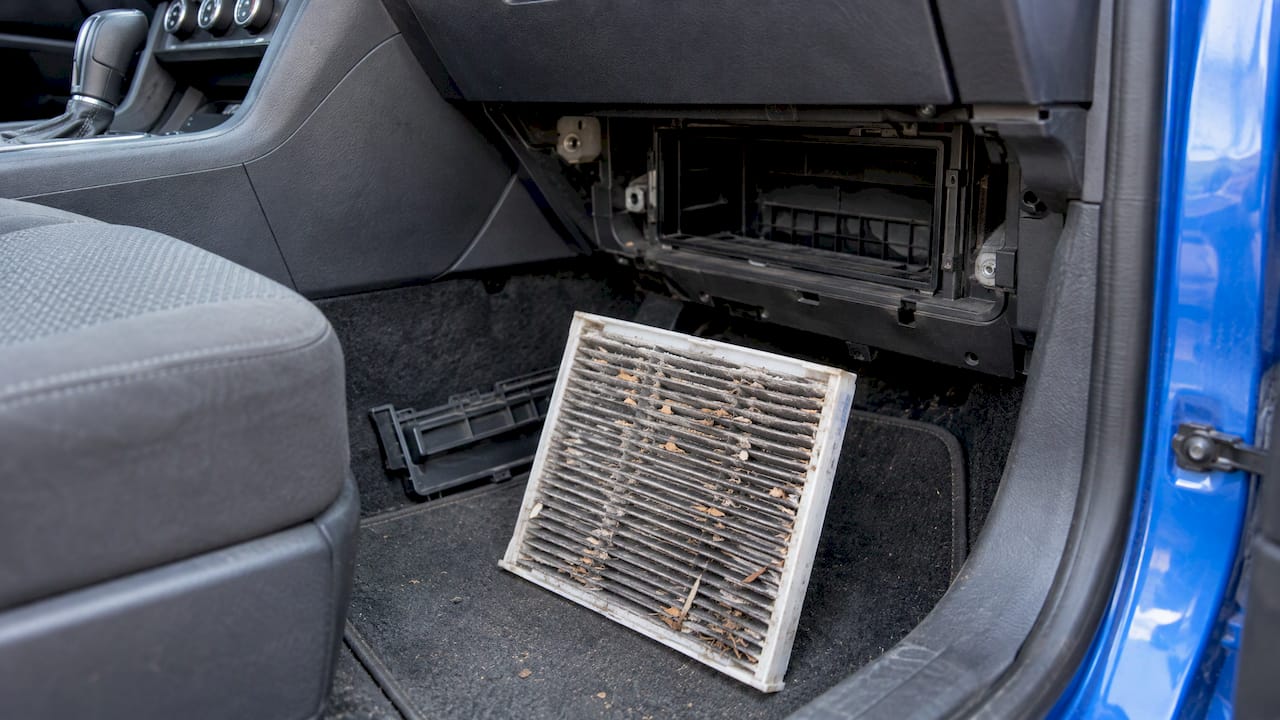
A clogged filter restricts airflow, so the system works harder and less air reaches you. This is the mildest cause on the list and the only one that is usually quick to check.
Cool but not cold: what it tells you
Cool air is a symptom of a problem still in progress. The usual suspects are a slowly leaking system, a compressor losing strength, a condenser that is partly blocked, or a dirty cabin filter. These are all causes that tend to get worse, not better.
Two patterns help narrow it down:
| What you notice | Likely direction |
|---|---|
| Cold at first, then warm after a few minutes | Pressure problem, restricted condenser or cooling fans, or the compressor cycling off |
| Clutch clicking on and off every few seconds | Low refrigerant is a typical cause |
| Cool air that slowly worsens over weeks | Gradual leak or a wearing compressor |
| Weak airflow from every vent | Cabin filter or blower |
| Cold on one side, warm on the other | Blend door actuator or dual-zone setting |
| Grinding or squealing when AC is on | Compressor or belt issue |
Use the table as a guide to the conversation, not a diagnosis. Several of these overlap, and the only way to separate them is to read system pressures and temperatures.
Checks you can do in five minutes
Before you book, a few quick checks cost nothing and give a technician useful information.
-
Check the settings. Make sure the temperature is at full cold and, on dual-zone systems, that the sides are not split. Confirm the AC button is on.
-
Try recirculation. Recirculation often cools better than fresh air, especially in hot weather.
-
Listen with the engine running. You should hear or see the compressor clutch engage when you press the AC button. Note whether it cycles on and off rapidly.
-
Feel the airflow. Weak flow on every setting points toward the blower or the cabin filter instead of the refrigerant side.
-
Look at the front of the car. Check for debris blocking the condenser, and for an oily film on the condenser or the lines near it.
Write down what you find, plus when it started and whether it changes with speed or idling. That timeline speeds up the diagnosis.
Where a driveway check should stop
The checks above are as far as most drivers should go. The reason is practical and legal.
AC systems run on highly compressed refrigerant. Kelley Blue Book cautions that safety is important and recommends a trustworthy mechanic if you feel overwhelmed or unsafe. Federal regulation backs that up: under the EPA’s rules at 40 CFR Part 82, no one servicing motor vehicle air conditioners for consideration may service refrigerant without approved equipment and without being trained and certified through an approved program.
There is a cost reason too. Adding refrigerant to a leaking system is a short-term patch. Kelley Blue Book notes that it is temporary and environmentally irresponsible, and that a qualified technician uses specialized tools to find and repair the leak before recharging. Overcharging or the wrong refrigerant can damage components, and refrigerant can cause frostbite or eye injury if it escapes. The efficient route is to find the leak once, fix it and charge the system to the correct amount.
How a proper AC diagnosis works
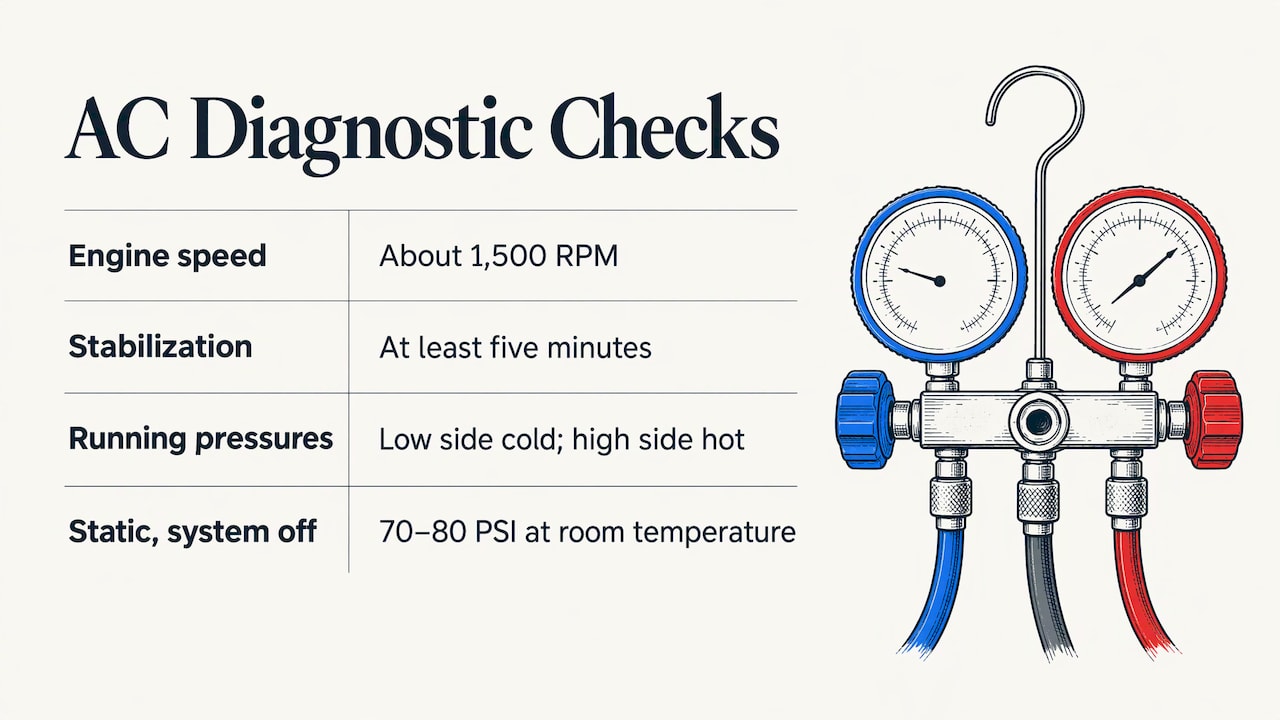
A technician does not guess from the vents. A professional check measures the system. With the engine running at about 1,500 RPM and everything set to AC, ALLDATA’s guidance allows at least five minutes for the system to reach maximum cooling. After that, the low-pressure side should be cold and the high-pressure side hot. Static pressure with the system off should read roughly 70 to 80 PSI on a properly charged system at room temperature. Readings that fall outside those patterns point to the part at fault.
A good diagnosis also asks what else is wrong. Some vehicles will not let the compressor run unless the blower and condenser fans work, so a cooling fan fault can look like an AC fault. A leak may call for dye to trace it. The result should be a clear answer: this part, this reason, this cost.
That is how we work in Parker. Every job begins with a free diagnostic, including a road test and a computer scan, before you spend anything. Repairs happen only with your approval. Our technicians are ASE and ATSG certified, and the repairs are backed by a warranty. We explain what we find and quote it transparently, with no surprise charges.
What AC repair can cost
Costs depend on the cause, which is why diagnosing first saves money. Kelley Blue Book data puts a refrigerant recharge service at about $200, and the average AC repair at a dealership at around $500. A defective compressor that needs repair or replacement can run $1,700 or more.
Those figures show why the cause matters. A clogged cabin filter and a failed compressor are very different bills, and both produce warm air. A free diagnostic tells you which one you are dealing with before any money changes hands. We do not publish a price list for AC work, so you will get your quote after the diagnostic, with your approval before we begin.
If you are weighing a bigger repair on an older vehicle, our guide on whether it is worth fixing a 10-year-old car can help you think it through.
Why the sooner the better
An AC that cools poorly rarely recovers on its own. A small leak keeps leaking. A worn compressor sheds metal particles into the system. AAA lists the signs that mean your AC needs repair, including weak airflow, warm air, odd smells, grinding or squealing noises, leaking fluids, frequent cycling and visible damage to belts or hoses. HowToGeek advises that if cooling is noticeably worse and continues to decline, the system should be inspected by a qualified technician.
Catching a leak while the system still holds most of its charge usually means a smaller repair. Waiting until the compressor has run low on lubricant can turn a hose or seal fix into a much larger job.
Book your AC diagnosis in Parker
We handle A/C and heating repair along with brakes, engine work, suspension, transmission and more, for all makes and models, so one shop covers the whole vehicle. If the cause turns out to be elsewhere, such as a fan, a sensor or the engine cooling side, you do not have to start over with a second shop. Our engine diagnostics and check engine light diagnostics are part of the same service.
We also offer complimentary local towing and ride service, so a car that cannot be driven comfortably, or a day without your vehicle, is not a barrier. We serve Parker, Centennial, Stonegate, Aurora, Castle Rock, Castle Pines, Foxfield and the surrounding Douglas and Arapahoe County area.

If you want to know what to expect from a shop before you call, read how to find a trustworthy mechanic in Parker, or see our overview of auto repair in Parker. When you are ready, bring the car in and we will start with the free diagnostic.
Keeping the AC cold longer
A few habits protect the system once it is repaired.
-
Run the AC regularly. Using it periodically keeps the refrigerant and its oil moving through the seals and the compressor.
-
Keep the front of the car clear. Debris on the condenser reduces how well it sheds heat.
-
Replace the cabin air filter on schedule. It protects airflow and system efficiency.
-
Act on early signs. Noises, slow cooling and cycling are cheaper to address early.
-
Include AC in routine maintenance. Our 30,000-mile service guide shows which fluids and parts are looked at at that interval, and preventative maintenance and tune-ups are part of what we do.
FAQ
Why is my car AC running but not getting cold?
The most common reason is low refrigerant from a leak. Other causes include a failing compressor, a dirty condenser, an electrical fault, a faulty blend door actuator or a clogged cabin filter. A diagnostic that measures system pressures and temperatures separates them, and ours is free.
Why does my car AC get cool but not cold?
Cool air usually signals a system that is partly working. A slow leak, a compressor that is losing strength, a restricted condenser or a dirty cabin filter can all cause it. Because these tend to worsen, it is worth having the system checked before the weather gets hot enough to make the problem obvious.
Can I just add refrigerant myself?
We do not recommend it. The AC is a sealed system, so low refrigerant means a leak, and topping it off does not fix that. Federal rules also require certified technicians and approved equipment for refrigerant service done for pay, and overcharging can damage components. A leak repair followed by a proper recharge is the lasting fix.
How much does it cost to fix a car AC that is not cold?
It depends on the cause. Kelley Blue Book data lists about $200 for a recharge service, around $500 as the average AC repair at dealerships, and $1,700 or more for a defective compressor. Starting with a diagnosis tells you which range applies before you commit to any work.
How long does it take to find out what is wrong?
We begin every job with a free diagnostic, including a road test and computer scan. Call or stop by, tell us what the AC is doing, and we will explain what we find and quote the repair before we do any work.
Sources
-
Kelley Blue Book: Car AC Not Blowing Cold Air, Possible Causes and Solutions
-
Kelley Blue Book: DIY Automotive Air Conditioning Repair and Diagnostics
-
eCFR: 40 CFR Part 82 Subpart B, Servicing of Motor Vehicle Air Conditioners


