A CV axle replacement usually costs a few hundred dollars per side at an independent shop. Your own number depends on your vehicle, the parts used, whether you have front wheel drive, all wheel drive or 4×4, and how much rust or related wear the mechanic finds. At Eagle Transmission & Auto Repair, every job starts with a free diagnostic, including a road test and computer scan. You get a clear explanation and a quote before you spend anything.
We can’t give you a price over the internet, and we won’t pretend to. This guide shows what drives the price, how to tell a bad CV joint from other noises, and why a quote from a shop that has actually looked at your car beats any online estimate.
Key Takeaways
- A CV axle is the shaft that sends power to a front wheel (or any driven wheel) and keeps turning smoothly while the wheel steers and bounces. Clicking when you turn is its classic warning.
- Published estimates for one front axle at an independent shop run from a couple of hundred dollars to several hundred. Vehicle type, parts choice and shop labor rate move the total the most.
- A torn boot caught early can be a smaller repair than a whole axle. Once the joint clicks, replacing the whole axle is the usual fix.
- Axles rarely fail as a matched pair, so you should get a clear reason for any quote that includes both sides.
- At Eagle, diagnostics are free, repairs happen only with your approval, and quotes are explained with no surprise charges.
Table of Contents
- What a CV axle does, in plain words
- Signs of a bad CV joint
- What a CV axle replacement costs
- Boot, joint or whole axle?
- How long can you wait?
- Colorado roads and your axles
- How a CV axle visit works at Eagle
- Your next step
- FAQ
- Sources
What a CV axle does, in plain words
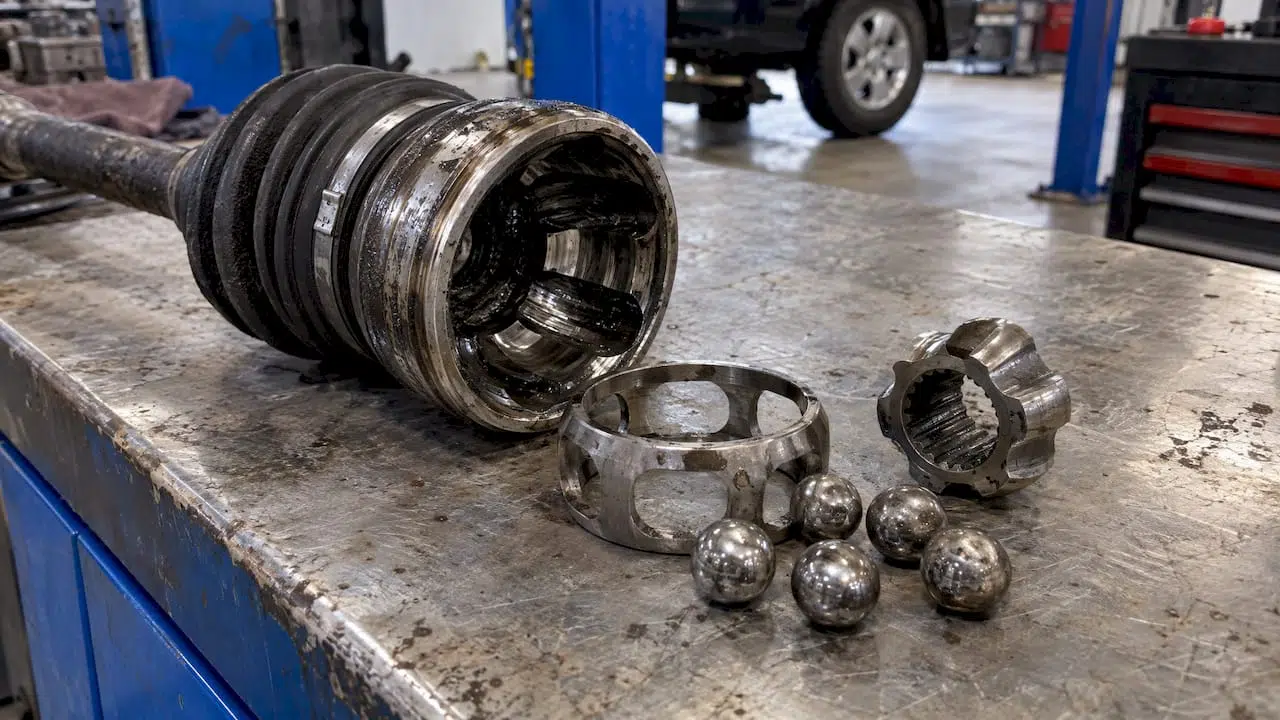
CV stands for constant velocity. Your engine and transmission turn a shaft, and that shaft has to reach a wheel that moves up and down over bumps and swings left and right when you steer. The CV axle (some people call it a half shaft) does that job. At each end is a CV joint, a ball and cage assembly packed with grease and sealed inside a rubber boot.
The boot is the weak point. According to MOOG’s explanation of why CV axles fail, a common cause of failure is a ruptured boot. Grease escapes, and water and grit get into the joint. Once that happens, the joint wears quickly.
That matters for the cost conversation. A boot is cheap to look at. A worn joint means a bigger repair.
Signs of a bad CV joint
You don’t need tools to notice most of these. The same MOOG guide lists the common signs:
- Clicking or popping when you turn. This points to the outer joint, the one near the wheel. It is usually loudest in a tight turn, like pulling into a parking spot at a Parker shopping center.
- Grease on the inside of the wheel or around the suspension. Thick, dark grease flung outward usually means a torn boot.
- Clunking when you accelerate or let off the gas. This points toward the inner joint, closer to the transmission.
- Vibration at higher speeds. You might feel it on E-470 or I-25, through the floor or the steering wheel.
Several things can mimic a bad axle. A worn wheel bearing, a loose suspension part or a brake problem can all make noise. That is why a road test and a proper look underneath come before any parts. If you also notice slipping or hard shifting, that is a separate question, and our transmission services page covers it.
Why the clicking happens
Inside the outer joint, small steel balls ride in grooves held by a cage. GSP’s driveline instruction sheet explains that the cage wears first and develops small dimples. The click is the balls moving in and out of those dimples as you turn. Once those dimples exist, they don’t heal. Wear spreads to the other parts of the joint.
What a CV axle replacement costs
Here is what independent published estimates say, so you have a realistic frame. These are industry figures, not Eagle quotes.
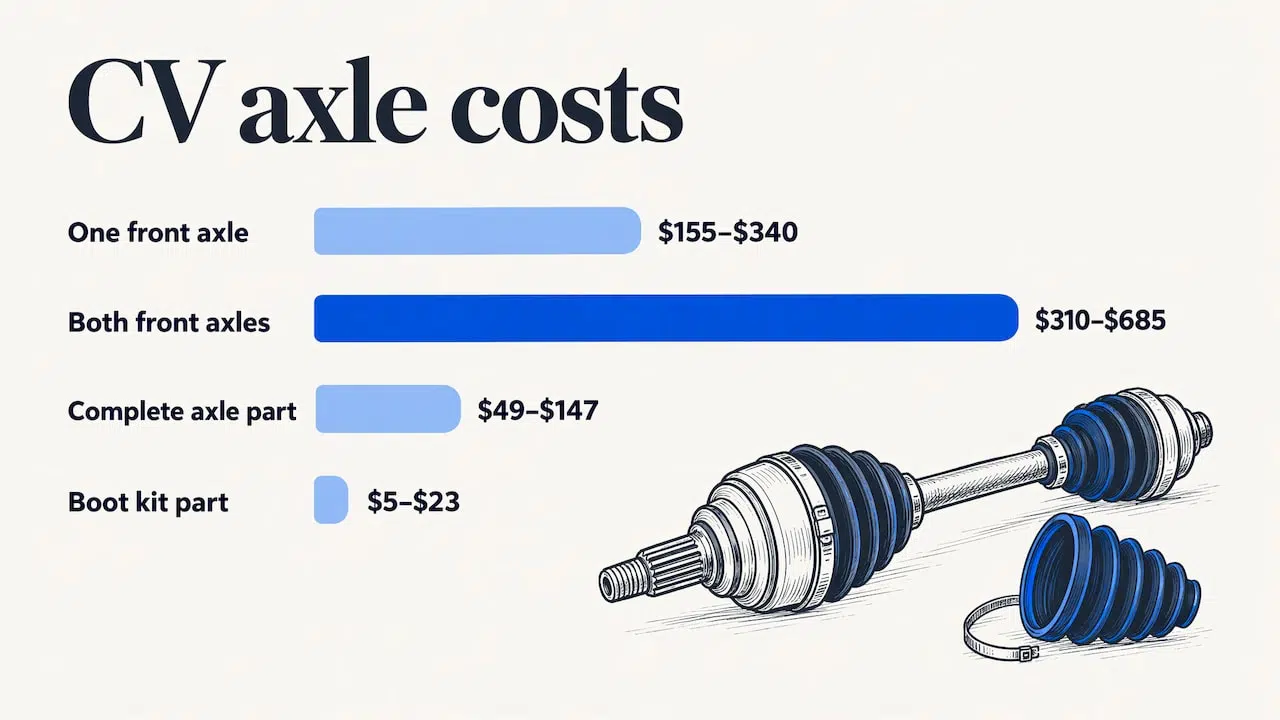
One published estimate for a single front CV axle at an independent shop puts the total at roughly $155 to $340. That breaks down as a complete axle for about $49 to $147 on common cars, plus roughly an hour to an hour and a half of labor. The same source puts both front axles at about $310 to $685, and a boot kit part at $5 to $23, before labor.
Other guides in the market report higher totals, especially for all wheel drive vehicles, trucks, luxury brands and dealership work. That is normal. A small sedan with an easy to reach axle and a three row SUV with extra shields and a transfer case nearby are very different jobs.
The honest takeaway: expect a range, not a single number. The table below shows what usually sets your place in it.
| What changes the price | Why it matters |
|---|---|
| Vehicle type | Compact front wheel drive cars are generally simpler than trucks, SUVs and all wheel drive models. |
| Parts tier | An original equipment (OEM) axle from the carmaker usually costs more than a quality aftermarket or remanufactured axle. |
| Drivetrain layout | All wheel drive and 4×4 can add time because there are more shafts and shields to move. |
| Rust and seized parts | Axle nuts and splines that won’t budge take extra labor. |
| Related items | A leaking axle seal, a new axle nut or a worn wheel bearing may be done at the same time. |
| Shop labor rate | Hourly rates differ between dealerships and independent shops, and labor is a large share of the bill. |
| One side or both | Most jobs are one side. Both sides adds parts and time. |
Boot, joint or whole axle?
This is the question that saves or costs you money, and it depends on timing.
If the boot is torn but the joint is still quiet, a boot replacement may be an option. The joint gets cleaned and repacked with fresh grease before dirt does real damage. It is usually the smaller repair, which is why it pays to look at your wheels and listen when you turn.
If the joint already clicks, the wear has started inside. Replacing just the boot generally delays the problem. The usual fix is a complete axle.
People often ask whether the joint can be replaced alone. On most modern cars, mechanics replace the whole axle instead. Complete axles are readily available, and swapping one is usually more practical than pressing a single joint off a shaft. GSP’s sheet adds that the cost of redoing both boots is often close to the cost of a complete axle. A complete axle also tends to carry a better warranty, because you get new boots, joints and shaft together.
So a quote for a whole axle is not an upsell. For a clicking joint it is normally the standard repair.
Do you need both sides done?
Usually not. Axles seldom wear out as a pair. A fair quote should point to a reason for each side: a torn boot, grease flung on that side, or a noise that traces to it. If a shop says both sides need replacing, ask what they found on each. At Eagle, we explain what we see before you approve anything.
How long can you wait?
A torn boot with a quiet joint gives you some time, but not unlimited time. Grease leaves and grit enters, so the joint tends to wear faster the longer you wait. A clicking joint is telling you it is already wearing.
Vibration that grows, or a rhythmic clunk, is a different matter. In that case, stop driving and arrange a tow. A fully failed axle can separate and swing around underneath the car, and that can damage nearby parts such as brake lines, struts and the exhaust. If you tow a lot, it helps to know how towing and labor coverage works on your own auto policy before you need it.
If your car is stuck, our complimentary local towing comes with a repair at Eagle, so the tow doesn’t add to the repair bill.
Colorado roads and your axles
CV axles lead a hard life here. Winter brings ice, packed snow and road treatments that can speed up rust on seized nuts and hardware. Spring brings potholes after freeze and thaw cycles. If you drive gravel roads out toward Franktown or Elizabeth, or climb into Castle Pines and Castle Rock in all wheel drive, the axles take plenty of turning, bouncing and load.
Two habits help:
- Glance at the inside of your front wheels when you wash the car or change a tire. Fresh grease is a flag.
- Listen on slow, tight turns in an empty lot. A rhythmic click that speeds up with the wheel is worth a visit.
If you’re deciding whether an older vehicle is worth the repair, our guide on whether fixing a 10 year old car makes sense walks through the thinking. We also have a local look at axle replacement cost and repair factors in Centennial and a page on CV axle repair signs and fixes.
How a CV axle visit works at Eagle
Here is what the process looks like when you bring your car to us:
- Free diagnostic. We do a road test and a computer scan, so we know what is causing the noise before you spend anything.
- A clear explanation. We tell you what we found, in plain words, and why.
- A quote with no surprises. Repairs go ahead only with your approval.
- The repair. ASE certified technicians do the work, and it is backed by warranty.
- Getting you home. Ride service is available during your visit, so a repair day doesn’t leave you stranded.
The diagnostic matters because a clicking sound isn’t always the axle. Finding the real cause first is how you avoid paying for parts you didn’t need.
Your next step
If you hear clicking in turns, see grease on a wheel or feel vibration, Eagle Transmission & Auto Repair can look at it. We handle CV axle repair along with brakes, suspension, differentials, 4×4 transfer cases, clutch work, fluid service, general auto repair and fleet service. We’re also the shop for transmission repair, rebuilds and replacement if shifting is your problem. Start with our transmission and auto repair services.
We serve Parker, Lone Tree, Castle Rock, Castle Pines, Highlands Ranch, Centennial, Aurora, Franktown and Elizabeth. You’ll find us at 10189 Parkglenn Way, Parker, CO 80138, open Monday to Friday, 8am to 6pm, and closed weekends. Fleet managers are welcome too.
FAQ
How much does it cost to replace a CV axle?
Published independent shop estimates for one front axle land in the low hundreds of dollars, and they climb for trucks, all wheel drive and luxury vehicles. Your exact price depends on your vehicle, the parts used and what the mechanic finds. We start with a free diagnostic so the quote is based on your car.
What is the difference between a CV axle and a CV joint?
The CV axle is the whole shaft that carries power to the wheel. The CV joints are the flexible ends of that shaft, and each one is covered by a rubber boot. On most modern cars, a worn joint is fixed by replacing the whole axle.
Why does my car click when I turn?
A clicking sound on turns most often points to a worn outer CV joint. Inside, the cage and balls have developed small dimples, and the balls click as they move through them. A worn wheel bearing or suspension part can also make noise, which is why a road test and inspection come first.
Is it safe to keep driving with a bad CV axle?
Occasional clicking means it’s time to book a visit soon. If vibration gets stronger or you hear rhythmic clunking, stop driving and have the car towed, because a failed axle can damage nearby parts. Call us at (720) 778-1888 and we’ll help you decide the next step.
Do I need to replace both CV axles at once?
Usually no. The two sides rarely wear out together, so each side should be replaced only when there is a reason, like a torn boot, flung grease or a noise traced to it. We tell you what we find on each side before you approve any work.
If you’d rather talk it through first, call Eagle Transmission & Auto Repair at (720) 778-1888, or stop by when it suits you. No pressure, just a straight answer about your car.
Sources
- Why CV Axles Fail | MOOG Parts
- GSP North America Performance Driveline & Axles Instruction Sheet
- CV Axle Replacement Cost | CarWhere