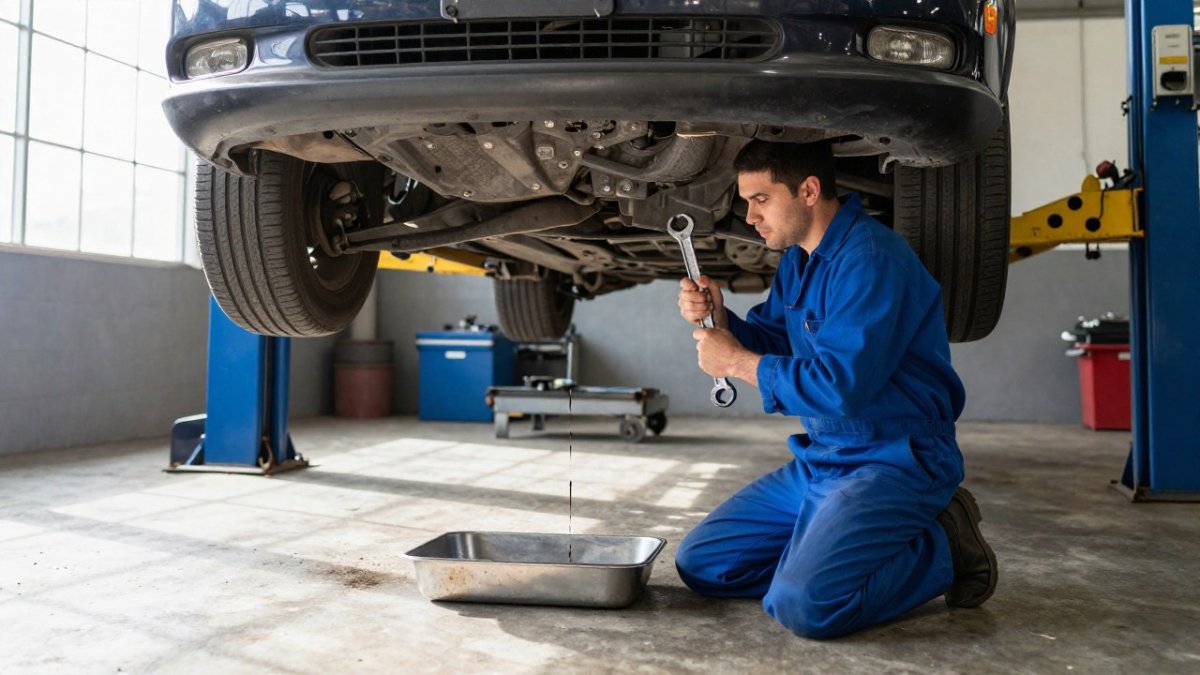
Fleet maintenance cost in the U.S. depends mostly on vehicle class, age and miles driven. A light-duty van or pickup typically lands between $0.08 and $0.15 per mile, which is $1,200 to $2,250 a year at 15,000 miles, according to one 2026 budgeting benchmark. Heavy trucks run far higher, and the oldest vehicles cost the most per mile. The way to hold your number down is to catch problems early, keep downtime short and work with a shop that explains every repair before you pay. For Parker and south Denver metro businesses, that is what we do at Eagle Transmission and Auto Repair: every job starts with a free diagnostic, and repairs go ahead only with your approval.
TL;DR
- Light-duty fleet vehicles typically cost about $0.08 to $0.15 per mile to maintain, or roughly $1,200 to $2,250 a year at 15,000 miles.
- Class 8 tractor-trailers averaged $0.198 per mile in repair and maintenance in 2024, and costs rose again in 2025.
- Age drives the bill: vehicles over 10 years old take a share of the maintenance budget far out of proportion to the miles they drive.
- Planned work is cheaper than emergency work, and downtime often costs more than the repair itself.
- Track cost per mile for every vehicle: total maintenance spend divided by miles driven in the same period.
Table of Contents
- What counts as fleet maintenance cost
- Typical fleet maintenance cost per mile and per year
- What pushes your cost up or down
- Preventive versus reactive: where the money goes
- How to calculate and budget your own number
- Practical ways to cut fleet maintenance cost
- Why a local shop with full drivetrain skills lowers your total cost
- Start with a free diagnostic on your fleet
- Fleet maintenance cost vs. fleet management cost
- FAQ
- Sources
What counts as fleet maintenance cost
Fleet maintenance cost is everything you spend to keep vehicles running safely: technician labor, replacement parts, outsourced repair work, tires, fluids, and the indirect costs of a vehicle sitting idle. Fleetistics lists downtime, lost productivity, missed routes and contract penalties among the indirect items, and puts maintenance at roughly 20% to 30% of total operating expenses for many fleets.
It helps to separate two budgets that search results often mix up. The first is what it costs to own and operate the vehicles: depreciation, fuel, maintenance, tires, insurance and so on. The second is what it costs to run a fleet-management program: software, tracking hardware and support. Geosavi’s cost guide draws exactly this line. Software typically runs $15 to $50 per vehicle per month, and Geotab cites $20 to $60 with basic telematics hardware starting around $100 per vehicle. That is a tool to track your costs. It is not the cost of keeping a van’s brakes, transmission and engine healthy, which is what this article covers.
Typical fleet maintenance cost per mile and per year
The range is wide because “a fleet” can mean ten pickups or fifty tractors. These figures give you a starting point by vehicle type.
| Vehicle type | Typical maintenance cost | Source |
|---|---|---|
| Light-duty (cars, pickups, small vans) | $0.08 to $0.15 per mile | OxMaint 2026 template |
| Medium-duty | $0.12 to $0.22 per mile | OxMaint 2026 template |
| Heavy-duty | $0.15 to $0.30 per mile | OxMaint 2026 template |
| Class 8 tractor-trailer (national average, 2024) | $0.198 per mile | ATRI 2025 report |
| LTL carriers (2024) | $0.222 per mile | ATRI 2025 report |
Two worked examples show what those rates mean in dollars. A light-duty vehicle driving 20,000 miles at $0.09 per mile suggests about $1,800 a year. A heavy truck driving 50,000 miles at $0.12 to $0.15 per mile suggests $6,000 to $7,500, per Fleetistics’ estimates. Use these as sanity checks against your own books, not as promises.
Costs are rising
The trend matters as much as the level. ATRI’s report on 2025 data found that repair and maintenance rose 8.6% to $0.404 per mile on its trucking cost measure, the second-fastest-growing category after tolls. Public fleets feel it too: the City of Dallas fleet study found an average maintenance, repair and operations cost of $8,903 per vehicle per year, a figure that includes police and heavy equipment, so it is a ceiling for most small business fleets rather than a typical number.
What pushes your cost up or down
Age and mileage
Age is the single biggest lever you can see on your own spreadsheet. Fleet-Connection reports the average vehicle age on U.S. roads has reached a record 13.0 years, with newer vehicles costing roughly $0.06 to $0.20 per mile and vehicles 10 years and older as much as $1.10. One benchmark finds that vehicles over 10 years old account for 12% of miles but 33.5% of maintenance spend.
For heavy trucks, Fleet Maintenance magazine quotes a fleet expert describing maintenance of about two cents per mile in a truck’s first year, rising to 10 to 20 cents per mile in years five to seven. The practical lesson from that article is to balance what a vehicle costs against the efficient miles it has left, because even trucks in the same fleet run different miles over different terrain and loads.
Fleet size
Small fleets pay more per mile. In ATRI’s 2026 findings as summarized by Summar, truckload fleets with fewer than five trucks spent $0.275 per mile on repair and maintenance, against $0.169 for fleets of more than 1,000 trucks. If you run a handful of vehicles, you do not have a scale advantage, so the quality of your repair relationship does more of the work.
Miles and local labor rates
A classic transportation research paper found that annual operating miles, the number of units and local wage and cost structure were the most powerful factors in fleet maintenance cost. You cannot control Front Range labor rates, but you can control how many repair visits turn into multi-day breakdowns.
Preventive versus reactive: where the money goes
Planned work is cheaper than emergency work. ATRI’s 2025 report found that carriers running more miles between breakdowns had lower repair and maintenance costs per mile with statistical significance, and that the industry average between breakdowns rose from 37,700 to 38,249 miles in 2024. Preventive maintenance is the report’s explanation for that improvement.
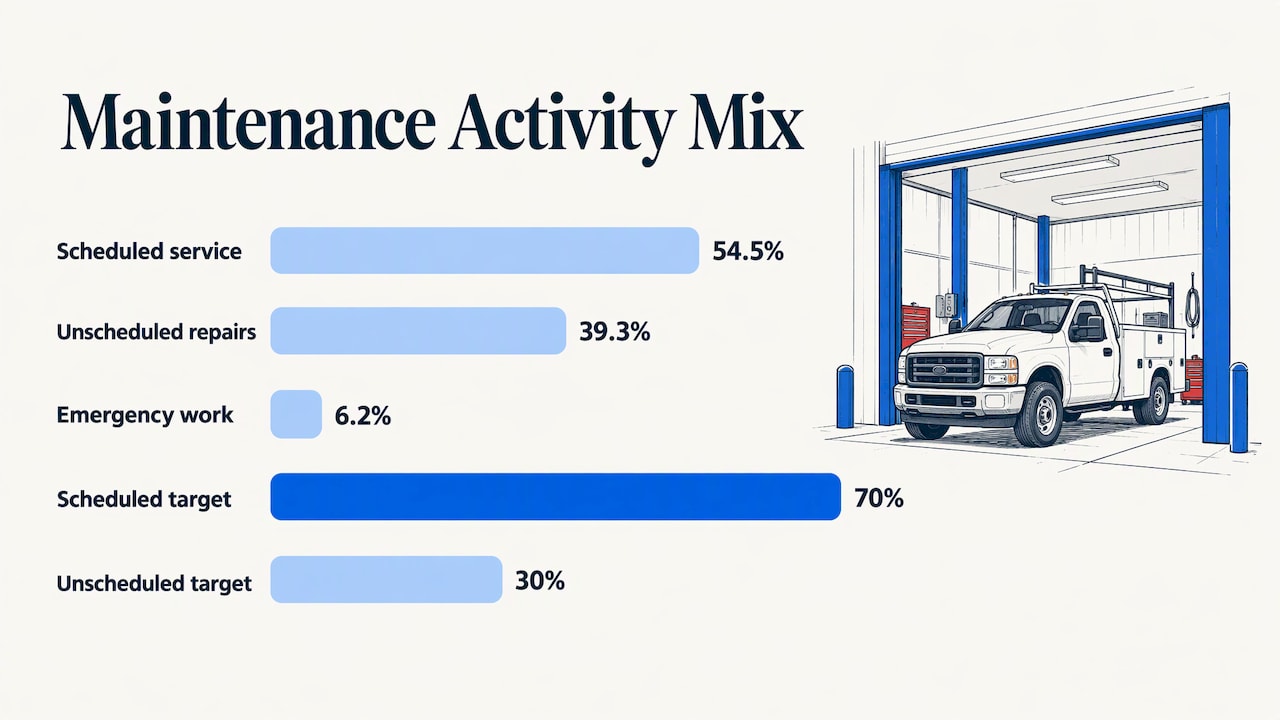
Fleetio’s benchmark data shows how fleets actually spend their time: scheduled service made up 54.5% of activities, unscheduled repairs 39.3% and emergency work 6.2%. The same report gives sample costs, such as $78.01 for an oil change, $446.29 for a tire replacement and $354.13 for a tow. Many managers aim for a 70/30 split of scheduled to unscheduled work, and the data shows most fleets have room to move closer to it.
The cost of an emergency is not only the repair. Fleet-Connection says total downtime for a repair now averages nearly seven days, driven by parts scarcity and communication gaps. A vehicle that is down for a week is a missed route, a late job or a rental you did not budget for. That is why the cheapest repair is often the one that gets the vehicle back on the road sooner. Our guide on how to reduce fleet vehicle downtime in Parker goes deeper on that side.
How to calculate and budget your own number
A budget you built from your own vehicles beats any national average. Here is the routine.
- List every vehicle with its age, class and annual miles. Group them: light-duty, medium-duty, heavy-duty, trailers.
- Add up a full year of maintenance and repair spend per vehicle. Include labor, parts, tires, towing and outsourced work. Pull it from invoices, not memory.
- Divide by miles. The standard formula is total maintenance cost over a period divided by miles driven in the same period. Motive’s example: $950 in a month over 2,000 miles is $0.475 per mile.
- Compare each vehicle to its class benchmark. A van far above the light-duty range is telling you something: a failing component, a driver habit or a vehicle that has aged out.
- Forecast using a three-year average by class, then adjust for age and mileage changes. Review budget against actual every month.
- Flag replacement candidates. One benchmark suggests the replacement sweet spot arrives when annual maintenance exceeds 40% to 45% of the vehicle’s market value. The same logic is behind our guide on whether it is worth fixing a 10 year old car.
When a big repair lands on one vehicle, the budget question becomes repair versus replace. For transmissions, we lay out that decision in transmission repair versus replacement, so you can weigh it against the vehicle’s remaining life before you commit.
Practical ways to cut fleet maintenance cost
None of these require cutting safety. They all work by catching cost earlier.
Schedule by mileage and hours, not by breakdown
Write a service interval for each vehicle class and hold to it. Fluids, filters, belts and brakes are cheap when replaced on schedule and expensive when they fail on the road. Our reference on which fluids and parts are serviced at 30,000 miles is a useful interval to build from.
Act on early warning signs
A drivetrain problem caught at the first symptom is usually a smaller job. Train drivers to report slipping, delayed or hard shifts, new noises, leaks and warning lights the same day. Our checklist of signs your transmission needs repair is short enough to hand out to drivers.
Keep tires properly inflated
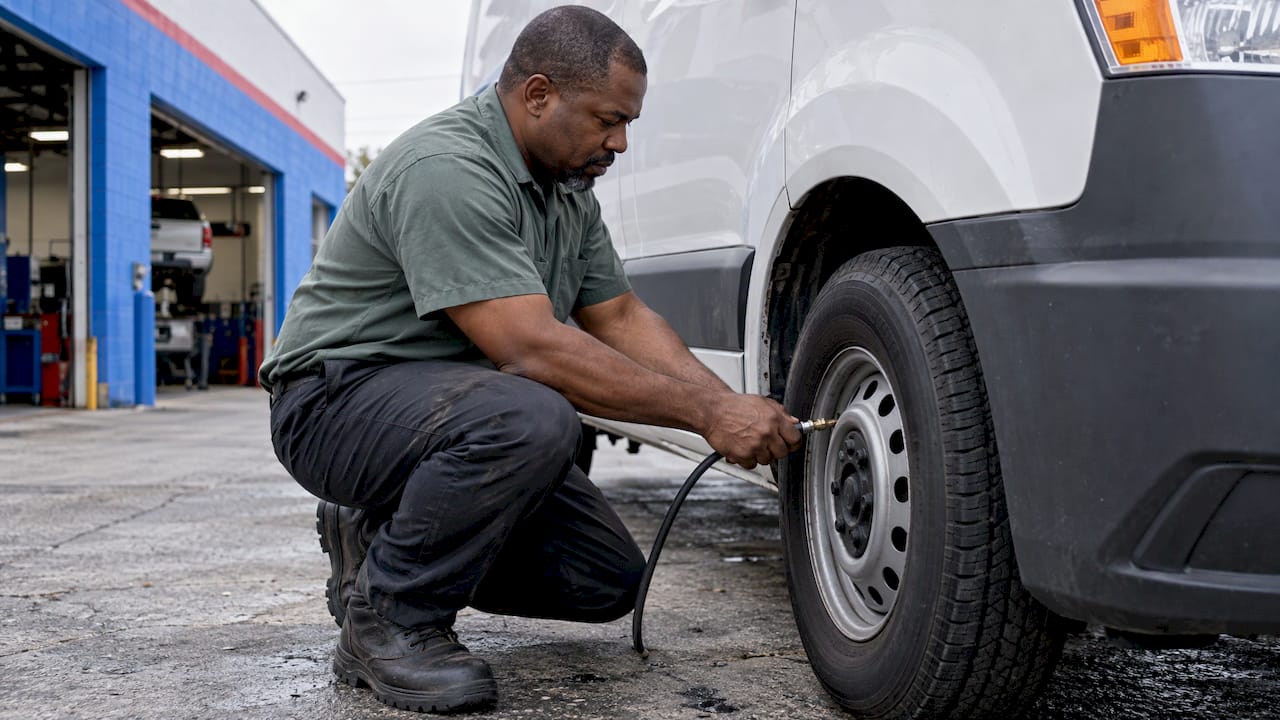
Underinflated tires cost both fuel and tire life. The Department of Energy estimate cited by one fleet tire guide is a 0.3% fuel economy loss for every 1 PSI of pressure drop. A weekly pressure check is the cheapest item on this list.
Replace on data, not on a birthday
Cost per mile by vehicle tells you when a truck has crossed the line. Without per-vehicle tracking, fleets can spend $15,000 to $20,000 repairing a vehicle worth $8,000, and a hard age cutoff misses the cases where a younger vehicle is the real problem.
Get a diagnosis before you spend
The most expensive repair is the one done on a guess. A proper diagnostic, with a road test and a computer scan, tells you what is actually wrong, what is urgent and what can wait until the next scheduled stop. That keeps unplanned work from displacing planned work.
Consolidate under one shop that knows your vehicles
When the same technicians see your vans and trucks repeatedly, they spot patterns: the same shock failing across a model, a transfer case leaking on every plow-season truck. Mixed vehicles do not need separate vendors for brakes, drivetrain, engine and A/C.
Why a local shop with full drivetrain skills lowers your total cost
The line items in a fleet budget that surprise people are usually drivetrain and engine jobs: transmissions, clutches, differentials, transfer cases, driveshafts. They are expensive when they fail and often preventable when serviced. We specialize in exactly that, and we also handle brakes, A/C and heating, suspension, engine repair and preventive maintenance and tune-ups, for all makes and models.
For a business fleet, our approach is built around keeping you informed and your vehicles moving:
- Every job begins with a free diagnostic, including a road test and computer scan, before you spend anything.
- Repairs are performed only with your approval, and we explain them with transparent quoting and no surprise charges.
- Work is done by ASE and ATSG certified technicians and is backed by warranty.
- Complimentary local towing and ride service keep a breakdown from turning into a logistics problem for your driver.
That combination goes straight at the biggest hidden cost in the research above: days of downtime. If you manage vans, pickups, or heavier trucks around Parker, Centennial, Castle Rock, Aurora or Douglas County, see our guides on fleet maintenance in Parker, fleet maintenance services, Sprinter van fleet maintenance and heavy duty truck repair in Centennial.
Start with a free diagnostic on your fleet
If your cost per mile is climbing on a particular vehicle, the quickest way to learn why is a diagnostic. We offer free transmission diagnostics and check engine light diagnostics, and our team covers the rest of the vehicle too. Bring the vehicle with the highest cost per mile first: you will leave with a clear explanation of what is wrong, what it takes to fix and what can wait, before you approve anything.

See everything we handle on our transmission and auto repair services page, or visit Eagle Transmission and Auto Repair in Parker to get a fleet vehicle on the schedule.
Fleet maintenance cost vs. fleet management cost
People often search the two together, so keep them apart in your budget. Maintenance is the hands-on cost of parts, labor and repairs. Fleet management is the cost of software, telematics and administration that helps you plan and track. A small 10-vehicle fleet with basic features may pay about $15 per vehicle per month, or $180 per vehicle per year, while a 50-vehicle fleet with advanced features may pay up to $50 per vehicle per month, or $600 per vehicle per year, per Tech.co’s 2026 guide. A spreadsheet with cost per mile per vehicle is enough to start. Software earns its place when it makes your maintenance schedule easier to hold, not as a substitute for the schedule.
FAQ
How much does fleet maintenance cost per vehicle per year?
Light-duty vehicles commonly fall around $1,200 to $2,250 per year at 12,000 to 15,000 miles, depending on age and how much you drive. Heavy trucks can reach $15,000 or more: ATRI-based figures put the average at $16,192 per heavy-duty truck per year. Your own invoices divided by miles are the number to trust.
What is a good fleet maintenance cost per mile?
For light-duty vehicles, roughly $0.08 to $0.15 per mile is a common benchmark. For Class 8 tractor-trailers, ATRI’s 2024 average was $0.198 per mile. Anything well above your class range points to an aging vehicle, a recurring failure or too much unplanned work.
Is preventive maintenance really cheaper than waiting for repairs?
The evidence says yes. ATRI found that carriers running more miles between breakdowns had lower repair and maintenance costs per mile, and it credits preventive maintenance for rising miles between breakdowns. Planned work also avoids the multi-day downtime that follows many emergencies.
When should I replace a fleet vehicle instead of repairing it?
Track cost per mile for each vehicle and watch the trend. One benchmark flags replacement when annual maintenance passes about 40% to 45% of market value. A diagnostic on the vehicle before a major repair shows exactly what the repair involves, so you can compare it against that threshold.
Sources
- Average Fleet Maintenance Cost Per Vehicle Per Year 2026, Fleetistics
- An Analysis of the Operational Costs of Trucking: 2025 Update, ATRI
- Truck operating costs rose 3.4% in 2025, ATRI finds, TT
- City of Dallas Fleet Management Study
- Fleet Budget Planning Template, OxMaint
- Fleet Maintenance Costs: Budget, Track & Reduce Expenses, OxMaint
- Rising Costs and Aging Assets Strain 2026 Budgets, Fleet-Connection
- Leveraging maintenance costs to plan fleet budgets, Fleet Maintenance
- 2026 Trucking Costs: What Small Carriers Need to Know, Summar
- Vehicle Maintenance: Cost Relationship, Transportation Research Record
- Fleet Benchmark Report, Fleetio via SoftwareReviews
- Fleet Maintenance Costs: How to Calculate, Motive
- Fleet Maintenance Cost Benchmarks
- Fleet Tire Management guide
- Fleet Management Cost: Pricing, Budget and ROI, Geosavi
- Fleet Management Cost Guide (2026), Tech.co
- Fleet Management Software Cost, Geotab
- Trucking Costs in 2025, Fleet Equipment