Table of Contents
- Vehicle A/C Repair Starts With Knowing How the System Works
- Why Your Car A/C Is Blowing Warm Air
- Step-by-Step: What a Car A/C Diagnostic Actually Checks
- Troubleshooting at Home Before You Book a Shop Visit
- Car A/C Recharge: When It Helps and When It Wastes Money
- What Car A/C Repair Cost Depends On
- Routine A/C Maintenance and Seasonal Checks
- Conclusion
- Frequently Asked Questions
Last Updated: October 21, 2026
Vehicle A/C Repair Starts With Knowing How the System Works
Vehicle A/C repair makes more sense once you understand what you’re actually fixing. At Eagle Transmission & Auto Repair, we’ve spent over 40 years under the hood, and the same pattern shows up again and again: drivers replace parts they don’t need because nobody explained how the system works. Automotive air conditioning is a closed loop that moves refrigerant between four components, and cooling only happens when every part of that loop does its job.
The Four Parts That Do the Cooling
- Compressor: Pressurizes refrigerant so it can absorb heat. It’s the engine-driven heart of the system.
- Condenser: Sits near the front of the vehicle and releases heat to the outside air.
- Expansion valve: Drops refrigerant pressure so it turns cold before entering the cabin.
- Evaporator: Absorbs heat from the cabin air. The blower motor pushes that air across it.
A weak compressor, a clogged condenser, or a dirty cabin air filter can all produce the same symptom: warm air. That’s why a proper A/C system diagnosis matters more than guessing.
Why Your Car A/C Is Blowing Warm Air
Warm air almost always traces back to one of three causes: low refrigerant, a leak, or a failed component. A car A/C blowing warm air is a symptom, not a diagnosis. The system may be full of refrigerant and still blow warm if the compressor clutch won’t engage or the blend door is stuck.
Low Refrigerant vs. a Real Leak
These get confused constantly. Low refrigerant means the charge has dropped, but refrigerant doesn’t get “used up” like fuel. If it’s low, it escaped somewhere. Topping it off without finding the leak is a temporary fix that wastes money. A refrigerant leak needs pressure testing and leak detection, not a quick can from the parts store. According to the U.S. EPA refrigerant handling requirements, refrigerant must be recovered and handled by certified technicians, which is one reason DIY recharge kits carry real risk.
Adding refrigerant to a system with an active leak can mask the real problem and damage the compressor. If the system is low once, it will be low again until the leak is found.
Step-by-Step: What a Car A/C Diagnostic Actually Checks
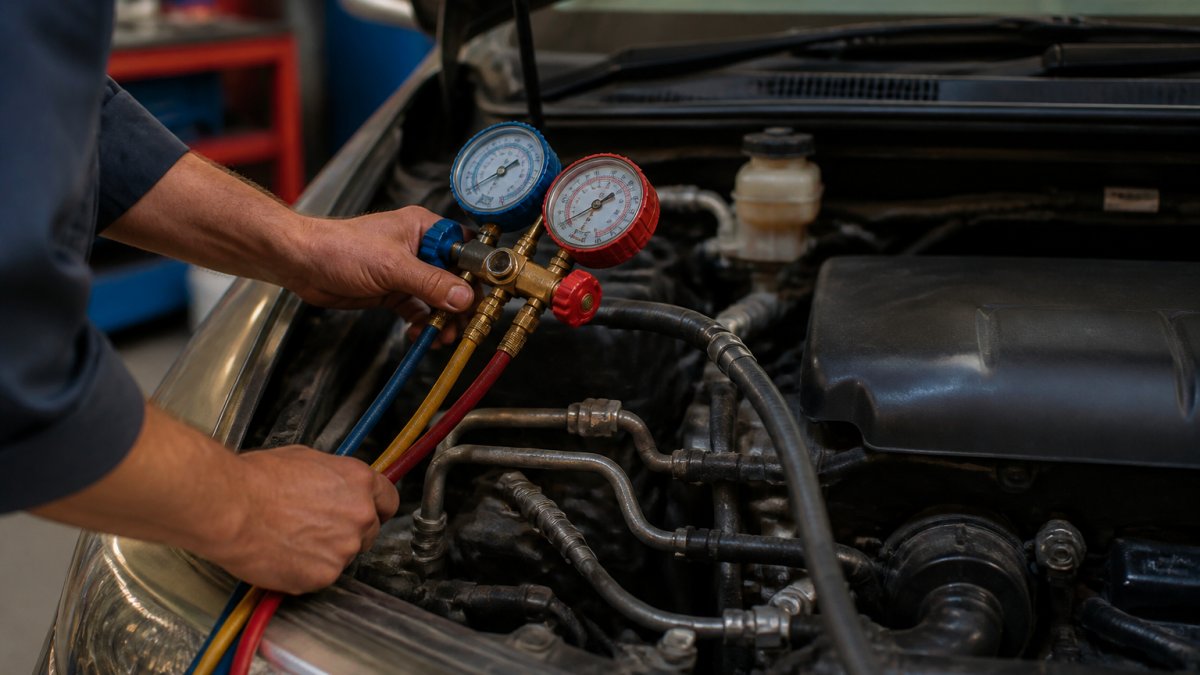
A car A/C diagnostic is a structured inspection, not a guess. A technician connects manifold gauges, reads high-side and low-side pressures, and compares them to spec. Then comes a visual inspection of the compressor, condenser, and lines, followed by leak detection and a check of the blower motor, cabin air filter, and electrical controls. What separates a real diagnosis from a parts swap is knowing what each reading means.

What the Pressure Readings Tell You
Manifold gauges read the low side (suction) and high side (discharge) at the same time, and the relationship between them is the diagnostic signal:
- Both sides low: the system is undercharged or leaking. The next step is leak detection, not a recharge.
- Both sides high: overcharge, a restricted condenser, or a cooling fan that isn’t pulling air through the condenser.
- Low side low, high side high: a restriction, often the expansion valve or a clogged orifice tube.
- Low side high, high side low: the compressor isn’t pumping, which usually means a worn compressor or a clutch that isn’t engaging fully.
A single gauge reading tells you almost nothing. The pair, read against ambient temperature and the manufacturer’s spec chart, is what points to a cause.
The Rest of the Inspection
- Static and running pressure readings on both sides, compared to the spec chart for the ambient temperature.
- Leak detection with UV dye or an electronic refrigerant sniffer, dye finds slow seeps, sniffers catch leaks at fittings and the evaporator core.
- Compressor clutch and drive belt inspection, a clutch that won’t engage can be an electrical fault, a low-pressure switch, or a failed coil, not a dead compressor.
- Condenser and evaporator airflow check, a condenser packed with road debris or bugs raises high-side pressure and cuts cooling.
- Cabin air filter condition, a clogged filter starves the evaporator of airflow and mimics a refrigerant problem.
- Blend door and temperature control function, if one vent blows cold and another warm, the refrigerant circuit may be fine and the actuator is the fault.
- Electrical and control check, the A/C request from the climate panel, the pressure switches, and the compressor relay all have to agree before the clutch engages.
At Eagle Transmission & Auto Repair, our free road test and computer diagnostics help us confirm the fault before we recommend a single part. The goal is to hand you a diagnosis that names the failed component and explains why it failed, not a list of parts to try.
Troubleshooting at Home Before You Book a Shop Visit
Before you schedule a service appointment, a few safe checks can narrow things down. Start simple: confirm the A/C button is on, the fan blows at every speed, and the cabin air filter isn’t clogged. Weak airflow with cold-ish air often points to a filter or blower issue, not refrigerant.
What most guides miss is the blend door. If one side blows cold and the other warm, the system may be fine and the door actuator is the culprit. Skip the DIY refrigerant cans, though. Modern systems need exact charge amounts, and overcharging damages the compressor. The U.S. Department of Energy vehicle efficiency guidance notes that A/C performance and fuel use are closely tied, so a system running wrong costs you at the pump too.
Feel the vents within the first minute of startup. If air is cold then fades to warm, that pattern often signals a charge or compressor issue rather than a blower problem.
Car A/C Recharge: When It Helps and When It Wastes Money
A car A/C recharge only helps when the system is slightly low and the leak is minor or already sealed. If pressures are normal, a recharge does nothing. If there’s an active leak, refrigerant escapes again and you’ve paid for a service that won’t last.
Repair versus recharge comes down to diagnosis. A pressure test and leak detection tell you which path makes sense. Many drivers find that a proper repair estimate saves money over repeated recharges. We’d rather fix the leak once than sell you the same recharge twice.
| Symptom | Likely Cause | Best Next Step |
|---|---|---|
| Warm air, normal pressures | Blend door or electrical fault | Diagnostic scan |
| Warm air, low pressures | Refrigerant leak | Leak detection and repair |
| Weak airflow, cool air | Clogged cabin air filter | Filter replacement |
| Cold then warm | Low charge or compressor | Pressure test |
What Car A/C Repair Cost Depends On
Car A/C repair cost depends on the failed component, the vehicle, and how much labor the job requires, and no honest shop can quote a firm number over the phone. What a shop can do is explain the cost drivers so you know what you’re paying for before you approve anything. Here’s how the math typically breaks down.
The Four Cost Drivers
- Parts. A cabin air filter is one of the least expensive parts on the vehicle. A condenser sits in the middle. A compressor is the single most expensive component in most systems, and on some vehicles it’s sold only as an assembly with the clutch and pulley.
- Labor hours. Filter and blower motor jobs are measured in minutes. Compressor replacement is measured in hours because the belt, lines, and often the condenser and receiver-drier come off with it. Labor rates vary by market and by shop, so the same job can land in very different places depending on where you are.
- Refrigerant type and charge. Older systems use R-134a; most vehicles built after the mid-2010s use R-1234yf, which costs substantially more per pound. A system that needs a full charge costs more in refrigerant alone than one that only needs a top-off.
- Diagnosis and related parts. A leak repair often means replacing the failed line, O-ring, or seal and the receiver-drier, because an open system absorbs moisture. Skipping the drier is a common shortcut that shortens compressor life.
What Each Job Usually Involves
| Job | What’s Included | Why It Costs What It Does |
|---|---|---|
| Cabin air filter | Filter, labor | Minutes of labor, low parts cost |
| Recharge only | Refrigerant, labor | Cheap if there’s no leak; wasted money if there is |
| Leak detection and repair | Dye or electronic test, line/seal replacement, evacuate and recharge | Labor-intensive; refrigerant and drier add cost |
| Condenser replacement | Condenser, drier, refrigerant, labor | Front-end disassembly; often bundled with other work |
| Compressor replacement | Compressor, drier, refrigerant, belt, labor | Highest parts cost; system flush may be required |
How to Read an Estimate
Ask for a written estimate that separates parts from labor and lists the refrigerant charge as its own line. Confirm whether the price includes evacuating and recharging the system, and whether the receiver-drier is being replaced, a compressor quote that skips the drier is a red flag. Ask what happens if the diagnosis turns up a second failed component; a good shop calls before adding work, not after.
The cheapest A/C repair is the one you actually need. Diagnosis first, parts second, always, and a written estimate that itemizes parts, labor, and refrigerant is the best protection against paying for a repair you didn’t need.
Routine A/C Maintenance and Seasonal Checks
Routine A/C maintenance prevents most warm-air surprises. Run the A/C for a few minutes every month, even in winter, to keep seals lubricated and the compressor cycling. Replace the cabin air filter on schedule, keep the condenser clear of debris, and get a seasonal check before summer.
A/C maintenance isn’t glamorous, but it’s the difference between a cool cabin and a midsummer breakdown. The ASE certification overview explains why choosing certified technicians matters for this kind of work: proper training and equipment catch problems early.
Drivers with older, high-mileage vehicles who want an honest diagnosis before committing to major repairs.
Conclusion
Warm air doesn’t have to mean an expensive repair, but it does mean you need a real diagnosis before anyone touches a part. Whether it’s a refrigerant leak, a failing compressor, or a simple cabin air filter, the right shop finds the cause first. Eagle Transmission & Auto Repair offers free road test and computer diagnostics, same-day service goals for most repairs, and complimentary Uber or Lyft so your day isn’t derailed. Get a quote from our ASE-certified team and get your cabin cool again.
Frequently Asked Questions
Why is my car A/C blowing warm air instead of cold?
Warm air usually points to low refrigerant from a slow leak, a failing compressor, a blocked condenser, or a blower motor that isn’t moving air through the vents. A weak cabin air filter can also cut airflow so much that the air feels warm. A proper car A/C diagnostic with pressure gauges and leak detection separates these causes before any parts are replaced, which is why guessing at the problem often leads to paying twice.
How much does vehicle A/C repair cost?
Car A/C repair cost depends on what failed. A recharge and leak inspection sits at the low end, while compressor, condenser, or evaporator replacement pushes the bill higher because of parts and labor hours. Pricing also varies by make, model, and how much of the dashboard must come apart. Eagle Transmission & Auto Repair provides a repair estimate before work begins, so you know the number before you commit.
Can I recharge my car A/C myself, and will an auto parts store do it?
DIY recharge kits exist, but they only add refrigerant without finding out why it escaped. If there’s a leak, that refrigerant leaves again within weeks and the compressor runs with less oil, which shortens its life. Some auto parts stores sell refrigerant but do not perform recharges. A shop-based car A/C recharge includes leak detection and the correct charge weight, so the fix holds.
Is it safe to drive with a broken car A/C?
Driving with no cold air won’t damage the engine, but it matters in summer heat, especially with children, pets, or older passengers in the car. A compressor that has seized can also affect the serpentine belt that drives other accessories. If you hear grinding or squealing from the engine bay when the A/C is on, have it inspected rather than continuing to drive.