That flickering yellow icon on your dashboard isn’t just a suggestion; it’s a “code red” emergency that demands your immediate attention before your engine pays the price. If you see your check engine light flashing Parker CO while you’re cruising down CO-83 or merging onto E-470, your vehicle is telling you that something is seriously wrong right now. Unlike a steady light, a flashing signal usually means your engine is misfiring, which can quickly melt your expensive catalytic converter or lead to a total engine breakdown.
We understand the immediate wave of anxiety that hits when your car starts acting up, especially with the fear of an expensive engine replacement looming over your head. At Eagle Transmission & Auto Repair, we believe in being a supportive partner rather than an intimidating shop. This guide will walk you through why this light is so critical in our demanding high-altitude conditions and provide the immediate safety steps you need to protect your car. We’ll also demystify the diagnostic process and show you how our “WE FIX EVERYTHING” philosophy helps get you back on the road with confidence.
Key Takeaways
- Understand why a check engine light flashing Parker CO is a critical emergency that requires pulling over immediately to prevent your catalytic converter from melting.
- Learn how Parker’s 5,900-foot elevation puts extra stress on your spark plugs and sensors, making your vehicle more prone to high-altitude misfires.
- Discover the surprising connection between transmission issues and dashboard warnings, and how a failing torque converter can often mimic engine trouble.
- Master a simple two-step safety plan to protect your engine and your wallet when you’re stranded on busy local routes like Parker Road or E-470.
- See how the expert diagnostic process at Eagle Transmission & Auto Repair provides a transparent, honest roadmap for repairs because “WE FIX EVERYTHING.”
Emergency Alert: What a Flashing Check Engine Light Means for Your Vehicle
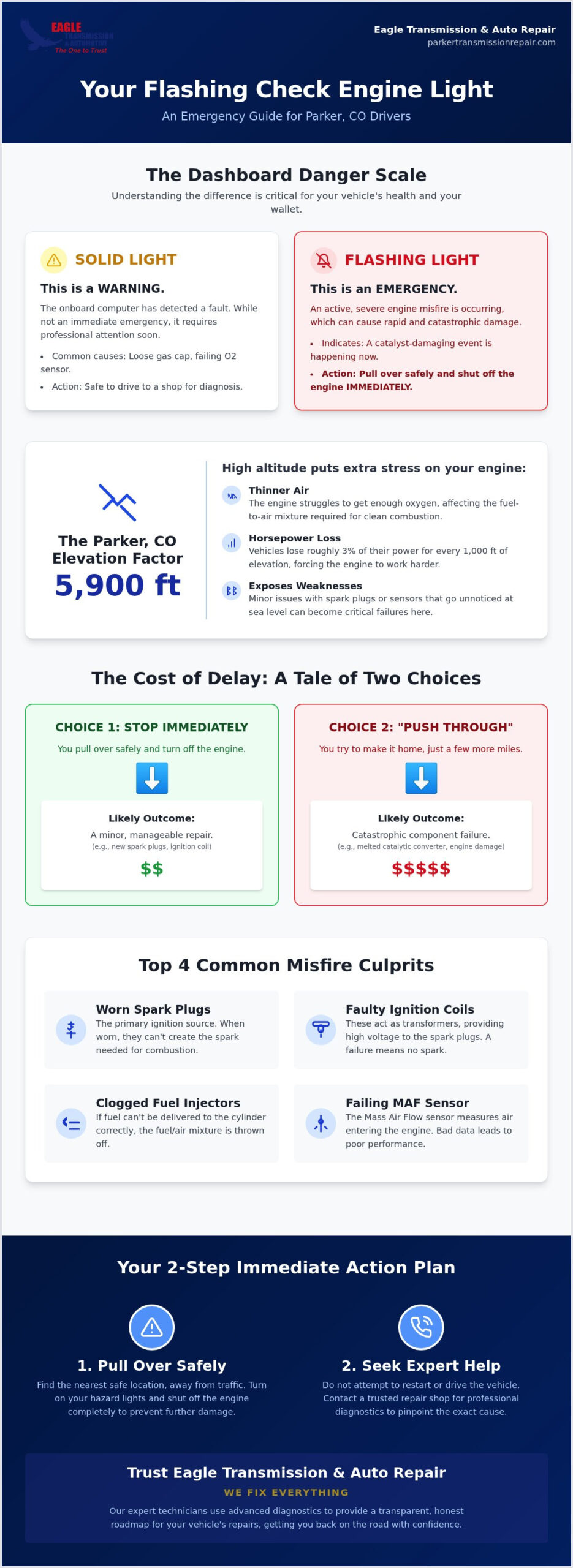
A flashing check engine light is a critical warning signal indicating a catalyst-damaging event that requires you to shut down your engine immediately to prevent permanent mechanical failure. While a steady glow on your dashboard might just indicate a minor sensor glitch, a blinking light is a desperate plea for help from your powertrain. At Eagle Transmission & Auto Repair, we often see drivers who try to “push through” a blinking light while driving home from the Cherry Creek Trail or Park Meadows, only to find that those extra few miles caused irreversible damage. If you ignore this signal, you aren’t just risking a breakdown; you’re actively allowing your car to destroy its most expensive components in real time.
One of the most telling signs of this emergency is a distinct “rotten egg” smell coming from your exhaust. This happens because raw, unburned fuel is being dumped into the exhaust system, where it ignites and creates extreme heat. This heat can liquefy the precious metals inside your catalytic converter in just a few minutes. Because we live in a community that relies on our vehicles for everything from school drop-offs to mountain adventures, our team takes these alerts seriously. We provide the expert check engine light diagnosis needed to stop the damage before it spreads, standing by our promise that “WE FIX EVERYTHING.”
Solid vs. Flashing: The Dashboard Danger Scale
Think of your check engine light as a traffic signal for your car’s internal health. A solid light is a yellow flag. It means the onboard computer has detected a fault in the emissions system, such as a loose gas cap or a failing O2 sensor, but the vehicle is still safe to drive to a shop. A flashing light is a bright red flag. It signals an active engine misfire that is currently occurring. This distinction is even more important for 2026 model year vehicles. Modern cars use highly sensitive sensors to monitor ignition timing and fuel delivery with incredible precision. When these sensors detect a misfire that could lead to a check engine light flashing Parker CO, the computer flashes the icon to warn you that the engine’s “brain” can no longer compensate for the fault.
The Cost of Delay: From a Simple Tune-Up to a Major Component Meltdown
The difference between stopping immediately and trying to reach your destination can be the difference between a minor repair and a total engine overhaul. A simple ignition coil or a set of worn spark plugs is a straightforward fix that restores your performance. However, when you continue to drive, that unburned fuel doesn’t just hurt your exhaust; it can wash the protective oil off your cylinder walls. This leads to increased friction and internal engine repair needs that are far more complex. Parker drivers should be especially cautious on steep local grades like Hess Road or the climb toward Castle Rock. Putting a misfiring engine under heavy load accelerates the “meltdown” process, turning a manageable issue into a catastrophic failure in a matter of seconds.
The Root Causes: Why Your Engine is Misfiring in Parker’s High Elevation
Living at 5,900 feet in Parker means your car is basically a high-performance athlete constantly breathing through a straw. The air is thinner here, which directly impacts how your engine mixes fuel and oxygen for combustion. In fact, vehicles can lose about 3% of their horsepower for every 1,000 feet of elevation gain. This environmental stress often exposes small weaknesses in your engine that wouldn’t be a problem at sea level. When you see a check engine light flashing Parker CO, it’s usually because one of those weaknesses has finally reached a breaking point under the load of Douglas County’s hills.
Most misfires we see at Eagle Transmission & Auto Repair stem from four main culprits: spark plugs, ignition coils, fuel injectors, and the Mass Air Flow (MAF) sensor. Colorado winters add another layer of difficulty. The extreme temperature swings from a freezing overnight soak to a hot commute can make ignition wires brittle and cause seals to shrink. This often leads to “cold-start misfires” that might disappear once the engine warms up, but they’re still a sign that a larger problem is brewing. If your car starts to shudder while you’re climbing a hill, it’s best to swing by our shop on Parkglenn Way so we can take a look before a small hiccup becomes a big headache.
Ignition System Failures
Your ignition system has the toughest job in our environment. Modern high-compression engines require a powerful, precise spark to ignite the air-fuel mixture. This phenomenon, often referred to as a high-altitude misfire, occurs because thinner air has less dielectric strength, making it harder for your ignition system to bridge the gap. We often see issues with “cheap” aftermarket spark plugs that just can’t handle the heat and pressure of mountain driving. When an ignition coil fails or a plug wears out, you’ll feel the vehicle shaking or stuttering, especially when you’re trying to accelerate onto E-470. Because “WE FIX EVERYTHING,” we don’t just swap parts; we make sure the entire ignition sequence is firing with factory precision.
Fuel and Air Delivery Issues
If the spark is fine, the problem usually lies in what’s being ignited. A clogged fuel injector can starve a cylinder of the gas it needs, creating a “lean” condition that triggers a misfire. Similarly, the MAF sensor acts as the engine’s nose, telling the computer exactly how much air is coming in. If this sensor is dirty or failing, it can’t compensate for Parker’s elevation, leading to a poor air-fuel ratio. We also specialize in Ford repair, particularly for EcoBoost engines which are prone to carbon buildup on the intake valves. This buildup can disrupt airflow and cause persistent misfires. For a complete solution, check out our Reliable Engine Repair in Parker, CO: The WE FIX EVERYTHING Promise to see how we restore your vehicle’s peak performance.
Beyond the Engine: How Transmission and Drivetrain Issues Trigger Warning Lights
Most drivers assume that a dashboard warning is strictly an engine problem. However, your vehicle’s onboard computer is a complex network that monitors every part of the powertrain, from the intake to the tailpipe. Sometimes, what feels like a check engine light flashing Parker CO event is actually a cry for help from your transmission. Because these systems are so tightly integrated, a mechanical hiccup in your gears can trick the computer into reporting an engine fault. At Eagle Transmission & Auto Repair, our “WE FIX EVERYTHING” approach means we don’t just look at the cylinders; we look at how the entire drivetrain is talking to your car’s brain.
When your car starts bucking or surging, it’s easy to panic about a total engine failure. But if you’ve noticed a drop in fuel economy or a strange smell lately, you might be dealing with Bad Catalytic Converter Symptoms caused by downstream issues. In many cases, the root cause isn’t a spark plug at all, but a transmission that isn’t shifting correctly, putting undue stress on the engine and triggering those scary dashboard lights. Our team uses specialized drivetrain diagnostics to separate these symptoms, ensuring you aren’t paying for an engine tune-up when your transmission actually needs the attention.
The Torque Converter Connection
One of the most common “fake” misfires we see involves the torque converter clutch. When this component begins to fail, it can create a sensation known as “transmission shudder.” It feels exactly like driving over a rumble strip or having a persistent engine stutter. Because this shudder causes the engine’s RPMs to fluctuate rapidly, the computer often misinterprets the vibration as an active misfire, which can lead to a check engine light flashing Parker CO. If your light is blinking while you’re maintaining a steady speed on the highway, it might be your transmission struggling to lock up. For a deeper look at these complex systems, visit our Professional Transmission Repair in Parker, CO: The Complete 2026 Guide.
4WD and Transfer Case Interference
Living in Douglas County means many of us rely on 4×4 and AWD systems to navigate winter weather and steep terrain. These systems use a variety of electronic sensors that interact directly with the main Engine Control Unit (ECU). In specialized vehicles like the Ford F-150 and F-250, a fault in the transfer case or a binding differential can actually force the vehicle into “Limp Mode.” This safety setting limits your speed and often triggers a check engine light to prevent further drivetrain damage. Whether it’s a sensor calibration issue or a mechanical bind, we have the specialized equipment to diagnose these heavy-duty systems. We treat your vehicle as a single, cohesive machine, making sure every gear and sensor is working in harmony to keep you safe on Colorado roads.
Immediate Action Plan: When the Light Starts Blinking
When that yellow icon begins to pulse on your dashboard, your priority shifts instantly from reaching your destination to saving your engine. It’s a high-stress moment, but staying calm and following a specific set of steps can prevent a small mechanical hiccup from becoming a total vehicle loss. If you’re dealing with a check engine light flashing Parker CO, treat it like a fire alarm for your car. You don’t need to panic, but you do need to act before the active misfire causes permanent damage to your internal components.
Follow this 4-step emergency plan to protect your vehicle:
- Step 1: Reduce speed immediately. Take your foot off the gas and avoid any heavy acceleration. If you’re currently towing a trailer or hauling a heavy load through Douglas County, find the earliest opportunity to stop.
- Step 2: Find a safe parking spot. Look for a flat area away from traffic. If you’re on Parker Road, pull into a nearby parking lot rather than sitting on the narrow shoulder.
- Step 3: Shut it down. Turn off the engine as soon as you’re safe. Don’t try to “test” the car by restarting it to see if the light goes away.
- Step 4: Arrange for a tow. Driving even two or three miles with an active misfire can destroy your exhaust system. It’s much cheaper to pay for a tow to Eagle Transmission & Auto Repair than it is to replace an entire catalytic converter.
If you’re currently stranded or need an expert to look at your dashboard, you can get directions to our Parker shop here to start the recovery process.
Safety First on Colorado Roads
High-speed corridors like E-470 or I-25 are dangerous places for a vehicle to lose power. If your car enters “Limp Mode,” it will significantly limit your speed to protect the drivetrain. While this feature is designed to help you reach safety, it isn’t a green light to drive all the way home to Castle Rock. Keep an eye out for secondary danger signs like visible smoke or loud knocking noises that suggest the engine is under extreme stress. At Eagle Transmission & Auto Repair, we’ve seen how Parker’s steep hills can turn a minor misfire into a major engine repair job in seconds if you try to push the vehicle beyond its current limits.
Why DIY Code Readers Can Be Misleading
It’s tempting to grab a cheap code reader from a local auto parts store to see what’s wrong. While these tools can tell you what the computer is seeing, they can’t tell you why it’s happening. A code for a “Cylinder 3 Misfire” is just a starting point. It doesn’t distinguish between a bad spark plug, a failing fuel injector, or a more serious mechanical issue with your valves. Our ASE-certified technicians use professional-grade diagnostic equipment capable of reading complex modern sensors. We perform a deep-dive analysis to find the root cause of the check engine light flashing Parker CO. We take pride in our “WE FIX EVERYTHING” motto by providing a complete picture of your car’s health rather than just clearing a code and hoping for the best.
Professional Diagnostics at Eagle Transmission & Auto Repair
When you encounter a check engine light flashing Parker CO, the uncertainty of what happens next at the repair shop can be just as stressful as the light itself. At Eagle Transmission & Auto Repair, we’ve designed our diagnostic process to be a supportive partnership rather than a technical lecture. We don’t just plug in a scanner and hand you a bill. Our ASE-certified technicians follow a rigorous three-stage process to ensure we find the actual problem the first time. We start with electronic code retrieval to see what the computer is reporting, followed by a detailed visual inspection of the engine or transmission, and finally, targeted mechanical testing to verify the root cause.
Transparency is the foundation of everything we do. We believe you should never feel pressured into a repair you don’t understand. Once our team identifies why your vehicle is misfiring or struggling, we sit down with you to provide a clear, jargon-light explanation of our findings. No repairs are performed until you have all the information and provide your explicit approval. Whether it is a simple sensor swap or a complex engine repair, we want you to feel like you’re talking to a neighbor who happens to be an expert, not a cold corporate chain.
The Eagle Transmission & Auto Repair Advantage
Our shop is uniquely equipped to handle the specific vehicle mix found in Douglas County. Because we see so many heavy-duty trucks and SUVs, we have developed specialized expertise in Ford, Diesel, and 4×4 drivetrain systems. Our “WE FIX EVERYTHING” motto isn’t just a catchy phrase; it’s a commitment to staying current with the latest 2026 model year diagnostic technology. We understand the nuances of how a failing transmission can trigger an engine light, and our dual expertise in both systems allows us to solve complex problems that other shops might miss. We work hard to create a welcoming atmosphere that reduces “repair shop anxiety,” making sure you feel safe and respected from the moment you walk through our doors.
Serving Our Neighbors in Douglas County
Since our founding, our mission has been to keep local families safe on Colorado’s demanding roads. We are a convenient hub for drivers in Parker, Lone Tree, Centennial, and Aurora who need reliable, high-quality care. We know that your vehicle is more than just a machine; it is what gets your kids to practice and gets you home safely during a winter storm. That is why we treat every check engine light flashing Parker CO with the urgency it deserves. For more details on what to expect during your visit, you can read our guide on Professional Engine Light Diagnosis in Parker.
Don’t let a dashboard warning leave you stranded or lead to expensive, avoidable damage. Take the first step toward a permanent fix and total peace of mind by contacting our friendly team today. Schedule your Check Engine Light Diagnosis in Parker today and let us show you the “WE FIX EVERYTHING” difference.
Restore Your Peace of Mind and Protect Your Engine
Dealing with a check engine light flashing Parker CO is undeniably stressful, but you don’t have to face it alone. By pulling over immediately and choosing a professional diagnostic approach, you’ve already taken the most important step in preventing a costly catalytic converter meltdown. Remember that our high-altitude environment in Douglas County puts unique demands on your ignition and drivetrain systems, meaning a quick response is your best defense against expensive repairs.
At Eagle Transmission & Auto Repair, our ASE-certified technicians and specialized Ford and diesel repair experts are here to provide the clarity you deserve. We take pride in being your neighborly guide through complex repairs, standing firmly by our “WE FIX EVERYTHING” promise. Whether it’s a simple spark plug swap or a deep dive into your transmission’s electronics, we’ll get you back on the road with confidence. Don’t wait for a small hiccup to become a major breakdown.
Schedule your professional diagnostic appointment and get directions to our Parker shop now. We look forward to helping you keep your family safe on every Colorado adventure.
Frequently Asked Questions
Can I drive my car if the check engine light is flashing?
No, you shouldn’t drive your vehicle if you see your check engine light flashing Parker CO. This signal indicates a severe engine misfire that is actively damaging your catalytic converter. Driving even a short distance can cause unburned fuel to ignite in your exhaust system, leading to extreme heat that can melt internal components. It’s safest to pull over immediately and arrange for a tow to our shop to prevent catastrophic damage.
How much does a check engine light diagnostic cost in Parker, CO?
The cost for a professional diagnostic varies depending on the complexity of your vehicle’s electronic systems and the time required for a physical inspection. While some local shops might offer a quick code scan, we provide a comprehensive evaluation that includes code retrieval, visual inspections, and mechanical testing. This ensures we identify the root cause correctly the first time, saving you money on unnecessary parts and labor.
Will a flashing check engine light turn off on its own?
It’s very unlikely that a flashing light will resolve itself without a repair. Even if the light stops blinking and stays solid, the underlying fault is still present and will likely return during your next commute or mountain climb. Ignoring the signal just gives the problem time to grow more expensive. Our technicians use advanced tools to find the specific ignition or fuel issue that triggered the alert so it doesn’t leave you stranded later.
Can a loose gas cap cause a flashing check engine light?
No, a loose gas cap will only cause a solid check engine light. A solid light usually points to minor emissions issues or sensor glitches that aren’t immediate emergencies. A flashing light is reserved for “code red” situations like an active engine misfire. If your light is blinking, the problem is much deeper than a gas cap and likely involves your spark plugs, ignition coils, or fuel system.
How long does an engine light diagnostic take at Eagle Transmission?
Most thorough diagnostics take between one and two hours to complete. We don’t believe in rushing the process because an accurate diagnosis is the only way to stand by our “WE FIX EVERYTHING” motto. During this time, our ASE-certified technicians look at everything from your engine sensors to your drivetrain to ensure we aren’t missing a transmission issue that might be mimicking an engine misfire.
What happens if I ignore a flashing check engine light?
Ignoring a flashing light can lead to a total engine meltdown or a very expensive catalytic converter replacement. Beyond the exhaust damage, a persistent misfire allows raw gasoline to wash the lubricating oil off your cylinder walls. This creates massive internal friction that can ruin your engine’s pistons and valves. Taking action now is the best way to protect your car and your budget from a major mechanical failure.