What if the speed where your car starts shaking is a useful clue, not a diagnosis? If you’re searching for “car shaking at high speeds diagnosis Parker,” you likely want to know whether it’s safe to keep driving and how to avoid guessing at repairs. A vibration may point to a tire or wheel concern, but steering, suspension, brake, or drivetrain problems can also be involved.
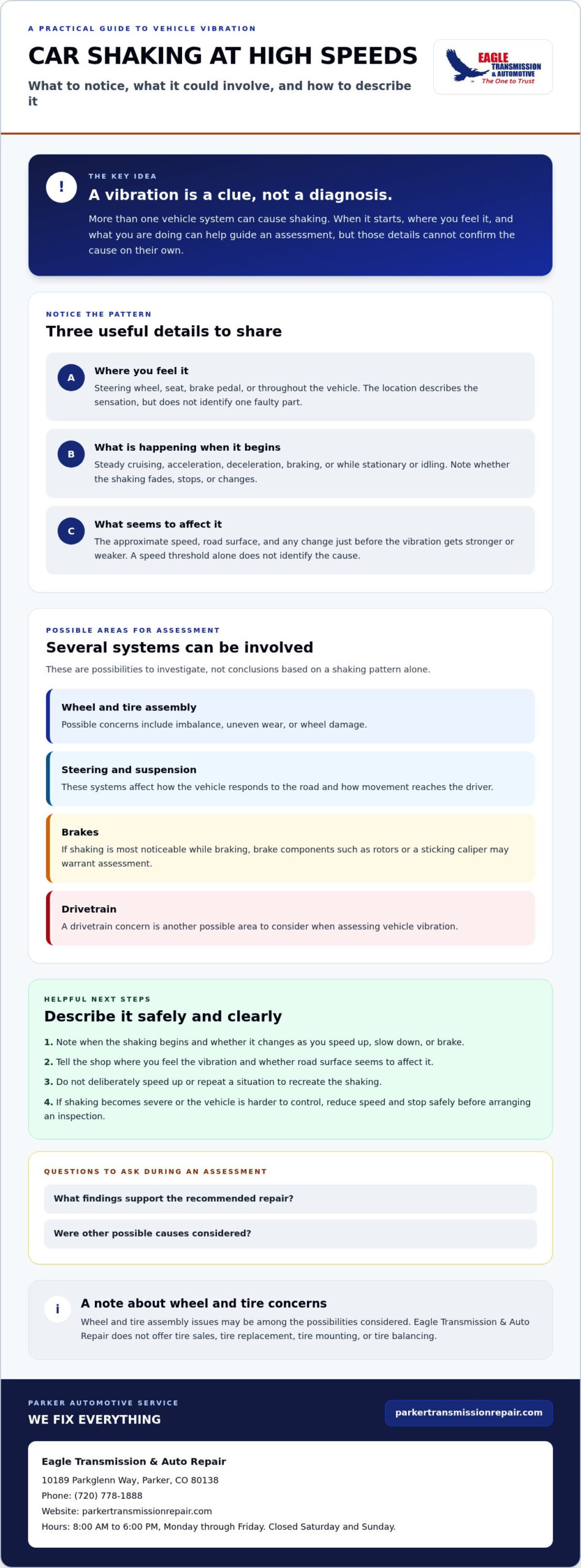
Pay attention to when the shaking begins, whether it changes as you speed up or slow down, and whether you feel it through the steering wheel, seat, or brake pedal. Those details can help narrow down what a technician should investigate, though they can’t confirm the cause on their own.
In this article, you’ll learn what can cause shaking at highway speeds, which driving details are helpful to share, and when to reduce driving and arrange an inspection. We’ll also explain how a Parker shop such as Eagle Transmission & Auto Repair can help with transmission, drivetrain, brake, and general automotive concerns, so you can take the next step with a clearer picture.
Key Takeaways
- Shaking can involve several vehicle systems, so where you feel the vibration is a clue, not a diagnosis.
- Note whether the shake happens while cruising, accelerating, braking, or driving on different road surfaces to help guide an assessment.
- For car shaking at high speeds diagnosis Parker, share when the vibration occurs and avoid deliberately speeding up to recreate it.
- If shaking becomes severe or you feel the vehicle is harder to control, reduce speed and stop safely before arranging an inspection.
- Ask the shop what findings support its recommended repair and whether other possible causes were considered.
Car shaking at high speeds in Parker: What the symptom can tell you
Several vehicle systems can cause shaking, so one symptom can’t confirm a specific fault. Where you feel the movement and what you’re doing when it begins can help guide diagnosis, but they’re clues, not proof. The useful next step is to describe the pattern and have the relevant systems checked, rather than guessing at a repair from one sensation.
A shaking pattern is a set of clues about when and where a vibration occurs, not a diagnosis of the part causing it. For car shaking at high speeds diagnosis Parker drivers can share those clues with a technician, who can use them to guide an inspection instead of treating the symptom as a definitive answer.
Where do you feel the shaking?
Notice whether the vibration comes through the steering wheel, the seat, or seems to move through the whole vehicle. Steering wheel feedback may be easiest to notice in your hands, while a vibration through the seat may feel more apparent to you or your passengers. Neither sensation identifies one component on its own.
Do passengers notice the same movement? Does it change on a smoother road or a rougher surface? These observations help describe the symptom without drawing conclusions too early. A vibration felt in the steering wheel, for example, doesn’t by itself prove that a particular wheel or steering part is at fault.
A wheel and tire assembly concern is one possible category a technician may consider. Rotating parts need to be balanced so their movement stays even; the reference on balancing of rotating bodies explains the underlying principle. That physics helps explain why balance can matter, but it doesn’t establish that imbalance is the cause of a specific vehicle’s shaking.
When does the vibration begin or change?
Pay attention to the driving circumstance rather than looking for a universal speed threshold. Does the shaking occur during steady cruising, change as you accelerate, continue as you decelerate, or appear mainly when you brake? Each is a different observation that can help guide which systems merit assessment. Shaking while the vehicle is stationary or idling is another useful distinction from a vibration that occurs only on the road.
During normal driving, note approximately how fast you’re going when the shake begins, whether it fades or stops, and what changes just before it gets stronger or weaker. Also mention whether the road surface seems to affect it. Don’t deliberately repeat or intensify the conditions just to test the symptom. A clear description gives a shop a more useful starting point, while an inspection is needed to identify the cause.
Possible causes of car shaking at highway speeds, from wheels to drivetrain
A vibration at highway speed can have several explanations, and similar shaking can come from different causes in different vehicles. The goal is not to match one sensation to one part. Instead, the speed and driving condition help a technician decide which systems to assess and what findings could support a diagnosis.
Wheel, tire, steering, and suspension possibilities
A concern with a wheel or tire assembly, such as imbalance, uneven wear, or wheel damage, may be associated with vibration as the vehicle moves faster. Those are possibilities to investigate, not conclusions based on speed alone. Eagle Transmission & Auto Repair provides automotive repair and diagnosis, but does not sell, replace, mount, or balance tires.
Steering and suspension components also affect how a vehicle responds to the road and how movement reaches the driver. Worn or damaged parts may change handling or make vibration more noticeable. Because these systems interact, feeling a shake through the steering wheel or seat doesn’t identify a single faulty component. A careful assessment can help distinguish what may be contributing to the symptom.
Training materials on advanced vibration diagnostics describe how vibration patterns can help differentiate areas for investigation. That’s useful context, but it doesn’t replace checking the vehicle itself. For car shaking at high speeds diagnosis Parker drivers can use, pattern recognition should guide the assessment, not serve as proof of a specific fault.
Brake and drivetrain causes to consider
If shaking is most noticeable while braking, that’s a different diagnostic context from vibration during steady cruising. Brake components, including rotors or a sticking caliper, may warrant assessment. Tell the shop whether the shake begins with brake pedal pressure, occurs before you brake, or changes as the vehicle slows. Those details help clarify the conditions without confirming the cause.
A vibration that changes during acceleration or under load may also lead a technician to assess drivetrain components. Depending on the vehicle and findings, the inspection may include the axle, driveshaft, transmission, or differential. These possibilities aren’t interchangeable, and acceleration-related shaking alone can’t confirm which system is involved. Learn more about rear differential and drivetrain repair.
If you’re in Parker and want a local shop for transmission, drivetrain, brake, or general automotive service, you can get directions to Eagle Transmission & Auto Repair.
How to compare shaking patterns before choosing a diagnosis
A short, clear description of the vibration can help a technician decide what to assess. Compare what the vehicle is doing when the shake occurs, rather than jumping from a sensation to a repair. The patterns below are starting points, not a way to diagnose a part at home.
| When shaking occurs | What to observe | Systems that may warrant assessment |
|---|---|---|
| During steady cruising | Note the approximate speed, whether the vibration stays consistent, and where you feel it. | Wheel and tire assembly, steering, suspension, or other relevant systems |
| During acceleration | Notice whether the vibration changes as you press the accelerator or as the vehicle carries more load. | Drivetrain, transmission, steering, or suspension |
| While braking | Record whether the shake appears only as you apply the brakes or continues when you release the pedal. | Brake system and related steering or suspension components |
| On particular road surfaces | Notice whether rough or smoother pavement changes how strong the vibration feels. | Suspension, steering, wheel and tire assembly, or other systems affected by road conditions |
Shaking during steady speed versus acceleration
A steady vibration that feels much the same while cruising is different information from shaking that becomes stronger or changes as you accelerate. If it shifts with acceleration or load, drivetrain components may warrant evaluation, but that pattern alone doesn’t confirm a drivetrain fault. Symptoms can overlap, so an inspection and, when appropriate, a road test may be needed to distinguish possible causes.
A tire can look normal from the outside and still not rule out every concern involving the wheel and tire assembly. Nor does appearance alone clear the steering or suspension. Don’t treat a quick visual impression as a complete assessment.
Shaking during braking or on certain road surfaces
Ask yourself: does the vibration begin only when you apply the brakes, or is it present before you touch the pedal? Shaking during braking gives the technician a different clue from shaking during steady cruising, but it doesn’t prove that a particular brake part has failed. For more on the system involved, see this brake repair guide for Parker drivers.
Road surface matters, too. A change in pavement can alter the vibration you feel or make an existing movement more noticeable. Mention where this happens and whether passengers notice it as well. For car shaking at high speeds diagnosis Parker drivers can use, these details help shape the conversation with a shop, while inspection findings determine what needs attention.
What to do when your car shakes at high speeds
A highway speed vibration can be unsettling, especially if you’re unsure whether it’s safe to keep driving. The right response depends on how severe the shaking is and how the vehicle behaves. Don’t assume there’s a safe distance you can continue driving. Instead, take these practical steps:
- Note the conditions. If you can do so safely, remember the approximate speed, whether you were cruising or accelerating, and whether braking or a change in road surface affected the shake.
- Don’t deliberately recreate it. Avoid speeding up or repeating a maneuver just to test the vibration. Your safety comes first.
- Arrange a professional inspection. Share what you noticed so the shop can assess relevant systems and explain its findings before recommending a repair.
What information should you share with a technician?
Describe when the shaking starts, where you feel it, and whether it changes with acceleration, deceleration, or braking. Mention recent impacts, such as hitting a pothole, as well as recent maintenance or repairs. If a warning light appeared, or you noticed a new sound, include that too. These details may help guide the assessment, but don’t assume any one event caused the vibration.
Also report changes in how the vehicle behaves. Does it pull to one side, handle differently, or feel harder to steer or control? Specific observations are more helpful than trying to name a faulty part. For car shaking at high speeds diagnosis Parker drivers can use, a clear account of the symptom gives the technician a useful starting point without locking the investigation into one guess.
When should you stop driving and seek help?
If the shaking becomes severe, or steering, braking, or vehicle control feels impaired, reduce speed carefully and stop somewhere safe. Don’t continue driving to see whether it gets worse. If the vehicle doesn’t feel controllable, arrange appropriate assistance rather than trying to reach a shop yourself.
If the vibration is mild and the vehicle still feels responsive, that doesn’t prove it’s safe to continue. The appropriate urgency depends on the symptom’s severity and the vehicle’s behavior, so contact a repair shop for guidance and arrange an inspection. Learn about relevant local services on the Parker auto repair service page.
For an inspection of related automotive concerns, get directions to Eagle Transmission & Auto Repair in Parker.
Car shaking at high speeds diagnosis in Parker: what to ask a local shop
A useful diagnosis looks for evidence across the systems that could match the symptom, rather than assuming one cause from the shaking alone. Ask how the shop connected its findings to the conditions you described, such as whether the vibration occurs while cruising, accelerating, or braking. Clear answers can help you understand why a repair is recommended and avoid approving work based only on a guess.
Questions to ask before approving a repair
It’s reasonable to ask what the technician found and how those findings relate to the vibration. Consider asking:
- Which inspection or test findings connect the suspected component to my shaking?
- Could another system produce a similar symptom, and how were those possibilities considered?
- What repair do you recommend, and what evidence supports it?
These questions invite a clear explanation without asking you to diagnose the car yourself. For example, if the symptom changes under acceleration, ask what findings point to the recommended repair rather than assuming the drivetrain is responsible. A careful explanation should distinguish what was observed from what remains uncertain.
Relevant local repair services for a shaking vehicle
Depending on the findings, a shaking vehicle may call for assessment of steering, suspension, brakes, drivetrain, or other general automotive concerns. Eagle Transmission & Auto Repair offers transmission repair and service, manual clutch replacement, differential gear service, 4×4 transfer case service, brake repair, and general auto repair in Parker. These are relevant service categories, not a promise that any one of them is the cause of your vehicle’s vibration.
For car shaking at high speeds diagnosis Parker drivers can seek a local evaluation that considers the symptom pattern and the findings together. Share when the shaking occurs, what changes it, and any recent changes in how the vehicle handles. Then ask the shop to explain how its recommendation follows from those details.
Get directions to Eagle Transmission & Auto Repair for a shaking vehicle.
Eagle Transmission & Auto Repair
10189 Parkglenn Way, Parker, CO 80138
Phone: (720) 778-1888
Hours: 8:00 AM to 6:00 PM, Monday through Friday. Closed Saturday and Sunday.
Take the next step toward a clear diagnosis
The key takeaway is simple: shaking is a symptom, not a verdict. Notice when it begins, where you feel it, and whether acceleration, braking, or road conditions change it. These details can help a technician investigate possible causes across relevant vehicle systems without assuming one part is at fault.
If you’re looking for car shaking at high speeds diagnosis Parker drivers can use, Eagle Transmission & Auto Repair offers transmission, drivetrain, brake, and general automotive service at 10189 Parkglenn Way, Parker, CO 80138. The shop serves drivers in Parker, Centennial, Castle Rock, Douglas County, Lone Tree, and Aurora. Ask what findings support a recommended repair and whether other possible causes were considered.
Get directions to Eagle Transmission & Auto Repair for a high speed shaking diagnosis. Share the conditions you noticed and arrange an inspection to discuss the next step.
Frequently Asked Questions
Why does my car shake only at high speeds?
Shaking that appears at higher speeds can be associated with a wheel or tire assembly concern, but it may also involve steering, suspension, brakes, or drivetrain components. Speed is a clue, not proof of a specific fault. Note approximately when the vibration begins and whether it changes during steady cruising, acceleration, or braking. A technician can use those details to guide an assessment and distinguish between possible causes.
Can a car shake at highway speeds because of a tire or wheel problem?
Yes, a wheel or tire assembly concern can be one possible source of highway speed vibration. Imbalance, uneven wear, or wheel damage may warrant assessment, but a tire that looks normal doesn’t rule out every wheel, steering, or suspension issue. Describe where you feel the shake and when it occurs. A visual check alone can’t confirm the cause, and Eagle Transmission & Auto Repair does not sell or service tires.
Is it safe to drive if my car shakes at high speeds?
It isn’t possible to confirm that a shaking vehicle is safe to drive without assessing its condition. If the vibration becomes severe, or steering, braking, or control feels affected, reduce speed carefully and stop somewhere safe. Don’t deliberately recreate the shake or rely on a universal speed or distance as a safety guide. Contact a repair shop to discuss the symptoms and arrange an appropriate inspection.
What should I tell a mechanic when I bring in a car that shakes while driving?
Explain when the vibration starts, approximately how fast you’re going, where you feel it, and whether acceleration, braking, or road surface changes it. Mention recent impacts, repairs, maintenance, warning lights, new sounds, or changes in handling without assuming they’re connected. For car shaking at high speeds diagnosis Parker drivers can share these details with Eagle Transmission & Auto Repair, serving drivers in Parker, Centennial, Castle Rock, Douglas County, Lone Tree, and Aurora.