What if a hard shift or clunk isn’t enough to tell you the transmission is failing? If you’re noticing F-250 transmission problems Centennial, it’s understandable to wonder whether a new noise, delayed engagement, or warning light means you should stop driving. These symptoms can point to a transmission concern, but engine or drivetrain issues may feel similar.
The useful next step is to treat each symptom as a clue, not a diagnosis. This guide explains possible causes of shifting changes, shuddering, unusual noises, and warning lights, along with signs that call for prompt inspection. You’ll also learn how towing or heavy loads may bring symptoms to the surface, what diagnostic testing can help clarify, and why guessing at a repair can miss the real source. A careful diagnosis can help narrow down the problem and determine what to do next.
Key Takeaways
- F-250 transmission problems Centennial drivers notice, such as slipping or delayed engagement, are clues, not a diagnosis.
- Transmission, control, engine, or drivetrain concerns can create similar symptoms, so appropriate testing helps narrow down the cause.
- If your truck cannot shift or operate predictably, stop in a safe place rather than continuing to drive.
- Before an inspection, note when the symptom happens and whether you can reproduce it.
- Repair options depend on the inspection findings and the truck’s condition, so avoid assuming a specific fix before diagnosis.
F-250 Transmission Problems in Centennial: Symptoms Drivers May Notice
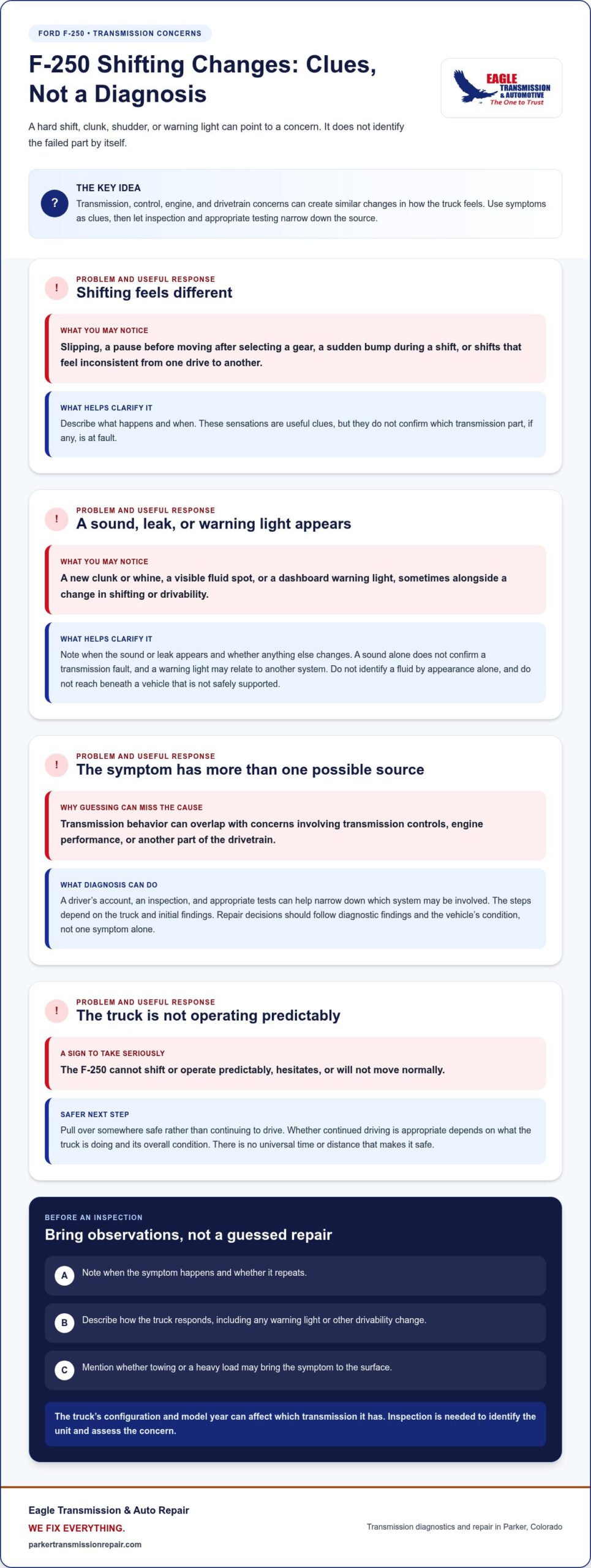
Shifting symptoms can have several possible causes, so a change in how an F-250 moves is a reason to pay attention, not proof that a particular transmission part has failed. A truck may slip, hesitate before moving, shift harshly, make a new noise, or leave a fluid leak. Engine, electronic control, and drivetrain concerns can sometimes create similar changes in how the truck feels.
For owners researching F-250 transmission problems Centennial, notice the details: when the symptom occurs, whether it happens repeatedly, and whether a warning light or another drivability change appears at the same time. Those observations can help guide an inspection.
What shifting changes can an F-250 driver notice?
Slipping may feel like the engine speed rises without the truck gaining speed as expected. Delayed engagement is a pause after selecting a gear before the truck begins to move. A harsh shift may feel like a sudden bump, while inconsistent shifting can mean the gear changes feel different from one drive to another.
These descriptions are useful clues, but they don’t identify the cause. Shifting behavior may involve the transmission or its controls, and an engine or drivetrain issue can affect how the truck accelerates. The specific transmission can also vary by vehicle configuration and model year. Ford transmission models offers historical context, but an inspection is needed to identify the unit and assess a symptom.
Which noises, leaks, or warning lights deserve attention?
A new or recurring clunk, whine, or other unusual sound deserves attention, particularly if it occurs alongside a shift change or altered drivability. A sound alone doesn’t confirm a transmission fault. Likewise, a dashboard warning light should be considered with the truck’s behavior and any other symptoms, since a warning may relate to a different system.
A visible fluid leak warrants inspection. Don’t identify the fluid by color or appearance alone, since a spot beneath the truck may have more than one possible source. Note where you see it and when it appears, but avoid reaching under a vehicle that isn’t safely supported.
One symptom can point toward a concern, but only inspection and appropriate testing can help confirm its source.
For information about repair options, see F-250 transmission repair guidance. Careful attention to what the truck is doing helps make the next diagnostic step more focused.
What Could Cause F-250 Transmission Problems? Diagnosis Before Assumptions
A transmission symptom can start in more than one place. The transmission itself may be involved, but its controls, the engine, or the drivetrain can also affect how the truck responds. For Centennial owners researching F-250 transmission problems Centennial, the key is to use each symptom as a clue and test the systems that could explain it.
Why the same symptom can have different causes
Slipping or delayed shifting may seem like clear evidence of a transmission fault, but those sensations don’t name the failed part. If the engine isn’t delivering power as expected, the truck may feel slow or uneven. A drivetrain concern can also change how power reaches the wheels. These possibilities can overlap, which is why the same complaint can lead to different diagnostic findings.
A warning light is another clue, not a verdict. It can alert the driver to a concern without identifying one specific component as the cause. Understanding how an automatic transmission works helps explain why transmission behavior depends on multiple parts and systems working together. The truck’s actual symptoms and test results matter more than a guess based on one sign.
What a transmission diagnostic can help determine
Diagnosis begins with the driver’s account of what happens, such as the conditions around a shift change or whether the concern is repeatable. An inspection and appropriate tests can then help narrow down whether the issue points to the transmission, its controls, engine performance, or another part of the drivetrain. The steps depend on the vehicle and what the initial findings show. No single check necessarily answers every question.
This is why it helps to describe what you notice in plain terms rather than naming a part you suspect. Note when the symptom occurs, how the truck responds, and whether other changes appear at the same time. Those details give the diagnostic work a useful starting point, while testing helps distinguish one possible cause from another.
Diagnostic findings, not a symptom alone, should guide repair decisions. Once the source is better understood, the next step can be based on the condition of the vehicle and the identified concern. For more information, read this Ford F-250 transmission repair guidance.
If you’d like to discuss transmission diagnostics for your truck, find Eagle Transmission & Auto Repair in Parker.
Can You Keep Driving With F-250 Transmission Problems?
Whether you can keep driving depends on what the truck is doing and its overall condition. A mild, occasional change may feel different from a truck that hesitates, shifts unpredictably, or won’t move normally. There isn’t a universal time or distance that makes continued driving safe. If the F-250 cannot shift or operate predictably, pull over somewhere safe and don’t continue the trip until you can determine a suitable next step.
Some mechanical problems may worsen with continued operation, but the effect in a particular truck can’t be predicted from a symptom alone. A leak also deserves inspection, especially if it appears alongside a change in shifting or drivability. Avoid unnecessary driving if the truck’s behavior feels unsafe or unreliable.
When should an F-250 be inspected promptly?
Arrange an inspection promptly if symptoms are getting worse, normal operation is disrupted, or you find a fluid leak. Pay attention to whether the truck hesitates to move, has trouble changing gears, or behaves differently during ordinary driving. If you can’t control its response confidently, stop in a safe place. The goal is to avoid unnecessary operation while the cause remains unknown, not to assume the transmission has a particular fault.
Why waiting for a second symptom is not a diagnosis
A problem may change, come and go, or develop another symptom, but that pattern alone doesn’t identify the cause. Waiting for more clues can leave you guessing rather than clarifying what is happening. Write down when the concern occurs, what the truck does, and whether it repeats. Those observations can help guide an inspection, but they can’t replace testing or guarantee that a repair will be smaller if addressed early.
For Centennial drivers concerned about F-250 transmission problems, the practical decision is based on how reliably the truck operates right now. If it shifts and responds normally enough to move safely, arrange an inspection rather than treating continued driving as proof that all is well. If it won’t shift or its response feels unpredictable, stop in a safe place. A qualified inspection can help determine whether the concern involves the transmission or another system.
How to Prepare for an F-250 Transmission Inspection in Centennial
A few clear notes can help make an inspection more focused. If you’re dealing with F-250 transmission problems Centennial, describe what the truck does and when you notice it. You don’t need to identify a failed part or recreate the symptom yourself.
What details should the driver share?
Before the inspection, jot down the concern in everyday language. Note whether it happens during a shift, while accelerating, or under another driving condition. Include whether it has changed over time or happens consistently. Share any warning lights, unusual sounds, or visible leaks you’ve noticed. Don’t try to trigger the symptom through unsafe driving.
- What does the truck do, and when does it happen?
- Can you recall whether the symptom is repeatable?
- Has the behavior become more frequent or changed?
- Did you notice a warning light, sound, or fluid leak?
These observations are more useful than a guess about the cause. If the symptom happens only occasionally, say so. A technician may not encounter it during an inspection, so your description can help guide appropriate testing.
What can inspection and testing clarify?
Inspection and diagnostic testing can help narrow down whether the concern involves the transmission, its controls, the engine, or another related system. The appropriate steps depend on the symptoms and what the findings show. A warning light or a particular shift sensation alone may not identify the source.
Repair recommendations should follow the inspection and diagnostic findings. Eagle Transmission & Auto Repair provides transmission repair and diagnostic services. For local service information, see Centennial transmission repair information.
Bring your notes and describe what you’ve observed. To arrange an inspection for your F-250, get directions to Eagle Transmission & Auto Repair in Parker.
F-250 Transmission Repair for Centennial Drivers: Choosing a Clear Next Step
Once the cause of a shifting concern is better understood, the next step is to review what the inspection found and what options fit the truck’s condition. For owners facing F-250 transmission problems Centennial, symptoms alone can’t determine which repair is appropriate. The recommendation should be based on the identified concern, the systems or components involved, and the vehicle’s overall condition.
How diagnostic findings shape repair recommendations
Different findings can point to different needs, so it’s reasonable to ask what the inspection established and how it connects to the proposed work. Make sure you understand which system needs attention, what the recommended repair addresses, and whether the diagnosis leaves any unanswered questions. A clear explanation helps you make an informed decision without assuming that one symptom automatically calls for a particular repair.
A local next step for Centennial F-250 owners
Eagle Transmission & Auto Repair in Parker provides Ford repair, F-250 repair, and transmission diagnostics and repair. If your truck has a shifting concern, an inspection can help clarify what is happening before you decide on a repair. The findings, rather than a guess based on a single symptom, should guide the discussion. Repair options depend on the diagnosis and the vehicle’s condition, so no specific repair can be determined in advance.
Bring your observations about the truck’s symptoms to a repair consultation, then review the diagnostic findings and proposed next step. If the F-250 isn’t operating predictably, consider its condition before driving it to an inspection.
For an F-250 transmission inspection or repair consultation, Get directions to Eagle Transmission & Auto Repair.
Eagle Transmission & Auto Repair
10189 Parkglenn Way, Parker, CO 80138
Phone: (720) 778-1888
Website: parkertransmissionrepair.com
Hours: 8:00 AM to 6:00 PM, Monday through Friday. Closed Saturday and Sunday.
Take the Next Step With a Clear Diagnosis
F-250 shifting concerns don’t point to one answer by themselves. A slip, delay, harsh shift, noise, or warning light is a useful clue, but more than one system may be involved. Note what you notice and when it happens, and avoid naming a failed part before the truck has been inspected. If it cannot shift or respond predictably, stop in a safe place rather than continuing to drive.
For drivers researching F-250 transmission problems Centennial, diagnostic testing can help distinguish a transmission concern from an issue with its controls, the engine, or the drivetrain. Repair recommendations should follow the findings and the vehicle’s condition. Eagle Transmission & Auto Repair offers transmission diagnostics and repair, Ford repair, and F-250 repair at 10189 Parkglenn Way, Parker, CO 80138.
Have your observations ready and arrange an inspection or repair consultation for your truck. Get directions to Eagle Transmission & Auto Repair, or visit parkertransmissionrepair.com to take the next step. With a clear diagnosis, you can discuss options based on what the inspection finds.
Frequently Asked Questions
What are common symptoms of transmission problems in an F-250?
Common symptoms include slipping, delayed engagement, harsh or inconsistent shifts, unusual noises, and visible fluid leaks. A driver might notice the truck hesitating before it moves after a gear is selected, or a shift feeling different than usual. These signs don’t identify a specific failed part. Transmission, engine, control, or drivetrain concerns can sometimes cause similar behavior, so inspection and testing are needed to narrow down the cause.
Can an F-250 transmission problem cause a warning light?
A transmission concern may occur alongside a dashboard warning light, but the light alone doesn’t confirm the transmission is responsible. It may relate to another vehicle system, so consider it together with changes in shifting or drivability. Make a note of which light appears and what the truck is doing at the time. Diagnostic testing can help determine what the warning relates to and guide the next step.
Is it safe to drive an F-250 that is slipping or shifting harshly?
Whether it’s appropriate to drive depends on how the truck behaves and its condition. If it can’t shift or respond predictably, stop in a safe place and don’t continue the trip. If the symptom is less severe, arrange an inspection rather than assuming the truck is fine because it still moves. Continued operation may worsen some mechanical problems, but the risk in an individual case can’t be determined from the symptom alone.
Where can Centennial drivers get F-250 transmission problems diagnosed?
Centennial drivers can bring an F-250 to Eagle Transmission & Auto Repair in Parker for transmission diagnostics and repair, as well as Ford and F-250 repair. The shop is located at 10189 Parkglenn Way, Parker, CO 80138. Testing can help distinguish a transmission concern from a related system issue. Repair recommendations depend on the inspection findings and the truck’s condition, so a symptom alone can’t determine the repair.
For an F-250 transmission inspection or repair consultation, get directions to Eagle Transmission & Auto Repair or visit parkertransmissionrepair.com.
Eagle Transmission & Auto Repair
10189 Parkglenn Way, Parker, CO 80138
Phone: (720) 778-1888
Website: parkertransmissionrepair.com
Hours: 8:00 AM to 6:00 PM, Monday through Friday. Closed Saturday and Sunday.