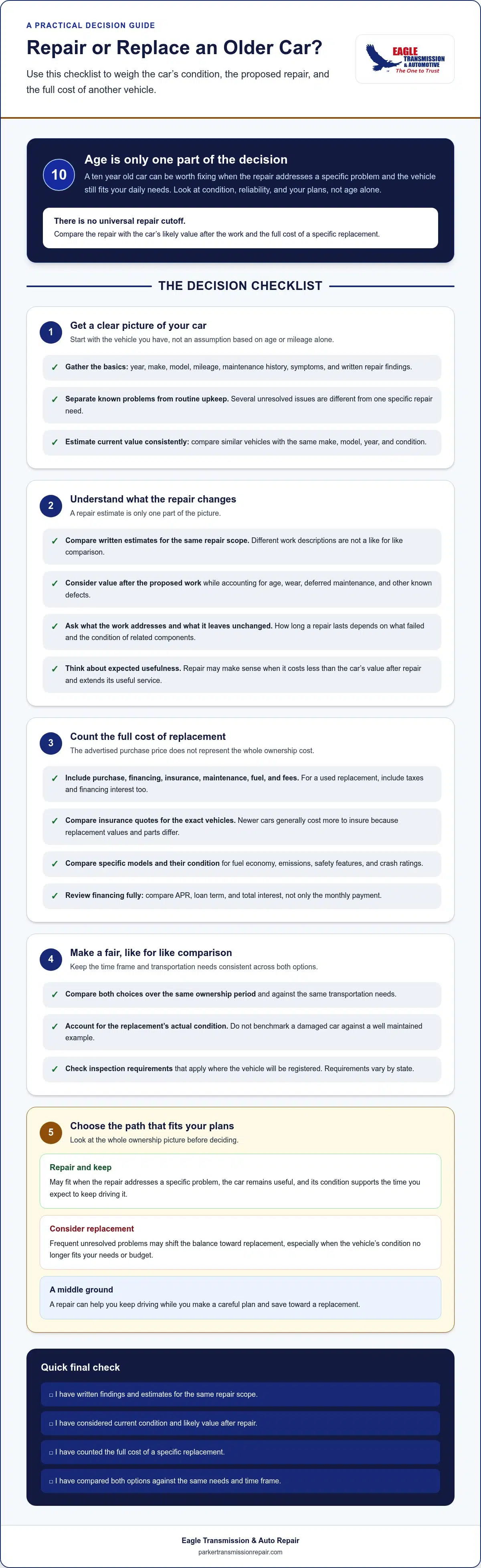
A ten year old car can be worth fixing when the repair addresses a specific problem and the vehicle still suits your daily needs. To decide whether it is worth fixing a 10 year old car, look beyond its age: consider its condition, reliability, and whether keeping it supports your plans better than replacing it.
A repair decision can feel like a fork in the road, especially if you’re already thinking about another vehicle. You don’t have to treat fixing the car and preparing for a replacement as opposite choices. A repair may help you keep driving while you make a careful plan for what comes next.
This guide shows how to weigh the options without relying on a single rule or gut feeling. Compare estimates, assess mileage and condition, and calculate the costs of buying another car. You’ll also see how saving toward a replacement can fit into the decision, so your next step matches your transportation needs and budget.
Key Takeaways
- Compare the repair bill with your car’s likely value after the work, not just its current condition.
- Include financing, insurance, maintenance, and other ownership costs when weighing replacement options.
- Use written estimates and compare the same repair scope so you can make a more informed decision.
- Consider mileage alongside safety, reliability, and the car’s overall condition.
- A repair and a savings plan for your next vehicle can be a practical middle ground.
What repair costs mean “replace it”?
Compare the repair estimate with your car’s condition, likely value after the work, and the cost of a specific replacement. A repair bill alone doesn’t tell you how long the car may remain useful or what replacing it would involve.
A ten year old car’s safety equipment and crash ratings vary by make, model, and trim. Compare the specific vehicles’ safety features and crash ratings rather than assuming every newer car performs the same.
Fuel economy and emissions depend on the vehicle and its condition. Insurance for newer cars generally costs more because replacement values and parts differ. There’s no single repair price or universal percentage of a car’s value that automatically means you should replace it.
Repair Costs Against Car Value
Estimate the car’s value in its current condition, then consider its value after the proposed work. That example illustrates why make, model, mileage, and condition matter; it isn’t a valuation for every ten year old car.
There’s no fixed percentage of a car’s value that you should spend before replacing it. Repair may make sense when the work costs less than the car’s value after repair and extends its useful life.
There’s no single U.S. repair bill for a ten year old car. Vehicle, parts, labor, damage, and diagnostic findings affect the estimate.
Repair Costs Versus Replacement Costs
Compare the repair with the full cost of replacing the car, including purchase, financing, insurance, maintenance, fuel, and fees.
Compare insurance quotes for the exact vehicles. Newer cars generally cost more to insure because replacement values, parts, and advanced sensors can raise coverage costs. Fuel economy and emissions also vary, so compare the specific models and their condition.
| Choice | Compare | Consider |
|---|---|---|
| Repair and keep | Estimate and post repair value | Expected usefulness and other needs |
| Replace | Purchase and financing | Insurance, fuel, upkeep, and fees |
Compare both options over the same ownership period and against the same transportation needs.
Repair Longevity and Expected Costs
How long a repair lasts depends on what failed, the condition of related components, and whether other known problems remain. Ask what the proposed work addresses and what concerns it leaves unchanged. Fixing one isolated fault is different from repeatedly repairing several systems.
Consider how long you need the car after the repair and whether its condition supports that plan. A repair that extends its useful service may be worthwhile despite the car’s age. Frequent, unresolved problems may tip the balance toward replacement.
Estimating a car’s value before and after repairs
Estimate the car’s current value, then compare it with its condition after the proposed work. Include replacement expenses and financing, as well as any inspection requirements that apply where the vehicle will be registered.
State inspection requirements vary, so include applicable rules when assessing whether you can register and use the car. A used replacement’s total cost can include its purchase price, taxes, fees, financing interest, and insurance, not just the advertised price.
Value Before Repairs
Start with the car’s condition, mileage, equipment, and maintenance history. Compare similar vehicles with the same make, model, year, and condition to estimate its private-party value before repairs.
List known problems separately from routine upkeep. A vehicle needing one repair differs from one with several unresolved issues, even at similar mileage. This estimate gives you a baseline, not a prediction of the car’s value after the work.
For a practical comparison, record the estimate, repair findings, and any other likely needs. Base the figures on the same vehicle condition and market, rather than comparing a damaged car with a well-maintained example.
Value After Repairs
Estimate the car’s value assuming the identified repair is completed, while accounting for other known defects. A repaired car may be more usable, but the work doesn’t erase age, wear, or deferred maintenance.
Compare that post repair value with the repair estimate and the time you expect to keep driving. A useful rule of thumb is to consider repair when the bill is below 12 months of a new car payment, especially if the work can extend useful service.
Calculate replacement financing fully. Compare the APR, loan term, and total interest instead of judging affordability by the monthly payment alone.
Repairing an Older Car
Frequent bills change the calculation. If repairs costing more than $1,000 occur several times within 3 to 6 months, reconsider whether continued ownership fits your budget and the vehicle’s condition.
Some owners may accept a larger repair to keep a car another year. One example values that year of use at $300 per month, making a repair bill of up to $3,600 potentially worthwhile. Your own transportation needs and expected repair life determine whether that trade makes sense.
DIY work may reduce labor expense, but only if you have the necessary skills and tools. Deferred maintenance can create separate needs, so distinguish overdue maintenance from the failure that prompted the estimate.
Before deciding, check the inspection rules that apply to your state and registration. For a replacement, include the purchase price, taxes, fees, loan interest, and insurance. Get insurance quotes for the exact vehicles and compare total out-the-door costs, not advertised prices.
Comparing vehicles and getting estimates
Start with consistent information. For your current car, gather its year, make, model, mileage, maintenance records, symptoms, and written repair findings. Collect the same details for each replacement candidate. This prevents a clean, lower-mileage listing from becoming the benchmark for a car with different equipment or condition.
When comparing repair estimates, look at the diagnosis and scope, not just the total. One estimate may address a failed component, while another includes related parts or additional testing. Ask what each proposal includes, what it leaves untouched, and which inspection findings support the work. If the explanations differ, clarify whether they address the same underlying problem.
Organize the estimate details in a simple comparison sheet:
- Record the identified fault and symptoms it explains.
- Note the parts and labor included in each proposed repair.
- Separate recommended maintenance from work tied to the current fault.
- List related concerns that remain after the proposed work.
- Write down the repair’s expected purpose and limitations.
This helps you recognize when a repair is only partial. For example, one proposal might replace a leaking component, while another also addresses damage caused by the leak. Compare the findings and expected outcomes, then decide whether the additional work fits your car’s condition and plans.
Use a similar method for replacement vehicles. Compare the same model year, trim, drivetrain, mileage, and condition where possible. A Ford F-150 with different equipment or use history may not be comparable to another F-150 merely because the model name matches. Check available service records, warning lights, visible leaks, unusual noises, and signs of prior repairs.
When viewing a used vehicle, note what you can observe, but don’t treat a short drive as a complete condition assessment. Ask about maintenance records and existing concerns. A pre-purchase inspection can help identify mechanical issues that aren’t apparent from the vehicle’s appearance or the seller’s description.
Keep your assumptions consistent across the options. If one car’s estimate includes overdue maintenance and another’s doesn’t, mark the difference clearly. If a replacement candidate has incomplete records, account for that uncertainty instead of assuming its condition matches a documented vehicle.
Finally, write down what matters most for your needs: dependable commuting, room for passengers, cargo space, or keeping a familiar vehicle. Compare each option with those priorities. Clear criteria help prevent a low advertised price or one attractive repair estimate from steering the whole decision.
Mileage and vehicle longevity
Mileage is a useful clue, not a verdict on a car’s remaining life. Two vehicles with the same odometer reading can have different outlooks because maintenance, driving conditions, and current mechanical condition differ. Ask yourself, “Is it worth fixing a 10 year old car?” The answer starts with the car’s history and needs, not age alone.
Households with vehicles averaging 6-15 years of age paid $151 more per vehicle annually, on average, for maintenance and repair than households with newer vehicles, according to the U.S. Bureau of Labor Statistics. That household comparison describes average spending, not the future bill for a particular car.
Many well maintained cars can reach 200,000 miles or more. Toyota, Honda, and Lexus vehicles can also last over 200,000 miles with regular upkeep. These figures show why a high odometer reading doesn’t automatically mean a vehicle has reached the end of its useful life.
To decide whether “Is it worth fixing a 10 year old car?” is the right question, pair mileage with evidence. Review service records, note recurring warning lights, and list symptoms such as leaks, unusual noises, or changes in starting and shifting.
A rule of thumb suggests considering repair for a car under 10 years old or with under approximately 150,000 miles, if it’s otherwise safe and reliable. That guideline isn’t a cutoff. A car above either mark still deserves a decision based on its condition and the repair’s purpose.
Use this quick review to organize the evidence:
- Compare mileage with age and the vehicle’s driving history.
- Look for regular maintenance records and repeated repairs.
- Separate the current fault from overdue maintenance.
- Consider whether the car remains dependable for essential trips.
- Assess any replacement vehicle by its condition and records, too.
Age and mileage can tell different stories. A ten year old car with modest mileage may have seen less use, while a regularly driven vehicle may have higher mileage and a detailed service history. Long periods without use can also leave maintenance needs, so the odometer cannot explain the whole picture.
Consider how you depend on the vehicle. A car used for a daily commute may need to be more dependable than an occasional second car. Record changes in performance and warning messages, then use them to distinguish an isolated repair from broader concerns.
Set your own keep-or-replace threshold based on the car’s actual condition, not a universal mileage limit. Consider the odometer alongside service records, current symptoms, and the repair’s expected benefit. This gives you a more grounded basis for planning your next move.
Paying cash and saving for a replacement car
Repairing a usable car while saving for another can bridge the gap between an urgent purchase and an endless repair cycle. It works best when the current vehicle remains safe and reliable and the repair gives you time to build a replacement fund.
One budget example sets aside $738 each month for 10 months. Selling the current vehicle contributes another $4,000, bringing the example replacement budget to over $11,000 after 10 months.
These figures are an illustration, not a recommended budget for every household. Your target depends on the car you need, available savings, sale proceeds, and how long you can reasonably keep driving your current vehicle.
Before you start, set a specific savings goal and account for the immediate repair separately. Decide how much you can regularly set aside without using the replacement fund for routine expenses. A calendar reminder or automatic transfer can help keep the plan on track.
- Estimate the replacement budget, including taxes, fees, and insurance.
- Choose a monthly savings amount that fits your household budget.
- Track repair and maintenance needs separately from replacement savings.
- Revisit the plan if the current car’s safety or reliability changes.
Cash savings can reduce the amount you need to borrow, but you still need to inspect a used car. A lower purchase price may leave less room for immediate maintenance or repairs. Reserve funds for ownership costs rather than spending your entire budget on the advertised price.
If you plan to finance a replacement, compare the APR, loan term, and total interest. A manageable monthly payment can still add up to a larger overall expense over the life of the loan. Compare each candidate’s total out-the-door cost, not just the payment.
Timing matters, too. Keeping a temporary vehicle can help preserve your savings plan, but only if its condition and expected needs fit your budget. If your current car needs repeated repairs or becomes unreliable, waiting may not be worth the disruption. Reassess after each new diagnosis instead of treating your original plan as fixed.
Use the savings period to compare actual vehicles, review maintenance records, and get insurance quotes for exact candidates. A clear target and a written timeline turn “save for later” into a practical choice. Plan a vehicle inspection in Parker as part of deciding whether your current car can safely cover that transition.
Eagle Transmission & Auto Repair: Transmission Repair
Eagle Transmission & Auto Repair provides transmission repair and service for shifting problems, slipping, or unusual transmission noises. Its transmission diagnostics are free and always free. The findings can help determine whether the concern involves the transmission or another part of the drivetrain, giving you useful information for your repair-versus-replacement decision.
For a manual vehicle, Eagle also provides manual transmission repair and clutch replacement. If engine trouble is part of the picture, engine repair is available too. The right repair depends on the vehicle’s condition and diagnostic findings, not its age alone. Learn about transmission repair services as you weigh your options.
Contact Eagle Transmission & Auto Repair or visit parkertransmissionrepair.com to discuss your vehicle’s repair needs.
Make Your Next Move With a Clear Plan
Deciding whether it is worth fixing a 10 year old car is also a decision about what you need from your next stretch of ownership. Set a practical goal: keep the car for now, prepare to replace it, or make a repair only if it supports that plan. This keeps one unexpected problem from dictating every choice.
Before committing, write down the repair decision you’re considering and what would make you reconsider. A new symptom, a change in how the car drives, or a change in your transportation needs can all be reasons to reassess. For transmission or engine concerns, Eagle Transmission & Auto Repair provides free diagnostics, transmission repair and service, and engine repair.
Bring your questions and repair information to the conversation. Get directions to Eagle Transmission & Auto Repair in Parker and discuss the next step for your car. A thoughtful decision today can help you move forward with a plan that fits your needs.
Frequently Asked Questions
How have you decided when it’s worth it to fix an old car?
Decide by weighing the car’s condition, the purpose of the repair, and how you use the vehicle. A car that reliably handles your commute may justify fixing one isolated fault, while recurring problems across several systems call for a broader reassessment. Write down the repair’s expected benefit, the car’s known problems, and what you’d need from a replacement. This makes your priorities clear before you commit.
How long should a modern car last?
There isn’t one lifespan that applies to every modern car. Maintenance, driving conditions, vehicle design, and repair history all influence how long it remains useful. Many well maintained vehicles can reach 200,000 miles or more, but the odometer alone doesn’t show whether a particular car is dependable. Look at service records and current condition, then consider whether its safety, reliability, and everyday usefulness still match your needs.
When Is It Not Worth Repairing a Car?
Repair may no longer make sense if the car has serious safety concerns, repeated failures across several systems, or a repair that leaves other major problems unresolved. Consider whether you can depend on it for essential trips and whether continued ownership fits your budget. A car needing attention to its brakes, engine, and transmission presents a different decision from one with a single, clearly diagnosed fault.
What is the average market value of a 10-year-old car by make, model, mileage, and condition?
There’s no single average that accurately values every ten-year-old car. A Honda Civic, Ford F-150, and Toyota Highlander differ in body style, demand, equipment, and condition. To estimate value, compare vehicles with the same model year, trim, mileage, and overall condition. Adjust your comparison for documented maintenance, accident history, warning lights, and needed repairs. A broad average can hide important differences between individual cars.
How do repair costs compare with a car’s current value and replacement cost?
Compare the repair estimate with the car’s current value, then consider what the repair would change. Also compare continued ownership with the full cost of a specific replacement, including financing and ownership expenses. A repair can cost more than the car’s resale value yet still cost less than replacing it. The key question is whether the work restores useful transportation and fits your plans for keeping the car.
How reliable are 10-year-old cars, and what repairs commonly arise?
Reliability at ten years varies by model, maintenance, mileage, and use. Age can bring wear in systems such as brakes, suspension, cooling, electrical components, and the engine or transmission. Those are possibilities, not a checklist every car will need. Pay attention to new warning lights, leaks, noises, or changes in starting and shifting. Service history can help show whether problems are isolated or recurring.
How can I estimate a car’s remaining lifespan and future maintenance costs?
Start with maintenance records, current symptoms, mileage, and the results of an inspection. Separate routine upkeep from diagnosed faults, then ask which concerns could affect safe, dependable use. Review the vehicle’s service schedule and note overdue items. An estimate of remaining life is more useful when tied to specific systems and your driving habits than to a single age or mileage cutoff.
Can a mechanic provide a reliable repair estimate or pre-repair inspection, and what should it include?
A mechanic can inspect and test the car, identify the diagnosed fault, and prepare an estimate for the proposed work. A useful estimate explains the repair scope, parts and labor, related findings, and items not included. Ask what evidence supports the diagnosis and which symptoms the repair is meant to address. For a changing or intermittent problem, share when it occurs and any warning messages you’ve noticed.