
A vehicle that’s off the road can disrupt the whole workday. To reduce fleet vehicle downtime in Parker, build maintenance into the schedule, inspect vehicles regularly, and address early signs of trouble before they become larger repairs. The U.S. Environmental Protection Agency notes that a well-planned preventive maintenance program can reduce equipment downtime and untimely repairs.
Keeping vehicles moving matters: unexpected repairs can disrupt schedules, reduce the vehicles available for work, and put pressure on the rest of the fleet. Regular checks and timely service help managers spot developing concerns and plan maintenance around vehicle use rather than react to a breakdown.
This guide covers practical ways to reduce fleet vehicle downtime, from preventive maintenance and driver inspections to tracking vehicle health and operating habits. It also explains which warning signs need attention and how consistent care supports the mechanical condition of fleet cars and trucks in Parker and nearby communities.
Key Takeaways
- Plan service around each vehicle’s use, maintenance history, and mileage so routine care fits fleet operations.
- Track vehicle availability and emerging maintenance needs to anticipate disruptions to work schedules and deliveries.
- Use consistent driver inspections to spot developing concerns and report them before they interrupt a trip.
- Review driving habits and vehicle condition together to identify practical ways to support reliability and asset use.
- Recognize when engine or transmission concerns call for professional diagnosis and repair.
1. How does preventive maintenance reduce fleet downtime?
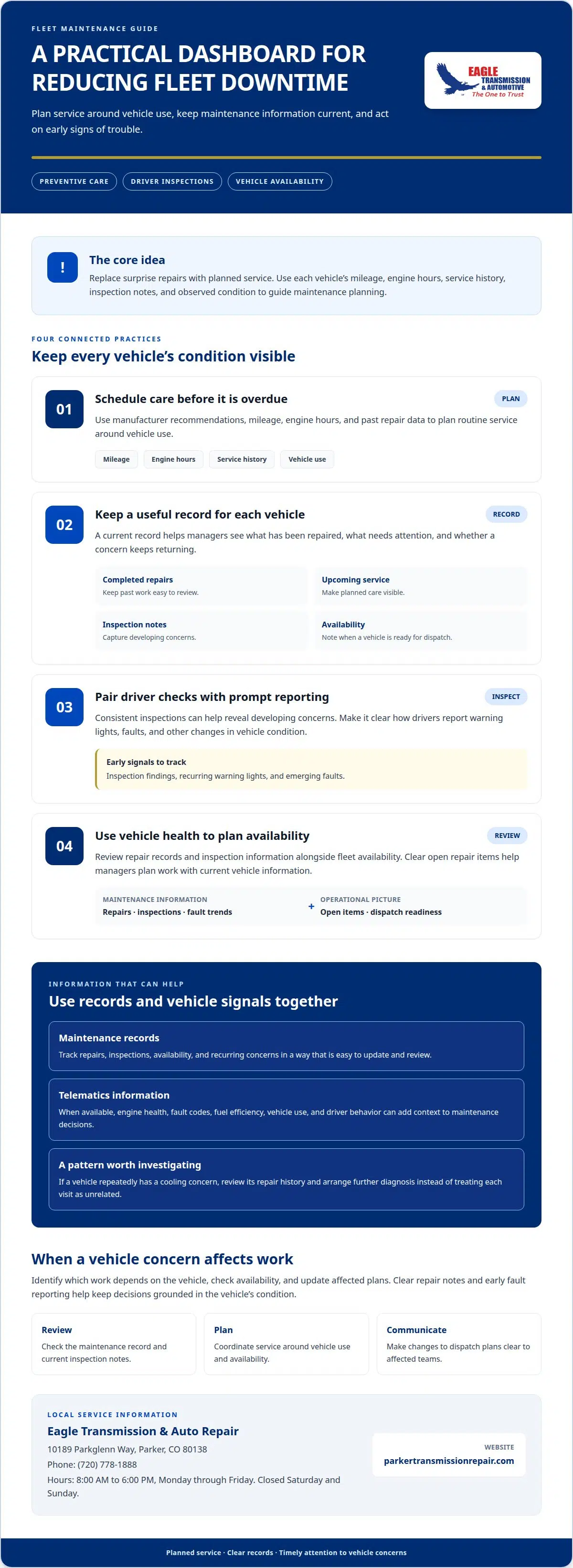
Preventive maintenance replaces surprise repairs with planned service. A fleet manager tracks each vehicle’s mileage, engine hours, service history, and manufacturer recommendations, then schedules care before work becomes overdue. The U.S. Environmental Protection Agency says a well-planned preventive maintenance program can reduce equipment downtime and untimely repairs and replacements.
Start with an up-to-date record for every vehicle. Include completed repairs, upcoming service, inspection notes, recurring warning lights, and periods when the vehicle was unavailable. If a truck repeatedly has a cooling concern, for example, review its repair history and arrange further diagnosis rather than treating every visit as an isolated event.
When comparing fleet maintenance software, consider whether it makes repair, inspection, and availability records easy to update, assign, and review in one place. Look for a clear view of open repair items and vehicles ready for dispatch, so managers can plan work using current information.
Telematics can add useful detail by tracking engine health, fault codes, fuel efficiency, vehicle use, and driver behavior. Managers can review those trends alongside inspection reports and repair records, then schedule maintenance around observed vehicle needs. The Government Accountability Office notes that systems that diagnose and predict engine problems before they develop are expected to reduce engine maintenance and downtime.
To reduce fleet vehicle downtime in Parker, Colorado, set maintenance schedules using manufacturer recommendations, mileage, engine hours, and past repair data. Pair those schedules with consistent inspections and prompt review of warning lights or emerging faults.
To reduce parts delays and speed up fleet repairs in Parker, record the parts needed for recurring repairs and plan service around vehicle availability. Clear repair notes help identify components earlier, while coordinating the work schedule helps limit disruption.
Fleet repair shops can handle scheduled diagnostics and maintenance, while mobile services may address some on-site repair needs. The right approach depends on the vehicle issue and whether the work requires shop equipment. For fleet repair in Parker, Eagle Transmission & Auto Repair provides in-shop service, including free transmission diagnostic testing, which is always free.
What roadside assistance and backup vehicle options help Parker fleets limit downtime? A fleet’s roadside assistance plan can support vehicles disabled during a route, while a spare vehicle or a planned reassignment can help cover scheduled work. Document who handles dispatch changes and how drivers report a breakdown.
For routes that also involve Castle Rock, this Castle Rock auto repair guide offers local context for planning vehicle service across the area. A clear maintenance record, early fault reporting, and realistic availability planning help keep fleet decisions grounded in each vehicle’s condition.
2. Lost productivity and delayed shipments
A delayed truck can interrupt the chain of work connected to its shipment. A retailer may be waiting for stock, a contractor may need materials at a jobsite, or another vehicle may be scheduled to collect the load. In Parker, understanding those dependencies helps fleet managers judge which shipment needs a revised plan first.
Think beyond the original delivery time. Check whether a delayed shipment affects a later pickup, a customer’s staffing plan, or another scheduled task. If a delivery supplies materials for a morning installation, for example, dispatch can contact the receiving team and adjust the work sequence before crews arrive without the materials.
When several shipments are affected, prioritize by operational impact, not simply route order. Consider receiving hours, whether the load supports time-sensitive work, and what other commitments depend on its arrival. Then decide whether to revise the stop sequence, split suitable work between vehicles, or notify the customer of a changed delivery plan.
- Identify shipments linked to another appointment or work task.
- Check receiving hours and any customer arrangements tied to delivery.
- Review whether another vehicle can carry the load safely and practically.
- Tell affected customers what changed and which commitments remain on schedule.
Load details matter when reassigning work. A replacement vehicle must suit the shipment’s size, handling needs, and route, and its driver needs accurate instructions. Before changing assignments, compare load information with vehicle availability and route commitments. This helps prevent an improvised transfer from creating another disruption.
Customer communication is most useful when it gives a clear update and next step. Rather than sending a general delay notice, explain which delivery is affected and when the customer can expect another update. Dispatch can also confirm that the revised plan fits the receiving location’s schedule.
After a disruption, review the shipment sequence and customer impact. Note whether a delayed load affected later stops, changed planned work, or left a vehicle waiting at a receiving site. These details help managers refine dispatch decisions for similar routes and keep customer commitments visible when plans change.
If a mechanical concern is disrupting fleet deliveries, plan the next repair step with Eagle Transmission & Auto Repair.
The Northgate Vehicle Hire survey put lost work for each unavailable UK light commercial vehicle at an average of £800 per day, illustrating how downtime can extend beyond the delayed delivery itself. Maintaining access to needed parts can help fleet managers reduce delays and last-minute shipping costs, making parts availability part of continuity planning rather than a task to address only after a vehicle is off the road.
3. Regular vehicle inspections
A consistent inspection routine gives drivers and fleet managers a shared record of vehicle condition. Drivers should perform pre trip and post trip inspections daily, noting visible changes and concerns before handing the vehicle to another shift. For example, a driver might record a new dashboard warning, a fresh fluid spot, or a change in steering feel.
Make the inspection form specific enough to guide attention without turning it into a repair diagnosis. Record the vehicle identifier, date, driver, warning indicators, visible leaks, exterior damage, and unusual sounds or changes in handling. “New clicking sound while turning left” gives maintenance staff more context than “noise.”
Requirements for Colorado and federal fleet inspections and maintenance can depend on vehicle classification and operation. Identify the rules that apply to your fleet. Keep records of inspections, reported defects, and follow-up actions, and distinguish driver checks from scheduled mechanical inspections.
Use inspection findings to decide what needs review, not to guess which part has failed. A driver reporting a warning light may not know which system triggered it. Visible wear can also signal a need for closer assessment without revealing the condition of every related component. Keep observations separate from conclusions.
- Record the vehicle identifier and inspection date.
- Describe the exact warning, sound, smell, or visible change.
- Note when and under what driving conditions it appeared.
- Track whether the concern was reviewed and what follow up remains.
Schedule comprehensive mechanical inspections at regular preventive maintenance intervals based on mileage or engine hours. Odometer readings can suit vehicles that travel regularly, while engine-hour records help account for equipment that runs for substantial periods while stationary. These measures help align inspection planning with actual use.
For example, compare a delivery van with frequent stop-and-start operation with a work truck that spends long periods at a jobsite. Their inspection notes may reveal different patterns, even if both vehicles appear similar on a basic schedule. Review records by vehicle and role, then update inspection planning when the work changes.
Close the loop after every inspection. Assign each concern for review, document the finding, and record whether further attention is needed. If a driver reports the same change again, connect the new entry to the earlier note. That history helps distinguish a one-time observation from a recurring condition and supports better fleet decisions.
4. Revenue loss and increased operating costs
When a fleet vehicle is unavailable, the financial effect extends beyond the repair itself. These figures describe potential fleet impact, not a repair charge or a Parker-specific calculation.
Separate the effects into clear categories. Record work that could not be completed, substitute vehicle use, additional fuel from changed assignments, and extra handling or delivery expenses. Keeping these entries distinct helps managers see whether an unavailable vehicle affects revenue, operating costs, or both.
Annual availability matters too. Fleets average 8.7 days of unplanned downtime per vehicle annually. A 50 truck fleet averaging 8.7 days of unplanned downtime per vehicle annually loses over 400 operational days each year. Fleet managers can compare this context with their own records rather than treating a single repair as the full measure of fleet impact.
Use a consistent record for every out-of-service event. Note when the vehicle became unavailable, the work assignment it missed, other vehicles used, and when it returned to operation. If a service truck misses scheduled jobs, for example, record which appointments were moved and whether another vehicle covered them. This connects availability to actual business activity.
- Track unavailable time separately from repair expenses.
- Record canceled, delayed, or reassigned work.
- Note added fuel, delivery, or vehicle substitution expenses.
- Compare repeated events by vehicle and reported concern.
Operating habits can add wear and affect maintenance costs. Hard braking, rapid acceleration, sharp turns, speeding, and excessive idling can increase vehicle wear and maintenance costs. Review driver practices alongside vehicle condition, then coach smoother driving where the records point to a useful change. This improves habits without assuming they explain every mechanical concern.
Review operating records during fleet planning. If repeated unavailability affects a vehicle’s assigned work, compare its repair history with its route demands and role. Managers can then consider adjusting its assignment, scheduling further assessment, or changing how it supports daily operations. Clear records turn downtime into information for better decisions.
Commercial truck downtime can cost hundreds of dollars per vehicle per day, so lost capacity may also create costs that are not visible in the repair invoice. A Northgate Vehicle Hire survey estimated that UK light commercial vehicle fleets lose a combined £2.4 billion per year due to downtime. That broader estimate underlines why firms should account for the consequences of missed work across the fleet, rather than assessing only the affected vehicle.
A Northgate Vehicle Hire survey found that 47% of fleets face fines or penalties when their vans are off the road for a week. Recording contractual deadlines, penalty triggers, and affected customer commitments alongside lost jobs can help managers identify which disruptions carry obligations as well as lost output. Keeping these items visible in the operating record supports clearer decisions about vehicle availability and the costs tied to interruptions.
5. Mechanical health and asset utilization
Asset utilization means keeping suitable vehicles available for their assigned work. A vehicle may be operational but poorly matched to its route, load, or daily demands. Review vehicle condition alongside assignments, using recurring repair notes and service records to identify units needing attention.
Brakes, tires, electrical systems, and engine cooling are common fleet repair areas. A brake concern can affect whether a vehicle should continue its planned work. An electrical fault may interrupt starting or other vehicle functions, while a cooling issue can limit dependable operation. Treat each report as a reason to assess the system, not as a confirmed diagnosis.
Prioritize repairs by considering safe operation, the likelihood of further mechanical problems, and the work affected by vehicle unavailability. A truck with a new cooling warning, for example, may need review before a demanding route. A van with a minor concern still needs attention, but urgency depends on inspection findings and intended use.
How should fleet managers prioritize repairs and decide when to replace a vehicle? Address concerns affecting safe operation or continued use first, then compare repair findings, recurring issues, service history, and the vehicle’s role. Consider replacement when the vehicle’s condition and repeated repair needs make it a poor fit for reliable fleet use.
Driver behavior can influence wear across the fleet. Hard braking, rapid acceleration, sharp turns, speeding, and excessive idling can increase vehicle wear and maintenance costs. Coaching drivers to limit harsh braking and speeding can support vehicle longevity and help prevent accidents. Review these habits alongside maintenance records rather than blaming one driver for every mechanical issue.
Compare vehicle availability with actual demand before assigning work. If one truck handles heavier routes while another has unused capacity, adjusting assignments may help balance use. Keep vehicle condition in view: shifting work to a unit with unresolved concerns could simply move the disruption elsewhere.
Use a consistent review process for each vehicle. Check inspection notes, repair history, recurring concerns, and its current role. Record whether the next step is continued operation, scheduled repair, or replacement review. This makes fleet decisions easier to explain and helps managers spot vehicles that repeatedly return to the repair list.
For a vehicle with a developing mechanical concern, plan a diagnostic inspection in Parker before assigning it to demanding fleet work.
Eagle Transmission & Auto Repair: Transmission Repair
Eagle Transmission & Auto Repair can help when a fleet vehicle develops a transmission concern that affects availability. Slipping, delayed gear changes, or unusual transmission noises are reasons to arrange diagnosis, since one symptom alone cannot identify the cause. Transmission diagnostic testing is free and always free.
Transmission repair and transmission service address different needs: repair responds to a diagnosed fault, while service supports scheduled care. For a vehicle with shifting concerns, transmission repair in Parker can help determine what the system needs. Eagle also provides engine repair for fleet vehicles with engine concerns.
For a fleet vehicle showing a new symptom, contact Eagle Transmission & Auto Repair or visit parkertransmissionrepair.com to take the next step.
Build a maintenance plan your whole team can use
Set a clear fleet decision process before the next vehicle issue interrupts work. Decide who receives driver reports, who reviews vehicle availability, and how dispatch learns when an assignment changes. A shared process gives drivers and managers the same steps to follow.
Use fleet records to adjust plans as vehicles and workloads change. If a vehicle shifts from local deliveries to heavier daily use, review whether its maintenance schedule still fits. If repair notes show a recurring concern, make sure that pattern informs the next service decision. These planning updates keep maintenance connected to operating needs.
For a fleet vehicle that needs mechanical attention, Eagle Transmission & Auto Repair can help with diagnosis and repair. Taking a practical next step can support your effort to reduce fleet vehicle downtime in Parker. Get directions to Eagle Transmission & Auto Repair, and keep your fleet’s next maintenance decision moving forward.
Frequently Asked Questions
How Does Truck Downtime Impact a Fleet’s Performance?
Truck downtime reduces the vehicles available for scheduled work, which can force dispatchers to reassign drivers or adjust delivery plans. Compare planned routes with completed routes, noting trips transferred, missed, or delayed. If a truck carrying scheduled loads is unavailable, other vehicles may absorb the work and have less capacity for their own assignments. Reviewing patterns by vehicle and route can reveal recurring operational bottlenecks.
How does preventive maintenance reduce fleet downtime?
Preventive maintenance creates opportunities to address service needs during planned care instead of waiting for a fault to interrupt work. A concern recorded during routine service, for example, can be assessed before the vehicle returns to a demanding route. Keep work orders clear about the reported issue, inspection findings, completed repair, and needed follow-up. This record helps managers see whether a concern has returned and what action remains.
What preventive maintenance schedule should fleet vehicles follow to minimize breakdowns?
Use the vehicle manufacturer’s recommendations as a starting point, then plan around each unit’s mileage, engine hours, and maintenance history. A vehicle that accumulates engine hours while idling may need a different tracking approach from one measured mainly by road mileage. Keep schedules specific to each vehicle, record completed service, and revise plans when usage patterns or recurring repair findings change.
Which fleet maintenance shops and mobile repair services serve commercial fleets in Parker, CO?
Eagle Transmission & Auto Repair is mentioned for transmission repair. Fleet repair shops can handle scheduled diagnostics and maintenance, while mobile services may address some on-site repairs; the right option depends on the issue and whether shop equipment is needed.
What are typical fleet vehicle repair and maintenance costs in Parker, Colorado?
Reactive emergency repairs can cost 3–5 times more than scheduled maintenance. The material gives no specific repair or maintenance prices for Parker.