
Last Updated: October 30, 2026
Quick Summary
A car A/C blower motor not working is usually caused by a blown fuse, a failed resistor, a bad relay, or a worn-out motor. Check the fuse and relay first, then test power and ground at the motor connector to confirm whether the motor or the wiring failed.
- A blower motor that only works on high speed almost always points to a failed blower motor resistor.
- A melted resistor connector can damage the wiring harness if you keep running the fan.
- Stop and book a diagnosis if the fuse blows repeatedly or you find melted plastic at the resistor.
- A motor that spins freely by hand but won’t run under power is usually worn out.
- Record when the fan quits and any smells or noises before your shop visit.
Table of Contents
- Why Your Car A/C Blower Motor Stopped Working
- Car Blower Motor Only Works on High: What It Means
- Blower Motor Resistor Symptoms You Should Not Ignore
- How to Test a Car Blower Motor Safely at Home
- When to Stop Driving and Call a Shop
- What a Mechanic Checks and How to Prepare for Your Visit
- Book Blower Motor Diagnosis at Our Parker Shop
- Frequently Asked Questions
Why Your Car A/C Blower Motor Stopped Working
When your car A/C blower motor not working leaves you with a silent vent and a foggy windshield, the cause is usually a blown fuse, a failed resistor, a bad relay, or a motor that has simply worn out. Once the motor is replaced and airflow returns, you should also clean air vents to ensure that dust and debris do not obstruct the newly restored circulation.
How the Blower Motor Fits Into Your A/C System
Think of the A/C system as two halves. One half makes cold air. The other half moves it into the cabin. The blower motor does the moving.
Air passes over the evaporator, a small radiator that gets cold, and the blower pushes that chilled air through your vents. If you want to know when that cold radiator itself is the problem, see the signs your car A/C evaporator needs replacement.
That is why a dead blower is often misdiagnosed as “the A/C is broken.” It usually isn’t the refrigerant. If you want the bigger picture on airflow and cooling problems, our guide on vehicle A/C repair walks through the whole system.
Car Blower Motor Only Works on High: What It Means
A blower motor that only works on high speed almost always points to a failed blower motor resistor. The resistor controls the lower fan speeds by adding resistance to the circuit. When it burns out, the motor loses those low and medium settings and defaults to full power.
This is one of the most common blower complaints we handle. Here is what that pattern tells you:
- Only high works: resistor is the prime suspect
- Nothing works at all: check fuse, relay, and motor power first
- Works sometimes, cuts out: loose connection or failing motor
Blower Motor Resistor Symptoms You Should Not Ignore
Resistor failure rarely happens without warning. The symptoms are usually clear if you know what to watch for:
- Fan works on high only, or on one or two speeds
- Fan speed changes on its own
- Burning smell near the glovebox
- Blower quits after running a while, then returns
Watch out: a melted resistor connector can damage the wiring harness if you keep running the fan. That turns a simple part swap into a bigger repair.
Airflow problems sometimes overlap with other A/C faults. If your vents blow warm even when the fan runs, our guide on how to fix a car A/C refrigerant leak covers the leak side of the equation.
How to Test a Car Blower Motor Safely at Home
You can narrow down a dead blower in your driveway with basic tools and no guesswork. The trick is to work in a safe order: observe first, check the cheap stuff second, and only then probe wiring.
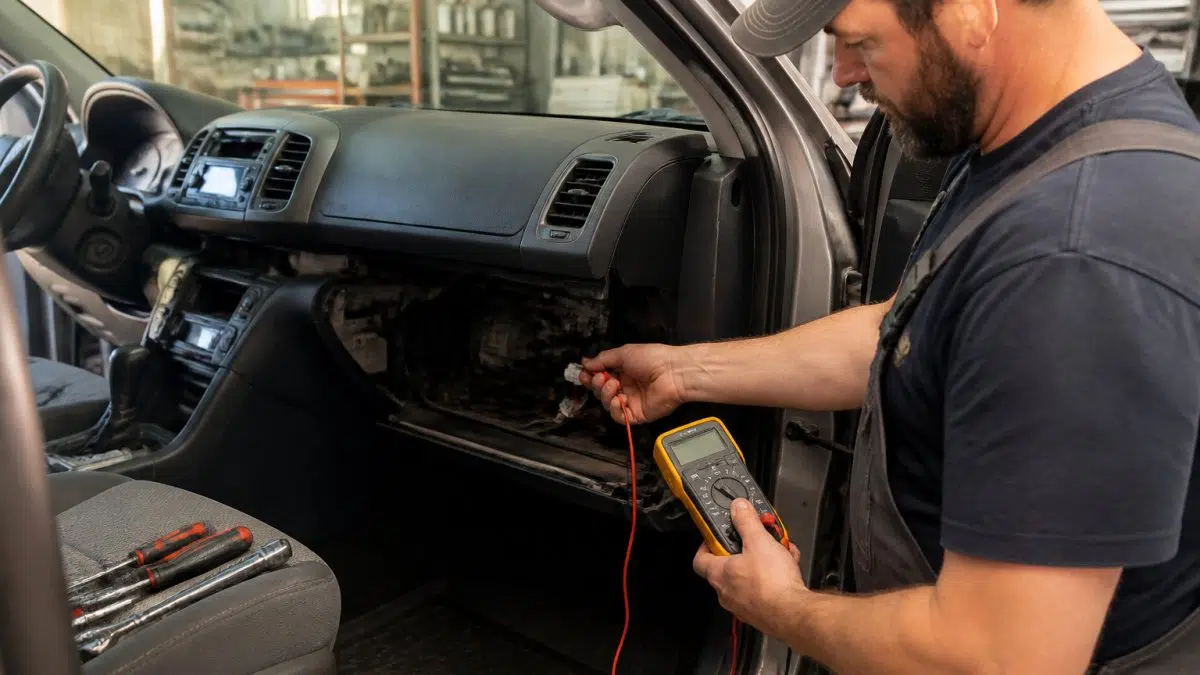
Step 1: Match the Symptom to the Likely System
Before you touch a tool, write down exactly what the fan does. The pattern usually points to one system.
| What You Notice | Most Likely System | Why |
|---|---|---|
| Nothing works on any speed | Fuse, relay, or motor power/ground | The circuit is dead upstream of the motor |
| Only high speed works | Blower motor resistor | Lower-speed resistance circuit has failed |
| Works, then cuts out after a while | Failing motor or loose connector | Heat and vibration break a marginal connection |
| Squeal or chirp that rises with fan speed | Motor bearing | The shaft is dry or worn |
| Fan runs with key off | Relay stuck closed | The relay is feeding power when it shouldn’t |
| Weak airflow but fan sounds normal | Cabin filter or blower case restriction | Air can’t get through, even though the fan spins |
This chart won’t diagnose the car for you, but it tells you which test to run first so you don’t waste an afternoon.
If you smell burning plastic, see smoke from the dash, or the fuse blows again the moment you replace it, stop. Those point to a short or a melting connector that needs a proper diagnosis, not another fuse.
Step 2: Check the Fuse and Relay First
Start with the cheapest, easiest checks.
- Find the fuse box, usually under the dash or in the engine bay.
- Locate the blower fuse using the diagram on the box lid.
- Pull the fuse and look for a broken wire inside.
- Swap in a fuse of the same rating if it looks blown.
- Test the blower relay the same way, or swap it with an identical relay nearby.
If the fuse blows again right away, stop. That points to a short that needs a proper diagnosis.
Step 3: Test Power and Ground at the Motor
Next, confirm the motor is actually getting power.
- Unplug the connector at the blower motor.
- Set your multimeter to DC volts.
- Turn the key on and the fan to high.
- Probe the power and ground pins at the connector.
If you get good voltage and the motor still won’t spin, give the fan cage a gentle nudge by hand with the key off. A motor that spins freely by hand but won’t run under power is usually worn out. A motor that feels stiff or gritty has a bearing problem.
Step 4: Know When to Stop and Book a Diagnosis
Home testing is safe up to the connector. Beyond that, you’re into wiring harness diagnosis, and a misprobe can damage a module. Stop and book a professional diagnosis if:
- The fuse blows repeatedly
- You find melted or discolored plastic at the resistor or connector
- The blower runs with the key off
- You can’t get a stable voltage reading
That last one is a safety issue, not a comfort issue. If defrost can’t keep up on a Colorado temperature swing, get it looked at before the next storm. If you’d rather hand off the testing, you can schedule a blower motor diagnosis with our team.
When to Stop Driving and Call a Shop
Some blower problems are safe to drive on. Others are not. If the only issue is no cabin airflow on a mild day, you can drive to a shop. But stop and get help if you notice:
- A burning smell or smoke from the dash
- The fuse blows repeatedly
- The blower stays on with the key off, draining the battery
- Defrost cannot clear the windshield
That last one matters in Colorado. A fogged or iced windshield is a safety problem, not a comfort problem. If you are weighing a repair on an older, high-mileage vehicle, our team can give you an honest read before you spend. Drivers searching for a Ford mechanic in Parker, Colorado can see how thorough diagnostics connect symptoms to a clear repair plan.
What a Mechanic Checks and How to Prepare for Your Visit
A good diagnosis follows a sequence, not a guess. Here is what we check, in order, and why each step matters.
| Step | What We Check | Why It Matters |
|---|---|---|
| 1 | Fuse and relay | Fastest, cheapest failure point |
| 2 | Resistor and connector | Common cause of one-speed fans |
| 3 | Power and ground at motor | Confirms whether the motor or wiring failed |
| 4 | Motor draw and spin | Reveals a seizing or worn motor |
| 5 | Blower case and cabin filter | Restricted airflow mimics a weak fan |
| 6 | Control head and blend door | Confirms the fan command is reaching the motor |
How Vehicle Type Changes the Diagnosis
The blower circuit looks similar across most vehicles, but the details differ enough that model-specific service information matters.
- Automatic climate control: The fan speed may be commanded by a control module rather than a simple resistor. A scan tool is often needed to see what the module is asking the motor to do.
- Manual climate control: A resistor block and a straightforward fan switch are common, which makes the one-speed-only pattern easier to pin down.
- Hybrid and electric vehicles: The blower may run off a DC-to-DC converter, and the fan can run after shutdown to dry the evaporator. That’s normal, not a stuck relay.
- Older vehicles: Worn motor brushes and corroded connectors are more common than module faults.
What to Record Before Your Visit
A few notes save diagnostic time and money.
- When the fan quits: cold start, after warm-up, over bumps, after rain, or on a specific speed setting
- Whether the fan ever comes back on its own
- Any smells, noises, or warning lights
- Recent work: battery, alternator, radio, or dash repairs
When to Stop Driving and Arrange a Tow
Some blower problems are safe to drive on. Others are not. If the only issue is no cabin airflow on a mild day, you can drive to a shop. But stop and get help if you notice:
- A burning smell or smoke from the dash
- The fuse blows repeatedly
- The blower stays on with the key off, draining the battery
- Defrost cannot clear the windshield
That last one matters in Colorado. A fogged or iced windshield is a safety problem, not a comfort problem. If you are weighing a repair on an older, high-mileage vehicle, our team can give you an honest read before you spend. Drivers searching for a Ford mechanic in Parker, Colorado can see how thorough diagnostics connect symptoms to a clear repair plan.
Bring your keys, your notes, and any recent repair receipts. The more precisely you can describe when the fan fails, the faster we can confirm the cause and get you back on the road.
Book Blower Motor Diagnosis at Our Parker Shop
A dead blower is usually a fixable part, not a failing A/C system. The key is testing in the right order so you replace the failed part once, not three times.
Our Parker shop serves drivers from surrounding communities. Our guide on choosing the best mechanic in Douglas County explains what to look for.
Dealing with a blower that quit in the middle of a Colorado temperature swing is frustrating, and guessing at parts gets expensive fast.
Frequently Asked Questions
Can I drive my car if the A/C blower motor is not working?
Yes, you can usually drive. A dead blower motor affects cabin airflow and defrost performance, not the engine or drivetrain. The bigger concern in Colorado is windshield fogging on cold mornings, because without blower airflow the defroster cannot clear glass quickly. If you cannot see clearly, do not drive. Otherwise, keep trips short and book a diagnosis at our Parker shop.
What is the difference between a bad blower motor and a bad blower motor resistor?
A failed blower motor usually stops turning at every speed setting, and you may smell burning or hear grinding. A bad resistor typically leaves the motor working on high speed only, because the resistor pack controls the lower fan speeds. If your car blower motor only works on high, the resistor is the first suspect.
How do I know if my blower motor resistor is bad?
Common blower motor resistor symptoms include a fan that works only on the highest setting, no airflow on low or medium speeds, intermittent fan operation over bumps, and sometimes a burning smell near the glovebox. The resistor pack sits in the air duct and heats up as it drops voltage for lower speeds, so heat damage is common.
Can a blown fuse cause the A/C fan to stop working?
Yes. The blower motor circuit has a dedicated fuse, and a blown fuse cuts power to the motor entirely. Check your owner’s manual for the blower motor fuse location, usually in the under-dash or under-hood fuse box. If a new fuse blows right away, stop and let a technician trace the short. Replacing fuses repeatedly without finding the cause can damage wiring.