If your engine stalls while you are driving, get the car out of traffic first, then get the cause found before you drive it again. Most stalls trace back to fuel delivery, spark or electrical supply, or the air and idle system, and each one leaves clues a technician can follow. At Eagle Transmission & Auto Repair in Parker, every job starts with a free diagnostic that includes a road test and a computer scan, so you learn what is wrong before you spend anything.
This guide covers the safe steps to take in the moment, the likely causes in plain words, what it means when the car restarts, and how to describe the problem to a shop so it gets solved faster.
Key Takeaways
- Stay calm, turn on your hazard lights, shift to neutral and steer toward the shoulder while you still have momentum.
- Expect the brake pedal and steering to feel heavier once the engine quits. You still have control, it just takes more effort.
- A restart does not mean the problem is gone. Stalls that come back are usually a fuel, spark or sensor fault that needs a proper diagnosis.
- How the engine died (slowly fading or suddenly cutting off) is one of the best clues you can give a technician.
- Eagle Transmission & Auto Repair offers a free diagnostic with a road test and computer scan for drivers in Parker and the surrounding towns.
Table of Contents
- What to do the moment your engine stalls
- Why an engine stalls while driving
- Read the clues: how did it feel when it died?
- It restarted. Is everything fine?
- Check for recalls
- Colorado driving makes stalls more noticeable
- How we find the cause at Eagle Transmission & Auto Repair
- What does a stalling repair cost?
- Fleet vehicles and work trucks
- Book a free diagnostic
- FAQ
- Sources
What to do the moment your engine stalls
The steps below follow guidance from the Rhode Island Division of Motor Vehicles and Consumer Reports. They apply on any road, whether that is a quiet street in Stonegate or a busy stretch of I-25.
- Turn on your hazard lights. Do it as early as you can so drivers behind you know something is wrong.
- Shift into neutral. This lets the wheels turn freely while you coast, and it lets you try a restart without stopping.
- Steer toward the shoulder or the nearest safe spot. Use the speed you have left to get out of the travel lanes, and signal normally.
- Try to restart the engine. If it starts, keep moving to a safe place before you stop. Once you are safely stopped, an automatic goes into Park and a manual into Neutral.
- If it restarts, let it run a few minutes before you pull back into traffic, and plan to have it looked at.
Try not to brake hard or yank the wheel. Smooth, early moves work better than sudden ones.
Why the pedal and steering suddenly feel heavy
Most modern cars use engine power to help you brake and steer. When the engine dies, that help fades. Consumer Reports, quoting an AAA repair systems manager, says the brake pedal becomes harder to push, stopping distance grows and the steering wheel is harder to turn. It also notes that airbags may not work properly depending on the cause of the stall.
That sounds alarming, but you are not locked out of control. Press the brake firmly and steadily, and turn the wheel with both hands. Knowing it will feel stiff is most of the battle.
If it will not restart
When the engine stays dead and you are stuck in a traffic lane, Consumer Reports advises staying in the vehicle, since the car protects you better than standing outside. Call 911 so police can help move the vehicle to safety, then call roadside assistance or a tow truck. If you are on the shoulder, keep your hazards on and wait for help. Keep your phone charged and know your location, such as the nearest mile marker.
Eagle Transmission & Auto Repair offers emergency towing, and complimentary local towing comes with repair, so you can have the car brought straight to our shop at 10189 Parkglenn Way, Parker, CO 80138.
Why an engine stalls while driving
An engine needs three things at all times: fuel, a spark to light it, and the right amount of air. Lose any one and it stops. Larry Carley, writing for Underhood Service, lists common causes as a failing idle speed control system, low fuel pressure from a weak fuel pump, loss of ignition, and vacuum or exhaust gas recirculation leaks. Here is what each one means in everyday terms.
Fuel delivery problems
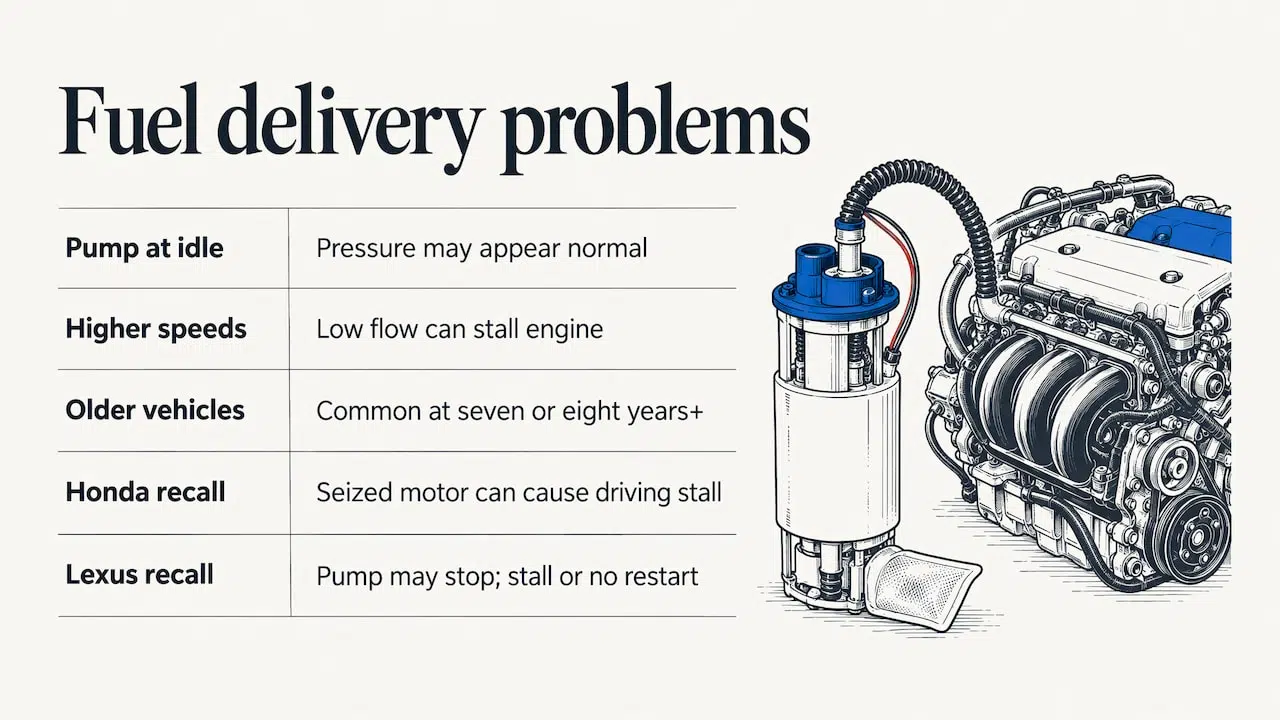
The fuel pump pushes gasoline from the tank to the engine. If it spins too slowly or cuts out now and then, the engine starves. Carley explains that a pump can show normal pressure at idle but not enough flow at higher speeds, so the engine stalls at highway speed and then starts right back up. That pattern is common on vehicles seven or eight years old or more. A clogged fuel filter can create a similar starved feeling.
Fuel pumps are also the subject of safety recalls. A Honda recall notice from NHTSA describes a seized fuel pump motor that can cause a stall while driving, and a Lexus recall document describes a low pressure fuel pump that may stop working, causing a stall or a no restart.
Spark and electrical problems
Ignition coils make the spark. Sensors tell the engine computer when to fire and how much fuel to add. The battery, alternator and wiring keep all of it powered. When one of these drops out, the engine can shut off abruptly. The Underhood Service article also points to loose or corroded battery and ground connections, and to a failed crankshaft or camshaft position sensor (a sensor that tells the computer how fast the engine is turning and where its parts are) as sudden shutdown suspects.
Air and idle problems
The engine also needs a steady, measured flow of air. A gummed up idle speed control valve or a vacuum leak can leave the engine unable to hold a smooth idle. Carley says a dirty idle control valve is the likely culprit when stalling only happens at idle or while coming to a stop.
Read the clues: how did it feel when it died?
Technicians pay close attention to how the stall happened. The article by Ricks Free Auto Repair Advice and the Underhood Service piece point the same direction, and the table sums it up. Treat it as a starting guide, not a verdict, because only testing confirms the cause.
| What you noticed | What it often points to |
|---|---|
| Engine slowly lost power and faded out | Fuel delivery, such as a weak pump or clogged filter |
| Engine shut off suddenly, like a switch | Ignition or electrical faults, such as a sensor or a power feed |
| Stalled only when slowing or stopped | Idle control, throttle area or a vacuum leak |
| Stalled at highway speed, restarted right away | Fuel pump flow at higher engine speeds |
| Battery warning light came on first | Charging system, such as the alternator or battery connections |
Before you visit a shop, jot down what you remember: speed, whether the engine was hot or cold, whether any warning light came on, whether the A/C was running, and how long it took to restart. Those details can save real diagnostic time.
It restarted. Is everything fine?
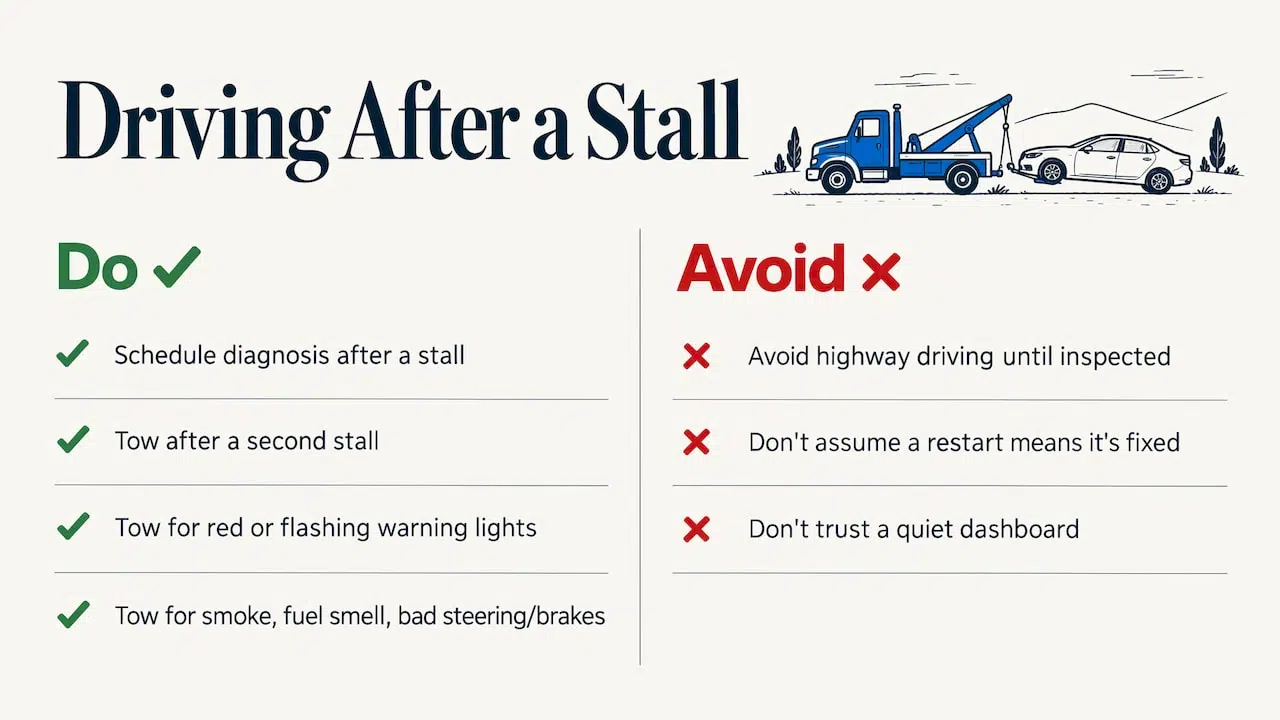
Not necessarily. A stall that goes away after a restart can be an intermittent fault, meaning it comes and goes. The Federal Trade Commission’s Auto Repair Basics guide lists rough idling or stalling, a lit check engine light, trouble starting and poor acceleration among symptoms that call for diagnosis and scheduled repair.
The practical point is simple. A car that can die in traffic is better checked on your schedule than discovered again at an intersection or on a mountain grade. Try to avoid highway driving until it has been looked at, and if it stalls a second time, have it towed rather than driven.
A few signs mean you should not drive on at all and should call for a tow: a red oil pressure or temperature warning, a flashing check engine light, smoke, a strong fuel smell, or steering and braking that feel wrong. Your dashboard is not a perfect guide, either. Some fuel and electrical faults leave no light and no stored code, so a quiet dashboard is not proof the car is fine.
If your car stalls and then cranks but will not fire, this explanation of an engine that cranks but won’t start walks through the same fuel, spark and air logic from another angle.
Check for recalls
Because fuel pumps, ignition switches and engine computers have all been subject to recalls, it is worth looking up your vehicle identification number (the VIN, the 17 character code on your dash and door jamb) on the NHTSA recall lookup. A recall repair is done at no charge to you at the manufacturer’s dealer. Tell us if one applies, and we can sort out which work belongs to the recall and which does not.
Colorado driving makes stalls more noticeable
Driving around Parker, Castle Rock, Highlands Ranch and Aurora means plenty of changes in elevation, long climbs on I-25, cold winter mornings and hot summer afternoons stuck on Parker Road. Those swings put extra demands on fuel pumps, sensors, batteries and cooling systems. If your stall tends to happen after a cold start, on a long uphill or after the car has heat soaked in a parking lot, tell the technician. Patterns like that narrow the search quickly.
Older vehicles feel this most. The more years and miles a car has, the more likely it is to have tired pumps, worn sensors and corroded connections, which is why stalling shows up so often on higher mileage cars.
How we find the cause at Eagle Transmission & Auto Repair
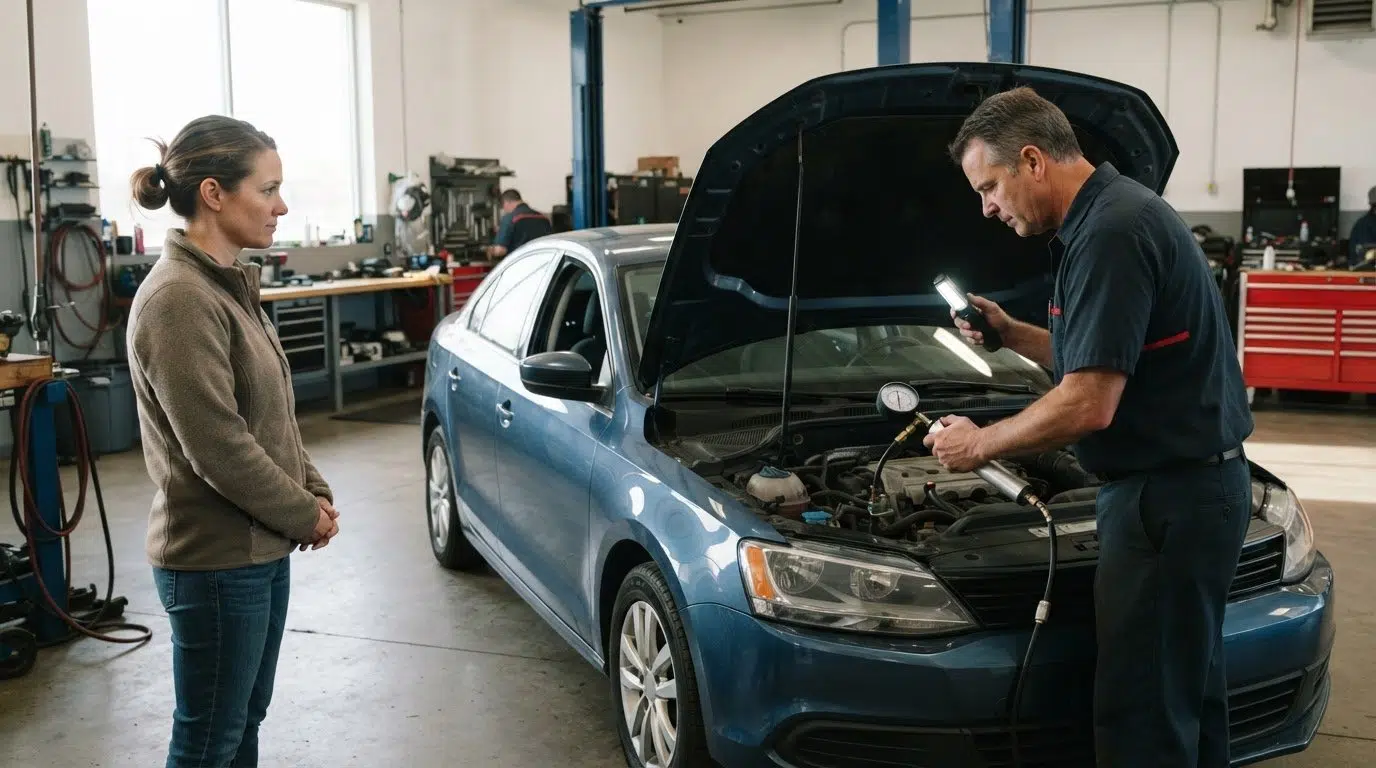
A stall can come from the engine, the fuel system, the electrical system or sometimes the transmission, so the work starts with testing, not guessing. Our process begins with a free diagnostic: a road test, which lets us feel and hear the problem the way you do, and a computer scan, which reads any stored trouble codes. We explain what we find, quote the repair clearly, and repairs go ahead only with your approval. Our technicians are ASE certified, and our repairs are backed by a warranty.
A few things make this easier on your day:
- Free diagnostic first. You know the problem and the quote before you commit.
- Transparent quoting. We explain the repair and there are no surprise charges.
- Towing and rides. Complimentary local towing comes with repair, and we offer ride service while your car is with us.
- One shop for the whole job. We handle engine repair, check engine light diagnostics, brakes, A/C, clutch, differential, transfer case and transmission work, so a stall that turns out to be more than one problem does not mean a second stop elsewhere.
If the stall came with a lit check engine light, our page on check engine light diagnosis explains how the process works. If the engine also idles roughly, rough idle diagnosis in Parker covers that symptom. And if the engine seems to hesitate or shake before it dies, you may also find misfire symptoms for Parker drivers useful.
What about the transmission?
Sometimes what feels like a stall is a transmission issue, such as the car bogging down when it shifts, slipping, or stopping the engine when it comes to a halt. We road test for that too, and our transmission services cover repair, rebuild, replacement and fluid service when that is the cause.
What does a stalling repair cost?
The honest answer is that it depends on the cause, and we do not quote a figure before we have tested your car. A loose battery terminal and a fuel pump inside the tank are very different jobs. In general, the repair ranges from small fixes to larger parts, and labor time varies with how hard a part is to reach.
The FTC’s guide suggests asking how a shop prices its labor and whether a diagnostic charge applies, and considering a second opinion for an expensive or complicated repair. With us, the diagnostic is free and the quote comes before the work. For a general picture of what drives engine work costs, see our guide to engine repair cost in Parker.
Fleet vehicles and work trucks
A stall is more than an annoyance for a business. A van that dies on a delivery route costs you time and customers. We provide fleet maintenance for local businesses, and preventative maintenance and tune ups help catch worn plugs, filters and sensors before they leave a driver on the shoulder. Call us to set up a routine for your vehicles.
Book a free diagnostic
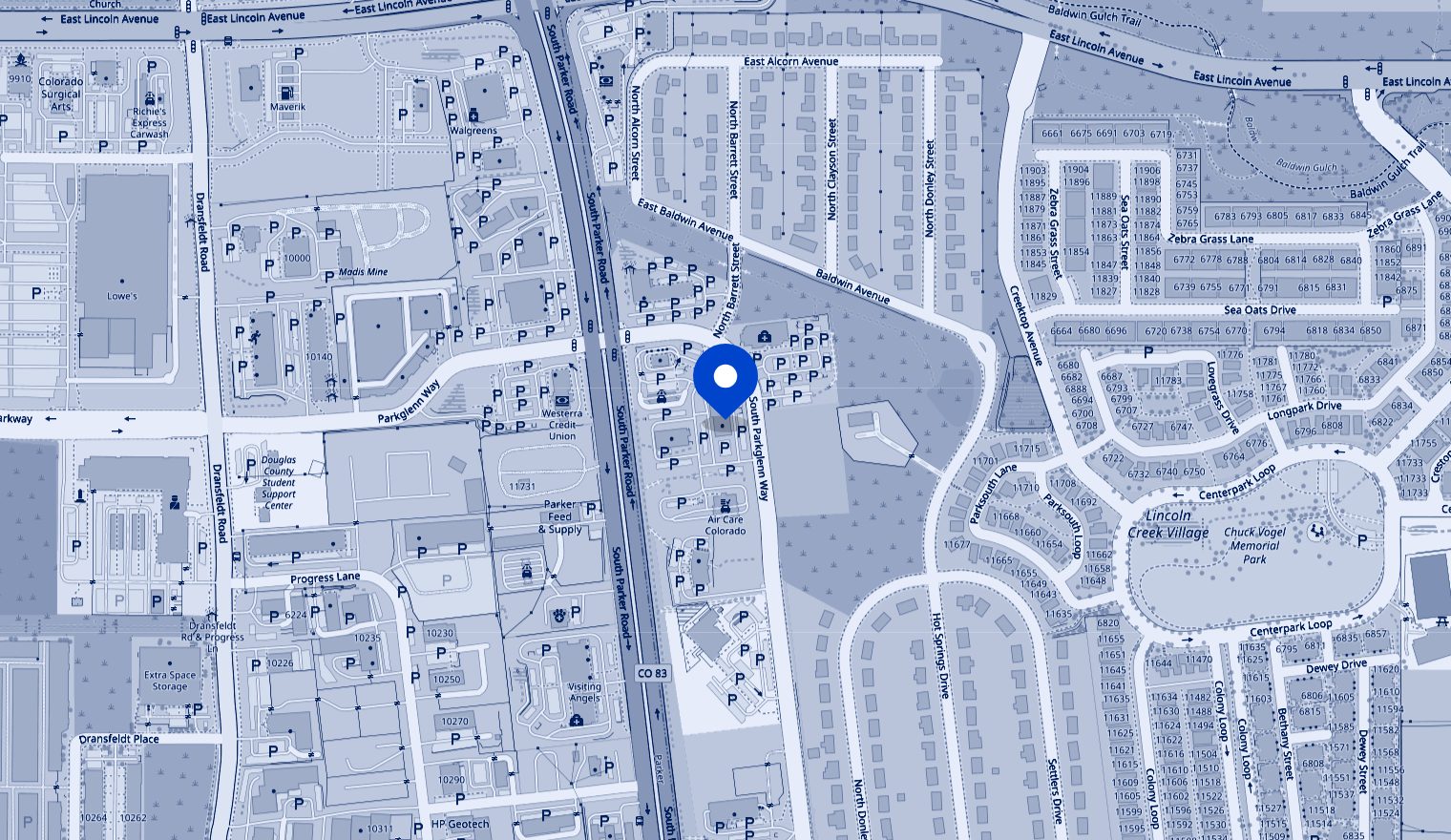
If your engine has stalled, even once, we would be glad to take a look. Eagle Transmission & Auto Repair is at 10189 Parkglenn Way, Parker, CO 80138, and we are open Monday to Friday, 8am to 6pm, closed weekends. We serve Parker, Lone Tree, Castle Rock, Castle Pines, Highlands Ranch, Centennial, Aurora, Franktown and Elizabeth.
You can see our full list of services, including free diagnostics, on our services page.
FAQ
What should I do if my engine stalls while driving?
Turn on your hazard lights, shift to neutral and steer toward the shoulder while you still have momentum. Try to restart once you are moving safely out of traffic. If it will not restart, stay in the car, call 911 if you are in a lane of traffic, and call for a tow.
Is it dangerous if my car stalls but restarts?
It is a sign something needs attention, because the cause may still be there. A stall can mean heavier steering and braking, and the engine may cut out again at a bad moment. Having it diagnosed soon is the sensible move, and until then avoid highways if you can.
Why would a car stall but then start again?
Intermittent faults are the usual reason. A fuel pump that cannot keep up at higher speeds, a sensor that drops out when it heats up, or a loose electrical connection can all let the engine die and then come back. A road test and computer scan help narrow it down.
Can a stalling engine be a transmission problem?
Sometimes. If the car shudders, slips or dies when it shifts or comes to a stop, the transmission may be involved. We road test for both engine and transmission causes, so you do not have to guess which one it is. Call us at (720) 778-1888 or stop by when you are ready, there is no pressure.
Sources
- Engine Failure, Rhode Island Division of Motor Vehicles
- What to Do When Your Car Stalls, Consumer Reports
- Driving Car Engine Stall, Underhood Service
- Why Did My Car Shut Off While Driving?, Ricks Free Auto Repair Advice
- Honda safety recall bulletin on fuel pump motor, NHTSA
- Lexus safety recall technical instructions, NHTSA
- Auto Repair Basics, Federal Trade Commission