Most drivers in the United States pay somewhere between a few hundred dollars and about a thousand for a new alternator, installed. Kelley Blue Book puts the average at $747 to $842, and the final number for your car depends mostly on three things: the part, the hours of labor your vehicle needs, and whether the alternator is really what failed. That last one is where drivers lose the most money. At Eagle Transmission & Auto Repair in Parker, every job starts with a free diagnostic, so you know what is wrong before you spend anything.
The alternator is the part that makes electricity while your engine runs. It recharges the battery and powers the lights, radio, heated seats and everything else. When it quits, the car runs on battery alone until the battery is empty, and then it stops.
Key Takeaways
- National averages sit in the high hundreds of dollars, but a plain sedan and a luxury SUV can land far apart on the same job.
- The bill is three pieces: the alternator itself, the labor to swap it, and the testing that confirms it is the culprit.
- A weak battery, a worn belt or a corroded cable can look just like a bad alternator, so test first and replace second.
- Ask for an itemized quote that separates parts, labor and testing before you approve anything.
- Eagle Transmission & Auto Repair offers a free diagnostic, including a road test and computer scan, and does the work only with your approval.
Table of Contents
- What alternator replacement usually costs
- What goes into the bill
- Why two quotes for the same car can differ
- Is it really the alternator?
- Repair or replace?
- Extra electrical load on trucks and SUVs
- Colorado driving and your charging system
- How to read an alternator estimate
- How we handle it at Eagle Transmission & Auto Repair
- Get a clear answer before you spend anything
- FAQ
- Sources
What alternator replacement usually costs
Published guides agree on the general shape, even if they differ on the exact figures. Kelley Blue Book lists an average of $747 to $842 for the full job. ConsumerAffairs reports that RepairPal’s national estimate runs $757 to $1,032. J.D. Power gives a wider total range of $350 to $900, and notes that dealership parts and labor often push the bill past $500.
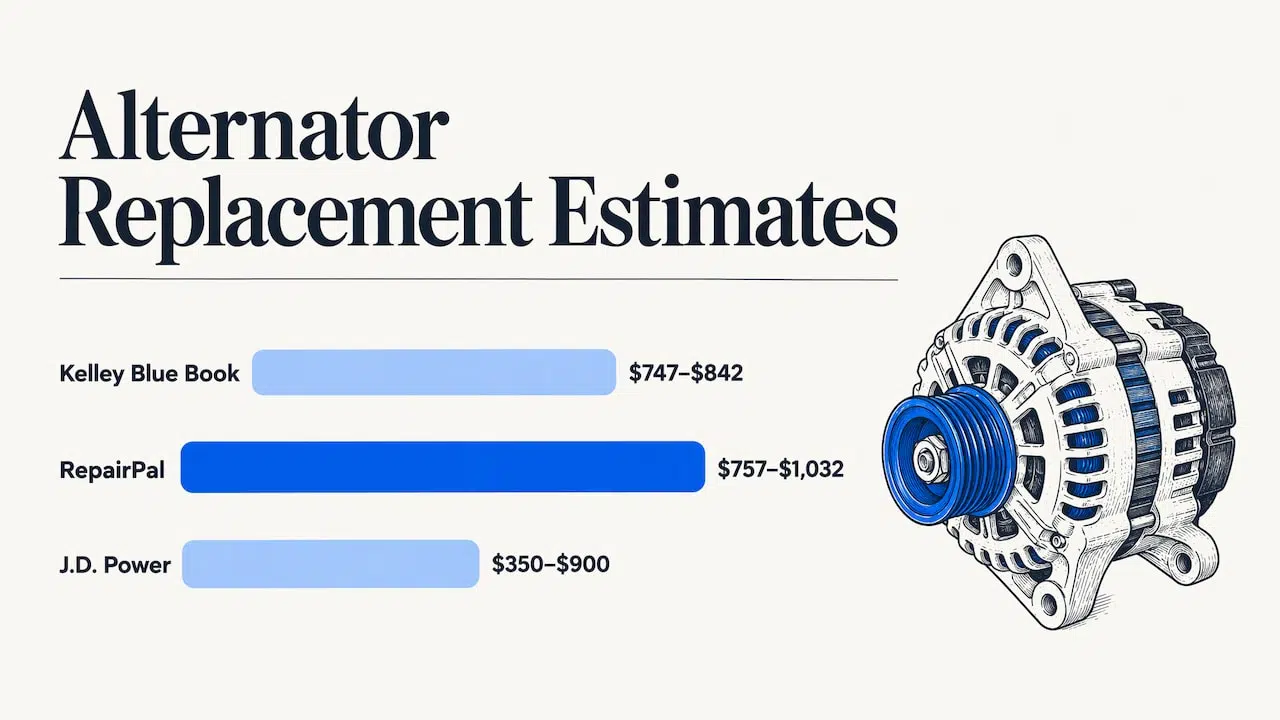
Why the spread? Each source samples different cars, regions and shop types. A national number is a planning range, not a quote. Your actual price comes from your vehicle’s year, make, model and engine, and from the shop’s labor rate.
One thing worth knowing about how these numbers move: parts prices and shop labor rates change over time, and published averages are updated when the publisher refreshes its data. Treat any figure you read, including these, as a starting point and get a written quote for your own vehicle.
What goes into the bill
There are three main pieces. Here is what to expect from each.
| Piece of the bill | What it covers | What to know |
|---|---|---|
| The alternator | A new, remanufactured or aftermarket unit | J.D. Power says the part alone averages $100 to $350, and $500 to $700 for luxury models |
| Labor | Removing the belt and old unit, installing the new one, checking the charge | Depends on how buried the alternator is in your engine bay |
| Testing | Checking the battery, cables, belt and charging output | Tells you whether the alternator is the problem at all |
| Extras | A new serpentine belt, if yours is worn | J.D. Power lists a belt at $20 to $50 |
The part: new, remanufactured or aftermarket
A new alternator from the vehicle maker is usually the most expensive choice. A remanufactured unit is an original alternator that has been taken apart, cleaned, fitted with fresh wearing parts and tested. Aftermarket units are built by other companies to fit your car. All three can do the job. The right one depends on your vehicle, how long you plan to keep it and the warranty that comes with the part.
Amperage matters too. Amps measure how much electrical current the alternator can put out. J.D. Power notes that an alternator running near its maximum output wears out sooner, so if you tow, run a plow light bar or have added accessories, ask your technician whether a higher output unit suits your vehicle.
Labor: where the car makes the difference
On some cars the alternator sits right on top of the engine and comes out in about an hour. On others it is tucked under the intake or behind other parts, and the job takes much longer. Shops bill by a published “book time” for your exact vehicle, multiplied by their hourly rate. Dealerships generally charge higher hourly rates than independent shops, which is one reason the same repair can cost noticeably more at a dealer.
Testing: the line drivers skip over
A proper charging system test checks the battery, the cables and the alternator output. It is the step that stops you from buying a part you do not need. Many shops charge a diagnostic fee, often credited back if you do the repair. At Eagle, the diagnostic is free.
Why two quotes for the same car can differ
If you have collected two or three estimates and they do not match, the gap usually comes from one of these:
- Part choice. New versus remanufactured versus aftermarket.
- Shop type. Dealerships, independent shops and chain stores set different labor rates.
- Vehicle design. Trucks, SUVs and luxury cars often cost more than compact sedans, both for the part and the hours.
- Extras bundled in. A belt, a battery or a cable replaced at the same time raises the total, sometimes for good reason.
- Whether testing was done. A quote written without testing is a guess.
When you compare quotes, compare the same list of items. A lower number that leaves out the belt or the testing may not end up lower.
Is it really the alternator?
Before you worry about cost, make sure the alternator is the problem. J.D. Power lists these common signs:
- Rough or slow starting
- Headlights that dim or change brightness with engine speed
- A battery warning light that stays on or blinks
- A whistling sound from the drive belt
- Humming or ringing noises under the hood
The trouble is that a worn out battery gives you many of the same signs. So can a loose belt or a corroded battery cable. A car that will not start in a cold Parker driveway on a January morning may need a new battery, a new alternator, or both. The only way to know is to test the charging system.
Your own basic check is a voltmeter reading at the battery with the engine running. J.D. Power says a reading under 13.5 volts with accessories on warrants professional confirmation. If you see that, or any of the signs above, stop guessing and have the system tested. If the battery light comes on while you are driving, head somewhere safe to stop, because the car is running on stored battery power and has limited time left. If you cannot make it, we offer emergency towing.

Repair or replace?
Sometimes a shop can repair an alternator by replacing a small internal part such as a bearing or a voltage regulator, the little electronic piece that controls charging output. Repair can make sense when the rest of the unit is in good shape. On an older alternator with high mileage, or one with more than one worn part, replacing the whole unit usually makes more sense, because paying for repeated small repairs adds up and the other worn parts are still in there.
A technician who has tested the unit can tell you which case you are in. That is another reason to get the diagnosis done before anyone quotes you.
Extra electrical load on trucks and SUVs
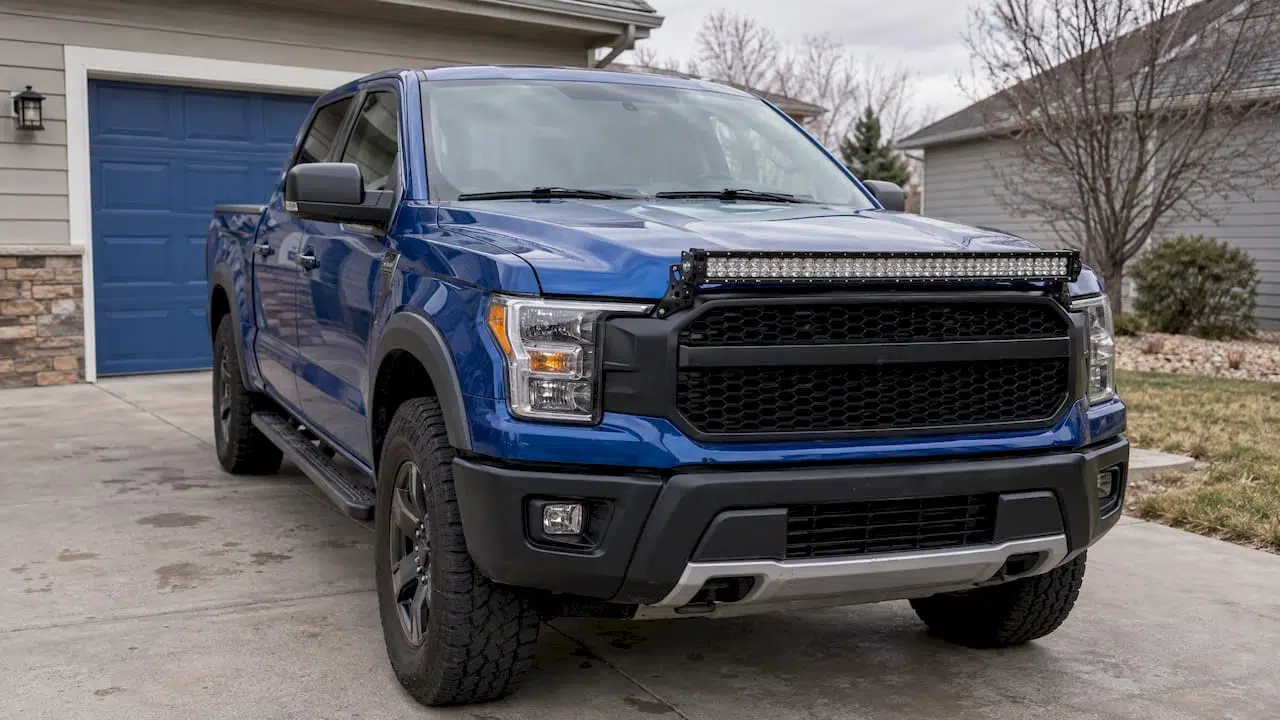
Colorado drivers often add things: light bars, winch controllers, aftermarket stereos, heated accessories for winter trips up toward the mountains. Each one draws power, and the alternator has to keep up. If you are adding lights, a quality wiring harness for added lighting keeps the load off your factory wiring. Tell your technician what you have added so the replacement unit is chosen to match.
Colorado driving and your charging system
Driving around Parker, Castle Rock, Highlands Ranch and Aurora means a mix of short trips, stop and go traffic on Parker Road and E-470, and longer highway runs. Short trips do not give a battery much time to recharge, so the alternator works harder to keep up. Cold mornings make starting more demanding too, and heater fans, defrosters and seat heaters all add to the electrical load. None of this means trouble is coming. It simply means a charging system that is slightly weak shows itself faster here, so it is worth listening to early warning signs.
How to read an alternator estimate
A good estimate is easy to follow. Look for these lines:
- Testing or diagnosis, listed separately, with the result in plain words.
- The part, with the type named: new, remanufactured or aftermarket, and the warranty that comes with it.
- Labor, with the hours and the rate.
- Extras, such as a belt, clearly marked as needed or optional, with the reason.
- The total, including shop fees and tax.
If something is unclear, ask. A shop that is comfortable explaining each line is usually one you can trust with the repair. Our own guide on how to find trustworthy auto repair close to you covers more of what to look for.
How we handle it at Eagle Transmission & Auto Repair
We are a full service shop in Parker, not only a transmission shop. We handle general auto repair, engine work, brakes, A/C, diagnostics and fleet service, so a charging problem is not a reason to go somewhere else. Here is how a visit works:
- Every job begins with a free diagnostic, including a road test and a computer scan, before you spend anything.
- We explain what we found and give you a clear quote with no surprise charges.
- Repairs happen only with your approval.
- Our technicians are ASE certified, and repairs are backed by warranty.
- Complimentary local towing with repair and ride service make it easier to get the job done.
If your check engine light is on along with a battery light, our check engine light service is a good place to start. For engine related questions, see our engine repair page.
We serve Parker, Lone Tree, Castle Rock, Castle Pines, Highlands Ranch, Centennial, Aurora, Franktown and Elizabeth. Businesses with vans, trucks or service vehicles can ask us about fleet maintenance, so a dead alternator does not take a vehicle off the road for long.
Get a clear answer before you spend anything
If your battery light is on, your headlights are dimming or the car is slow to start, our free diagnostics let you find out what is wrong first. You can see everything we offer on our services page.

Eagle Transmission & Auto Repair is at 10189 Parkglenn Way, Parker, CO 80138. Our hours are Monday through Friday, 8am to 6pm, and we are closed weekends. Call us at (720) 778-1888.
FAQ
How much does it cost to replace an alternator?
National guides put the average somewhere between about $350 and $1,000, depending on the source, with Kelley Blue Book averaging $747 to $842. Your price depends on the part, your vehicle and the shop’s labor rate. A written quote after a diagnostic is the only number that applies to your car.
Can I keep driving with a bad alternator?
Only for a short time. The car runs on battery power once the alternator stops charging, and when the battery drains, the engine stops, often without warning. If the battery light comes on, avoid long trips and get the car tested promptly. In Colorado, that is especially wise before a winter drive or a trip through the mountains.
Is a battery or an alternator the problem?
It can be hard to tell from symptoms alone, because both cause slow starts and dim lights. A charging system test checks both and settles the question. That is why we begin every job with a free diagnostic, so you only pay to fix what is actually broken.
Should I replace the belt at the same time?
Often it makes sense, since the belt has to come off to replace the alternator. J.D. Power lists a serpentine belt at $20 to $50. Your technician can check its condition and tell you whether it needs replacing now or can wait.
Where can I get my alternator checked near Parker?
Eagle Transmission & Auto Repair serves Parker and nearby towns including Lone Tree, Castle Rock, Centennial and Aurora. There is no pressure to decide on the spot. Call (720) 778-1888 or stop by when it suits you, and we will take a look and explain what we find.
Sources
- Kelley Blue Book: alternator replacement costs
- J.D. Power: what it costs to replace an alternator
- ConsumerAffairs: cost of an alternator replacement