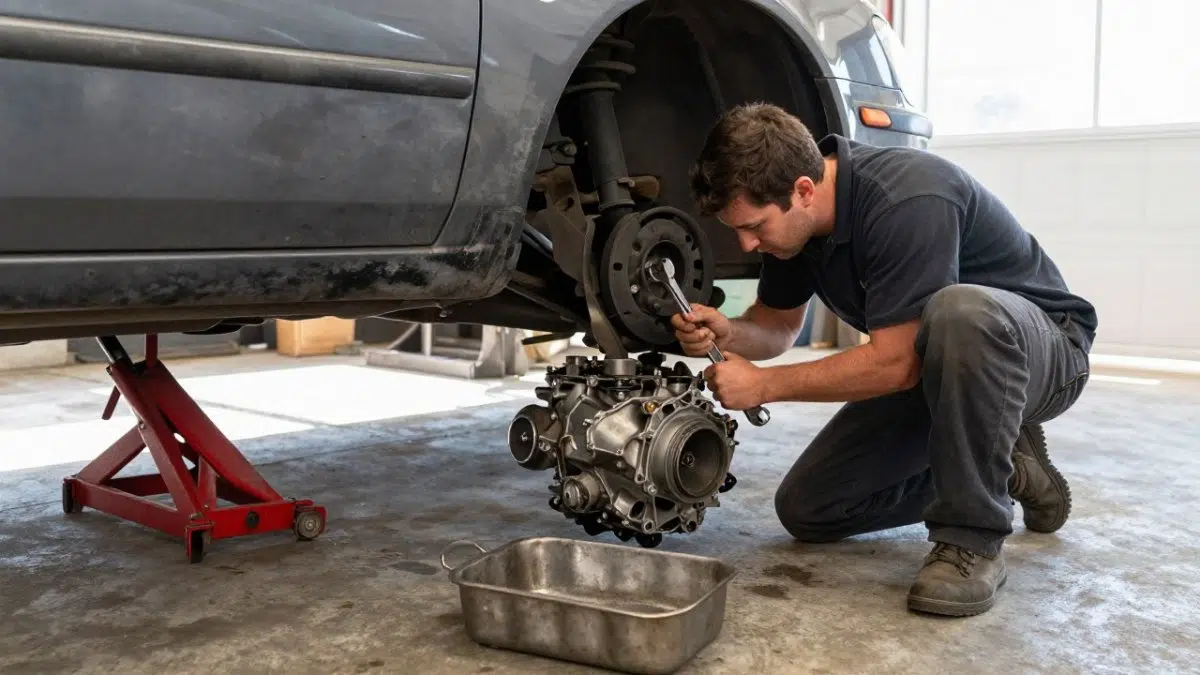
An engine knocking noise is your engine telling you something is off, and the sound it makes usually points to where the trouble starts. A light, metallic ping when you press the gas often comes from fuel and combustion. A quick ticking that fades after a minute is often about oil reaching the top of the engine. A deep, heavy knock that follows engine speed is the one that deserves a prompt look. At Eagle Transmission & Auto Repair in Parker, every job starts with a free diagnostic, including a road test and computer scan, so you learn which of these you are hearing before you spend anything.
Key Takeaways
- Knocking falls into two groups: abnormal combustion (a sharp ping, usually under load) and mechanical noise (a tick, tap or deep thud from moving parts).
- When the sound happens, cold start, idle, acceleration or turning, is the quickest clue to the cause.
- A deep knock that stays after warm up, changes with engine speed or comes with an oil pressure warning should be looked at right away.
- Checking your oil level and the fuel grade your owner’s manual calls for are sensible first steps before you book.
- We offer a free diagnostic with a road test and computer scan, and repairs only go ahead with your approval.
Table of Contents
- What an engine knock actually is
- Match the sound to the likely cause
- Why an engine knocks when you accelerate
- Ticking, tapping and the cold start question
- The deep knock that needs attention
- What you can check before you call
- How a technician finds the source
- How knocking gets fixed
- Knocking and related symptoms
- Get the knock checked at Eagle Transmission & Auto Repair
- FAQ
- Sources
What an engine knock actually is
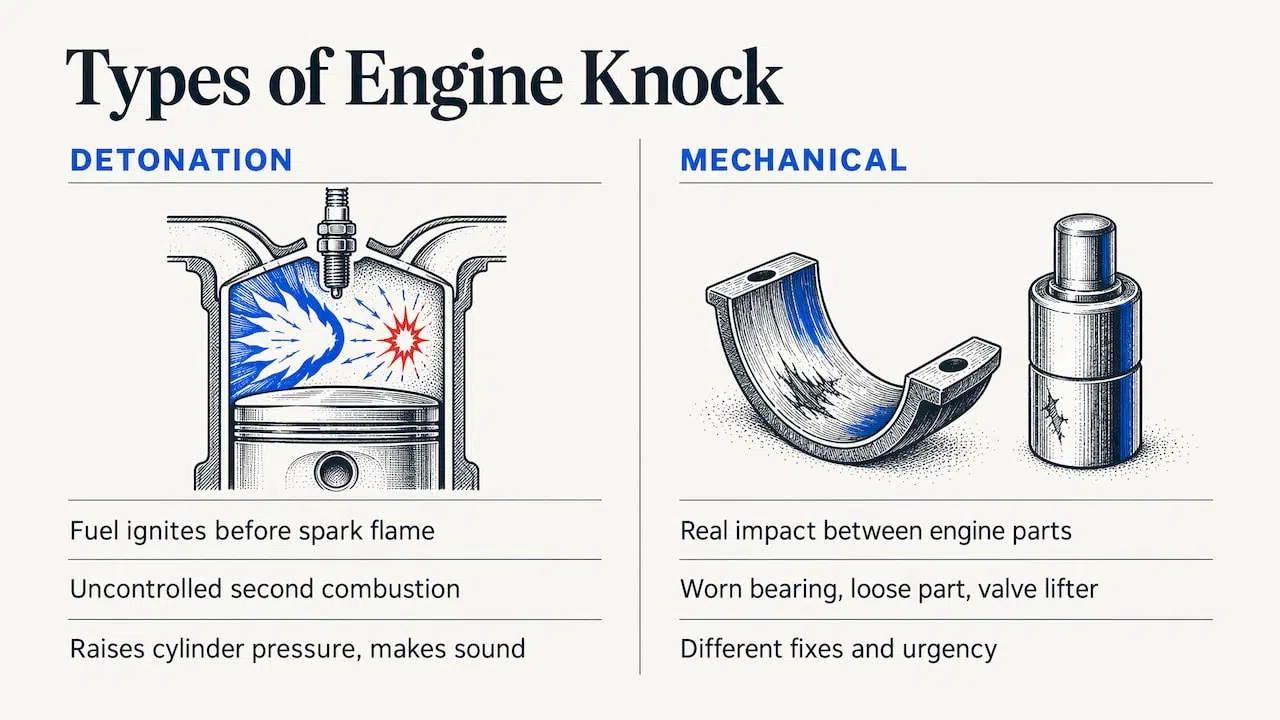
Inside each cylinder, a spark plug lights a mix of fuel and air at a precise moment. That push drives the piston down. Knock, also called detonation, happens when the leftover fuel ignites by itself from rising heat and pressure, before the flame from the spark reaches it. The U.S. Energy Information Administration describes this as an uncontrolled second combustion that raises cylinder pressure and creates the knocking sound.
That is one kind of knock. The other kind has nothing to do with fuel burning: it is a real mechanical impact, such as a worn bearing, a loose part or a noisy valve lifter (a small part that helps open and close an engine valve). Mechanics separate the two because the fixes, and the urgency, are very different.
Match the sound to the likely cause
Try to describe your noise in plain words. You do not need to name the part. Just notice these four things:
- When it happens. Cold start only, at idle, while accelerating, or when turning.
- What it sounds like. A light metallic ping, a fast tick, or a deep, heavy thud.
- Where it seems to come from. The top of the engine, the front, or low near the oil pan.
- How it changes with speed. Louder as the engine revs up, or the same no matter what.
Here is how those clues usually line up:
| What you hear | When | Often points to |
|---|---|---|
| Light metallic ping or rattle | Accelerating or climbing a hill | Fuel grade, spark plugs, carbon buildup, ignition timing |
| Quick tick or tap | First seconds after a cold start | Oil slow to reach the valve lifters at the top of the engine |
| Tick that stays and speeds up with the engine | Any time, warm or cold | Valvetrain or fuel injector noise |
| Deep, rhythmic thud | Idle and louder with engine speed | Worn bearings in the lower engine |
| Rattle or slap | Idle or low speed | Timing chain, loose heat shield, or other parts |
This table is a guide to the conversation with your technician, not a diagnosis. Several causes share similar sounds, which is why listening and testing on the vehicle matters.
Why an engine knocks when you accelerate
Knocking is most common when the engine is working hard at low speed: pulling away from a light in Parker, merging onto E-470 or climbing toward Castle Rock. Under that load, cylinder pressure and temperature are highest, so any weakness in the combustion process shows up.
Fuel with too low an octane rating
Octane is a rating of how well gasoline resists igniting on its own. The U.S. Department of Energy’s FuelEconomy.gov explains that fuel with an octane rating that is too low can damage the engine and emissions system over time, and that older vehicles can make an audible knocking or pinging sound. Many newer vehicles adjust spark timing to reduce knock automatically.
That last point matters. When the engine computer quietly pulls back timing to protect itself, you may not hear much, but you can lose some power and fuel economy. Your owner’s manual lists the fuel grade your engine needs, and that is the first thing to confirm. Our high altitude here in Colorado means the lower octane pumps look different from what drivers see at sea level, so it helps to read the manual rather than guess.
Spark plugs, carbon buildup and sensors
Worn or wrong spark plugs, carbon deposits in the combustion chamber that glow hot and light the fuel early, a lean fuel mixture, and a failing knock sensor can all produce the same ping. The knock sensor is a small microphone like part that tells the computer when knock is happening so it can adjust timing. If it fails, the computer cannot protect the engine the way it was designed to. A Check Engine light often comes along with it, and our check engine light diagnostics read what the computer has stored.
For a longer rundown of causes, see our guide to the causes of engine knocking.
Overheating and timing
An engine that runs hotter than it should, a sticking exhaust gas recirculation (EGR) valve, or ignition timing set too far ahead can all push a healthy engine into knock. Stop and top climbs on a hot afternoon can make these problems easier to hear.
Ticking, tapping and the cold start question
Not every noise is a knock. A short tick when the engine is cold, which fades as oil circulates, is common on many engines. It is the sound of oil still working its way to the top of the engine. A tick that stays for the whole drive, gets faster with the engine, or arrives with a warning light is different and worth having heard by a technician.
If your car is a performance model and you are curious about how a cold engine sounds in general, there is a useful read on reducing cold start noise. The key point for everyday drivers is the pattern: brief and fading is one thing, persistent and changing is another.
The deep knock that needs attention
The sound most mechanics take seriously is a deep, rhythmic thud that comes from low in the engine and gets louder as the engine speeds up. The Wisconsin Department of Agriculture’s motor vehicle care tips say a heavy, rhythmic pounding knock points to worn crankshaft or connecting rod bearings, or a loose transmission torque converter. (The torque converter is the part that links the engine to an automatic transmission.) That second possibility is one reason a shop that handles both engines and transmissions is useful: the noise may not be where you think it is.
AAA’s guide to common car problems also lists fuel with a lower octane than recommended, low engine oil, and loose internal parts such as connecting rods, pistons or bearings as causes of a knocking or pinging sound.
Signs to stop driving and call
If you hear a knock and any of these also happen, pull over when it is safe, shut the engine off and call us for a tow:
- The oil pressure warning light is on.
- The temperature gauge is climbing or the engine is overheating.
- The Check Engine light is flashing.
- The engine suddenly loses power.
- The knock got much louder very quickly, or came with a bang or smoke.
These are simple, practical triggers. Acting on them early is how drivers keep a smaller repair from growing. We offer complimentary local towing with repair, so you are not left figuring out how to get the car to us.
What you can check before you call
A few quick, safe checks help us understand the noise faster:
- Oil level. With the engine off and the car level, pull the dipstick, wipe it, reinsert it and read it. Low oil is a common reason for engine noise, and it tells us a lot.
- Warning lights. Note whether the oil pressure, temperature or Check Engine light is on.
- Fuel. Think about the last fill up and the grade your owner’s manual calls for. If the ping started right after a tank of lower grade fuel, tell us.
- The pattern. Write down when it happens: cold, warm, idle, accelerating, turning. Even a phone recording of the noise helps.
That is as far as a quick check needs to go. Pinpointing the actual source takes tools and training, which is where a proper diagnosis comes in.
How a technician finds the source
A good diagnosis does not guess. Technicians usually work through the same kind of sequence:
- Listen and locate. A mechanic’s stethoscope or electronic listening tool is used to find where the noise is loudest. Noise strongest near the top of the engine points to injectors, camshaft or valvetrain. Noise strongest low near the oil pan or block points to the crankshaft, connecting rods or bearings.
- Road test. Driving the vehicle shows whether the noise follows load, speed or temperature.
- Computer scan. The engine computer can store codes for knock sensor, misfire, lean mixture, fuel delivery or camshaft timing problems.
- Oil pressure check. A mechanical gauge reads actual oil pressure, rather than relying on a dash light alone.
- Further tests when needed. A cylinder test, a compression test or a look at the oil and filter for metal debris can narrow things down.
On our side, every job begins with a free diagnostic that includes a road test and computer scan. Our technicians are ASE certified, and we explain what we find in plain terms, with a clear quote and no surprise charges. Repairs only go ahead once you approve them, and they are backed by warranty.
How knocking gets fixed
The repair follows the cause, which is why the range is so wide:
- Fuel and combustion causes. Using the correct fuel grade, replacing worn spark plugs, cleaning carbon deposits or replacing a failed knock sensor are usually the more modest repairs.
- Oil related causes. An oil and filter service, or repairing a worn oil pump or pickup, can resolve noise tied to low oil or poor oil flow.
- Valvetrain and timing parts. Noisy lifters or a stretched timing chain call for parts replacement at the top of the engine.
- Bottom end wear. Worn rod bearings or damaged pistons mean deeper engine work: repair, rebuild or replacement of the engine, depending on the engine’s condition.
AAA’s guide above gives published cost ranges for the bottom end jobs, and they run far higher than a plug or sensor swap. That gap is the reason to get a knock diagnosed early. We do not quote prices in articles because they depend on your vehicle and the cause, but our guide to engine repair cost in Parker explains what drives the total. When you approve a repair, you will know what it covers first.
Knocking and related symptoms
A knock often travels with other signs. If your engine also shakes at a stop, our page on rough idle diagnosis may fit. If it stumbles or hesitates, read about engine misfires. Both are common alongside combustion trouble, and the same scan helps find them.
Get the knock checked at Eagle Transmission & Auto Repair
We are a full service shop for engines and transmissions. Beyond engine repair, we handle transmission repair, rebuilds and replacement, fluid service, clutch work, differential repair, brakes, A/C, general auto repair, diagnostics and fleet service for local businesses. Because we work on engines and drivetrains under one roof, a heavy knock that could come from either gets looked at by the same team. You can see everything we offer on our services page.
We serve drivers in Parker, Lone Tree, Castle Rock, Castle Pines, Highlands Ranch, Centennial, Aurora, Franktown and Elizabeth. Colorado driving puts real demands on an engine: steep grades, thin air, cold mornings and winter commutes. If you would like us to listen to your engine, you will find us at 10189 Parkglenn Way, Parker, CO 80138, open Monday to Friday, 8am to 6pm, and closed weekends. Ride service is available while we work on your vehicle.
FAQ
What does it mean when my engine sounds like it is knocking?
It means either fuel is igniting at the wrong moment (a light ping, usually under load) or a moving part is making contact it should not (a tick, tap or deep thud). The timing of the sound and where it comes from tell a technician which one it is.
Is it safe to drive with an engine knocking noise?
A light ping on acceleration is often related to fuel grade and can be looked at soon. A deep knock, or any knock with an oil pressure light, overheating, a flashing Check Engine light or sudden power loss, is a reason to stop and call for a tow. When in doubt, call us at (720) 778-1888.
Why does my car knock when I accelerate?
Acceleration puts the engine under load, which raises cylinder heat and pressure. That exposes fuel that is too low in octane, worn spark plugs, carbon buildup or a failing knock sensor. A computer scan and road test usually separate these quickly.
How do you fix a knocking engine?
The fix depends on the cause: the right fuel grade, new spark plugs, a replaced sensor, an oil service, valvetrain parts, or bearing and engine work. We start with a free diagnostic so you know the cause before you approve anything.
Sources
- Gasoline explained: octane in depth, U.S. Energy Information Administration
- Selecting the Right Octane Fuel, FuelEconomy.gov
- Motor Vehicle Care Tips, Wisconsin Department of Agriculture, Trade and Consumer Protection
- 13 Common Car Problems Explained, AAA Automotive
If you would like a second set of ears, give us a call at (720) 778-1888 or stop by to schedule a free diagnostic whenever it suits you. No pressure, just a straight answer about what your engine is saying.