Duramax owners in Centennial can find maintenance and repair guidance for LB7, LLY, LBZ, LMM, LML, and L5P engines. A Duramax diesel specialist serving Centennial can help assess symptoms and service needs, while the right approach depends on the engine and the concern. Clear vehicle information is a useful starting point, whether you are planning routine maintenance or responding to a change in how your truck runs.
If you’re searching for a Duramax diesel specialist in Centennial, start by describing the truck’s symptoms and gathering its engine details. Warning lights, hard starting, or reduced power can have several causes, so a symptom alone cannot identify the repair needed. Clear information helps guide diagnosis and the next steps.
This guide looks at service considerations for different Duramax generations, how Chevrolet and GMC truck details help identify the right engine, and what to consider when discussing estimates and repair terms. It also explains when a symptom calls for diagnosis, so you can move from uncertainty toward a practical next step for your truck.
Key Takeaways
- Identify your Duramax engine code, since service considerations can differ across LB7, LLY, LBZ, LMM, LML, and L5P engines.
- Use the truck’s model year and engine information to narrow down which Duramax generation it has.
- Pay attention to changes in engine performance, warning lights, or unusual sounds, and have the cause diagnosed rather than guessing from one symptom.
- Before arranging service, understand how estimates, warranty terms, towing, and loaner vehicles are handled by the shop you choose.
- For Duramax maintenance or repair in the Centennial area, Eagle Transmission & Auto Repair offers diesel engine repair.
Service for LB7, LLY, LBZ, LMM, LML, and L5P engines
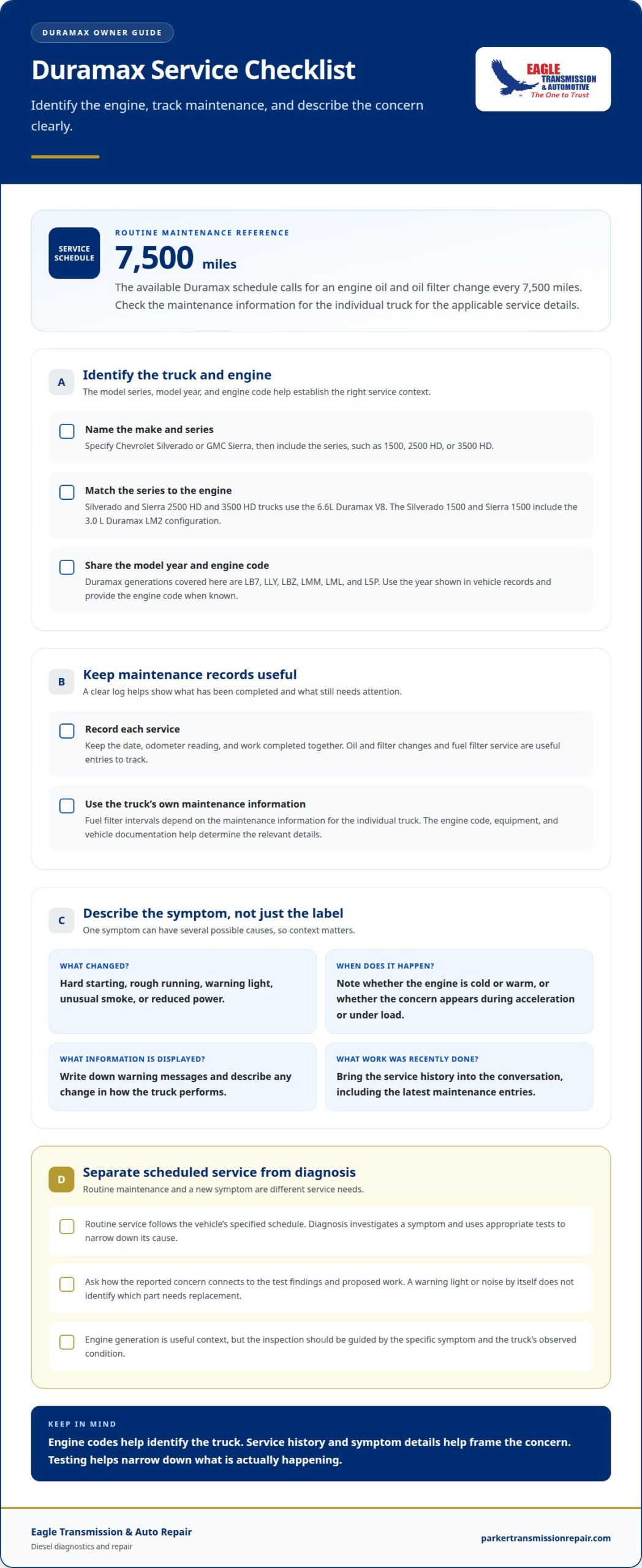
Service planning for an LB7, LLY, LBZ, LMM, LML, or L5P starts with the truck’s actual concern. A maintenance visit and a repair visit have different goals, even when both involve the same 6.6L Duramax. Routine service follows the vehicle’s specified schedule, while diagnosis investigates a symptom. Separating those needs helps keep the conversation focused on what the truck requires today.
For maintenance, the available Duramax schedule calls for engine oil and oil filter changes every 7,500 miles. Fuel filter replacement is part of routine maintenance, with intervals depending on the maintenance information for the individual truck. These are useful schedule points, not a substitute for the maintenance information that applies to an individual truck. The engine code, equipment, and vehicle documentation help determine the appropriate service details.
Keep a service record with the date, odometer reading, and work completed. For example, recording an oil and filter change helps you track maintenance. Fuel filter records can also show whether that service has been completed. A consistent log is useful if the truck changes owners or is used for a mix of personal driving, work, and towing.
For a new symptom, note when it happens and under what conditions. Hard starting, rough running, a warning light, unusual smoke, or reduced power can each have multiple causes. Record whether the engine is cold or warm and whether the issue appears during acceleration or under load. These details give diagnosis a clearer starting point.
The engine generation is useful context, but the reported symptom should guide the inspection. For example, an LML warning light needs to be considered alongside changes in how the truck runs. Diagnostic information and appropriate tests help a technician narrow the cause before recommending repair or replacement. Replacing a part based only on a warning light or noise can miss the underlying problem.
- LB7 and LLY: provide the engine code, current concern, and recent maintenance details.
- LBZ and LMM: note whether a symptom changes during starting, idle, acceleration, or towing.
- LML and L5P: record warning messages and describe any change in performance.
- Every generation: keep service dates and odometer readings together for easier maintenance tracking.
These examples are starting points, not a list of failures specific to each generation. The same complaint can involve different systems, so diagnosis should connect test findings with the driver’s description. Reduced power during acceleration, for example, needs more context than “the engine feels weak.” Load, conditions, warning messages, and recent service history can all help narrow the investigation.
A Duramax maintenance plan should distinguish scheduled work from repairs prompted by symptoms. If an LBZ is due for routine service, its records can show which items have been completed. If the truck also develops rough running, that new symptom needs its own diagnostic attention. Keeping the two needs separate prevents a routine service entry from being mistaken for an explanation of a new problem.
When discussing a repair, ask for the connection between the reported symptom, the test findings, and the proposed work. For an L5P with a starting concern, that means understanding what the diagnosis indicates before deciding on replacement parts. Clear reasoning makes it easier to compare the recommended repair with the truck’s service history and intended use. The goal is a repair plan grounded in the specific engine and observed condition.
Which Duramax engine models and Chevrolet or GMC truck years do local specialists service?
Duramax service coverage depends on matching the truck’s model year, series, and engine, rather than relying on its Chevrolet or GMC badge alone. Silverado and Sierra pickups have used different Duramax configurations, so naming the truck accurately helps establish which engine information applies. A specialist can use those details to determine whether the question concerns a 6.6L HD engine or a light duty 1500 configuration.
For heavy duty applications, the Chevrolet Silverado 2500 and 3500 HD use the 6.6L Duramax V8. GMC Sierra HD models also belong to the Duramax truck family, but the exact engine generation still needs identification. The truck’s series and model year narrow the possibilities, while its engine code identifies the specific version under discussion.
Light duty trucks need a separate distinction. The 3.0 L Duramax LM2 is found in the Chevrolet Silverado 1500 and GMC Sierra 1500. That means “1500 Duramax” does not automatically refer to the same engine as a 2500 HD or 3500 HD. The model series and engine code work together to identify the right service context.
Duramax generations covered in this guide include LB7, LLY, LBZ, LMM, LML, and L5P. Each code points to a particular engine generation, while the year range helps narrow which code may apply. When discussing a truck, pair the model year with the code whenever available. This avoids treating every 6.6L Duramax as interchangeable.
Before discussing service, gather a few details about the truck:
- Make and series: identify Chevrolet Silverado or GMC Sierra, then specify 1500, 2500 HD, or 3500 HD.
- Model year: use the year shown in the registration or vehicle records.
- Engine code: provide LM2 or the applicable 6.6L generation code when known.
- Concern: describe the symptom and the conditions when it appears.
- Use: mention whether the pickup is used for work, towing, or mostly unloaded driving.
These details help prevent a common identification error: assuming engine displacement alone settles the question. A Silverado 1500 with the LM2 and a Sierra HD with a 6.6L Duramax have different configurations. Even trucks within the HD group can have different generations. An exact model year and engine code therefore provide more useful information than a general description such as “Chevy diesel.”
Engine identification also helps distinguish engine concerns from issues elsewhere in the truck. A complaint about engine power raises different diagnostic questions than delayed shifting or a gear-change concern, which involves the transmission. Note when the issue occurs, such as during starting, acceleration, towing, or a shift.
If you’re unsure of the engine code, provide the full model and year rather than guessing. Vehicle records and identification information can help establish the truck’s configuration before service is discussed. A specialist can then assess the concern using details for the correct engine family, rather than assuming it matches another Silverado or Sierra version.
Centennial owners comparing service options can use the same identification details when describing their truck. Ask whether the discussion applies to the vehicle’s specific engine code, not simply to Duramax trucks generally. That keeps the conversation grounded in the pickup’s actual configuration and helps ensure the proposed diagnostic direction matches its model series and engine.
That identification can also frame expectations about capability without turning a torque figure into a diagnosis. The Duramax engine was first released in late 2001, and more than 1.5 million Duramax engines have been produced in the United States. The Chevrolet Silverado 1500 Duramax Turbo-Diesel is listed with up to 495 lb-ft of torque, while the Chevrolet Silverado 2500 and 3500 HD Duramax is listed with 975 lb-ft of torque. Those figures apply to their named configurations; they do not identify an individual truck’s engine code or explain a symptom.
The L5P Duramax engine is rated at 445 hp at 2800 rpm and produces 910 lb-ft of torque at 1600 rpm. For owners exploring electronic performance adjustments beyond factory parameters, stagex-performance.com provides custom-developed engine and TCU tuning files. A specialist can use the code and model year to place those specifications in context, then assess the concern against the truck’s actual configuration and use. Keeping the engine identity, series, and symptom together makes a service discussion more precise than relying on a broad label alone.
Do local Duramax diesel shops provide warranties, estimates, towing, or loaner vehicles?
Warranty coverage, estimates, towing, and loaner vehicles are separate service details, not automatic parts of Duramax repair. For a Chevrolet Silverado with an LBZ engine, start by understanding what the proposed repair includes. A clear estimate describes the diagnosed concern, recommended work, and parts involved before repairs proceed. Warranty terms, transportation arrangements, and repair approval should be treated as distinct topics.
An estimate should connect the recommended repair to the diagnosis. A check engine light on a GMC Sierra, for example, does not identify a failed part on its own. The estimate should explain which inspection findings support the recommendation and whether further diagnosis could change the scope. This gives you a clear basis for deciding whether to approve the proposed repair.
Look for specific descriptions rather than a broad phrase such as “engine work.” A useful estimate can distinguish diagnostic work, parts, labor, and related repairs. For a Duramax fuel system concern, it should identify the affected area and explain what the proposed replacement addresses. If new findings change the plan, the revised scope should be explained before additional work proceeds.
A warranty is defined by its written terms, not by a general assumption that every future issue is covered. The terms specify which repair or parts are covered, how related concerns are handled, and what exclusions apply. A warranty for a specific repair, for example, should not be assumed to cover every engine or emissions concern on an LML truck.
Keep the estimate and final invoice with any warranty document. Record the repair date, odometer reading, parts listed, and work performed. If a similar symptom returns, these records can help distinguish a concern related to the earlier repair from a separate issue. Reduced power on a Silverado, for example, may need a fresh diagnosis even if earlier work addressed another system.
Towing is a separate logistical question from engine diagnosis. A truck with a no start condition, a severe warning, or a concern affecting safe operation may not be suitable to drive. Whether towing is available depends on the arrangement being discussed, so do not assume it comes with a repair estimate. Planning transportation early can prevent confusion if a Sierra cannot be driven to service.
Loaner vehicles are also separate from the repair itself. A loaner may have its own availability, eligibility, and use conditions, and should not be assumed as part of diesel service. If you rely on a Chevrolet Silverado for work, plan for another way to travel while the vehicle is being assessed or repaired. The repair estimate and transportation plan address different needs.
Before approving work on an LB7, LLY, LBZ, LMM, LML, or L5P truck, organize the discussion around four items:
- Diagnosis: identify the symptom and findings supporting the recommended repair.
- Estimate: understand the parts, labor, and scope before authorizing work.
- Warranty: read the written coverage and exclusions for the specific repair.
- Transportation: plan separately for towing or a loaner if the truck cannot be driven.
Those steps make repair decisions clearer without assuming that one shop’s terms apply to another. If a Duramax Silverado or Sierra has a no start concern or a warning light, arrange a diagnosis and discuss the written repair scope before authorizing work. Clear records and a separate transportation plan help you manage the decision from inspection through pickup.
Before booking, separate vehicle capability from shop commitments. A truck’s stated towing capability does not establish that a local shop offers towing. Ask whether pickup is available and whether any transportation charge is separate from the estimate. Request loaner-vehicle terms directly, too, including availability and any conditions, rather than assuming a replacement vehicle is part of the repair.
Vehicle specifications and maintenance details can help frame questions, but they do not replace a diagnosis or written warranty terms. The Chevrolet Silverado 1500 Duramax Turbo-Diesel is listed with an EPA-estimated highway fuel economy of 29 MPG on select trims, and the Chevrolet Tahoe Duramax Turbo-Diesel is listed with an estimated highway range of over 600 miles per tank. The page recommends changing diesel transmission fluid every 30,000 to 60,000 miles, with vehicle-specific factors and manufacturer recommendations also considered. The Duramax injector warranty was extended to 200,000 miles after widespread failures. A forum owner reported that his 2011 LML used about one gallon of DEF every 800 miles when towing heavy. Ask whether a warranty applies to the specific repair and request its written limits.
Eagle Transmission & Auto Repair: Diesel Engine Repair
Eagle Transmission & Auto Repair provides diesel engine repair for GM Duramax trucks, including diagnosis when a warning light, hard starting, or reduced power needs attention. If the concern also involves engine performance, engine repair can address related mechanical issues. A symptom alone cannot identify the failed component, so diagnosis helps determine which repair applies.
For Centennial drivers, sharing the truck’s model, engine code, symptoms, and service history can help frame the concern. If shifting symptoms accompany an engine issue, transmission repair or transmission service may also be relevant, since those concerns involve a separate system.
For help with a Duramax concern, contact Eagle Transmission & Auto Repair to discuss a diagnostic or repair appointment.
Take the Next Step With a Clear Repair Plan
Turn the concern into a specific diagnostic question: note what the truck does, when the symptom appears, and whether it changes during starting, acceleration, or towing. These details help focus the conversation about your Duramax and support a repair decision based on diagnostic findings.
For Centennial drivers, Eagle Transmission & Auto Repair provides engine repair, transmission repair, and transmission service, with diagnostics always free. A Duramax diesel specialist in Centennial can help clarify whether the concern involves the engine or another system and explain the service options that fit the diagnosis. Bring your questions about the recommended work and written terms to the conversation.
If you’re ready to talk through a Duramax concern, connect with Eagle Transmission & Auto Repair in Parker and take the next step toward a clearer plan.
Frequently Asked Questions
Which auto repair shops in or near Centennial, Colorado specialize in Duramax diesel trucks?
Eagle Transmission & Auto Repair in Parker provides diesel diagnostics and repair for GM Duramax trucks, and diagnostics are always free. If you’re in Centennial, describe the truck’s symptoms and share its make, model, and engine information. Mention whether a Silverado has a warning light, rough running, or a starting concern. That context helps focus diagnosis on the relevant system.
What Duramax diesel repair and maintenance services do Centennial area specialists offer?
Services can include diesel diagnostics and repair, engine repair, and maintenance related to the specific concern. For example, if a GMC Sierra develops a warning light alongside reduced power, diagnosis can help distinguish an engine concern from another system issue. Eagle Transmission & Auto Repair provides diesel diagnostics and repair for GM Duramax engines, as well as engine repair. Describe any changes in starting, performance, or warning lights when arranging service.