Last Updated: November 26, 2026
Quick Summary
To troubleshoot an A/C pressure switch, unplug the connector, test continuity across the switch terminals with a multimeter, and check for reference voltage at the harness with the key on. A switch that stays open with a known-good charge is suspect, but confirm the system actually has refrigerant first.
- A bad A/C pressure switch often shows as a compressor clutch that never engages despite a normal charge.
- Test the circuit and connector voltage before replacing the switch, since upstream faults mimic a bad switch.
- A 3-wire switch has two circuits inside one housing, so test each pair of terminals separately.
- Never jump the high-pressure switch and drive with it installed, because it defeats compressor protection.
- Cold air that quits in stop-and-go traffic usually points to high pressure, so check the condenser fan first.
Table of Contents
- What Does a Car A/C Pressure Switch Do?
- How Do I Know If My Car A/C Pressure Switch Is Bad?
- Where Is the A/C Pressure Switch Location on Your Vehicle?
- How to Test A/C Pressure Switch with Multimeter
- The 3-Wire A/C Pressure Switch Test Explained
- A/C High-Pressure Switch Symptoms You Should Not Ignore
- Frequently Asked Questions
What Does a Car A/C Pressure Switch Do?
At Eagle Transmission & Auto Repair in Parker, this part is often blamed for “my A/C quit” complaints.
Here is how the switch fits into the system:
- It reads pressure on the low side, the high side, or both, depending on the design
- It opens or closes an electrical circuit based on that reading
- The control unit or clutch relay uses that signal to allow compressor activation
Think of it as a gatekeeper. It stops the compressor from running dry or from building pressure it cannot handle.
Colorado’s temperature swings and high elevation can change how an A/C system behaves, and a weak charge can show up quickly on a hot afternoon.
How Do I Know If My Car A/C Pressure Switch Is Bad?
The clearest sign of a bad A/C pressure switch is a compressor clutch that never engages while the system still has a normal refrigerant charge.
Common symptoms of a faulty A/C pressure switch include:
- Air blows warm at every setting
- The compressor clutch stays off no matter what
- The clutch clicks on and off every few seconds
A common mistake is replacing the switch first. Test the circuit before you buy parts.
If your vents are blowing warm and you want the full picture before chasing one sensor, our guide to vehicle A/C repair walks through the whole system.
Where Is the A/C Pressure Switch Location on Your Vehicle?
You will usually find the A/C pressure switch threaded into a metal line or the receiver-drier under the hood. It sits on the line itself, not on the compressor body.
Look in these spots:
- On the low-side line between the firewall and the compressor
- On the high-side line near the condenser
- Screwed into the receiver-drier canister
Follow the A/C hoses from the compressor. The switch is a small sensor with a two- or three-wire connector on top.
Low-Side vs. High-Side Switch Placement
Low-pressure switches sit on the suction side and protect against low refrigerant. High-pressure switches sit on the discharge side and protect against overpressure. Some vehicles use a combined trinary switch that handles both jobs plus a fan signal.
Which side you are looking at matters. A low-side switch will not read anything useful while the compressor is off, so test conditions change with location.
How to Test A/C Pressure Switch with Multimeter
Testing an A/C pressure switch with a multimeter means checking continuity across the switch terminals and checking for voltage at the connector.
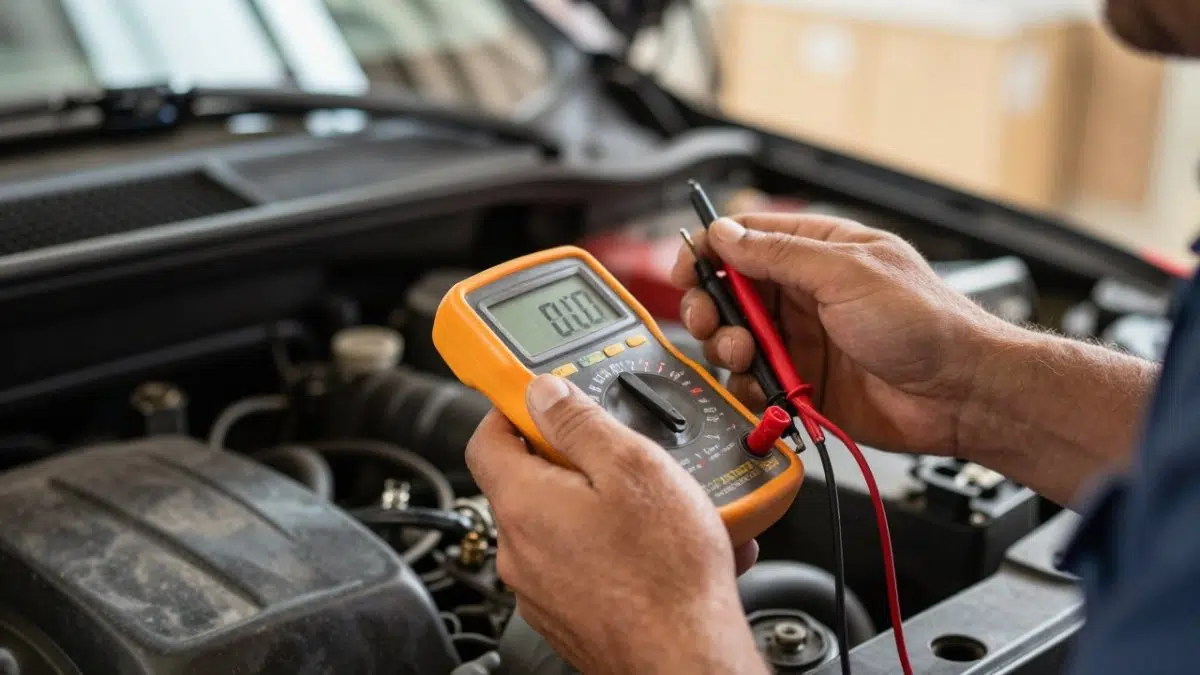
Total time: about 20 minutes
Difficulty: beginner with basic tools
What you need:
- Digital multimeter
- Back probe pins or a thin paper clip
- Safety glasses
Step by step:
- Locate the switch and unplug the connector. Look for corrosion, pushed-back pins, or a cracked housing before you test anything electrical.
- Set the multimeter to ohms and test across the switch terminals. A switch that is closed at normal pressure should read near zero ohms; an open switch reads OL or infinite.
- Compare the reading to what the switch should show at current pressure. This is the step most people skip. A low-pressure switch is normally closed above its cutoff point and opens when pressure drops too low. A high-pressure switch is normally closed below its limit and opens when pressure climbs too high. Without knowing which type you have and what pressure the system is actually at, a continuity reading tells you almost nothing.
- Key on, engine off: check for reference voltage at the harness side. Most systems send 5 volts or battery voltage to the switch, depending on design. No voltage at the connector means the fault is upstream, a fuse, relay, or control module, not the switch.
- Wiggle the harness while watching the meter. A reading that flickers as you move the wires points to a chafed wire or loose pin, which is common on older vehicles after years of heat cycling.
Expected result: a switch that changes state correctly as pressure changes, and steady voltage at the connector.
Reading the Results Without Guessing
A switch that stays open with a known-good charge is suspect.
Ambient temperature matters. On a cool Parker morning, static pressure on a properly charged system reads lower than it will at 90 degrees in July.
If your meter readings are inconclusive and you want a professional scan, OBD2 scanner diagnosis in Castle Rock explains what a diagnostic scan can and cannot tell you.
Watch out: never probe a connector by forcing thick meter leads into the terminals, you can spread the pins and create a new fault.
Here is the test sequence at a glance, from unplugging the connector to wiggling the harness.
| Step | What to do | What to look for |
|---|---|---|
| 1 | Unplug connector and inspect | Corrosion, pushed-back pins, cracked housing |
| 2 | Test across switch terminals on ohms | Near zero ohms closed, OL open |
| 3 | Compare reading to expected state at current pressure | Switch type and actual system pressure |
| 4 | Key on, engine off, check harness voltage | 5 volts or battery voltage; none means upstream fault |
| 5 | Wiggle the harness while watching the meter | Flickering points to chafed wire or loose pin |
The 3-Wire A/C Pressure Switch Test Explained
A 3-wire A/C pressure switch test checks two separate circuits inside one housing. The third wire usually carries a signal to the control unit, so you test each pair of terminals on its own.
Here is the simple version:
- Wire 1 and 2: the low-pressure or cycling circuit
- Wire 2 and 3: the high-pressure or fan circuit
- Wire 3 to ground: the signal the control unit reads
Test each pair with the meter set to ohms. Then check voltage on the signal wire with the key on.
Watch out: do not jump the terminals to “make the compressor run.” Bypassing the switch removes the protection that keeps a compressor from destroying itself.
A/C High-Pressure Switch Symptoms You Should Not Ignore
A failing high-pressure switch often shows up as a compressor that cuts out in traffic or on a hot day. The system builds pressure, the switch opens, and the cold air stops until things cool down.
Signs to take seriously:
- Cold air that quits in stop-and-go traffic
- The cooling fan running constantly
- A compressor that shuts off and stays off
Those last two can point to a refrigerant leak rather than the switch. Low refrigerant is the most common cause of a no-cool condition, and it mimics a bad switch closely.
Why High Pressure Builds in the First Place
The high-pressure switch is a safety device, not a performance part. It opens when discharge pressure climbs past its threshold to protect the compressor, hoses, and seals from overpressure. When it trips, the question is not only “is the switch bad?” but “why did pressure get that high?” Common causes include an overcharged system, a condenser that cannot shed heat because of a failed cooling fan or a blocked airflow path, and restricted refrigerant flow.
Telling a Switch Fault from an Overcharge or Fan Problem
- If cold air returns after the car sits and cools, the system is likely tripping on high pressure, check the condenser fan first.
- If the fan never runs when the A/C is on, the fan circuit is a prime suspect before the switch.
- If the compressor cuts out at idle but runs at highway speed, airflow across the condenser is the usual culprit.
Mountain grades and summer heat can both push discharge pressure up, and a marginal fan or a slightly overcharged system may show up first on those drives. Drivers who commute through stop-and-go traffic place a similar load on the system.
The Safe Limits of Jumping the Switch
Jumping the high-pressure switch to force the compressor on is a diagnostic shortcut, not a repair. It defeats the protection that keeps a compressor from destroying itself, and pressure can climb fast enough to damage hoses or seals.
If you have confirmed a bad switch or ignored the symptoms long enough, contact our Parker auto repair shop to schedule an inspection.
Frequently Asked Questions
Can I bypass my A/C pressure switch to get cold air back?
Bypassing the switch by jumping its connector tells the compressor to run no matter what the refrigerant pressure is. That can destroy a compressor running with too little oil or refrigerant, or overpressure a system with a blocked condenser. It is a diagnostic shortcut at best, never a repair, and it can turn a small fix into a major one. If you suspect the switch, test it with a multimeter instead and replace it if it fails.
Will a bad pressure switch stop the compressor from engaging?
Yes. The switch is wired into the compressor clutch circuit, so when it reads pressure outside its safe range it opens the circuit and the clutch never engages. A failed switch, a broken connector, or low refrigerant can all produce the same no-cool result. Check for battery voltage at the clutch connector and test switch continuity before assuming the compressor itself has failed.
How do I test a 3-wire A/C pressure switch?
A 3-wire switch usually has a ground, a signal return to the control module, and a reference voltage. With the key on and the connector plugged in, back-probe the signal wire and compare its voltage to the chart for your vehicle as pressure changes. With the connector unplugged, check resistance between the terminals. A signal that stays fixed while pressure rises or falls points to a failed switch or an open circuit.
What else can cause the A/C compressor not to turn on?
Low refrigerant from a leak, a blown fuse, a bad relay, a failed clutch coil, a faulty ambient temperature sensor, or a control module that has set a fault code can all keep the clutch from engaging. Colorado’s temperature swings and stop-and-go commuting put extra load on the system, so a pressure check with manifold gauges and a scan for codes should come before any parts are replaced.