The cost to replace a steering rack depends on your exact vehicle more than on any national average. The part, the hours it takes to reach it, the fluid, and the alignment afterward all change from one car to the next. The honest way to get a real number is to have someone look at your vehicle first. At Eagle Transmission & Auto Repair in Parker, every job starts with a free diagnostic that includes a road test and a computer scan, and nothing gets repaired without your approval. This guide explains what goes into a steering rack quote so you can read an estimate with confidence.
Key Takeaways
- Your quote is built from four pieces: the rack itself, the labor to reach it, fluids and small parts, and a wheel alignment afterward.
- Where the rack sits in your vehicle often matters more than what the part costs. Some racks are easy to reach, and others need the front subframe lowered.
- Hydraulic racks and electric power steering racks are different parts, and the type changes the price and the labor.
- A good estimate lists every item, so you can compare two quotes on equal terms.
- A proper diagnosis comes first. Sometimes the problem is a tie rod or a hose, not the rack.
Table of Contents
- What the steering rack actually does
- What goes into the cost
- Why access to the rack changes the price
- Hydraulic or electric: why your steering type matters
- The alignment is part of the job
- Repair or replace?
- What a complete estimate should list
- Signs your steering rack needs a look
- Can you keep driving with a bad rack?
- Driving in Parker and along the Front Range
- How to get a clear number for your vehicle
- Get your steering looked at in Parker
- FAQ
- Sources
What the steering rack actually does
When you turn the wheel, the steering rack (often called the rack and pinion) is the part that turns that motion into the sideways push that points your front tires. A small gear, the pinion, meshes with a toothed bar, the rack. Power steering, either hydraulic fluid pressure or an electric motor, makes that effort light enough to turn with one hand.
Because the rack is part of how you control the vehicle, it is worth getting a clear answer when something feels off. That does not mean panic. It means a calm, early look so the repair can be planned rather than rushed.
What goes into the cost
Every steering rack estimate is a stack of line items. Here is what each one covers, in plain terms.
The rack itself
Racks come in a few forms: brand new from the vehicle maker, new from an aftermarket maker, or remanufactured, which means a used rack that has been taken apart, cleaned, and rebuilt with new seals and worn parts replaced. Prices across these choices can differ a lot. Luxury and performance vehicles tend to carry pricier racks than common sedans, and published guides list an expensive factory rack among the main reasons a quote climbs.
Labor
Labor is the hours a technician spends removing the old rack and fitting the new one, multiplied by the shop’s hourly rate. Rates vary by shop and by area, and the hours vary by vehicle. A rack that is easy to reach takes less time. One that is tucked between the engine, transmission, and exhaust takes more.
Fluid and bleeding
A hydraulic system needs fresh power steering fluid, and the air has to be bled out of the lines so the steering feels smooth. This is a small part of the bill, but it should be on the estimate.
Tie rods and small parts
Tie rods are the short arms that connect the rack to each front wheel. If the ends are worn, a shop may recommend replacing them while the area is open. Some quotes include them and some do not, which is one reason two estimates for the same vehicle can look so different.
Alignment
A wheel alignment sets the angles of your wheels so the vehicle tracks straight and the tires wear evenly. It is part of the job, not an extra, and we cover why below.
Why access to the rack changes the price
On some vehicles, the rack is mounted where a technician can reach it with the front wheels off and a few bolts removed. On others, it sits in a tight spot, and the shop has to support the engine and lower the front subframe, which is the steel cradle that holds the engine and suspension. That takes more hours, and it can involve stuck hardware that has to be worked free.
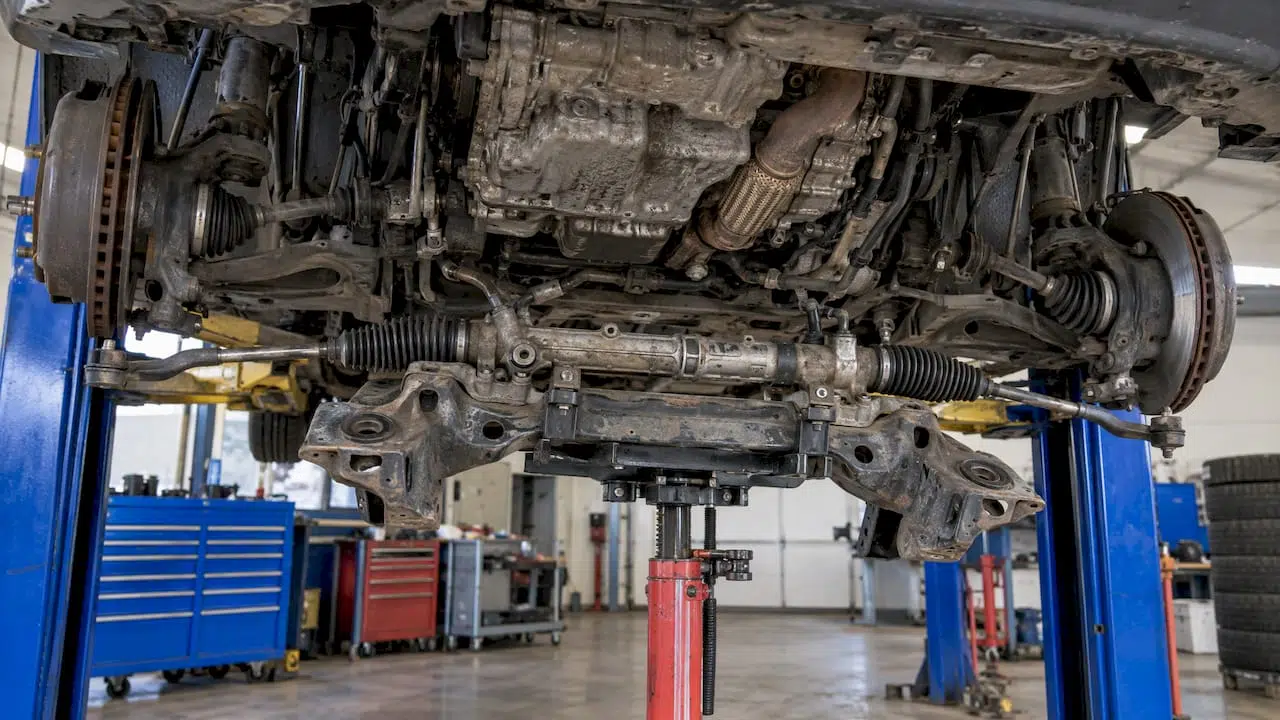
This is why a guide that explains how rack location affects the bill says a modest part can still produce a larger total than a more expensive part on an easy car. Front wheel drive vehicles often have a more accessible rack than all wheel drive or rear wheel drive ones, though it varies by model.
Subframe work can also touch other systems. Some vehicles have sensors near the front structure, and a dash light can show up afterward if something is disturbed. A good shop scans the vehicle before and after the work. There is a useful walkthrough on an airbag light after subframe work if you want to understand how that connects.
Hydraulic or electric: why your steering type matters
Older vehicles and many trucks use hydraulic power steering. A pump pushes fluid through the rack to help you turn. Many newer vehicles use electric power steering, where a motor does the assisting and there is no pump or fluid.
For your quote, this matters in two ways. First, electric racks often include sensors and a motor, so the part can cost more and may need calibration after installation. Second, hydraulic racks leak in a particular way, which brings us to symptoms.

The alignment is part of the job
When a rack comes out and a new one goes in, the front wheel angles change. That is why an alignment afterward is standard. One guide notes that skipping it can wear out a new set of tires quickly, and that worn outer tie rod ends can add to the parts list.
If you get two quotes and one has no alignment line, ask about it. The quote may look lower only because a needed step is left off.
Repair or replace?
Not every steering complaint means a new rack. A torn boot, a leaking hose, or a worn tie rod can feel similar to a failing rack, and those fixes cost less. Detroit Axle’s team points out that a proper inspection of tie rods, hoses, and fittings first can show whether the problem really is inside the rack.
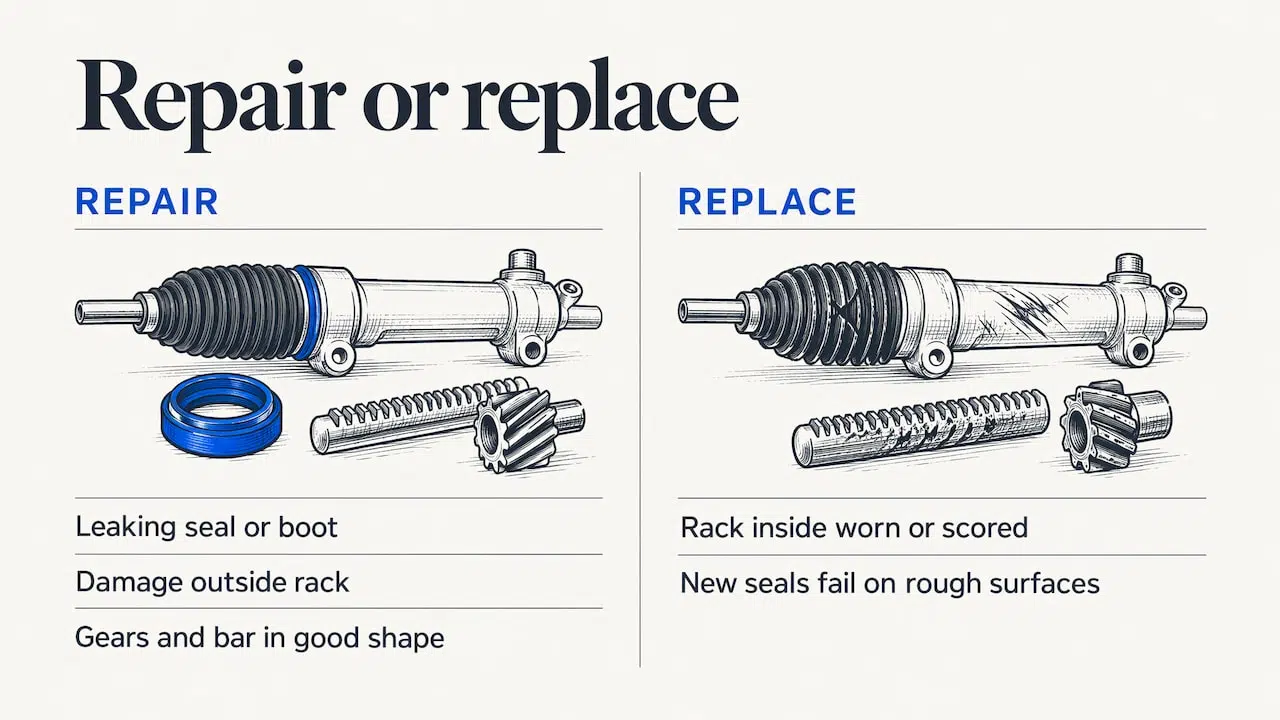
As a rule of thumb, repairing a leaking seal or boot makes sense when the damage is outside the rack and the internal gears and bar are in good shape. Replacement is the better answer when the inside of the rack is worn or scored, since new seals will not hold for long on a rough surface.
There is also the bigger picture. If your vehicle is older and has other repairs coming, it helps to weigh the whole picture. Our article on whether it is worth fixing a 10 year old car walks through how to think about it.
What a complete estimate should list
When you are handed a quote, look for each of these lines. If one is missing, ask whether it is included.
- The steering rack assembly, and whether it is new, aftermarket, or remanufactured.
- Labor to remove and install it.
- Power steering fluid and bleeding the system.
- Inner and outer tie rods, either included or listed separately.
- A four wheel or front wheel alignment.
- Shop supplies, disposal fees, and tax.
- Any programming or calibration for electric steering.
- The warranty on parts and labor.
That last item is worth a question. At Eagle, repairs are backed by warranty and explained with transparent quoting and no surprise charges.
Signs your steering rack needs a look
A steering rack usually gives hints before it fails. These are the common ones:
- Fluid under the front of the vehicle. Power steering fluid often looks red or amber.
- Steering that feels loose or wanders. You find yourself making small corrections to hold a straight line.
- Stiffness, especially on cold mornings or at low speed. This can show up as the fluid pressure drops.
- Clunking or knocking over bumps when you turn.
- Uneven wear on the front tires.
- Fluid that keeps disappearing with no puddle. On some hydraulic racks, fluid can collect inside the rubber boots at the ends of the rack, so you lose fluid without ever seeing a spot on the driveway.
These signs can also point to something simpler, like a tie rod or a hose. That is exactly why a proper diagnosis comes first.
Can you keep driving with a bad rack?
If your steering feels loose, heavy, or is leaking noticeably, treat it as a reason to have it checked soon. Steering is a safety system, and a rack that is leaking badly or has play in it should not be put off. Drive gently, avoid highway speeds if you can, and get the vehicle looked at. If the steering suddenly becomes very heavy or the wheel feels disconnected, pull over safely and call for a tow. Eagle offers emergency towing, and local towing is complimentary with a repair.
A lot of drivers wonder how long a rack should last. Racks are generally durable, and many go past 100,000 miles before leaks or wear show up. Hard use, rough roads, and old fluid can shorten that.
Driving in Parker and along the Front Range
Colorado roads are tough on steering and suspension. Freeze and thaw cycles break up pavement and leave potholes along Parker Road, Hilltop, and the county roads out toward Franktown and Elizabeth. Gravel roads, washboard surfaces, and winter ice melt add stress to the front end. Cold mornings thicken power steering fluid, so a rack that is starting to wear can feel stiff until the fluid warms up.
If you commute from Lone Tree, Castle Rock, Castle Pines, Highlands Ranch, Centennial, or Aurora, steady stop and go driving and curb bumps add up too. None of this means your rack will fail. It is simply a good reason to mention any steering change early, before a small leak becomes a larger repair.
How to get a clear number for your vehicle
Published averages can swing widely because they mix hydraulic and electric racks, easy and hard to reach vehicles, and shops with very different hourly rates. A national figure cannot tell you what your truck or SUV will need. Here is a simple routine that gets you to a real answer:
- Note what you feel. When does it happen: cold start, low speed, over bumps, turning one direction? Details help the technician.
- Get a diagnosis before a quote. The inspection should check tie rods, hoses, boots, and fittings, not just the rack.
- Ask for an itemized estimate. Use the list above.
- Ask about the part type and the warranty. Know whether you are getting new or remanufactured, and what is covered.
- Approve the work only when it makes sense to you. A good shop explains the findings and waits for your yes.
Get your steering looked at in Parker
At Eagle Transmission & Auto Repair, we start every job with a free diagnostic: a road test and a computer scan, before you spend anything. Our ASE certified technicians explain what they find, you approve any work, and repairs carry a warranty. We handle brakes, shocks and struts, engine and check engine light diagnostics, A/C, and general auto repair alongside our transmission, clutch, differential, and fluid service, and we also do fleet service for local businesses. Complimentary local towing with repair and ride service make it easier to get your day back.
You can see everything we do on our services page.
We serve Parker, Lone Tree, Castle Rock, Castle Pines, Highlands Ranch, Centennial, Aurora, Franktown, and Elizabeth. Our shop is at 10189 Parkglenn Way, Parker, CO 80138, open Monday to Friday, 8am to 6pm, and closed weekends. If your steering feels different and you would like a straight answer, call us at (720) 778-1888 or stop by when it suits you. There is no pressure, and we are happy to talk it through.
FAQ
Why do steering rack quotes vary so much?
The rack type, how hard it is to reach, the shop’s labor rate, and what the quote includes all change the total. One estimate may include the alignment and fluid while another leaves them out. Compare line by line rather than by the bottom number alone.
Do I need an alignment after a steering rack replacement?
Yes. A new rack changes the front wheel angles, so an alignment sets them back to spec. Without it, the vehicle may pull or wander, and the front tires can wear unevenly and quickly.
Can a steering rack be repaired instead of replaced?
Sometimes. If the leak is from an outer boot, a hose, or a tie rod, those parts can often be fixed without replacing the rack. If the inside of the rack is worn, replacement is usually the more lasting answer. A diagnosis tells you which case you have.
How long does a steering rack last?
Many racks run well past 100,000 miles. Rough roads, old or low fluid, and leaks can shorten that. Mention any new stiffness, looseness, or fluid loss as soon as you notice it.
Sources
- Rack and Pinion Replacement Cost guide, SuspensionHQ
- Rack and Pinion Replacement Cost, Super Car Digest
- Is It Worth Replacing a Rack and Pinion, Detroit Axle
- How To Diagnose Rack and Pinion Steering, AA1Car
- Diagnose an Airbag Light After Subframe Work