Could the cause of a shaking car be simpler than you think? If you’re wondering what causes a car to vibrate, the answer depends on when it happens. Shaking while parked, accelerating, driving at highway speed, or braking can point to different systems, including the engine, wheels, steering, suspension, or brakes.
Pay attention to the pattern, not just how strong the vibration feels. Note whether it starts suddenly or gradually, changes with speed, or comes through the steering wheel, seat, or brake pedal. These details offer useful clues, but one symptom alone cannot confirm which component needs attention.
This guide explains how vibration patterns can narrow down possible causes, including tire balance, wheel alignment, steering and suspension parts, brakes, shocks, and spark plugs. You’ll learn how engine shaking can differ from vibration tied to road speed, what an inspection can determine, and when professional diagnosis can identify the right repair. These clues can help you describe the problem clearly and understand the diagnostic process.
Key Takeaways
- Notice when the vibration happens, such as at a certain speed, while braking, or when the engine idles, to help narrow down its likely source.
- A steering wheel shake can point to tire balance, alignment, or worn steering and suspension parts.
- Vibration during braking can signal an issue with the brake discs, pads, or related components.
- Bouncing or wobbling on rough roads may indicate worn shocks or struts that need inspection.
- An uneven engine idle can be related to deteriorated spark plugs, but testing helps distinguish this from other engine problems.
Wheel alignment, tire imbalance, and steering-wheel shake
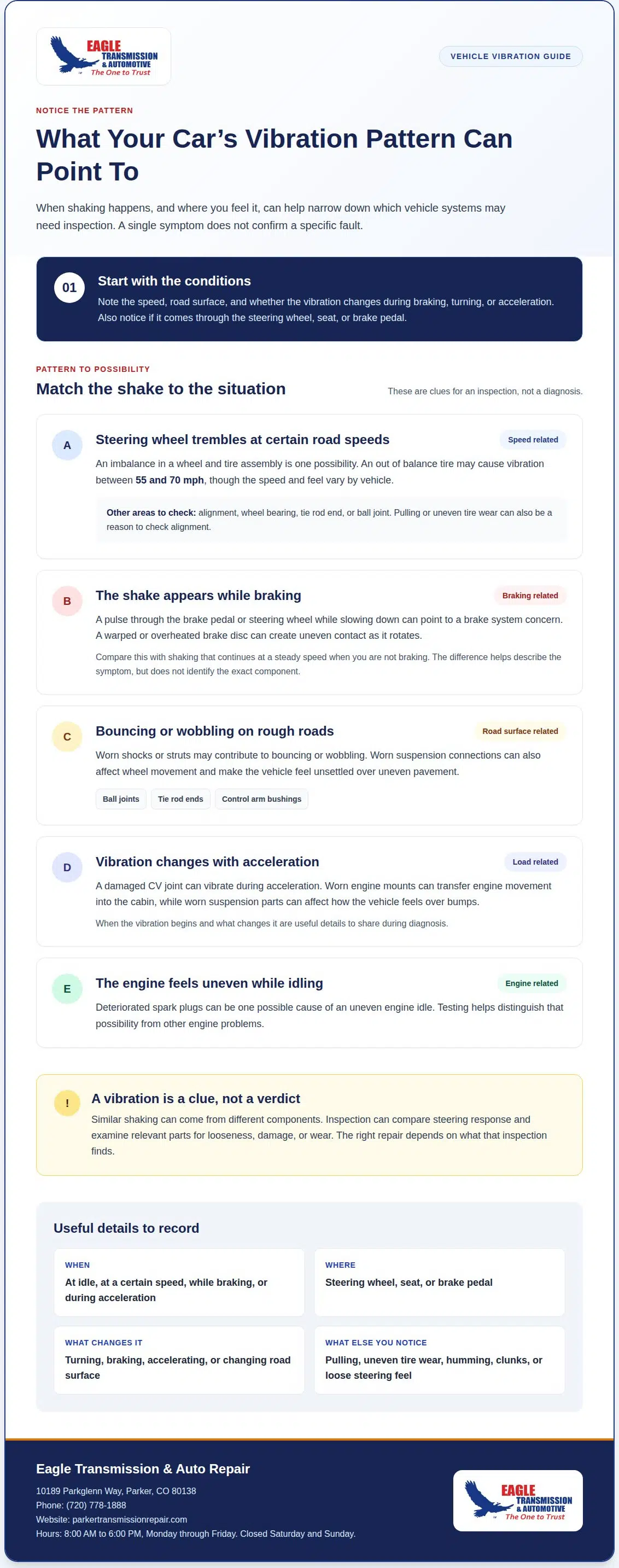
A steering wheel that trembles at certain road speeds can point to an imbalance in a wheel and tire assembly. An out of balance tire may cause vibration between 55 and 70 mph, although the speed and feel vary by vehicle. Note whether the shake starts at a particular speed, fades as speed changes, or continues across different roads. That pattern helps distinguish rotating wheel concerns from engine or brake symptoms.
Balancing distributes the wheel and tire assembly’s weight evenly as it rotates. Tires should be balanced whenever they are mounted. Hitting a pothole or curb can loosen a balancing weight or shift the assembly’s balance point, creating a new vibration. A temporary flat spot after extended parking may disappear after a few miles as the tire warms.
Alignment sets wheel direction through camber, toe, and caster. Camber describes wheel tilt, toe describes whether wheels point inward or outward, and caster relates to steering stability. Incorrect alignment can contribute to shaking at certain speeds, pulling, or uneven tire wear. Have the alignment checked if the vehicle pulls or tire wear looks uneven.
A wheel bearing, tie rod end, or ball joint can cause similar shaking. A worn bearing may hum or growl, with the sound changing as speed or turning changes. Loose tie rod ends can affect steering response, while worn ball joints may cause looseness or clunks over bumps. A visible bulge in a tire’s sidewall can indicate belt separation, which balancing alone may not address.
Can worn engine mounts, CV joints, or suspension parts cause shaking? Yes. Worn engine mounts can transfer engine movement into the cabin, a damaged CV joint can vibrate during acceleration, and worn suspension parts can make the vehicle feel unstable over bumps.
What repairs can reduce or prevent car vibration? The right fix depends on inspection findings. Balancing can correct uneven rotation, and alignment can reset wheel angles. A worn bearing, tie rod end, ball joint, engine mount, or CV joint may need repair or replacement. Damaged tires and bent wheels require separate attention.
Diagnosis connects when the vibration occurs with what the vehicle is doing. A steering wheel shake differs from a cabin-wide tremor, but neither proves a particular cause. Record the speed, road conditions, and whether turning, braking, or accelerating changes the sensation. These details help focus inspection on relevant components instead of treating every shake as an alignment problem.
Ball joints, tie rod ends, and control arm bushings
Ball joints, tie rod ends, and control arm bushings connect steering and suspension parts and help control wheel movement. Wear can let a wheel shift under load, causing vibration along with steering play, knocking, or an unsettled feeling on uneven pavement. The exact sensation depends on which connection is loose and the vehicle’s suspension design.
A ball joint pivots between a control arm and steering knuckle. If it develops excess movement, the wheel may not stay consistently positioned as the suspension travels. You might notice a knock when entering a sloped driveway or a change in steering feel over broken pavement. These clues guide an inspection but don’t identify a specific failed joint.
Tie rod ends transfer steering movement to the wheels. If an end becomes loose, the steering wheel may feel less precise, or the vehicle may wander despite small steering inputs. For example, you might need to make frequent corrections to stay on a straight path. Similar behavior can result from alignment or other worn steering parts, so the full linkage needs assessment.
Control arm bushings are flexible mounts that cushion movement between a control arm and the vehicle structure. Cracked or deteriorated rubber can allow unwanted arm movement during braking, acceleration, or turns. A clunk as the vehicle moves from a stop can be a useful clue. A visual check may reveal damaged rubber, but internal wear may require closer inspection.
Diagnosis considers how the symptom changes as the vehicle moves. A technician can compare steering response during a road test, then inspect steering and suspension connections for looseness, damaged boots, shifted components, or worn bushings. Checking the parts together matters because one loose connection can increase movement in neighboring components.
The repair depends on the component and extent of wear. A damaged ball joint, tie rod end, or bushing may need replacement, followed by an alignment check if the repair affects wheel position. Replacing a part without confirming the source may leave the vibration or wandering unchanged. The inspection should account for the vehicle’s specific suspension layout.
Describe whether the symptom appears during a turn, over a bump, or while driving straight. A clunk at a driveway entrance differs from steering looseness that persists on smooth pavement. If steering response changes noticeably or the vehicle becomes difficult to keep on course, reduce driving and have the relevant parts inspected.
Brake disc, brake pad, and brake-fluid problems
If the steering wheel or brake pedal pulses while slowing down, the braking system needs attention. Front brakes handle substantial braking stress, so vibration during braking may involve the front brake mechanism. A warped or overheated brake disc can create uneven contact as it rotates, sending a repeated pulse through the pedal or steering wheel.
Notice when the shake begins. Vibration that appears only when you press the brake differs from shaking that continues at a steady speed without braking. For example, a car may travel smoothly, then develop a steering wheel tremor during a firm stop. That pattern points to brake components, but it doesn’t identify a failed part on its own.
Brake pads create friction against the discs to slow the wheels. Worn pads can make braking feel uneven, while damaged or unevenly worn discs may cause pulsing. A burning smell, unusual noise, or change in pedal feel adds useful diagnostic context. Pad condition, disc surface, and brake operation should be assessed together, since vibration alone doesn’t prove the discs are warped.
Brake fluid matters because it transfers pressure from the pedal through the hydraulic system. A fluid problem can interfere with consistent brake operation, though vibration alone cannot establish that as the cause. A technician can assess fluid condition and inspect related components, checking for leaks or uneven braking response.
Brake replacement timing varies by vehicle and use. Brakes are replaced about every 50,000 miles on average, though timing varies by make and model. That figure is a broad average, not a service interval for every car. Frequent stops, driving conditions, vehicle design, and observed wear affect when parts need attention.
A useful diagnostic sequence begins by safely reproducing the symptom, then inspecting the pads, discs, calipers, and hydraulic system. The inspection may reveal uneven pad wear, disc damage, a sticking caliper, or fluid concerns. Measurements and the vehicle’s specifications help determine whether a disc can remain in service or needs replacement.
Vibration during braking deserves prompt attention because brakes are central to vehicle control. Don’t assume replacing the pads alone will correct the shake; the discs, calipers, and fluid system may also need assessment. Brake repair and replacement address worn or damaged components, with the repair guided by inspection findings and the vehicle’s condition.
Broken shock absorbers and vibration at speed
Shock absorbers control spring movement after a wheel hits a bump. A worn or broken shock can let the tire bounce against the road instead of settling smoothly. At speed, that repeated movement may feel like vibration, wobbling, or a loose ride. Rough pavement can make the symptom more noticeable.
Worn shocks and struts can also contribute to cupping, a pattern of uneven dips across the tire tread. A vehicle that bounces repeatedly after a dip in the road may have reduced damping. One worn corner can make the car feel unsettled, while wear at multiple corners may affect ride control more broadly.
Look for a pattern, not just one sensation. A car that feels stable on smooth pavement but bounces sharply over a rough patch gives different clues from one that shakes steadily on level roads. A broken shock absorber can cause vibration or wobbling at high speed, along with severe bouncing on rough roads.
Diagnosis typically compares your description with a physical inspection. A technician can check each shock and strut for damage, leakage, loose mounting points, and uneven response. The tires and suspension connections also need attention, since their condition can cause similar symptoms or worsen poor control.
The repair depends on which parts are damaged and how the vehicle is built. A failed shock or strut may need replacement, and worn mounts or related suspension parts may also need attention. Afterward, the vehicle’s ride and handling should be reassessed. Replacing one component won’t automatically correct a separate tire or steering problem.
How much does it cost to fix common causes of car vibration in the US? There is no single cost for every cause: the vehicle, parts, labor, and extent of damage affect the repair, and an accurate quote requires inspection.
Is it safe to drive a car that vibrates, and when should you stop? A mild vibration still needs diagnosis. Stop in a safe place if severe bouncing, pronounced wobbling, or reduced control makes the vehicle difficult to manage. A broken shock can affect stability, especially on rough roads or at speed.
Record when the shake occurs, such as over bumps, during a turn, or at highway speed. These details help distinguish a shock or strut concern from tire, wheel, or steering problems. Avoid high speeds if the car is wobbling, and arrange an inspection before resuming normal driving.
Deteriorated spark plugs and engine vibration
A deteriorated spark plug can make an engine run unevenly, causing vibration at idle or during acceleration. If you’re asking what causes a car to vibrate, inconsistent combustion is one possibility, though other engine faults can feel similar.
Deteriorated Spark Plugs
A spark plug ignites the air and fuel mixture inside an engine cylinder. As it wears or becomes damaged, that cylinder may produce power less consistently, which can make the engine shake. Spark plugs generally last about 80,000 to 100,000 miles, depending on make and model. That range offers context, but it isn’t a universal replacement interval.
Engine design affects access to the spark plugs and nearby parts. A technician may inspect the plugs for wear or deposits and compare their condition with the engine’s symptoms. Replacing every plug without identifying the fault can miss another cause, such as an ignition coil or fuel delivery problem.
Shaking at Idle and During Acceleration
At idle, the engine runs while the vehicle is stationary, so a rough shake may be easier to feel through the seat or cabin. During acceleration, a weak spark can cause hesitation or uneven power. If you’re wondering what causes a car to vibrate as the engine works harder, note whether the shake appears only under throttle or continues after you ease off.
That difference can help separate a combustion concern from vibration tied mainly to road speed. For example, shaking while parked with the engine running points toward engine operation, while vibration that begins only as the car gains speed may involve another system. Neither pattern identifies a failed part on its own.
A warning light may accompany rough running, but it doesn’t prove the spark plugs are responsible. Diagnostic codes and further checks can help identify a cylinder or broader engine performance issue. Testing matters because plugs, coils, fuel delivery, and other components can produce overlapping symptoms.
When worn plugs are identified as the cause, replacement can restore consistent ignition. The suitable parts and service approach depend on the engine design. If the engine still shakes afterward, further diagnosis can determine whether another fault remains. Record whether the vibration happens at idle, during acceleration, or in both conditions.
Get a diagnosis for your car’s vibration
Eagle Transmission & Auto Repair can help identify the source of a vibration and address related engine or transmission concerns. Turn to the shop when shaking persists, changes with acceleration, or comes with rough running or shifting symptoms. A vibration is a clue, not a diagnosis, because several vehicle systems can produce similar sensations.
The timing and location of the shake help narrow the possibilities. A tremor felt mainly through the steering wheel differs from a rough idle or vibration that appears as the vehicle accelerates. Note whether it happens while stopped, moving, braking, or changing gears. Sharing those details gives diagnosis a useful starting point.
Diagnosis involves testing and inspecting relevant systems rather than choosing a repair based on one symptom. The vehicle’s behavior, warning lights, and changes in engine performance or shifting can help guide the evaluation. For example, a rough idle may direct attention to engine operation, while vibration during gear changes may call for transmission assessment.
Engine repair may be appropriate when inspection identifies an engine problem contributing to the shake. If symptoms relate to gear engagement, slipping, or unusual shifting, transmission repair or service may be relevant. Manual vehicles may also need clutch or related transmission work. Inspection findings determine which system needs repair, rather than the vibration alone.
Keep a short record of when the shaking occurs and what changes it. A note such as “rough at idle, smoother in Park” or “starts during acceleration” is more useful than simply reporting that the car vibrates. Include any warning light, recent change in behavior, or accompanying noise. These observations help distinguish patterns and focus the evaluation.
When the cause remains unclear, don’t assume one repair will address every symptom. Vibration can come from different systems, and more than one concern may be present. The next step is an evaluation that connects the driving pattern with inspection findings, then determines whether engine repair, transmission service, or another diagnosis is appropriate.
If your car’s vibration persists or its behavior changes, contact Eagle Transmission & Auto Repair to discuss a diagnostic evaluation in Parker, Colorado.
Frequently Asked Questions
Why Is My Car Shaking?
A car can shake because of a problem with its wheels, steering, suspension, brakes, engine, or drivetrain. When it happens helps narrow the possibilities. For example, shaking while parked points toward a different diagnostic path than shaking that begins during a turn. Note whether the sensation reaches the steering wheel, seat, or brake pedal, and whether it changes with engine speed.
What are the most common causes of car vibration?
Common possibilities include an unbalanced wheel, a tire or wheel problem, worn steering or suspension parts, brake wear, engine misfire, or a drivetrain concern. There’s no single answer to what causes a car to vibrate, because different systems can produce similar sensations. A recent pothole impact, new noise, warning light, or change in handling can help identify areas for closer inspection.
Why does a car vibrate when driving at high speeds?
At higher road speeds, an imbalance in a wheel, tire, axle, or driveline may be easier to feel because the parts rotate faster. Vibration may change as speed or acceleration changes, providing useful clues. A shake that grows under acceleration differs from one that stays steady while coasting. Speed alone doesn’t identify the cause, since worn suspension or damaged components can create similar symptoms.
What causes vibration when braking?
Brake vibration can result from uneven contact between brake pads and discs, a sticking caliper, or another braking system concern. Notice whether the pedal pulses, the steering wheel shakes, or the vehicle pulls as you slow down. These details describe the symptom but don’t confirm a specific fault. Report any change in braking feel or unusual noise, too.
Can unbalanced tires or wheel alignment cause car vibration?
Yes. An imbalance can make a wheel and tire assembly rotate unevenly, while incorrect alignment can affect how the wheels track and wear. Vibration may occur alongside pulling or irregular tread wear, but these clues can also point to steering and suspension faults. Mention any recent curb or pothole impact and when the shake appears. Diagnosis can distinguish wheel balance from alignment or component damage.
How can you diagnose the cause of a vibrating car?
Start by describing the conditions that bring on the vibration: parked or moving, accelerating or coasting, turning or braking. Include where you feel it, any new noise or warning light, and changes after a road impact. A technician can use those clues to guide inspection and testing across relevant systems. Eagle Transmission & Auto Repair serves drivers in Parker, Centennial, and Aurora.