
What if that mystery spot on your driveway is actually a roadmap to preventing total drivetrain failure? WE know that decoding your transmission fluid color is the most effective way to catch expensive mechanical problems before they leave you stranded in Douglas County. WE FIX EVERYTHING, and our team understands that a proactive approach is the best defense against high repair costs.
You demand total reliability from your vehicle, and understanding the fluid that powers it is the first step toward maintaining peak performance. WE provide the technical mastery needed to interpret these shifts in hue with absolute confidence. We promise to give you a clear understanding of what your car is trying to tell you, ensuring you never have to guess about the state of your transmission again.
This guide explores the healthy red baseline, identifies critical danger signals like metallic flakes, and provides a simple way to test your fluid at home so you know exactly when to call in the pros.
Key Takeaways
- Spot the difference between healthy, bright red fluid and the dark, oxidized shades that can lead to expensive repairs.
- Decode your transmission fluid color to understand if your vehicle is facing routine aging or a looming mechanical crisis.
- Identify “strawberry milkshake” fluid and other critical danger signs that require immediate professional attention to avoid a total breakdown.
- Master the 60-second home blotter test to monitor your transmission’s health between scheduled services.
- Learn how WE look beyond the dipstick with pressure tests and computer scans to solve the root cause of any fluid discoloration.
The Healthy Baseline: What Color Should Your Transmission Fluid Be?
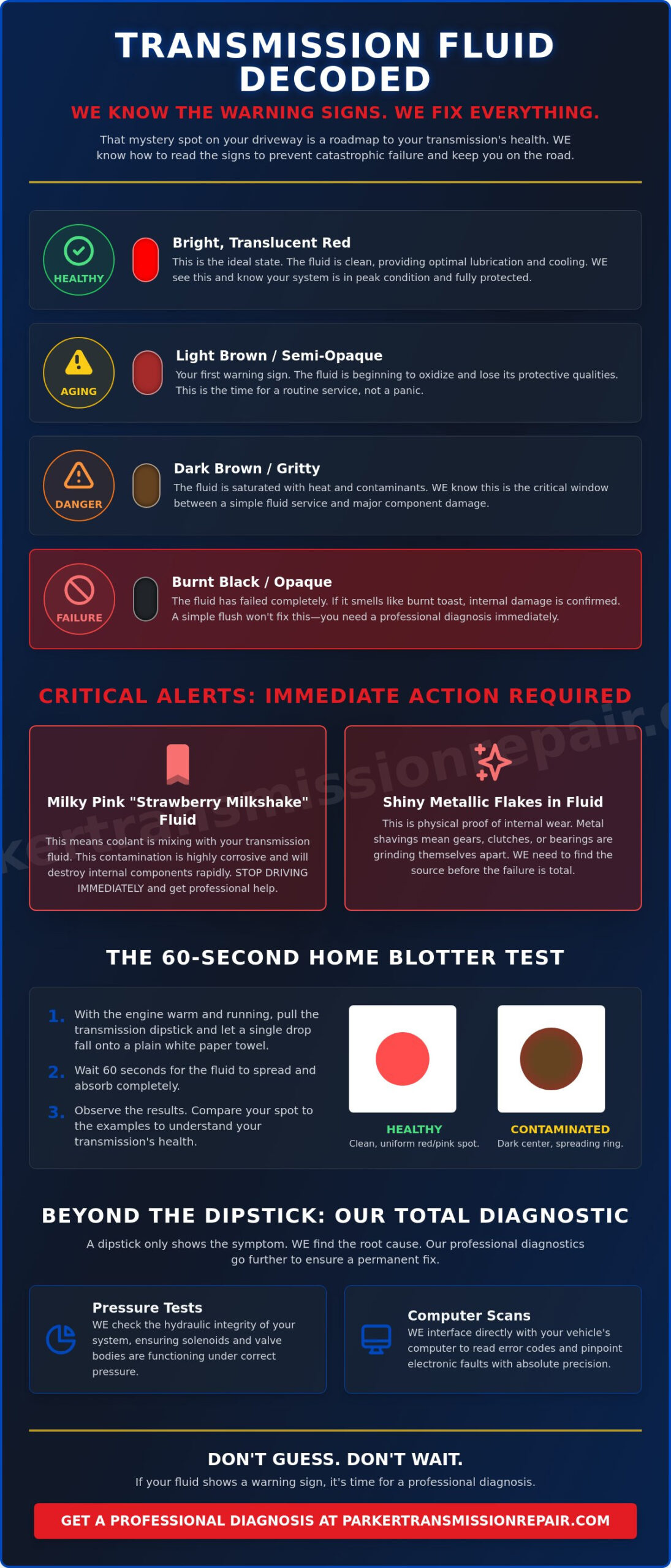
When you pull the dipstick, you’re looking for a specific, reassuring sight. Healthy Automatic transmission fluid is typically a bright, translucent red. Think of it like a clean window; you should be able to see through the liquid easily. This vibrant color is your first line of defense in vehicle maintenance. It acts as a primary indicator that your system is protected and operating exactly as the manufacturer intended. WE look for that clear hue because it confirms the fluid hasn’t been scorched by extreme heat or contaminated by internal wear. Precision is our standard.
While the transmission fluid color is the most obvious sign, clarity is just as vital. You should be able to see through the drop on your finger or a white paper towel. If it looks thick, muddy, or contains tiny bits of metal, your transmission is trying to tell you that something is wrong. WE prioritize a clean consistency that lacks any debris or foamy bubbles. If the fluid is bubbly, it often means there’s an air leak or the level is too high. Don’t ignore these subtle changes.
The Role of Red Dye in Modern Transmissions
Understanding your transmission fluid color starts with knowing that the red isn’t the natural state of the oil. That distinct color comes from a specific dye added during the manufacturing process. This serves as a brilliant diagnostic tool for every driver in Douglas County. If you spot a fresh puddle on your garage floor, that red tint helps you immediately distinguish it from dark brown motor oil or bright orange coolant. It takes the guesswork out of identifying leaks. Keep in mind that modern engineering is always evolving. Some specialized Ford fluids or CVT oils might have a slightly different base tint, such as blue, green, or even a pale amber. Regardless of the specific starting shade, the “new” look should always be bright and clear, never dull, cloudy, or opaque.
Why Fluid Health Dictates Transmission Longevity
Your transmission fluid is a bit of a multitasker. It works as a hydraulic medium to shift gears, a coolant to pull heat away from moving parts, and a lubricant to prevent metal-on-metal wear. Fresh fluid maintains the exact friction coefficients your car needs for those crisp, smooth gear changes you rely on. When the fluid breaks down, your transmission has to work harder. This leads to friction, excess heat, and eventual failure. For a deeper look at how to protect your vehicle, check out our Professional Transmission Repair in Parker, CO: The Complete 2026 Guide. WE believe in proactive care because catching a small shift in color today prevents a massive repair bill tomorrow. WE FIX EVERYTHING, and that starts with keeping your fluids in peak condition.
Decoding the Spectrum: From Dark Red to Burnt Black
If your transmission fluid color has shifted from a healthy cherry red into something darker, your car is sending a definitive distress signal. WE see this progression clearly. It begins as a light brown or semi-opaque hue, which marks the exact moment the fluid begins to oxidize and lose its protective qualities. When it reaches a dark brown stage, the fluid is saturated with heat and contamination. WE do not ignore these changes because they represent the critical window between a simple service and a catastrophic failure.
Black and opaque fluid is the ultimate danger zone. At this stage, the liquid has lost its viscosity and no longer protects your internal gears. If you pull the dipstick and detect the smell of burnt toast, you are looking at confirmed internal clutch damage. Performing a standard transmission service is insufficient when the fluid reaches this state. In fact, replacing black, gritty fluid with fresh oil often causes a failing transmission to slip because the grit was providing the last bit of friction the worn clutches had left. If you see these dark shades, visit our shop in Parker for a professional diagnostic.
The Science of Fluid Oxidation
Oxidation is the chemical breakdown of fluid caused by heat and air exposure. When your transmission operates under heavy loads, oxygen interacts with the fluid and breaks down its molecular carbon chains. This process creates a sticky residue known as varnish. This varnish coats sensitive valve bodies and causes your gears to lag or shift roughly. WE understand the chemistry behind the color. WE know that once oxidation starts, the fluid’s ability to manage heat disappears, creating a cycle that guarantees hardware failure if left unaddressed.
When Color Indicates a Necessary Flush vs. a Repair
Deciding between a routine service and a more serious repair depends on the specific cause of the discoloration. Brown fluid typically requires a standard transmission service to restore peak performance. However, black fluid signals that we must determine if the hardware inside remains viable. Check our guide on Transmission Repair vs. Replacement to see which path secures your vehicle’s future. WE FIX EVERYTHING, and we provide a straight answer on whether a simple fluid change is the solution or if your car requires a total repair to stay reliable on the road. If the internal damage is severe enough that repair is no longer viable, our guide on remanufactured transmission replacement in Parker, CO explains why a factory-engineered rebuild is often the smartest long-term investment for your vehicle.
The Danger Zones: Milky Pink and Metallic Flakes
While standard aging turns fluid brown, certain colors signal a catastrophic failure that requires immediate intervention. If your transmission fluid color looks like a milky pink strawberry milkshake, you’re looking at a critical system breach. This isn’t just old oil; it’s a sign that your vehicle’s cooling system has compromised the drivetrain. WE see this most often when the internal cooler inside your radiator fails, allowing engine coolant to mix with the transmission fluid. It’s a messy situation that demands a fast, professional response.
This mixture is lethal for your car. Glycol, the main ingredient in most coolants, is chemically incompatible with the friction material found on your transmission’s internal clutches. It causes those materials to swell and eventually peel right off their metal backings. WE treat this as a true mechanical emergency. Driving even a few blocks with contaminated fluid can destroy the entire unit beyond repair. Because we specialize in both drivetrains and the systems that support them, our team provides Reliable Engine Repair in Parker, CO to address these complex cooling system crossovers. WE FIX EVERYTHING, especially when systems collide.
The “Strawberry Milkshake” Radiator Leak
When the barrier between your radiator and transmission cooler fails, the pressure difference usually forces coolant into the transmission. This creates that telltale pink, frothy appearance. It’s a deceptive color because it almost looks “cleaner” than dark brown fluid, but it’s actually the most dangerous state your transmission fluid color can reach. Once glycol enters the system, a simple flush is rarely enough to save the clutches. We have to act quickly to isolate the leak and assess the internal damage before the unit is a total loss. When the damage is this severe, drivers facing a full transmission replacement in Parker, CO will find that a remanufactured unit offers a reliable, warranty-backed alternative to a used or rebuilt part.
Identifying Internal Mechanical Wear
Sometimes the fluid stays red but takes on a shimmering, glittery appearance. If you see silver flakes or “glitter” in the fluid, your internal components are actively grinding away. This isn’t the normal fine metallic dust often found on a pan magnet during a routine service. These are actual chunks of metal from bearings, gears, or clutch drums. This debris quickly clogs the filter and starves the system of the hydraulic pressure needed to shift. WE use advanced diagnostics to find exactly which part is failing before the entire planetary gear set is lost. Recognizing these warning signs early is critical; our checklist of signs your transmission needs repair can help you identify when metallic contamination and other symptoms demand immediate professional attention.
You might also notice foamy or bubbling fluid on the dipstick. While it might look less threatening than metal flakes, it’s still a serious concern. Bubbles usually mean the system is overfilled or there’s an air leak in the pump circuit. Aerated fluid cannot provide the consistent pressure required for shifting, leading to heat spikes and erratic behavior. Whether it’s heavy sludge from years of neglected maintenance or a sudden foamy leak, we have the tools and the expertise to resolve the root cause. We don’t just change the fluid; we fix the underlying problem.
The Parker Pro Tip: How to Perform a 60-Second “Blotter Test” at Home
Simply glancing at the dipstick can be deceptive. A thin film of liquid often looks cleaner than it actually is, hiding the true state of your gearbox. WE recommend the “Blotter Test” for a far more accurate home diagnostic. This quick check gives you a clear, honest look at your transmission fluid color and its ability to keep protecting your vehicle. It takes less than a minute and can save you thousands in future repairs.
Follow these five simple steps for the best results:
- Step 1: Park your vehicle on a level surface. Keep the engine running until it reaches normal operating temperature, as warm fluid provides a more accurate reading.
- Step 2: Locate the transmission dipstick under the hood. If you can’t find one, your car might have a “sealed” unit, which we’ll address below.
- Step 3: Pull the dipstick and let a single, large drop of fluid fall onto a clean, white paper towel.
- Step 4: Wait 30 seconds. This allows the fluid to soak in and spread naturally across the fibers.
- Step 5: Examine the results closely. Look for the “halo” effect and check for any solid specks left on the surface.
Analyzing the Blotter Results
A healthy test result shows a wide, translucent red halo. This indicates that the fluid is dispersing properly and still has its detergent qualities intact. If you see a dark, concentrated spot in the very center that doesn’t spread, that’s a sign of heavy contamination. It means the fluid is saturated with debris and can no longer keep particles in suspension. Living in Parker means our vehicles face unique challenges. Our high-altitude driving and steep grades generate significantly more heat than sea-level cruising. This extra heat accelerates the breakdown of your transmission fluid color, making this simple blotter test a vital monthly habit for Colorado drivers. If your blotter results concern you, reviewing the crucial signs your transmission needs repair can help you decide whether it’s time to schedule a professional inspection before a small issue becomes a costly breakdown.
What if Your Car Has a Sealed Transmission?
Many newer Ford models and European vehicles are built with “sealed” transmissions that lack a traditional dipstick. Manufacturers often market these as having “lifetime fluid,” but WE know that’s a myth in the extreme temperature swings of Douglas County. From sub-zero winter mornings to blistering summer afternoons, your fluid is under constant stress. These units still need service, even if they don’t make it easy for you to check at home. WE use specialized equipment and professional lifts to access these systems and verify the fluid quality. If your car is “sealed” but shifting strangely, don’t wait for a warning light. It’s time to stop by our shop for a professional fluid check. WE FIX EVERYTHING, and we have the tools to handle even the most complex “maintenance-free” units.
Beyond the Dipstick: Why WE FIX EVERYTHING Means Total Diagnostics
While monitoring your transmission fluid color at home is a vital first step, it only tells part of the story. Color provides the symptom, but WE identify the disease. WE do not believe in the “drain and pray” method of simply swapping fluid and hoping for the best. Our team looks deeper to find the root cause of any discoloration to ensure your vehicle remains a reliable asset. WE FIX EVERYTHING, and that starts with a commitment to finding permanent resolutions rather than temporary patches.
Our diagnostic process utilizes precision pressure testing and high-level computer scanning to uncover hidden codes that a visual check will never reveal. WE perform a comprehensive inspection of every seal, filter, and solenoid to guarantee a total fix. Whether you are driving a standard sedan or a heavy-duty diesel, we possess the technical mastery to handle the most complex drivetrain challenges. We deliver results that keep your family safe and your vehicle on the road.
The Eagle Transmission & Auto Repair Diagnostic Advantage
WE use advanced electronic scanners to see exactly what is happening inside your vehicle’s control module. This technology allows us to pinpoint issues that the transmission fluid color cannot show, such as erratic sensor data or solenoid timing failures. During every professional service, we perform a thorough pan inspection to look for “clutch mud.” This paste-like residue confirms internal wear that a simple fluid change cannot resolve. Our technicians are specialized in Ford truck repairs, including the F-150 and F-250 lines, which means your work truck receives the highest level of expert care available in Colorado.
Protecting Your Vehicle in Parker and Douglas County
Driving in Douglas County places unique demands on your drivetrain that standard maintenance schedules often ignore. Our steep mountain grades and high-altitude environment force transmissions to hunt for gears, which generates extreme internal heat. This stress makes proactive fluid monitoring a requirement for any reliable vehicle in our community. WE also provide specialized fleet services to keep local businesses operational with rigorous fluid quality checks. We are your supportive partner in automotive health, providing the expertise needed to navigate Colorado’s terrain with confidence. Schedule your transmission fluid check at Eagle Transmission & Auto Repair in Parker today!
Take Control of Your Car’s Health Today
You’ve learned how to spot the difference between healthy red fluid and the dangerous shades of brown or black. You’ve also mastered the blotter test to check for hidden debris. These small steps make a huge difference in the longevity of your vehicle. Keeping an eye on your transmission fluid color is the simplest way to prevent a total mechanical failure before it leaves you stranded on a Douglas County road.
WE have been serving Parker, Centennial, and Castle Rock for decades, and we’ve seen every possible drivetrain challenge. Our team is specifically trained as specialized Ford F-150 and F-250 repair experts, and we provide expert 4×4 transfer case and drivetrain services for those tough Colorado winters. We don’t just guess; we use precision tools to find the truth. WE FIX EVERYTHING, and we’re ready to tackle any problem your vehicle throws our way.
Need a professional eyes on your transmission? WE FIX EVERYTHING; Book your diagnostic today!
Your car is a vital part of your daily life, and we are here to help you keep it safe and reliable for your family. Drive with peace of mind knowing your transmission is in expert hands.
Frequently Asked Questions
Is it normal for transmission fluid to get dark over time?
Yes, it is normal for fluid to darken gradually as it ages and heat cycles through the system. Over tens of thousands of miles, the bright red dye will naturally fade into a darker red or light brown. However, if the fluid turns dark brown or black prematurely, it indicates that your transmission is running too hot or experiencing internal mechanical stress that requires a professional diagnostic check.
What color is transmission fluid when it is leaking?
Transmission fluid usually looks like a bright red or dark red oily puddle when it leaks onto your driveway. Manufacturers specifically add red dye to the fluid so you can easily distinguish it from other vehicle liquids. This helps you tell the difference between a transmission leak and amber motor oil or bright green coolant. If you see red spots under your car, it’s a clear sign to have your seals inspected.
Can I change my transmission fluid if it is already black?
You should have a professional diagnostic performed before changing fluid that has already turned black. While fresh fluid is usually good, putting slippery new oil into a transmission with burnt, black fluid can sometimes cause worn clutches to start slipping. WE analyze the health of your gears first to determine if a service will help or if the internal damage requires a more comprehensive repair to keep you safe.
How much does it cost to change transmission fluid in Parker, CO?
The cost of a transmission service depends on several factors, including your vehicle’s make, the total fluid capacity, and whether your car requires specialized synthetic oils. High-performance trucks like the F-250 often have different requirements than a standard sedan. We provide transparent, upfront estimates based on your specific vehicle’s needs. Factors like the type of filter used and whether you choose a drain-and-fill or a full flush will also influence the total.
Why does my transmission fluid look like pink milk?
Fluid that looks like pink milk or a “strawberry milkshake” indicates that engine coolant has leaked into the transmission. This usually happens when the internal cooling tank inside your radiator ruptures. This is a mechanical emergency because the water and glycol in the coolant will quickly destroy the glue holding your transmission’s clutch friction material together. WE recommend stopping the vehicle immediately if you see this color.
What does it mean if there are bubbles in my transmission fluid?
Bubbles or foam on the dipstick usually mean the fluid is being aerated, which prevents it from maintaining proper hydraulic pressure. This often happens if the system is overfilled, causing the moving gears to “whip” the fluid into a froth. It can also be caused by an air leak in the pump circuit. Because aerated fluid can’t lubricate parts correctly, it leads to rapid heat buildup and erratic shifting behavior.
How often should I check my transmission fluid color?
WE recommend checking your transmission fluid color at least once a month or during every oil change. Regular monitoring is vital for drivers in Douglas County because our steep mountain grades and high altitudes put extra strain on the drivetrain. Catching a shift from healthy red to a darker hue early allows us to perform a simple service before the heat causes permanent damage to your internal gears.
Can bad transmission fluid color cause my car to stop shifting?
Yes, a severely degraded transmission fluid color is a leading indicator of shifting failure. When fluid turns black and loses its thickness, it can no longer generate the hydraulic pressure needed to move the internal components that change your gears. This results in “slipping,” where the engine revs but the car doesn’t move. Eventually, the lack of lubrication will cause the system to seize entirely, leaving you stranded.