
You’re cruising up Hess Road or heading south on I-25 when a strange, rhythmic metallic tapping starts echoing from under your hood. It’s a sound that makes your heart sink because you immediately start wondering if you’re looking at a total engine replacement. Understanding the common causes of engine knocking Parker CO drivers encounter is the first step toward keeping your vehicle on the road and your budget intact. Whether it’s a light pinging during acceleration or a heavy thud while idling, that noise is your car’s way of asking for help before a minor issue turns into a major breakdown.
We know how stressful it is to hear an unfamiliar sound and worry about which mechanic in Douglas County to trust. It’s easy to confuse a simple spark knock with a much more serious rod knock, but knowing the difference can save you plenty of sleep and a lot of unnecessary expense. In this guide, we’ll help you identify exactly what those sounds mean and how our local driving conditions affect your engine’s health. You’ll learn how to spot the specific mechanical problems behind the noise and exactly what to do next to ensure your family stays safe on the road.
Key Takeaways
- Learn to differentiate between a minor “ping” caused by fuel issues and the deep “thumping” of a rod knock that requires immediate mechanical attention.
- Understand how high-altitude driving and specific octane levels contribute to the common causes of engine knocking Parker CO vehicle owners face.
- Identify specific failure patterns in popular local vehicles, such as cam phaser rattles in Ford F-150s or the notorious “HEMI tick” in Ram trucks.
- Discover how professional diagnostic tools like automotive stethoscopes isolate internal engine problems before they lead to a total breakdown on I-25.
Understanding the “Knock”: What Your Engine is Trying to Tell You
Hearing an unusual sound from under your hood can feel like your car is trying to tell you a secret in a language you don’t quite speak. At its core, engine knocking is a rhythmic sound that signals something is out of sync. It usually happens for one of two reasons: either the fuel isn’t burning correctly in the cylinders or internal metal components are physically striking each other. Identifying the specific causes of engine knocking Parker CO drivers experience is vital because the sound itself is often a final warning before a larger mechanical issue occurs.
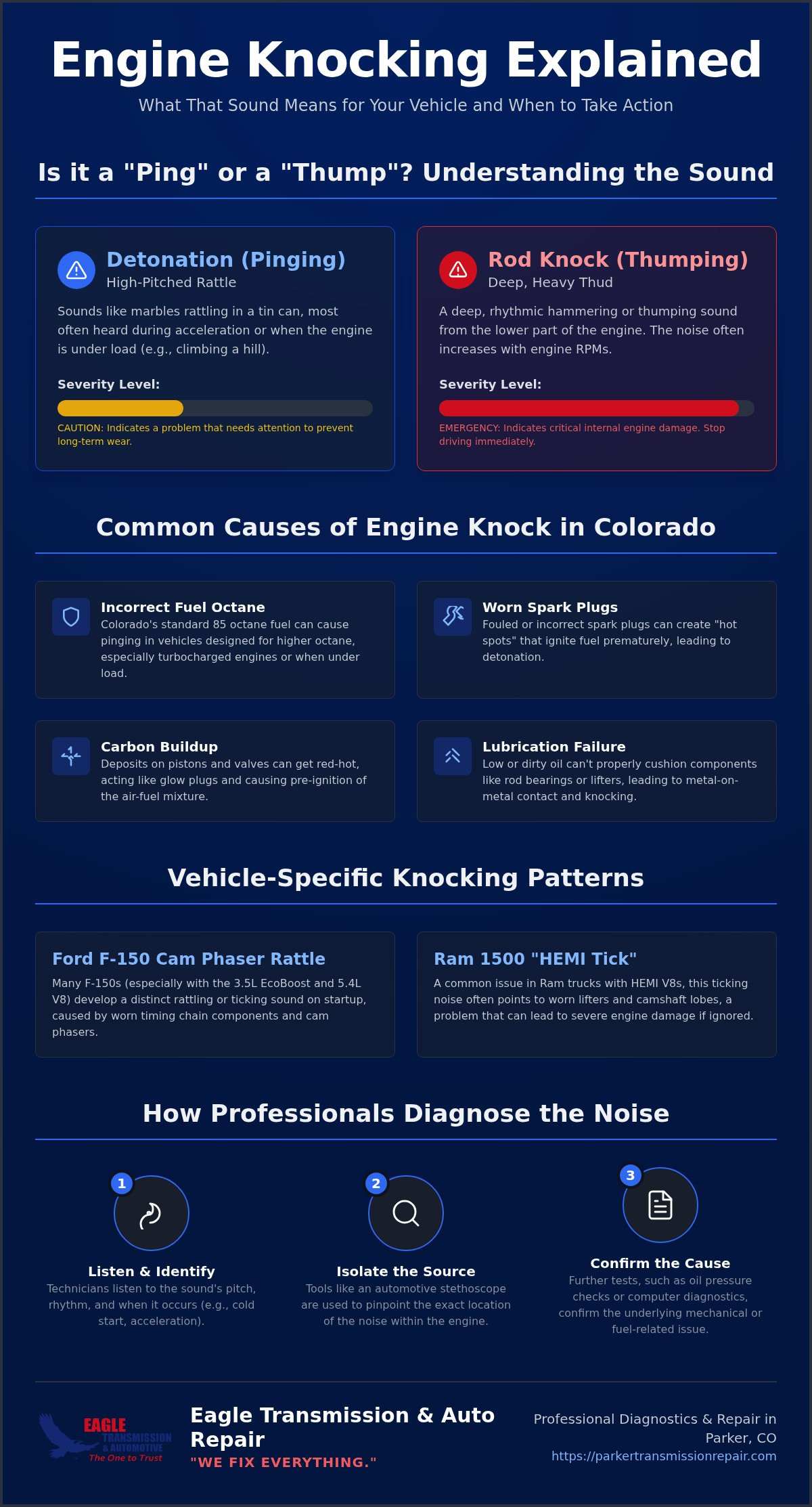
You might notice a light “pinging” or “rattling” sound, which often sounds like marbles being shaken in a metal tin. This is typically related to pre-ignition or detonation, where the air-fuel mixture in your engine ignites at the wrong time. On the other hand, a deep, heavy “thumping” or “clunking” is much more concerning. Rod knock is a serious mechanical failure of the crankshaft bearings. While a light ping might only happen when you’re accelerating up a steep hill toward Castle Rock, a heavy mechanical knock is often constant and signals that your engine is in immediate trouble.
Timing is everything when it comes to these noises. Does the sound only happen during a cold start in the morning? Or does it only show up when you’re pushing the engine hard on I-25? Paying attention to these details helps us provide a much faster and more accurate diagnosis. For a deeper look at the science of combustion, Understanding Engine Knock can help explain why these pressures occur in the first place.
The Sound of Detonation vs. Mechanical Knock
Detonation or pre-ignition happens when the fuel in your cylinder burns unevenly. Instead of one smooth flame, multiple mini-explosions happen at once, creating that high-pitched pinging sound. Mechanical knock is different; it’s the sound of parts like pistons or connecting rods physically hitting things they shouldn’t. When you talk to your mechanic, try to describe the pitch. Is it a high-pitched “tink” or a low-pitched “thud”? Knowing if the sound speeds up with your engine RPMs also helps us narrow down the list of potential culprits quickly.
When is Engine Knocking an Emergency?
Some noises are more urgent than others. If you hear a loud, rhythmic metallic hammering that gets louder as you give it gas, you’re likely hearing what technicians call a “death knock.” This is an emergency that requires you to pull over and shut down the engine immediately. Often, these severe mechanical issues are accompanied by a flashing check engine light. Ignoring a heavy knock while driving on Parker roads can lead to catastrophic failure, such as a broken connecting rod punching a hole right through your engine block. If the sound is deep and heavy, it’s always safer to have the vehicle towed than to risk a total engine meltdown.
Common Causes of Engine Knocking in Colorado
Living in Parker means your vehicle deals with conditions that flat-landers just don’t face. Between our high elevation and the steep grades of the Front Range, your engine is under constant pressure. One of the most frequent causes of engine knocking Parker CO drivers deal with is actually related to the fuel pump. In Colorado, regular gas is often 85 octane because the thinner air naturally reduces cylinder pressure. However, if you’re driving a modern turbocharged vehicle or towing a trailer up to the mountains, that lower octane might not be enough to prevent “pinging” under load.
Carbon buildup is another local culprit. Over time, high-mileage engines develop deposits on the pistons. These deposits act like tiny charcoal briquettes, staying red hot and igniting the fuel before the spark plug even fires. It’s like a runner starting the race before the starter pistol goes off. Similarly, worn spark plugs with the wrong heat range can cause the same premature ignition. Lubrication failure is also a huge factor. Your engine uses hydraulic lifters that rely on steady oil pressure to stay quiet. If your oil is low or dirty, those lifters can start clattering like a sewing machine.
The Impact of Altitude and Mountain Driving
Thin air in Douglas County changes how your engine breathes. When you’re towing a heavy trailer or climbing toward the mountains, your engine works harder and runs hotter than it would at sea level. This extra heat is a major trigger for knocking. If your cooling system isn’t in top shape, the internal temperatures can skyrocket, making the fuel-air mixture unstable. A healthy cooling system is your first line of defense against heat-related engine knock, especially when the summer sun is beating down on I-25.
Internal Component Wear and Tear
When the noise is deep and heavy, it’s usually not a fuel issue. Worn rod bearings are the primary reason for that rhythmic thumping sound. These bearings are the “cushion” between your connecting rods and the crankshaft. When they wear out, the metal parts physically slap together. You might also encounter “piston slap,” which is common on cold mornings in Parker. This happens when the piston has too much room to move inside the cylinder until it warms up and expands. If you’re hearing these heavy sounds, it’s time to look into reliable engine repair in Parker to prevent a total breakdown. If the noise has you worried, you can stop by our shop on Parkglenn Way for a professional diagnostic.
Make and Model Specific Knocking Patterns
While general issues like fuel octane and carbon buildup affect everyone, many vehicles have “signature” noises that help us narrow down the problem. If you drive a popular truck or SUV in Douglas County, you might be hearing a noise that’s specific to your engine’s design. Identifying these patterns is a big part of diagnosing the causes of engine knocking Parker CO residents bring to our shop most often.
Truck and SUV Failure Patterns
For owners of the Ford F-150, a common sound is a rhythmic rattling that happens during a hot idle or right at startup. This is often related to the cam phasers or the timing chain tensioners. It’s a complex system that relies on oil pressure to stay in time. Getting an expert Ford F-150 repair in Parker early can prevent the chain from stretching and causing expensive internal damage. We also see unique patterns in high-torque diesel engines like the Power Stroke or Cummins. These engines naturally have a louder combustion sound, but a sharp, metallic “clack” can signal an injector issue or a failing turbocharger bearing that needs immediate attention.
Ram truck owners often deal with the “HEMI Tick.” If you drive a Ram 1500, you’ve probably heard it. Sometimes it’s just a broken exhaust manifold bolt, but it can also be a sign of a failing lifter roller. Similarly, Chevy Silverado and GMC Sierra trucks with Active Fuel Management (AFM) often struggle with lifter collapse. When an AFM lifter fails, it creates a rhythmic tapping that sounds like a mechanical knock because the valve isn’t opening correctly. This often happens in high-mileage trucks that haven’t had frequent oil changes.
High-Mileage Wear in Common Commuter Cars
In our cold Parker winters, Subaru and Toyota owners often report a “cold engine” knock. This is frequently piston slap. As the engine warms up and the pistons expand, the noise usually disappears. While it’s often considered a characteristic of these engines, it’s worth having checked if the sound persists after the engine reaches operating temperature. Piston slap that doesn’t go away can indicate excessive cylinder wear.
Modern commuter cars use different technology that creates its own set of sounds. Kia and Hyundai models with GDI (Gasoline Direct Injection) engines are very prone to carbon buildup on the intake valves. This leads to pre-ignition pinging that is most noticeable when you’re accelerating away from a stoplight. Older Honda and Toyota models might just need a valve adjustment. Over time, the gap between the valves and the camshaft grows, leading to a “tappy” sound that people often mistake for a more serious engine knock. Keeping up with these specific maintenance needs is the best way to keep your daily driver quiet and reliable.
How We Diagnose Engine Noises in Parker
When we investigate the causes of engine knocking Parker CO drivers report, we don’t just guess. A knock can be anything from a minor timing issue to a major mechanical failure, and pinpointing the source requires a methodical approach. We start by checking your vehicle’s oil. By examining the oil condition and looking for “glitter”—tiny metallic shavings—we can tell if internal bearings are physically wearing down. It’s a simple step that provides immediate clues about the health of your engine’s bottom end.
Next, we use an automotive stethoscope to isolate the sound. This tool allows us to listen to specific areas of the engine, helping us determine if the noise is coming from the top-end valves or deeper in the crankcase. We also rely on computerized diagnostics to look at live data from your knock sensors and ignition timing. If the computer is trying to overcompensate for a bad sensor, it might actually be creating the sound you’re hearing. To confirm our findings, we often perform compression or leak-down tests to ensure your cylinders are sealing properly and holding the pressure they need for healthy combustion.
The Professional Diagnostic Process
A simple code scan at a parts store rarely tells the whole story. While a scan tool might show a “misfire” code, it won’t tell you if that misfire is caused by a bad spark plug or a failing piston. That’s why we prioritize a test drive to replicate the specific conditions where the noise occurs. We need to know if it happens under load, while coasting, or only when the engine is hot. Sometimes, what sounds like an internal engine problem is actually coming from a failing torque converter or loose flywheel. We are careful to distinguish between engine issues and transmission-related noises so you aren’t paying for a repair you don’t actually need.
Repair Options: From Simple to Complex
The good news is that not every knock requires a new engine. If the sound is caused by carbon buildup or “pinging,” a professional fuel system cleaning or a simple tune-up can often restore quiet operation. However, if our tests reveal worn rod bearings or internal damage, the conversation becomes more serious. We provide honest, transparent advice on engine repair vs. replacement, weighing the cost of an overhaul against the value of your vehicle. We want you to make the best decision for your family’s safety and your long-term budget.
Don’t let a small tapping sound turn into a major breakdown on your next trip to the mountains. If you’re worried about a new noise, bring your vehicle to our shop for a professional diagnostic so we can get you back on the road with confidence.
Expert Engine Care at Eagle Transmission & Auto Repair
At Eagle Transmission & Auto Repair, our motto “WE FIX EVERYTHING” is the standard we live by every single day. When you’re dealing with the stressful causes of engine knocking Parker CO drivers often face, you need more than a quick guess. You need a team that understands the intricate relationship between your engine’s internal components and the unique demands of Colorado’s high-altitude driving. We handle the full spectrum of automotive needs, from a specialized Ford F-150 repair to complex diesel diagnostics for heavy-duty work trucks. Our goal is to provide a supportive partnership that takes the mystery out of mechanical repairs.
Proactive maintenance is the best way to avoid a catastrophic engine failure that could leave you stranded on a mountain pass. By catching a small tapping sound early, we can often save you from the massive expense of a total engine replacement. Our technicians treat every vehicle as if it were their own, ensuring that your family’s SUV or your company’s fleet vehicle stays safe and reliable. We don’t just fix parts; we provide the reliability you need to navigate I-25 and local backroads with total confidence.
A Community-Focused Repair Experience
We take immense pride in being a local, independent fixture in Douglas County. Whether you’re coming to us from Centennial, Castle Rock, or right here in Parker, you’ll find a team that prioritizes clear communication over technical jargon. We believe that a well-informed customer is a confident one. That’s why we take the time to explain our findings and provide a transparent roadmap for your repairs. Your safety is our primary concern, and we work hard to build long-term trust with every neighbor who walks through our doors.
Schedule Your Diagnostic Appointment Today
Don’t let that rhythmic knocking sound go unaddressed for another day. Ignoring these warnings usually leads to more expensive repairs and the risk of a breakdown at the worst possible time. Our expert technicians are ready to put their experience to work for you, using the latest diagnostic tools to find the exact source of your engine’s trouble. If you’re ready for a professional opinion and a reliable fix, you can schedule your engine diagnostic at Eagle Transmission & Auto Repair today. We’re here to help you get back on the road safely.
Keep Your Vehicle Quiet and Reliable on Parker Roads
Hearing an unexpected noise from your engine can be unsettling, but taking action early often prevents a small tapping sound from becoming a major mechanical failure. Whether your vehicle is struggling with low octane fuel at our high altitude or dealing with internal wear and tear, understanding the common causes of engine knocking Parker CO owners encounter is the first step toward a solution. From simple carbon cleanings to complex bearing replacements, identifying the source of the noise ensures your car or truck stays ready for the demands of Colorado driving.
At Eagle Transmission & Auto Repair, we live by our motto: WE FIX EVERYTHING. Our team provides expert diagnostics for all makes and models, proudly serving Parker and the rest of Douglas County with transparency and care. You don’t have to guess about your vehicle’s health or worry about being stranded on I-25. We’re here to provide the clear answers and reliable repairs you need to keep your family safe. Schedule your engine diagnostic at Eagle Transmission & Auto Repair in Parker today and let our local experts handle the rest. We look forward to seeing you at the shop!
Frequently Asked Questions
Is it safe to drive with an engine knock?
Driving with an engine knock is risky and can lead to permanent damage. While a light pinging might allow you to limp home, a heavy mechanical knock means internal parts are failing. If you continue driving on I-25 with a severe knock, you risk a catastrophic failure like a thrown rod. It is always best to have a professional diagnose the causes of engine knocking Parker CO drivers notice before a small tapping turns into a total engine replacement.
Can bad gas cause my engine to knock in Colorado?
Yes, low-quality fuel or using an octane rating lower than your manufacturer recommends is a primary cause of knocking. In Colorado, our regular 85 octane gas is designed for high-altitude combustion, but modern turbocharged engines or heavy-duty trucks often require 87 or 91 octane. If your fuel ignites too early under the stress of mountain driving, it creates that signature rattling sound. Switching to a higher grade or a different station often solves this specific issue.
How much does it cost to fix an engine knock in Parker?
The cost varies significantly depending on whether the noise is a simple fuel issue or a major internal failure. A professional diagnostic is the only way to get an accurate estimate for your specific vehicle. Repairs can range from a basic fuel system cleaning or spark plug replacement to more involved work like bearing repairs or a full engine overhaul. We prioritize transparency and will always provide a clear roadmap of the necessary steps to get you back on the road safely.
Why does my engine only knock when it is cold?
Knocking that disappears as the engine warms up is often caused by piston slap. This happens when the piston has a tiny bit of extra room inside the cylinder. As the metal expands with heat, the clearance tightens and the noise stops. It can also be a sign that your oil isn’t reaching the top of the engine quickly enough during cold starts in our chilly Douglas County winters. Having our team check your oil viscosity can help resolve this.
What is the difference between engine knocking and a lifter tick?
A lifter tick is usually a faster, high-pitched “clacking” sound that comes from the top of the engine. It sounds a bit like a sewing machine and is often related to oil pressure issues in the valve train. An engine knock is typically a deeper, heavier “thud” or “hammering” sound coming from the middle or bottom of the engine. While both sounds require attention, a deep mechanical knock usually signals a more urgent internal failure that needs immediate repair.
Can a low oil level cause my engine to make a knocking sound?
Absolutely, low oil is a dangerous and common reason for engine noise. Without enough oil, the internal bearings lose their protective cushion, leading to metal-on-metal contact. This lack of lubrication creates heat and friction, which quickly destroys rod bearings and creates a heavy knocking sound. Regularly checking your dipstick is the simplest way to prevent these expensive causes of engine knocking Parker CO technicians see in high-mileage cars and hard-working diesel trucks throughout the Front Range area.


