You’re heading down the Palmer Divide toward the heart of town, but as you press the pedal to slow for a light on Parker Road, your steering wheel starts vibrating violently. It’s a stressful moment that leaves many local drivers wondering if their vehicle is still safe for mountain passes or highway speeds. If you’ve noticed your car shaking when braking in Parker, CO, you aren’t alone, and it doesn’t always mean a massive repair bill is on the horizon.
We understand how frustrating it is to feel that rhythmic thumping or shuddering every time you try to stop. You want to know if the issue is a simple fix or something that requires immediate professional attention. This guide is designed to help you identify the most likely causes of brake pulsation, from thin rotors to the “rust-jacking” caused by the magnesium chloride used on Colorado roads. We will explain how our 5,900 foot elevation and steep descents put extra stress on your vehicle. By the end of this article, you’ll know exactly what to look for and how to ensure your car is ready for whatever the Front Range throws your way.
Key Takeaways
- Learn why your steering wheel vibration is often caused by uneven pad material or rotor thickness variation rather than just “warped” metal.
- Discover how Colorado’s extreme temperature swings and road chemicals contribute to your car shaking when braking in Parker, CO.
- Identify specific vibration symptoms common in heavy-duty trucks and SUVs, especially those used for towing or mountain driving.
- Understand the importance of a professional diagnostic process that looks at the whole vehicle, including suspension components and hub cleanliness.
- Find out how proper maintenance and driving habits on steep descents can prevent future brake shudder and save you money on repairs.
Common Causes of Steering Wheel Shaking and Brake Pulsation
When you notice your car shaking when braking in Parker, CO, it’s easy to assume your rotors are simply “warped.” While that’s the most common term used by drivers, the actual cause is usually more specific and mechanical. Most vibration issues stem from failures that disrupt the smooth, flat contact between your brake pads and the rotor surface. At Eagle Transmission & Auto Repair, we look beyond the surface to find exactly why your vehicle is losing its composure during a stop.
Understanding Rotor Thickness Variation
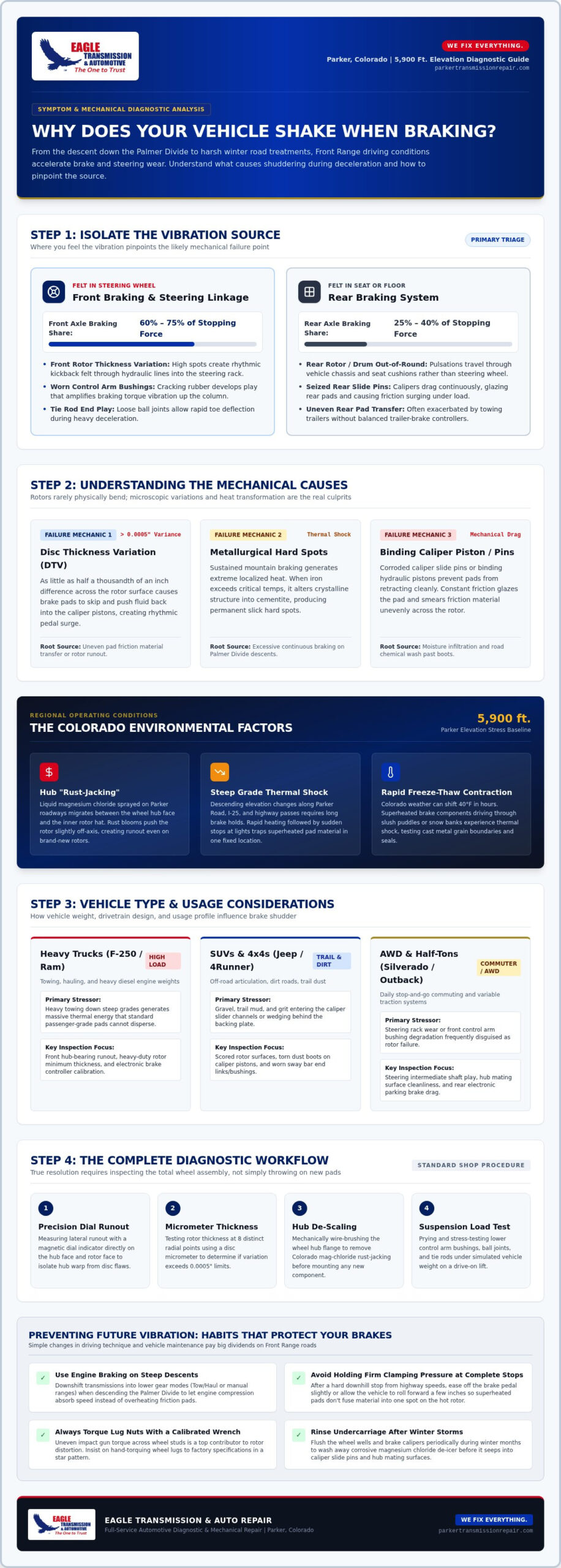
Heavy cast-iron rotors rarely bend or warp like a piece of plastic. Instead, they develop what we call Disc Thickness Variation (DTV). This occurs when the rotor surface wears unevenly by as little as 0.0005 inches. When the pads hit these microscopic high and low spots, it creates a rhythmic kickback you feel directly through the brake pedal. High-heat cycles from descending the Palmer Divide can also create “hard spots” in the metal. These spots change the actual metallurgy of the rotor, leading to brake judder and rotor runout that makes every stop feel inconsistent and unrefined.
Suspension and Steering Links
Sometimes, the braking system is just the messenger for a deeper suspension problem. If your steering wheel shakes during stops, worn control arm bushings or tie rod ends are often the real culprits. These parts are designed to keep your wheels aligned and steady. When the rubber bushings crack or the ball joints loosen, they develop “play.” The massive force generated during braking amplifies this existing play, causing the vibration to travel straight up the steering column.
Since 60% to 75% of total braking force happens at the front wheels, front-end suspension issues are usually very aggressive. It’s helpful to pay attention to where you feel the vibration. If it’s in the wheel, it’s likely the front end; if you feel it in your seat, it typically points to the rear brakes. Getting a reliable brake replacement or a suspension diagnostic can pinpoint if the vibration is coming from the pads or the components holding the wheels in place.
A sticking brake caliper is another frequent cause of excessive heat and vibration. If the internal piston or slide pins bind, the pad stays pressed against the rotor even after you let off the pedal. This creates a hotspot that unevenly deposits pad material onto the rotor face. This “smearing” creates a bumpy surface that ruins your stopping power and makes the car feel like it’s driving over a washboard every time you slow down for a red light.
Vibration Issues in Popular Parker Trucks and SUVs
Parker is definitely truck and SUV country. Whether you’re hauling a trailer up the Palmer Divide or taking the family up to the mountains, your vehicle’s braking system faces specific stresses that standard sedans just don’t see. Identifying why your car shaking when braking in Parker, CO happens often depends on what you drive and how you use it. Heavier vehicles generate significantly more heat, and that thermal energy has to go somewhere.
Heavy-Duty Braking for Ford and Ram Trucks
If you drive a Ford F-250 or a Ram 2500, you know these rigs are built for work. However, towing heavy loads puts immense pressure on the front rotors. When you’re descending steep grades with a trailer, the constant friction can lead to rapid heat buildup. This often results in uneven pad material transfer, which creates a noticeable shudder in the steering wheel. We see specific wear patterns in these heavy-duty systems where the excessive heat causes the metal to expand and contract repeatedly. Investing in high-quality, heavy-duty pads is essential for Douglas County work trucks to handle these loads safely. If your half-ton is struggling, our team provides specialized Ford F-150 repair in Parker to get your stopping power back to factory standards.
SUV and 4×4 Considerations
For those who take their Jeep Wrangler or Grand Cherokee off-road, the “shake” might not be caused by heat alone. Mud, gravel, and trail debris can easily get trapped in the brake assemblies. A small pebble caught between the pad and the rotor can score the metal surface or cause the caliper to hang up, leading to a persistent vibration. In vehicles like the Chevy Silverado, we also pay close attention to the steering rack and front-end components. A vibration felt during deceleration in a Silverado can sometimes be a steering issue masquerading as a brake problem.
Subaru Outback owners frequently deal with heat management in their AWD systems during mountain trips. Intense friction and heat are the enemies of smooth stopping. Following CDOT mountain driving safety guidance by using your engine to help slow down can prevent your rotors from reaching the breaking point. Specialized 4×4 drivetrains are sensitive; if one corner has uneven braking force, it can create a pull or vibration that feels like it’s coming from the drivetrain. We recommend a full system check at our Parker location if you’ve recently been out on the trails or noticed a change in how your SUV handles. Before you head out for your next weekend adventure, consider having a technician inspect your vehicle’s braking system for total peace of mind.
The Colorado Factor: Why Our Environment Warps Brakes
Living in Parker means our vehicles face a unique set of challenges that drivers in flatter, warmer climates simply never encounter. When you experience your car shaking when braking in Parker, CO, the environment is often a silent contributor to the problem. From the 5,900 foot elevation to the aggressive chemicals used on our winter roads, Colorado driving conditions can turn a minor brake issue into a safety concern very quickly. At Eagle Transmission & Auto Repair, we understand these local stressors because we drive these same roads every day.
One major culprit is thermal shock. Imagine you’re driving down from the Palmer Divide on a snowy afternoon. Your rotors are generating intense heat as you slow for traffic, often reaching several hundred degrees. If you suddenly hit a deep puddle of freezing slush, that rapid temperature drop causes the metal to contract unevenly. This doesn’t just “warp” the rotor; it creates metallurgical hot spots that lead to AAA brake vibration and wear warning signs. Over time, these thermal cycles ruin the smooth surface required for consistent stopping.
Heat Management on Steep Grades
Whether you are navigating the steep descents of Crowfoot Valley Road or heading back from a weekend in the mountains on I-70, your brakes are working overtime. Riding the brakes during a long descent causes heat to soak into the pads and fluid. When brake pads exceed 500 degrees Fahrenheit, the resin that holds the friction material together can start to “outgas,” creating a thin layer of hot gas between the pad and the rotor. We define brake fade as the temporary loss of stopping power caused by this excessive heat buildup. To prevent this, we always recommend engine braking, which uses the vehicle’s transmission to help control speed and keeps your rotors from glowing red.
Corrosion and Seized Components
The Colorado Department of Transportation (CDOT) uses liquid magnesium chloride to keep our highways safe in winter. While it’s great for melting ice, this chemical is incredibly corrosive to your braking system. It often leads to “rust-jacking,” where corrosion builds up on the hub face or behind the brake pad clips. This buildup pushes the pads out of alignment, causing them to stick in their slides rather than moving freely.
When pads can’t retract properly, they stay in constant contact with the rotor, creating even more heat and vibration. This is why we perform a thorough cleaning and lubrication of all hardware during every brake repair service. We don’t just swap parts; we address the environmental damage that caused the failure in the first place. Because we believe in the “WE FIX EVERYTHING” approach, we ensure your entire braking assembly is protected against the harsh Front Range elements.
The Professional Diagnostic Process for Braking Shudders
If you’ve noticed your car shaking when braking in Parker, CO, you know how unnerving that vibration can be. At Eagle Transmission & Auto Repair, we believe a proper fix starts with a real conversation and a thorough test drive. We don’t just guess which parts might be worn. Instead, we perform a methodical road test to replicate the exact conditions of the shudder. We need to know if it happens during a high-speed descent on I-25 or while slowing down for a stoplight on Mainstreet. Identifying the specific speed and pressure that triggers the vibration is the first step in a professional diagnostic.
Measuring Rotor Runout vs. Thickness Variation
Once the vehicle is on the lift, we look closer than a simple visual check allows. We use a precision tool called a dial indicator to measure lateral runout. This tool tracks the microscopic “wobble” of the rotor as it spins. Even a variation of a few thousandths of an inch can cause a violent steering wheel shake. We also use a micrometer to measure the rotor’s thickness in multiple spots. If the thickness varies, the brake pads will skip across the surface rather than gripping it smoothly.
Many drivers ask if they can simply “turn” or resurface their rotors. While this was common years ago, modern rotors are often thinner to save weight. If a rotor has been damaged by high heat or Colorado road salt, it often lacks the necessary thickness to be safely machined. We always check the manufacturer’s minimum discard specifications to ensure your vehicle remains safe for the long haul.
Beyond the Brakes: Suspension and Hubs
Brake issues don’t exist in a vacuum. Sometimes, the shaking is actually a symptom of a worn wheel bearing or a loose steering rack. A wheel bearing with even a tiny amount of play will allow the entire rotor assembly to tilt, mimicking a warped brake. Because our motto is “WE FIX EVERYTHING,” we inspect the entire front-end suspension. We check for worn control arm bushings and tie rod ends that might be amplifying a minor braking vibration into a major safety concern.
Our reliable engine and auto repair services ensure that we look at the whole mechanical picture. We also test your brake fluid for moisture contamination, which is common in our high-elevation environment. If you’re tired of that annoying vibration, schedule a professional brake diagnostic at our Parker shop today so we can get you back on the road with confidence.
Reliable Brake and Vibration Repair in Parker, CO
If you’ve been dealing with your car shaking when braking in Parker, CO, you need a solution that goes beyond a quick part swap. At Eagle Transmission & Auto Repair, we take our “WE FIX EVERYTHING” motto seriously. We know that a vibration in your steering wheel or a pulse in your pedal isn’t just annoying. It’s a sign that your vehicle’s safety systems are struggling. Whether you drive a compact commuter car or a heavy-duty Ford Super Duty, we have the specialized tools and local experience to get your stopping power back to where it belongs.
Why Choose Eagle Transmission & Auto Repair?
Many big-box chains or simple brake shops only look at the pads and rotors. While those are often the culprits, we know that Colorado driving conditions affect the entire vehicle. Our diagnostic process includes looking at the suspension, steering links, and wheel hubs to ensure we aren’t just treating a symptom. We use high-quality parts specifically chosen to withstand the intense heat of mountain descents and the corrosive nature of Front Range road chemicals. You can learn more about our local history and commitment to our neighbors on our About Us page.
We pride ourselves on transparency. When we find the cause of your brake shudder, we show you exactly what’s happening. We believe an informed customer is a safer driver. Our shop is conveniently located to serve our community in Parker, as well as our neighbors in Centennial and Castle Rock. We want you to feel confident every time you head out on E-470 or take a trip up to the high country.
Schedule Your Inspection Today
Don’t let a small vibration turn into a major mechanical failure. What feels like a minor shake today can lead to premature wear on your steering rack and suspension bushings if left unaddressed. When you come in for your appointment, try to note if the shaking happens at a specific speed or only on downhill grades. This information helps our technicians pinpoint the issue even faster.
We are here to be your partners in vehicle health. If your car or truck isn’t stopping as smoothly as it used to, let us provide the professional diagnostic you deserve. Get directions to our Parker shop for a professional brake inspection and experience the difference that a full-service, “WE FIX EVERYTHING” approach makes for your safety on the road.
Restore Your Smooth Ride and Stopping Power
A vibrating steering wheel or pulsing brake pedal is more than a nuisance; it’s your vehicle’s way of asking for help. These issues often stem from Colorado’s harsh thermal cycles or road salt buildup rather than simple mechanical failure. By choosing a shop that understands the specific needs of Ford trucks and 4×4 drivetrains, you ensure that the root cause is addressed, not just the symptoms. Professional diagnostics save you time and money by preventing unnecessary part replacements.
At Eagle Transmission & Auto Repair, we apply our “WE FIX EVERYTHING” motto to every diagnostic. We look at the whole vehicle, from the brake pads to the suspension bushings, to ensure your loved ones stay safe on every mountain descent. If you’re tired of your car shaking when braking in Parker, CO, it’s time for a transparent, expert evaluation from a team that knows these roads as well as you do.
Schedule your professional brake and vibration diagnostic at Eagle Transmission & Auto Repair in Parker today. We are ready to help you get back to a quiet, confident drive through the Front Range.
Frequently Asked Questions
Is it safe to drive my car if the steering wheel shakes when I brake?
It isn’t safe to continue driving with a shaking steering wheel because the vibration indicates your braking system isn’t functioning at its full potential. This shaking means your pads aren’t making smooth contact with the rotors, which can lead to longer stopping distances or even mechanical failure during an emergency. If you notice your car shaking when braking in Parker, CO, you should have it inspected immediately to ensure your vehicle remains reliable.
Can unbalanced tires cause shaking only when I hit the brakes?
Unbalanced tires typically cause a vibration that is felt at certain speeds, regardless of whether you are using the brakes. If the shaking only occurs when you press the brake pedal, the issue is almost certainly related to your rotors, calipers, or suspension components. While Eagle Transmission & Auto Repair doesn’t offer tire services, we can help you determine if the problem is actually coming from your vehicle’s mechanical stopping system.
Do I always have to replace my rotors if they are warped?
You don’t always have to replace them, but it is often the most reliable solution for Colorado drivers. In some cases, rotors can be resurfaced if they still meet the manufacturer’s minimum thickness requirements. However, our extreme temperature changes often cause deep metallurgical damage that resurfacing cannot fix. We always measure your rotors with a micrometer to see if they are thick enough to be safely machined or if a replacement is necessary.
Why does my car only shake when braking at high speeds on the highway?
High speeds on highways like E-470 or I-25 amplify small mechanical imperfections that you might not notice while driving through a neighborhood. A rotor with very minor thickness variation might feel smooth at 20 mph but will create a violent shudder at 65 mph. This happens because the brake pads are hitting those uneven spots much more frequently at higher speeds, creating a rapid vibration that travels through your steering column.
Can a bad transmission cause shaking when I’m slowing down?
Yes, a transmission issue can sometimes mimic a braking problem. If the torque converter clutch fails to disengage properly as you slow down, it can cause a shuddering sensation similar to a warped rotor. Because we specialize in both drivetrains and general auto repair, we look at the whole vehicle. Our “WE FIX EVERYTHING” approach ensures we find the real culprit, whether it’s located in your brakes or your transmission system.
How long does a professional brake diagnostic take at your Parker shop?
A professional brake and vibration diagnostic at our Parker shop usually takes about one to two hours. This time allows our technicians to perform a comprehensive road test to replicate the symptom and a detailed lift inspection. We measure rotor runout with precision tools, check for suspension play, and test your brake fluid for moisture contamination. We want to be thorough so you leave with a clear answer and a safe vehicle.
Will new brake pads fix a vibrating steering wheel?
Simply installing new brake pads will rarely fix a vibrating steering wheel. If your car shaking when braking in Parker, CO is caused by uneven rotors or worn suspension bushings, new pads will only be a temporary mask for the deeper problem. In fact, putting new pads on a damaged rotor can actually ruin the new pads very quickly. A proper repair involves addressing the rotors and any underlying suspension play simultaneously.