A trouble code is merely a clue about an electrical circuit, not an instruction telling you to start swapping expensive parts. If an amber glow just popped up on your dashboard, you are probably wondering whether you can safely commute tomorrow or if you are facing a massive repair bill. Getting thorough check engine light diagnostics Centennial CO drivers can rely on means looking past the surface. Stopping by an auto parts store for a quick scan often leaves you with confusing code numbers and zero real answers about what is actually malfunctioning under the hood.
Nobody enjoys the sinking feeling that accompanies an illuminated dash warning, especially when you depend on your vehicle for daily driving across the south metro area. In this guide, you will learn how pinpoint diagnostic testing uncovers the real mechanical or electrical cause behind an alert so you can avoid buying parts you don’t need. We will break down the crucial difference between a simple code reading and active testing, helping you make informed decisions to protect your vehicle.
Key Takeaways
- Colorado altitude shifts and freezing winter temperatures often trigger sensor faults across engine and emission systems.
- Professional check engine light diagnostics Centennial CO drivers rely on use live data and active component testing rather than simple code reading.
- Trouble codes identify an electrical circuit operating outside normal parameters, not necessarily a part that needs immediate replacement.
- The diagnostic process varies based on whether symptoms are steady or intermittent, often requiring dedicated road testing under load.
- Choosing a comprehensive repair facility ensures the underlying electrical or mechanical failure gets properly fixed without recurring issues.
What an Illuminated Check Engine Light Signals to Centennial Drivers
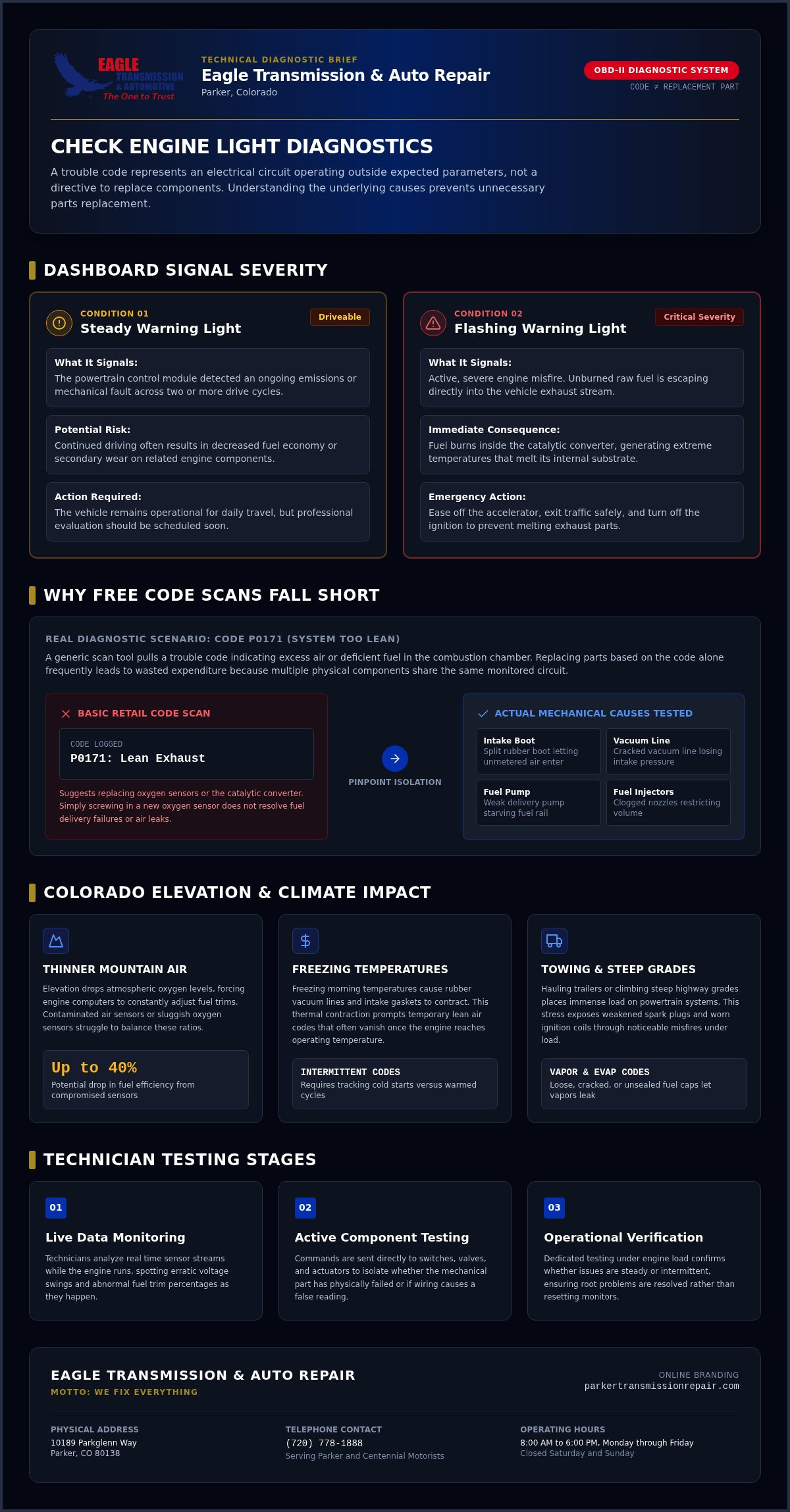
Modern vehicles rely on a network of sensors coordinating with the powertrain control module to track combustion efficiency, transmission shifts, and tailpipe emissions. Standardized through the On-board diagnostics (OBD-II) system, this computer continuously checks hundreds of operational values. When a reading drifts past factory limits for two or more drive cycles, the computer logs a fault code and turns on the amber instrument panel light. Centennial motorists face distinct driving challenges because regional elevation drops atmospheric oxygen levels, which forces the engine computer to adjust fuel trims. Freezing winter mornings also cause rubber vacuum lines and intake gaskets to contract, prompting lean air codes that vanish once the engine block reaches operating temperature.
Ignoring that yellow glow often leads to reduced fuel economy or secondary component wear. Seeking professional truck repair shop for Centennial drivers ensures accurate interpretation of sensor data before minor issues expand into larger repairs.
Steady Warning Versus Flashing Check Engine Light
A steady dashboard symbol means the onboard computer detected an ongoing emission or mechanical fault. The vehicle remains driveable, but you should schedule an evaluation soon. In contrast, a flashing check engine light indicates an active, severe engine misfire. Raw fuel is dumping directly into the exhaust stream, where it burns inside the catalytic converter and melts the internal substrate. If your light begins flashing while driving along E-470, ease off the accelerator, exit traffic safely, and turn off the ignition to prevent melting exhaust components.
Common Triggers for Engine Warning Lights in Colorado
High elevation and extreme seasonal temperatures make vehicles in the south metro area susceptible to several common triggers:
- Fuel filler caps: A loose, cracked, or improperly sealed fuel cap lets fuel vapor escape into the open air, triggering an evaporative emissions code.
- Mass air flow and oxygen sensors: Thinner mountain air requires rapid air fuel adjustments. Contaminated air sensors or sluggish oxygen sensors struggle to balance these ratios, which can cut fuel efficiency by up to 40 percent.
- Ignition coils and spark plugs: Hauling trailers or climbing steep highway grades puts immense load on the ignition system, exposing weakened spark plugs and worn ignition coils through heavy misfires.
Accurate check engine light diagnostics Centennial CO motorists schedule will isolate whether these parts have physically broken down or if vacuum leaks and wiring faults are producing misleading sensor reads.
Why Free Code Scans Differ from Professional Automotive Diagnostics
A diagnostic trouble code is not a direct order to replace a part. Instead, it indicates that a specific circuit or monitored system operated outside its expected parameters. When drivers rely on free retail scans, they often leave with a printout recommending a replacement sensor or catalytic converter. Swapping components based solely on code descriptions leads to wasted money, because the underlying mechanical or electrical fault remains untouched. Reviewing federal consumer advice on auto repair highlights why verifying issues through proper testing protects motorists from buying parts they do not need.
The Limitations of Handheld Retail Code Readers
A generic scan tool pulls basic trouble codes, but it cannot explain why the condition occurred. For instance, a lean exhaust code like P0171 points to excess air or deficient fuel in the combustion chamber. That condition can stem from a split rubber intake boot, a weak fuel pump, clogged fuel injectors, or a cracked vacuum line. Simply screwing in a new oxygen sensor will not resolve a fuel delivery issue. Worse, clearing active codes without solving the root problem merely resets emissions monitors, causing the warning light to return during your next commute.
The Multi Step Diagnostic Process Used by Technicians
Thorough check engine light diagnostics Centennial CO motorists schedule involve structured testing stages rather than guesswork:
- Live data evaluation: Technicians monitor real-time sensor data streams while the engine runs, spotting erratic voltage swings, abnormal fuel trim percentages, or incorrect throttle positions.
- Electrical pin testing: Using digital multimeters, technicians verify wiring harness continuity, ground integrity, and reference voltages directly at component connectors.
- Smoke testing: Introducing vaporized testing fluid under light pressure quickly reveals hairline fractures in intake runners or evaporative hoses that visual inspections miss.
Electrical System Problems That Trigger False Engine Codes
Modern vehicles depend heavily on steady electrical system voltage. A weak battery or failing alternator diodes can introduce voltage ripples, confusing sensitive control modules into logging false sensor codes. Corroded ground wires, particularly on older work trucks exposed to winter road magnesium chloride, create intermittent electrical resistance that turns warning lights on and off unpredictably. If you want definitive answers before spending money on unnecessary replacement parts, you can easily get directions to our Parker repair facility for active diagnostic testing.
Evaluating Check Engine Light Diagnostics Centennial CO Motorists Trust
Selecting the right facility for diagnostic evaluation shapes your entire repair experience. While a retail counter scan offers a convenient glance at raw trouble codes, it does not confirm the physical health of underlying parts. Choosing a dedicated repair shop bridges the gap between seeing an error code and executing an accurate mechanical repair. When you work with a full service auto facility, technicians cross-examine computer records against physical system tests, ensuring that only defective items are repaired or replaced.
Comparing Parts Counter Scans and Full Diagnostic Testing
Parts store employees use read-only code scanners designed to quickly pull generic emission faults. These devices cannot send digital commands back to the vehicle, leaving active components untested. In contrast, comprehensive check engine light diagnostics Centennial CO motorists schedule at a dedicated shop use bi-directional scan tools. Technicians command actuators to click on, run fuel trim resets, and test electrical pinout voltages at the harness. Clear documentation detailing both sensor readings and mechanical integrity protects vehicle dependability across Douglas County roads, giving you complete clarity on what is truly happening under the hood.
Questions to Ask Your Service Center Before Diagnostic Approval
Before handing over your keys, ask clear questions to understand how the shop approaches computer warnings. A trustworthy service advisor will answer these directly:
- Do your technicians test the circuit or simply install recommended parts? Verify that the staff checks wiring, connectors, and power supplies rather than automatically replacing whatever sensor the code names.
- How do you handle complex, intermittent electronic glitches? Ask if the technicians use live flight recorders or road testing under engine load to capture faults that occur unpredictably.
- Does your estimate separate urgent mechanical faults from standard maintenance items? Ensure the shop clearly distinguishes between immediate safety hazards and routine fluid or filter services.
Asking these questions helps you partner with technicians who respect your vehicle and your repair budget. Motorists seeking comprehensive care can rely on our specialized Centennial truck repair services to diagnose electronic and mechanical systems with complete transparency.
Factors That Influence the Cost and Scope of Engine Diagnostics
Every vehicle presents a unique electrical and mechanical layout. Because modern cars and trucks operate as networked computers on wheels, pinpointing a failure is not a uniform, one-size-fits-all procedure. Diagnostic scope depends on component accessibility, whether a symptom stays constant, and the extent of testing required to confirm the root failure. Investing in comprehensive check engine light diagnostics Centennial CO motorists schedule prevents unnecessary parts purchases while outlining precisely what is required to restore proper operation.
Variables That Determine Diagnostic Depth
Several technical factors dictate how deeply a technician must inspect a vehicle to locate a fault:
- System architecture: Modern domestic and import platforms feature dozens of modules communicating across high-speed controller networks. Isolating an errant signal requires tracing communication data across multiple systems.
- Physical component access: Checking reference voltage on an easily reached mass air flow sensor takes far less disassembly than testing an oil pressure switch buried beneath an intake manifold.
- Intermittent symptoms: Faults that only surface while climbing highway grades or during cold morning warmups require customized road testing with active data recorders to catch the problem in real time.
You can assist your technician by noting exactly when the dashboard light triggered. Recording whether the engine was cold, accelerating uphill, or idling at a stoplight gives technicians vital clues that streamline the physical evaluation.
Preventing Compounded Failures by Addressing Warnings Early
Postponing an inspection often turns a minor component failure into extensive secondary damage. An engine misfire might begin with a worn spark plug, but running that cylinder continuously allows unburnt fuel to enter the exhaust, ruining the catalytic converter. Similarly, an unaddressed coolant temperature sensor fault can prevent electric cooling fans from triggering, leading to severe engine overheating during heavy summer traffic. Even small intake vacuum leaks disrupt the calculated load values the powertrain module uses to manage transmission hydraulic pressure, resulting in harsh or delayed shifts during highway acceleration.
Prompt diagnostic testing catches these interconnected issues early, keeping vehicle repairs manageable and straightforward. To have our technicians evaluate your warning light before secondary problems develop, navigate directly to our Parker facility for an in-person assessment.
Complete Diagnostic and Auto Repair Solutions for Centennial Drivers
When dash warning lights disrupt your daily schedule, having a dedicated partner makes all the difference. Eagle Transmission & Auto Repair serves motorists seeking complete diagnostic accuracy and dependable mechanical care. While our name reflects deep powertrain proficiency, our service scope covers complete vehicle systems. True to our motto, WE FIX EVERYTHING, we combine detailed electrical evaluations with full mechanical solutions under one roof. That unified approach prevents you from driving back and forth between different specialty garages just to solve a single check engine light.
Full Service Auto Care Beyond Transmission Repair
Modern vehicles contain complex interconnections between engine management, exhaust treatment, and transmission controls. A fault code logged in one module frequently traces back to an entirely separate system. Our facility uses advanced diagnostic equipment capable of communicating with domestic platforms from Ford, GM, and Ram, alongside Asian and European makes.
We provide specialized diagnostic support across diverse vehicle platforms:
- Passenger cars and crossovers: Rapidly uncovering sensor discrepancies, variable valve timing faults, and cooling system leaks.
- Heavy duty diesel trucks: Dedicated testing for Ford Power Stroke, GM Duramax, and Ram Cummins platforms, including turbocharger boost issues and high pressure fuel system faults.
- Commercial fleet vehicles: Comprehensive electrical tracking, steering repair, and brake repair to keep work vehicles operating safely on Colorado roads.
Visiting Our Parker Facility from Neighboring Communities
Centennial vehicle owners often look past national chain operations in favor of transparent, locally owned automotive care. Located at 10189 Parkglenn Way in Parker, our shop is conveniently accessible for drivers throughout Centennial, Aurora, and Lone Tree. Instead of dealing with confusing code readouts or pushy counter sales, our team takes the time to explain testing findings in clear, everyday language. We outline the exact circuit or mechanical component causing the problem, helping you make informed decisions regarding your vehicle’s longevity.
If you are ready to resolve your vehicle’s dashboard warnings with complete clarity, you can easily get directions to our Parker repair shop. Schedule your check engine light diagnostics Centennial CO motorists count on to keep their daily drivers running smoothly.
Restore Your Vehicle’s Dependability with Accurate Testing
An illuminated warning symbol does not mean you have to brace for guesswork or endless parts swapping. A trouble code simply highlights an electrical circuit requiring methodical verification. Pinpoint diagnostic testing cuts through retail scan ambiguity by evaluating live sensor streams, testing circuit continuity under load, and inspecting mechanical components across passenger cars, commercial fleet vehicles, and heavy duty diesels.
When you need reliable check engine light diagnostics Centennial CO drivers count on, getting clear answers directly from dedicated technicians protects both your engine and your repair budget. Eagle Transmission & Auto Repair delivers comprehensive evaluations across powertrain and electrical systems so you know exactly what your vehicle needs. Visit our Parker shop for complete check engine light testing today, and get back behind the wheel knowing your vehicle is running at its absolute best.
Frequently Asked Questions
Can I safely drive my vehicle if the check engine light is illuminated?
Yes, you can typically continue driving if the light stays steadily illuminated and your car handles normally. A solid light signals an advisory fault, meaning the computer detected an emissions or engine parameter variance. You should still schedule an inspection soon to prevent worsening conditions. If the vehicle begins hesitating, sputtering, or the light flashes, pull over safely because driving with severe misfires can cause extensive exhaust damage.
What is the main difference between a diagnostic trouble code and an actual diagnosis?
A diagnostic trouble code merely tells you that a specific circuit is reporting abnormal data. It does not identify the exact defective component. Professional check engine light diagnostics Centennial CO technicians conduct go much further by analyzing live engine data, running circuit voltage tests, and testing mechanical components. This step by step confirmation ensures the right part is fixed without wasting money on components that are working properly.
Why does my check engine light turn on and off intermittently?
Your vehicle computer tracks operating values across multiple trips. If a sensor reports irregular readings during cold morning starts or heavy acceleration, the light activates. If the issue does not repeat across several warmup cycles, the light turns off, though the event remains stored as a pending or history code. Loose electrical pins, fluctuating fuel trims, and developing vacuum leaks often cause these intermittent warnings.
Will a loose gas cap really trigger my check engine light?
Yes, a loose or damaged gas cap is a very common trigger. Modern fuel tanks run pressurized tests through the evaporative emission control system to detect escaping fuel vapor. If the cap is loose, cracked, or improperly seated, pressure drops and triggers a warning code. Tightening the cap until it clicks will often resolve the problem, though it may take a few driving cycles for the light to clear itself.
Can auto electrical problems cause the check engine light to illuminate?
Yes, electrical faults frequently cause unexpected warning lights. Sensors require constant, stable electrical voltage to transmit accurate readings to the powertrain computer. A dying car battery, failing alternator diodes, or corroded engine ground cables can disrupt this power supply. When voltage spikes or drops, control modules misinterpret the signals and log false sensor trouble codes even when the engine components themselves are working properly.
How does driving at high Colorado altitudes affect check engine light warnings?
Colorado’s thinner air contains less oxygen, which directly affects combustion and air fuel ratios. Engine computers must constantly recalculate fuel delivery based on barometric pressure and mass airflow sensors. Small intake leaks or sluggish oxygen sensors that might pass tests at sea level often trip warning codes here in the south metro area. Professional check engine light diagnostics Centennial CO drivers receive account for these local elevation differences during testing.
What should I do immediately if my check engine light begins flashing?
Treat a flashing check engine light as an urgent mechanical warning. A blinking light signals that unburnt fuel is dumping into the exhaust stream, which can overheat and ruin your catalytic converter within minutes. Safely reduce your speed, avoid aggressive acceleration, pull off the road when clear, and switch off the ignition. Call for a diagnostic evaluation rather than continuing to drive your vehicle under heavy load.