What should you look for beyond a shop’s label? A Ford mechanic Parker Colorado owners can speak with should connect a vehicle concern to clear findings and explain how those findings support a repair recommendation. At Eagle Transmission & Auto Repair, Ford owners can get help with diagnostics and repair for their cars and trucks.
Ford vehicles come in different configurations, and the same symptom can have several possible causes. A warning light, unusual sound, or change in how your vehicle drives is useful information, but it does not identify a failed part by itself.
This guide explains how diagnostics help narrow down concerns, what to consider when choosing a mechanic, and what information to bring to a service conversation. You’ll also learn how to understand repair recommendations and choose a practical next step for your Ford.
Key Takeaways
- Warning lights, unusual sounds, handling changes, and starting trouble can have multiple causes, so a symptom alone does not identify the repair.
- A computer scan provides useful clues, while testing and inspection help connect those clues to the concern.
- When comparing options for a Ford mechanic Parker Colorado, consider whether the shop handles the system involved and explains how its findings guide recommendations.
- Bring your Ford’s model details, warning light information, symptom timing, and relevant service history to help describe the concern.
- Eagle Transmission & Auto Repair works on Ford vehicles, with services including engine, diesel, and drivetrain repair.
When should a Ford owner look for a mechanic in Parker?
Arrange an evaluation when a warning light appears, a new sound develops, handling changes, or starting becomes difficult. Eagle Transmission & Auto Repair provides Ford repair, engine and diesel repair, computer diagnostics, and drivetrain work. These concerns can have several possible causes, so treat a symptom as a reason to investigate, not as a diagnosis.
Pay attention to changes, especially if they repeat or become more noticeable. A warning light may point to a system that needs further testing. A sound may vary with speed or engine load, while a starting concern might happen only after the vehicle has been parked. Describe what you observe in everyday terms. You do not need to identify the failed part.
What details help explain a Ford concern?
A useful description gives the mechanic clues about when the concern occurs. Note when you first noticed it, whether it happens every time or only occasionally, and what the vehicle is doing at that moment. For example, record whether a sound occurs during startup, braking, turning, or acceleration, without guessing at its cause.
- List any warning lights and whether they stay on or appear intermittently.
- Describe unusual sounds, smells, or changes in starting, steering, braking, or shifting.
- Note whether the symptom changes with speed, temperature, road conditions, or another driving situation.
- Share recent maintenance or repairs as background, without assuming they caused the concern.
These observations help explain the concern, but diagnostic results need to be considered alongside the symptom and any additional evaluation. A warning light, sound, or change in performance is one clue, not a complete repair plan.
How Ford models can have different service needs
A Ford F-150 and a Super Duty are both Ford trucks, but their engines, transmissions, and drivetrains can differ. Configurations can also vary within a model line. The vehicle’s model and details therefore matter when describing a concern. Avoid labeling a symptom a model year failure without evidence. For information focused on one truck, explore this Ford F-150 repair guide.
Bring the concern forward if it affects safe or dependable operation, persists, or returns after seeming to go away. If a warning light is flashing, the brakes or steering feel different, or the engine behaves unusually, do not assume the symptom is harmless. Share what happened and ask for the findings to be explained before deciding on repairs. Clear details give the service conversation a useful starting point.
How does a Ford diagnostic narrow down the problem?
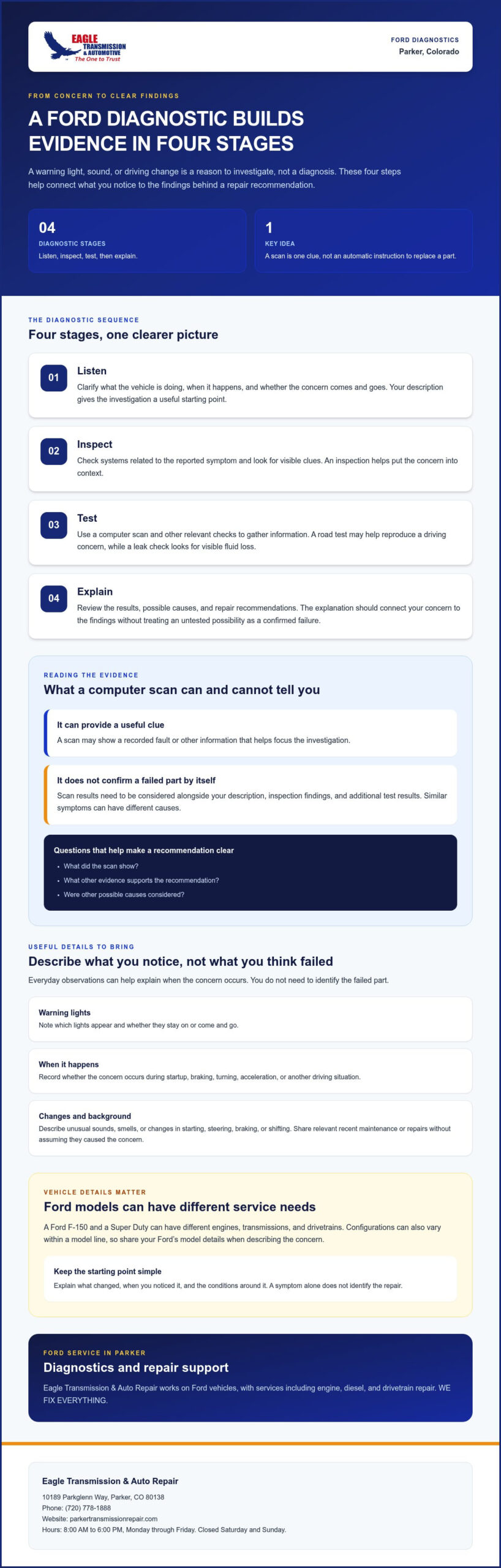
A useful Ford diagnostic starts with the driver’s description and gathers evidence to help distinguish between possible causes. The general steps are to discuss the concern, inspect relevant systems, test what may be involved, and explain the findings in plain language. This helps prevent a warning light or unusual sound from becoming an unsupported guess about which part to replace.
- Listen: Clarify what the vehicle is doing, when it happens, and whether the concern comes and goes.
- Inspect: Check systems related to the reported symptom and look for visible clues.
- Test: Use a computer scan and other relevant checks to gather information.
- Explain: Review the results, possible causes, and repair recommendations with the owner.
A computer scan reads information recorded by vehicle systems. It can point the investigation in a useful direction, but a code is not an automatic instruction to replace a particular part. The scan is one piece of evidence, considered alongside the reported symptom, inspection findings, and test results.
What a scan can and cannot tell you
A scan may reveal a recorded fault or other information that helps focus the investigation. It does not necessarily identify the failed component or explain why the issue occurred. A technician considers scan results alongside your description, inspection findings, and additional test results. Even when a code relates to a specific system, further checks may be needed to determine whether the problem is within that system or connected to another cause.
This matters because similar symptoms can arise from different problems. A warning light is a starting point, not a complete repair plan. Ask what the scan showed, what other evidence supports the recommendation, and whether other possible causes were considered. A clear explanation should connect the reported concern to the findings without presenting an untested possibility as a confirmed failure.
Why inspection and road testing matter
A road test may help reproduce a concern under driving conditions similar to those you described. If a symptom appears only while accelerating or at a certain point in a drive, experiencing the vehicle in motion may provide useful context. A leak check looks for visible fluid loss. Neither check identifies every possible fault on its own.
Eagle Transmission & Auto Repair’s computer diagnostics are always free and include a computer scan, road test, and leak check. These checks provide information to consider before repair options are discussed. The findings still need to be interpreted in context, and a concern may require further evaluation.
For routine service planning, Ford owners can consult the Official Ford Maintenance Schedule for guidance relevant to their vehicle. If a new symptom is the concern, describe when it occurs and the conditions surrounding it. A map to Eagle Transmission & Auto Repair can help you plan a visit for Ford diagnostics in Parker.
What should you compare when choosing a Ford mechanic?
Look beyond whether a shop calls itself a Ford specialist. Consider whether its services match your concern, whether it explains diagnostic findings, and whether the repair recommendation makes sense to you. Eagle Transmission & Auto Repair is a full service facility for all makes and models, including Ford, with repair options across several vehicle systems.
Use this table to organize what matters for your Ford. The goal is to understand whether the repair conversation connects your concern to evidence and a clear next step.
| What to compare | What to look for |
|---|---|
| Service scope | Does the facility work on the system related to your concern, such as the engine, brakes, electrical system, diesel engine, or drivetrain? |
| Diagnostic explanation | Can the shop describe what it checked and how the findings support its recommendation? |
| Communication | Are possible causes, repair options, and unanswered questions explained in language you understand? |
| Location | Is the shop in a location that fits your schedule and makes it practical to bring your Ford in for service? |
A clear explanation matters because a scan result or symptom can point toward several possibilities. A sound, warning light, or change in how the vehicle drives is not enough on its own to confirm which part needs attention. A repair recommendation should connect the concern to inspection or test findings. That reasoning is more useful than a broad label, whether the shop describes itself as a Ford specialist or a general repair facility.
Questions that clarify a repair recommendation
Before approving work, ask which findings support the recommendation and what the proposed repair is intended to address. If more than one option fits the findings, ask how the options differ and what each would resolve. You can also ask what remains uncertain. A straightforward explanation should separate confirmed observations from possibilities, without making the conversation feel like a technical exam.
An accurate quote requires an inspection. The amount depends on the vehicle, parts, labor, extent of the issue, and diagnostic findings. If new information changes the recommendation, ask what the finding means and how it affects the proposed work. This helps you understand the decision rather than relying on a parts list without context.
Match the service to the concern
Consider the system involved, not just the vehicle badge. Engine symptoms call for engine diagnosis and repair. Braking concerns relate to brake service, while electrical problems need electrical diagnostics. Diesel owners can look for diesel repair, including Ford Power Stroke work. For a vibration, noise, or other concern involving the drivetrain, Eagle’s Ford truck drivetrain repair guide offers more information about that service area.
When comparing a Ford mechanic Parker Colorado owners can visit, prioritize relevant service coverage and a repair discussion that makes the reasoning understandable. Ask: “What did the inspection show, and how does that support this next step?”
How can you prepare for Ford service in Parker?
A little preparation can make it easier to describe a Ford concern and understand the next steps. You do not need to identify the cause. Bring the vehicle details you know, describe what changed, and share the conditions under which you notice it. Clear observations help start a focused service conversation with a Ford mechanic Parker Colorado owners can speak with.
Information to have ready
Before bringing in your vehicle, jot down the basics and any changes you have noticed. The goal is to give a useful account, not to arrive with a diagnosis. If a detail is uncertain, say so rather than guessing. Notes about when a concern appears can help distinguish a steady issue from one that comes and goes.
- Vehicle details: Note the Ford model and any engine or drivetrain information you already know. Do not guess at specifications.
- Symptoms: Describe what you notice, such as a new noise, warning light, change in handling, or difficulty starting.
- Timing and conditions: Record when the symptom began and whether it happens during startup, acceleration, braking, turning, or another situation.
- Service background: Bring relevant maintenance or repair records if available. They can provide context, but you do not need a complete service file.
Specific observations are more useful than conclusions. “A sound happens while turning left” gives a mechanic a condition to consider. “The steering part is broken” assumes a cause that still needs testing. If the symptom is intermittent, note how often it occurs and what was happening just before it appeared. Details that seem minor may help shape the diagnostic conversation.
How to understand the next steps
After the vehicle has been assessed, ask for a plain language explanation of the findings. Which observations or test results relate to the concern? What work is recommended, and what is it intended to address? These questions help connect the inspection to the repair discussion without requiring you to interpret technical terms on your own.
Inspection findings shape which repair options are appropriate. If the cause is not clear yet, ask what remains to be checked and what the current evidence supports. A careful explanation should distinguish confirmed findings from possibilities. You can also ask what may happen if you monitor a non urgent symptom rather than address it immediately. Safety concerns deserve prompt attention.
Pricing depends on the Ford, parts, labor, and diagnostic findings. An accurate quote requires an inspection because a symptom description alone may not reveal the work involved. Ask for the recommendation and quote to be explained before authorizing repairs. This gives you a clearer basis for deciding how to proceed.
Once you have gathered your notes and records, get directions to Eagle Transmission & Auto Repair for Ford service.
Where can Ford owners get repair help in Parker, Colorado?
Ford owners in Parker can bring their vehicles to Eagle Transmission & Auto Repair, a local full service facility that works on Ford vehicles and all makes and models. Drivers looking for a Ford mechanic Parker Colorado can consider a shop’s service range and how clearly it explains the work a vehicle may need. Eagle offers Ford repair, computer diagnostics, engine repair, diesel repair, and drivetrain work.
Ford repair within a full service shop
A Ford is one of many makes serviced at Eagle. That broad scope can be useful if a concern involves more than one area of the vehicle or the source is not obvious at first. The relevant repair discussion depends on the findings, whether the concern relates to the engine, a diesel system, or the drivetrain.
An owner might notice a change in how a truck runs without knowing whether the source is the engine or drivetrain. Sharing the symptom and when it happens gives the repair conversation a practical starting point. The appropriate service should follow the evidence, not a guess based on the vehicle badge.
Eagle’s diesel repair includes Ford Power Stroke service. Its drivetrain work can also help Ford owners whose concerns involve the system that transfers power through the vehicle. The company’s commitment to excellence is “WE FIX EVERYTHING,” reflecting its broad approach to automotive repair, not a claim that every symptom has one simple answer.
Plan a visit to Eagle Transmission & Auto Repair
Before contacting the shop, have your Ford’s model details and a short description of the concern ready. Note any warning light, change in performance, or condition that seems to bring on the symptom. You can also share relevant service history if available. These details help make the conversation more focused without requiring you to identify the cause.
During the repair discussion, look for an explanation that ties the recommended work to inspection or diagnostic findings. If a term is unfamiliar, ask for it in plain language. Understanding what was found and what the proposed repair addresses can help you make an informed decision.
Visit Eagle Transmission & Auto Repair at 10189 Parkglenn Way, Parker, CO 80138. Call (720) 778-1888 or review parkertransmissionrepair.com for information. Get directions to the shop for Ford repair.
Take the next step with confidence
Choosing a Ford mechanic Parker Colorado drivers feel comfortable speaking with starts with a practical conversation, not a perfect description of the problem. You do not need to arrive knowing which part has failed. Bring your observations, ask what the findings mean, and take time to understand the recommendation before deciding how to proceed.
If a concern is still on your mind, make it the starting point. A brief note about what changed and when it happens can help explain why you are seeking service. From there, you can discuss inspection findings and repair options with Eagle Transmission & Auto Repair. You deserve to understand the next step without needing to speak in technical terms.
Frequently Asked Questions
Does Eagle Transmission & Auto Repair work on Ford cars and trucks?
Yes. Eagle works on Ford cars and trucks as part of its service for all makes and models. You can discuss an engine concern, brake issue, or driveline symptom without assuming the vehicle needs a particular repair. Share the model and what you have noticed so the concern can be assessed.
Does Eagle diagnose Ford Power Stroke diesel problems?
Yes. Eagle provides diesel diagnostics and repair for Ford Power Stroke vehicles. If your truck has a warning light, a change in performance, or another concern, describe when it happens and any conditions that seem connected. Those details help frame the evaluation, but do not identify a failed part by themselves.
Is the Ford computer diagnostic always free?
Yes. Computer diagnostics are always free and include a computer scan, road test, and leak check. These checks provide information about the vehicle and the concern you have noticed. A scan result is not automatically a parts diagnosis, so the findings need to be interpreted in context. If a symptom is intermittent, describe when it appears.
How much does Ford repair in Parker, Colorado cost?
There is no single amount for every Ford repair. The vehicle, parts, labor, extent of the issue, and diagnostic findings all affect the work involved. An accurate quote requires an inspection because the same symptom can have different causes and repair needs. Ask which findings support the recommended work and what the quote includes.
Can Eagle repair a Ford with an automatic or manual transmission problem?
Yes. Eagle provides transmission diagnostics and repair, including manual transmission repair and clutch replacement. If your Ford shifts differently, makes a new sound, or has trouble engaging a gear, describe the behavior and when it occurs rather than trying to name the failed component. An inspection helps determine which repair options fit the findings.
Can I bring my Ford to Eagle if I live outside Parker?
Yes. Eagle serves Ford owners in Parker and nearby Centennial, Castle Rock, Douglas County, Lone Tree, and Aurora. Gather your vehicle details and a short description of the concern so you can explain what prompted the visit. For Ford repair, call (720) 778-1888 or visit parkertransmissionrepair.com.
For Ford repair in Parker, Colorado, call Eagle Transmission & Auto Repair at (720) 778-1888 or visit parkertransmissionrepair.com to discuss your vehicle’s symptoms and next steps. Get directions to Eagle Transmission & Auto Repair.
10189 Parkglenn Way, Parker, CO 80138
Phone: (720) 778-1888
Website: parkertransmissionrepair.com
Hours: 8:00 AM to 6:00 PM, Monday through Friday. Closed Saturday and Sunday.