What if a locking differential that won’t engage doesn’t need to be replaced? A flashing indicator, clunk during a turn, or wheels that bind can point to different issues, from an actuator or electrical connection to worn internal gears. For locking differential repair Castle Rock drivers need a diagnosis that identifies the locker design and the source of the problem before repair options are chosen.
It’s understandable to worry that an unusual noise or engagement problem means a complete differential replacement. It may not. The type of locking system and what inspection reveals help determine whether service, a component repair, a rebuild, or replacement makes sense. Eagle Transmission & Auto Repair serves Castle Rock drivers with differential gear service and repair from its Parker location. In this article, you’ll learn how locking differentials work, which symptoms are useful to describe, and what diagnosis can uncover. We’ll also look at how repair choices depend on the vehicle and the condition of its differential, so you can approach an evaluation with clearer expectations.
Key Takeaways
- A locking differential helps coordinate wheel rotation when engaged, but its operation depends on the vehicle and locker design.
- Note when noises, vibration, or inconsistent engagement happen. These observations can guide an evaluation, but they do not confirm the cause.
- Inspection findings help determine whether locking differential repair Castle Rock drivers need involves a repair, rebuild, or replacement.
- Vehicle details, warning indicators, symptoms, and maintenance history can help you describe the problem clearly.
- Ask how the diagnosis supports the recommended repair and what factors affect its scope.
What a Locking Differential Does for Castle Rock Drivers
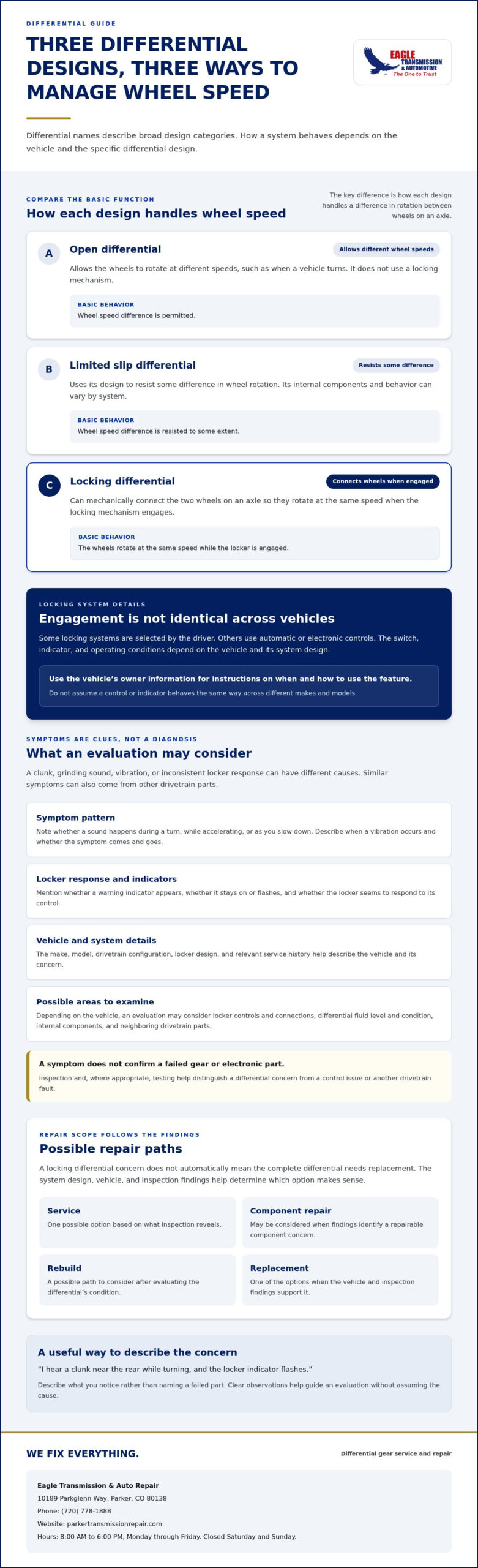
A locking differential helps coordinate wheel rotation when its locking design engages. In a locked state, it connects the two wheels on the same axle so they rotate at the same speed. That differs from a standard open differential, which allows the wheels to rotate at different speeds, such as when a vehicle turns. The exact operating rules depend on the vehicle and differential design.
A locking differential is a drivetrain component that can connect the wheels on an axle so they rotate at the same speed when the locking mechanism engages. This concise definition describes the basic function, not the specific way a vehicle activates the system. The broader locking differential overview describes how these designs differ.
Why does the distinction matter? The word “differential” covers several designs, and their internal arrangements affect how they manage wheel speed. Recognizing the general type is a useful starting point for understanding the vehicle, but it doesn’t identify its exact equipment or tell you how a particular model should behave.
How a locking differential differs from other differential designs
A differential directs power through the axle while allowing the wheels to turn at different speeds as needed. An open differential permits that difference without a locking mechanism. A limited slip differential uses its design to resist some difference in wheel rotation, while a locking differential can mechanically connect the axle wheels when engaged. The actual behavior varies by system.
These labels describe broad design categories, not a guarantee of identical operation across vehicles. A limited slip unit and a locking unit may use different internal components and controls. A vehicle may also have different differential designs at the front and rear, so identifying one axle doesn’t necessarily establish the configuration of another.
What drivers should know about locker engagement
Some locking systems are selected by the driver, while others use automatic or electronic controls. The switch, indicator, and operating conditions are specific to the vehicle. Check the owner information for instructions on when and how to use the feature. Don’t assume that a control or indicator behaves the same way across different makes and models.
Understanding the system type helps frame a conversation about locking differential repair Castle Rock, but it doesn’t identify a fault. A control concern and an internal mechanical concern are different possibilities, and the vehicle’s design determines what components are involved. Eagle Transmission & Auto Repair offers differential gear work as part of its drivetrain services, including rear differential repair.
Locking Differential Symptoms and Diagnosis in Castle Rock
A locking differential concern can show up as a clunk, grinding sound, vibration, or a locker that responds inconsistently. The timing and pattern matter. A noise during a turn may suggest a different area to examine than a vibration that follows vehicle speed, but neither observation proves the differential is at fault. Similar symptoms can come from other drivetrain parts, so a diagnosis requires examining the specific vehicle.
A sound or engagement symptom can point toward an area to inspect, but it cannot identify the failed component by itself. For locking differential repair Castle Rock drivers are considering, separating a differential issue from a control concern or another drivetrain fault is an important part of deciding what work may be appropriate.
Which details help describe the problem
When describing the concern, explain what the vehicle was doing when you noticed it. For example, note whether a sound happens during a turn, while accelerating, or as you slow down. If it comes and goes, say whether you have noticed a pattern. These details can help make the symptom easier to reproduce and evaluate, without requiring you to identify its source.
Also mention whether a warning indicator appears, whether it stays on or flashes, and whether the locker seems to respond to its control. Share the vehicle’s make, model, and drivetrain configuration, along with relevant service history or recent changes. Avoid translating a sensation into a diagnosis. “A clunk near the rear while turning” is more useful than saying a particular gear has failed.
How a technician narrows down possible causes
An evaluation may consider mechanical and control related causes. Depending on the vehicle, relevant areas can include the locker controls and connections, differential fluid level and condition, and internal components. A warning indicator can be useful context, but it doesn’t by itself confirm a damaged gear or a failed electronic part. The system design and the vehicle’s observed behavior both matter.
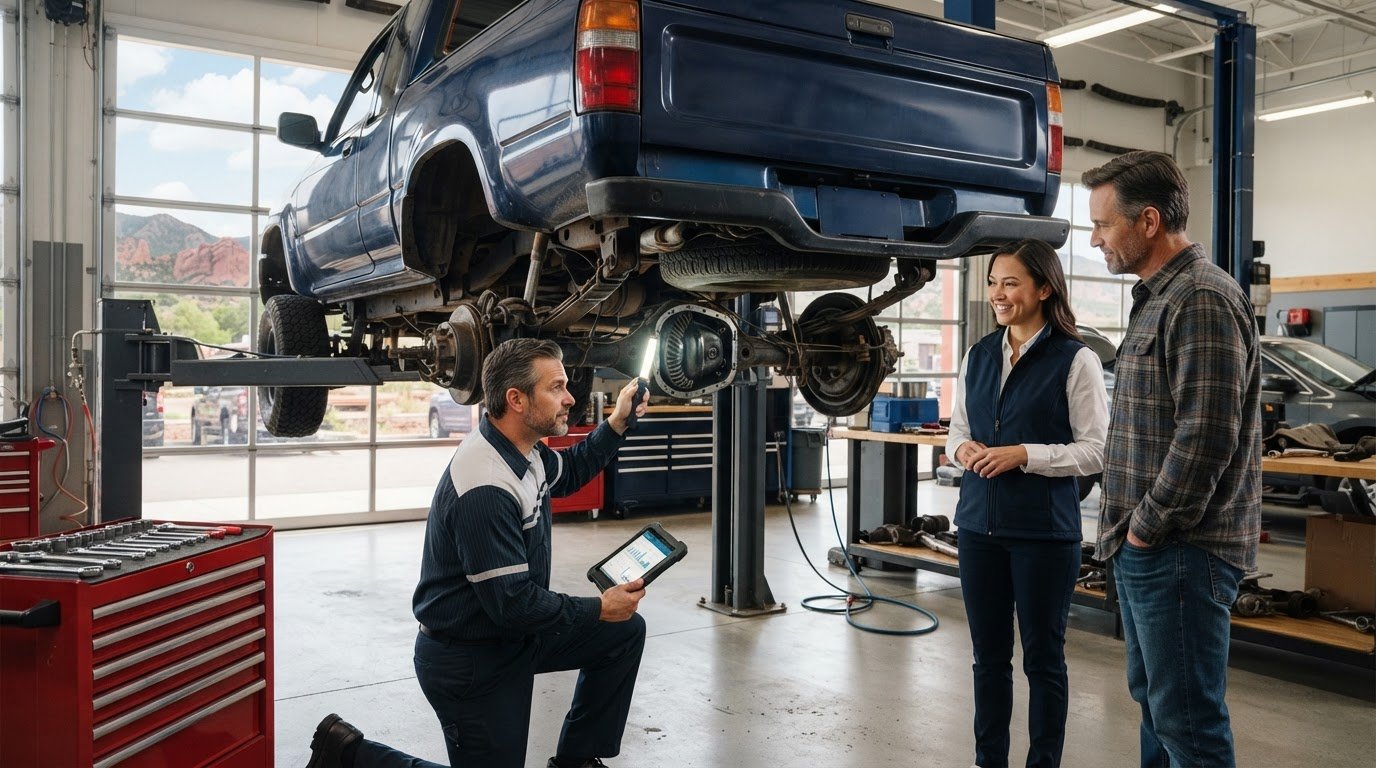
Inspection also helps distinguish the differential from neighboring drivetrain components that can produce similar sensations or sounds. For example, a vibration may need to be assessed in relation to other rotating parts, while a clunk may require locating where it originates. The fact that a symptom seems to come from one end of the vehicle is a clue, not proof. A technician needs to examine and, where appropriate, test the vehicle before identifying a cause. The findings may point toward the differential, its controls, or another part of the drivetrain, and the repair recommendation should follow those findings rather than the symptom alone.
Locking Differential Repair Options and What Determines the Scope
After an inspection identifies the source of a locking differential concern, the possible paths may include service, a focused repair, a rebuild, or replacement. These are options to consider, not steps every vehicle automatically needs. The findings help determine whether the issue involves a service item, a specific component, or damage that affects a larger part of the assembly. An accurate quote requires inspection.
The scope and cost depend on the vehicle, parts, labor, and inspection findings. A useful recommendation should explain what the inspection found and connect that finding to the proposed work. This helps answer a practical question: does the vehicle need attention to one part, or does the condition call for a broader approach?
When repair, rebuild, or replacement may be considered
A technician first needs to identify which components are affected. If the findings point to a specific repairable part, a focused repair may be considered. A rebuild involves work on components within the existing differential. Replacement means replacing the differential assembly. The vehicle’s design and the condition of its parts help determine which options are suitable. No approach is always cheaper, faster, or more durable.
Inspection: Establishes what condition the differential and related components are in. It provides information for a recommendation, but is not itself a repair.
Repair: Addresses an identified fault in a component when that work fits the findings.
Rebuild: Involves work on the existing unit, with the scope shaped by which internal components need attention.
Replacement: Replaces the differential assembly, with fit and vehicle configuration considered in the recommendation.
When reviewing an estimate, ask which finding supports the proposed work, what parts and labor are included, and whether related components are part of the scope. Those details make it easier to compare the options on their actual merits rather than assume a rebuild or replacement is automatically necessary.
Fluid service and related differential work
Differential gear service may be relevant when fluid condition or service history is part of the evaluation. The correct fluid depends on manufacturer specifications and assessment of the vehicle, so don’t select it based only on a generic product description. Eagle’s guidance is: change your differential fluid every 25,000 to 30,000 miles. Follow vehicle specific manufacturer guidance when determining the appropriate service for your vehicle.
Fluid service and mechanical repair address different needs. A fluid change does not establish that an internal part is damaged, and it should not be treated as a substitute for investigating a mechanical concern. Eagle Transmission & Auto Repair provides differential fluid service as related drivetrain work. The inspection findings, vehicle design, parts, and labor shape which option is appropriate and the cost.
Preparing for Locking Differential Repair in Castle Rock
A little preparation can make a differential inspection more useful. You don’t need to diagnose the problem before bringing in the vehicle. Instead, gather the details you know and describe what you noticed in plain language. For locking differential repair Castle Rock drivers can start by recording the conditions around the noise or engagement concern.
What to note before arranging an inspection
Write down when the symptom occurs and whether it happens repeatedly. Note whether it appears while turning, accelerating, slowing down, or trying to engage the locker. Also record any warning indicator you see and what the vehicle does at that moment. These observations help explain the concern without assuming which part is responsible.
- Vehicle make, model, and drivetrain configuration.
- What you hear or feel, and when it happens.
- Whether a warning indicator appears or locker operation seems inconsistent.
- Relevant maintenance history, including known differential service or recent drivetrain changes.
- Any available service records or owner information for the vehicle.
Specific circumstances matter. A sound that occurs only during a turn may provide different context from one heard while driving straight. If the concern happens intermittently, say so and describe what you were doing when it appeared. Avoid naming a failed gear or control unless an inspection has identified it. A clear description is more helpful than a confident guess.
How to plan the next step
Bring your notes and vehicle details when arranging an inspection. Appointments are not required, but highly recommended. That gives you a chance to share the concern and relevant service information, and helps make the visit easier to plan.
Maintenance records can help establish what service has already been performed. If you’re unsure about the differential fluid history, note that as well. Fluid requirements vary by vehicle, so use its manufacturer information and an appropriate assessment rather than choosing fluid based on a general recommendation. Eagle’s differential fluid service information can help you understand how fluid service relates to drivetrain care.
For Castle Rock drivers seeking differential service, Eagle Transmission & Auto Repair provides differential gear work as part of its broader drivetrain repair services. An inspection can help clarify whether the concern points to the differential or another component, and whether service or a more involved repair should be considered.
Have your vehicle details and symptom notes ready, then get directions to Eagle Transmission & Auto Repair to arrange an inspection.
Choosing Locking Differential Repair Near Castle Rock
Choosing a shop for locking differential repair Castle Rock drivers can start by finding out how the recommendation connects to the inspection findings. A useful explanation should identify the part or system that needs attention, describe the proposed work in plain language, and clarify whether repair, rebuild, or replacement is being considered. You should be able to understand why that option fits the vehicle’s condition.
Questions that clarify a repair recommendation
Use your inspection discussion to understand the reasoning, not to arrive with a predetermined repair in mind. These questions can help:
- Which component or system appears to need attention, and what findings point to it?
- Could the symptom involve another part of the drivetrain?
- How does the proposed repair, rebuild, or replacement address the identified condition?
- What parts and labor are included in the recommended scope?
- Which details about the vehicle or inspection findings affect the cost?
Cost depends on the vehicle, parts, labor, and inspection findings. An accurate quote requires inspection, so a general estimate cannot replace an evaluation of the specific differential and related components. If you’re comparing approaches, ask what each option involves for your vehicle rather than assuming one is automatically less expensive or more appropriate.
A local next step for Castle Rock drivers
Eagle Transmission & Auto Repair provides differential gear repair, rebuild, and replacement as part of its drivetrain work. That gives Castle Rock drivers a local option for discussing a locking differential concern alongside other differential findings. The rear differential repair guide offers further context about this type of drivetrain work.
Before arranging an inspection, have your vehicle details and a clear description of the symptoms ready. Appointments are not required, but highly recommended. Eagle Transmission & Auto Repair is located at 10189 Parkglenn Way, Parker, CO 80138, and is open 8:00 AM to 6:00 PM, Monday through Friday. Closed Saturday and Sunday.
If you’re ready to discuss a differential concern, get directions to Eagle Transmission & Auto Repair. WE FIX EVERYTHING is the company motto, and the right next step is an inspection that helps clarify the repair options for your vehicle.
Eagle Transmission & Auto Repair
10189 Parkglenn Way, Parker, CO 80138
Phone: (720) 778-1888
Website: parkertransmissionrepair.com
Hours: 8:00 AM to 6:00 PM, Monday through Friday. Closed Saturday and Sunday.
Move Forward With a Clear Repair Plan
You don’t need to know which part has failed before taking the next step. The goal is to have the vehicle assessed and understand how the findings connect to the recommended work. That gives you a practical basis for deciding what to do, whether the concern calls for differential service or a more involved repair.
For locking differential repair Castle Rock, bring your observations and questions to Eagle Transmission & Auto Repair. A conversation about the inspection findings can help you understand the available options for your vehicle without assuming the repair in advance.
Ready to plan an evaluation? Get directions to Eagle Transmission & Auto Repair and take the next step toward a clearer picture of your differential concern.
With the right information in hand, you can make the repair decision one step at a time.
Frequently Asked Questions
Is a locking differential the same as a limited slip differential?
No. A limited slip differential can limit how differently the wheels rotate and help transfer power, but it doesn’t necessarily lock the axle wheels together. A locking differential can connect the wheels so they turn at the same speed when engaged. Because designs vary, the vehicle’s manual or specifications can clarify which type is installed. The distinction matters when discussing locking differential repair Castle Rock, since the unit’s design affects what needs evaluation.
Can I tell whether my vehicle has a factory locking differential?
You may be able to confirm it by checking the original vehicle window sticker, build information, or owner’s manual for the specific model and equipment. A dashboard switch or indicator can be a clue, but it isn’t conclusive by itself because controls and features differ among vehicles. If records are unavailable, use the vehicle identification information with manufacturer or service documentation to identify the axle and differential configuration.
Does a locking differential use special fluid?
It may require fluid with specifications specific to the vehicle and differential assembly. Don’t select lubricant from the words “locking differential” alone, or assume that fluid used in another vehicle is suitable. Check the owner’s manual or vehicle specific service information for the required specification. If the axle configuration is uncertain, identifying the exact vehicle setup first helps avoid choosing fluid based on a guess.
Can an electronic locking differential have a control problem instead of a gear problem?
Yes. A locker that doesn’t respond to its control may have an issue in the control system, such as a switch, electrical connection, sensor, or actuator, rather than damaged internal gears. A warning indicator or unsuccessful engagement doesn’t identify which part is responsible. Diagnosis needs to distinguish whether the system is receiving and carrying out the command or whether a mechanical issue is present.