
A timing belt can wear without making a clear noise, so waiting for an obvious warning is not a reliable way to decide when it needs attention. If you are researching timing belt replacement in Castle Rock, start by identifying your vehicle’s engine: some engines use a timing chain instead of a belt, and maintenance guidance varies by design.
Rough idling, a misfire, or difficulty starting can have several causes. These symptoms alone do not confirm a timing belt problem, and the belt may sit behind a protective cover. An inspection and the vehicle’s service history can help determine whether the belt needs attention or another issue is more likely.
This guide explains what the timing belt does, which signs may warrant an inspection, and what information helps clarify a repair recommendation. Eagle Transmission & Auto Repair provides engine diagnostics and repair for drivers in Castle Rock and nearby communities, including Parker, Centennial, Aurora, Douglas County, and Lone Tree.
Key Takeaways
- A timing belt keeps key engine parts moving in sync. The engine design affects what may happen if the belt fails.
- For timing belt replacement Castle Rock drivers can make the discussion more productive by bringing the vehicle’s year, make, model, and engine details.
- Maintenance records can show whether the belt has been replaced and help clarify whether service may be due.
- A belt inspection and engine diagnostics can help distinguish a timing belt concern from other possible causes of rough running or starting problems.
- Describe changes in the engine’s sound or operation, but avoid treating one symptom as proof that the belt is failing.
What a timing belt does and why replacement matters
A timing belt is a toothed belt that coordinates the movement of an engine’s crankshaft and camshaft. The crankshaft moves the pistons, while the camshaft controls when the engine’s valves open and close. Keeping these parts in sync allows the engine to run as designed.
If a belt wears, slips, or breaks, the engine may run poorly or stop running. Depending on the engine design, a belt failure can also allow internal engine parts to collide and cause additional damage. That is why replacement decisions should follow guidance for the specific vehicle and engine, rather than a general mileage estimate.
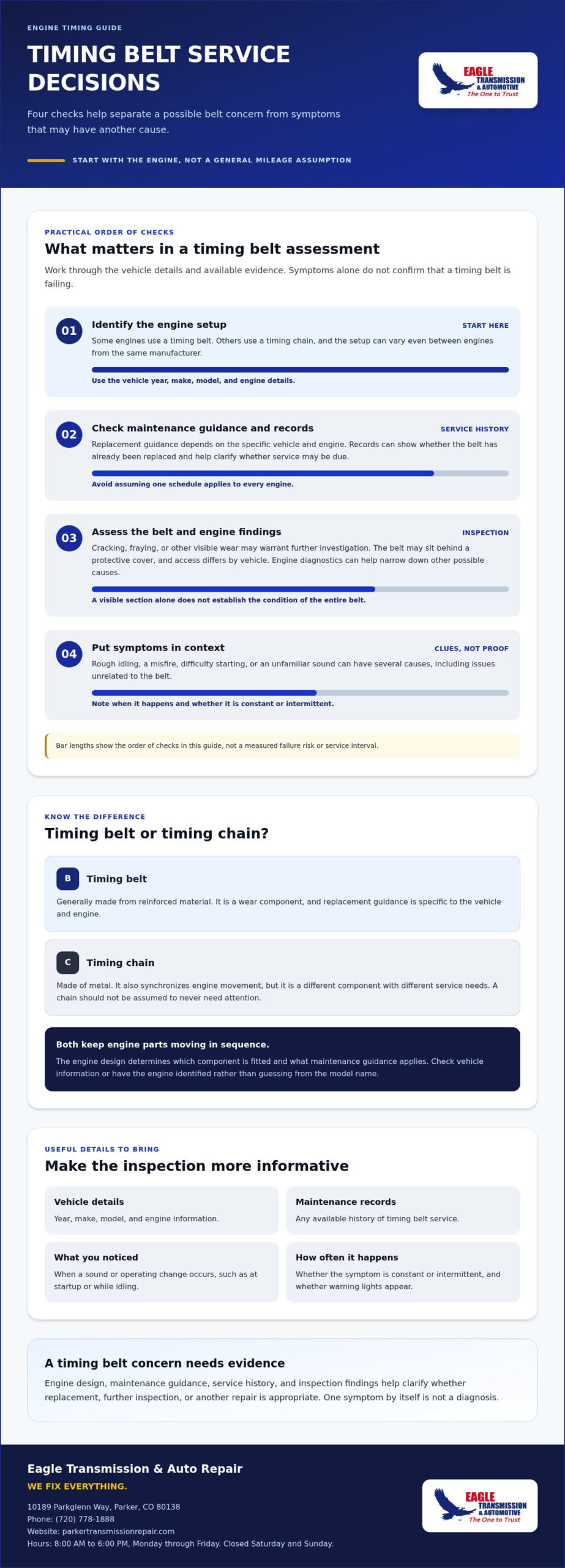
Not every vehicle has a timing belt. Some engines use a timing chain, and the setup can vary between engines from the same manufacturer. For timing belt replacement Castle Rock drivers should start with the vehicle’s year, make, model, and engine, then check the applicable maintenance guidance and service records. If the engine type or past service is unclear, an inspection can help establish the next step.
How the belt keeps engine parts working in sequence
The crankshaft turns as the pistons move. The camshaft turns in coordination, opening and closing the valves so the engine can take in air and fuel and release exhaust. Teeth on the belt help maintain the correct relationship between those movements. If the timing shifts, the engine’s parts may no longer work together as intended. The timing belt (camshaft) overview offers additional background on the component and its role.
Timing belt or timing chain: what is the difference?
A timing belt is generally made from reinforced material, while a timing chain is metal. Both synchronize engine movement, but they are different components with different service needs. The engine’s design determines which one is fitted and what maintenance guidance applies. Check the owner information for the correct terminology or have the engine identified during an inspection rather than guessing from the vehicle’s model name.
A belt is a wear component, but its replacement interval is specific to the vehicle and engine. Do not assume every belt follows the same schedule or that a timing chain never needs attention. Owner information and maintenance records help establish what service is appropriate. If the records are incomplete, an inspection can help clarify the options without treating a symptom or a general schedule as proof that replacement is due.
Eagle Transmission & Auto Repair provides engine diagnostics and repair to help identify the concern and guide the appropriate next step.
Timing belt symptoms that may call for an inspection
An unusual sound, a change in engine operation, or visible wear may be a reason to investigate, but none of these signs proves the timing belt is failing. Some vehicles provide little obvious warning before a belt problem, so consider symptoms alongside the engine design and maintenance history. For timing belt replacement Castle Rock drivers should rely on vehicle specific information and inspection findings, not one clue or a general assumption.
Note what changed and when. Does a noise happen only at startup, continue while the engine runs, or occur alongside a rough idle? Is the engine harder to start than usual? These details give a technician useful context, but they do not identify the cause on their own.
What unusual engine sounds can and cannot tell you
A ticking, clicking, or other unfamiliar sound deserves attention, particularly if it is new or becoming more noticeable. Sound alone cannot confirm a timing belt concern. Other engine components can make noise, and it can be difficult to identify where a sound comes from while driving. Describe what you hear and when it occurs instead of assuming a particular part has failed.
Changes in engine operation also need context. Rough idling, misfiring, and difficulty starting can have several possible causes, including issues unrelated to the belt. A check engine light or an intermittent symptom adds information, but still needs to be interpreted alongside other findings. Replacing a component based only on a sound or one episode of poor performance can miss the actual cause.
Visible wear and changes in engine operation
If the belt is accessible during an appropriate inspection, cracking, fraying, or other visible wear may warrant further investigation. Access differs by vehicle, and the belt may be behind a protective cover. Looking at one exposed section does not establish the condition of the entire belt or prove it caused an engine symptom.
Inspection and testing help connect the evidence. A professional assessment can take the engine design, service records, and reported symptoms into account. For example, a misfire may come from components other than the timing belt. Engine diagnostics can help narrow down possible causes, while a physical inspection may be needed to assess the belt itself.
- Record when the sound or operating change occurs, such as at startup, while idling, or during acceleration.
- Note whether the issue is constant or intermittent, and whether any warning lights appear.
- Bring available maintenance records, especially if you are unsure whether the belt has been serviced.
If a new sound or change in engine operation concerns you, consider visiting Eagle Transmission & Auto Repair for an engine inspection. An assessment can help distinguish a belt concern from another possible cause and guide the next step.
Replacement, inspection, or another repair: how to think it through
A timing belt concern does not automatically mean the belt needs replacement. The next step may be reviewing the vehicle’s maintenance guidance, inspecting the belt, replacing it according to vehicle specific service requirements, or diagnosing another cause of the symptoms. A sound recommendation should fit the engine design, service history, and inspection or test results.
Consider three questions: Does this engine use a timing belt? Is there reliable information showing that replacement is due or has already been completed? Do the symptoms and inspection findings point to the belt, or could another component explain them? These questions help avoid a guess based on a general schedule or an unnecessary repair based on one symptom.
When vehicle specific maintenance information matters
Replacement guidance differs by vehicle and engine, so there is no single interval that applies to every timing belt. Check the owner information and maintenance guidance for the exact vehicle and engine. If service records are incomplete, do not assume the belt is overdue or recently replaced. Share what is known and use an inspection to help clarify the history and appropriate next step.
How a technician narrows down the possible cause
A technician considers the reported symptoms, service records, engine design, and inspection or test results together. Depending on the concern and access to the belt, the assessment may include checking its condition and timing related evidence, as well as evaluating other possible sources of rough running or starting trouble. A scan result can provide useful clues, but it does not prove by itself that the timing belt is at fault.
An engine misfire, for example, can have several possible causes. Spark plugs, sensors, and other components may be involved, and symptoms can overlap with concerns related to engine timing. The diagnostic process compares the clues instead of treating one code, sound, or rough idle as a complete answer. If the belt is difficult to see, a glance at an accessible area may not represent its full condition.
After reviewing the vehicle details and available evidence, the appropriate recommendation may be:
- Inspection: Useful when belt condition, engine design, or maintenance history is uncertain.
- Scheduled replacement: Considered when vehicle specific maintenance guidance and service records indicate that service is due.
- Diagnosis of another cause: Appropriate when the evidence points to a different engine component or system.
The findings should explain why a repair is recommended and what evidence supports it. If testing has not identified the source, further diagnosis may be needed before choosing a repair. For timing belt replacement Castle Rock drivers can bring vehicle details and service records to an engine diagnostic assessment, so the next step is based on findings rather than a symptom alone.
Preparing for timing belt service in Castle Rock
Accurate vehicle details, maintenance records, and a clear description of what you have noticed can make a timing belt inspection more useful. For timing belt replacement Castle Rock drivers should focus on information specific to their engine, rather than a generic mileage assumption.
Before arranging an inspection, use this short sequence:
- Gather the vehicle details. Write down the year, make, model, and engine information. If you are unsure which engine is in the vehicle, mention that when arranging an inspection.
- Collect maintenance records. Look for service invoices or notes that may show whether timing belt work was completed. If records are missing, say so rather than guessing about past service.
- Describe what you noticed. Note when a sound or change in engine operation began, whether it happens consistently, and what conditions bring it on. Describe the observation, such as “rough idle after starting,” rather than stating that the belt is definitely the cause.
- Bring your questions. Make a short list so you can understand the findings, the vehicle specific guidance, and the reasoning behind the recommendation.
Information to bring to a timing belt inspection
Include the vehicle year, make, model, and engine if known, along with any available maintenance history. If a symptom started after another repair or changed over time, mention that too. These details help frame the inspection, but they do not replace checking the vehicle and its applicable maintenance information.
Questions that help clarify the recommendation
A clear explanation should connect the proposed work to evidence. Consider asking:
- What inspection findings support replacing the belt instead of investigating another cause?
- Which maintenance guidance applies to this specific engine and vehicle?
- Could another component explain the sound or change in engine operation?
- What parts and labor are included in the recommended repair, and what findings could change its scope?
The repair scope depends on the vehicle, the parts involved, the labor required, and the inspection findings. An accurate estimate requires assessing the vehicle. If the evidence points to an issue beyond the belt, diagnostic results can help explain why another repair may be appropriate. Ask for the findings in plain language so you can understand what was checked and how it supports the recommendation.
Preparation does not mean arriving with a diagnosis. It means sharing useful details and getting a clear explanation before deciding how to proceed. To discuss an inspection, plan your visit to Eagle Transmission & Auto Repair.
Timing belt replacement in Castle Rock: choose a clear next step
If you are unsure whether your engine needs a timing belt inspection, replacement, or diagnosis for another concern, start with the vehicle details and available service history. Eagle Transmission & Auto Repair is in Parker and provides engine diagnostics and repair for Castle Rock drivers. Inspection findings help guide the appropriate next step.
What to expect when discussing an engine concern
Share the vehicle details you have, any maintenance records, and a clear description of what you have noticed. Explain when a sound or change in operation began and whether it happens consistently. The recommendation depends on inspection findings and information specific to your vehicle. Eagle’s engine repair service connects diagnostic findings with the repair decision, whether the concern points to the timing belt or another possible cause.
Request a local timing belt inspection
You do not need to know whether the engine has a timing belt or chain before discussing an inspection. Share what you know about the vehicle and its service history, then use the inspection findings to guide the conversation.
For timing belt replacement Castle Rock drivers can take a straightforward next step by discussing their engine concern with Eagle Transmission & Auto Repair. Visit parkertransmissionrepair.com to contact the shop about an inspection.
Take the next step with clear information
You do not need to arrive with a diagnosis. Bring the details you have and let the inspection findings guide the conversation. This helps determine whether timing belt replacement is relevant to your specific engine or whether another issue deserves attention first.
Before your visit, jot down any changes you have noticed and gather available maintenance records. Use the inspection results to ask what was found, how it relates to your vehicle, and which options make sense. A clear explanation can help you make a practical decision without relying on guesswork.
Get directions to Eagle Transmission & Auto Repair for a timing belt inspection.
Frequently Asked Questions
How do I know if my car has a timing belt or a timing chain?
Check the maintenance information for the exact engine in your vehicle. Engines within the same model line can differ, so a broad model listing may not identify the right setup. If the information is unclear, an inspection can help confirm which component the engine uses.
Can a timing belt fail without an obvious warning?
Yes. A belt may not give a dependable warning that shows how much service life remains. The absence of noise or rough running does not establish its condition, so consider the vehicle specific maintenance guidance and available service history.
Is timing belt replacement the same as timing chain replacement?
No. Both components synchronize engine movement, but they have different designs and service procedures. Confirm which component is fitted and what work is recommended for your engine before approving a repair.
Can I keep driving if I suspect a timing belt problem?
If the engine is running abnormally or the concern is worsening, avoid continuing a routine drive based on guesswork. Pull over somewhere safe if the vehicle’s operation changes substantially, then arrange an assessment. If it runs normally but its service history is uncertain, check the vehicle specific maintenance guidance and have the concern assessed.
What information should I bring to a timing belt inspection?
Bring available service records and the vehicle’s year, make, model, and engine information if known. Also note when the symptom began, what it feels or sounds like, and whether it happens consistently. These details help connect the concern with the correct engine information.
For timing belt replacement Castle Rock drivers considering an inspection can call Eagle Transmission & Auto Repair to discuss the vehicle’s symptoms and service history, or visit parkertransmissionrepair.com.
Eagle Transmission & Auto Repair
10189 Parkglenn Way, Parker, CO 80138
Phone: (720) 778-1888
Website: parkertransmissionrepair.com
Hours: 8:00 AM to 6:00 PM, Monday through Friday. Closed Saturday and Sunday.