A rear differential whine doesn’t automatically mean the gears are failing. For rear differential noise diagnosis in Castle Rock, note when the sound occurs and whether it changes with speed, acceleration, or turning. A howl under acceleration can point to worn ring and pinion gears or an improper gear setup. Leaking seals or gaskets, low or degraded gear oil, and worn bearings can also cause differential noise.
It’s understandable to wonder whether a clunk, vibration, or whine signals a major repair. The sound alone can’t confirm the cause: wheel bearings, CV axles, and driveshaft problems can create similar symptoms. This guide explains how seals, gaskets, bearings, and gears can contribute to noise, what patterns may help narrow down the source, and how diagnosis can distinguish differential trouble from other drivetrain or wheel-related issues. You’ll also learn which repairs may address the problem and why a persistent whine deserves attention.
Key Takeaways
- Note whether the sound changes during acceleration, deceleration, turning, or as road speed increases. Those patterns help narrow down the possible source.
- A leak around an axle seal or gasket can reduce gear oil, while worn bearings or damaged gears may create noise or vibration.
- Clunks and steady vibration can also come from other drivetrain components, so one symptom alone does not identify the faulty part.
- Compare how the noise responds to throttle and turning to help distinguish differential concerns from possible wheel bearing or tire noise.
- A persistent whine may worsen as internal wear continues. Diagnosis helps determine whether service, a component repair, or gear work is appropriate.
Axle seals, gaskets, bearings, and gears
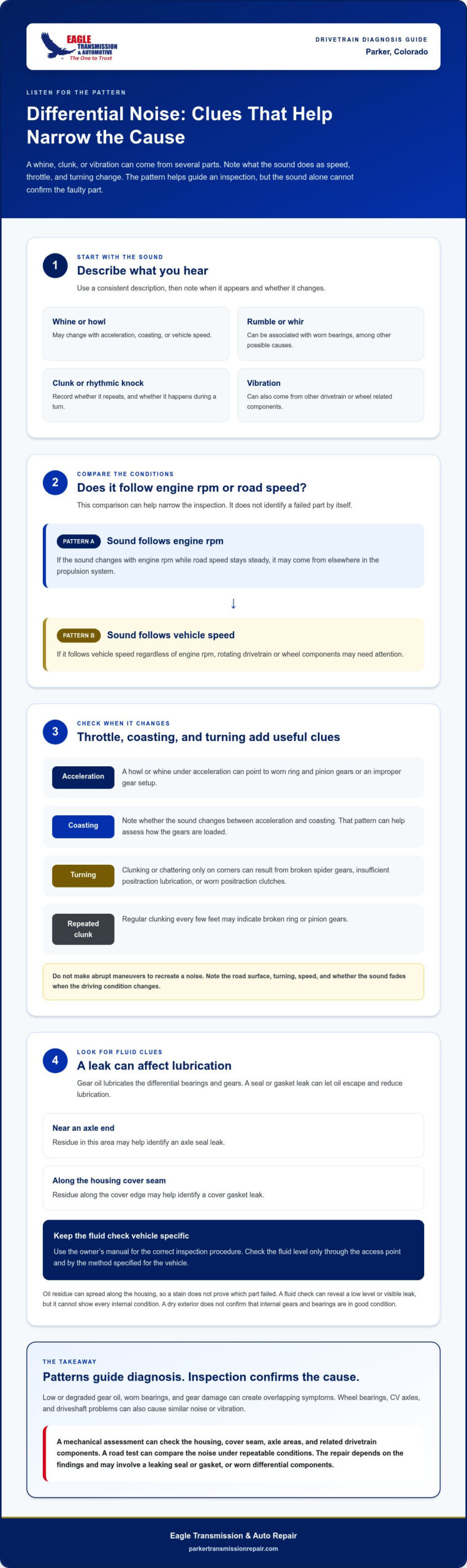
A rear differential relies on gear oil, sealed housing joints, bearings, and meshing gears. A leak or worn internal part can change its sound during acceleration, under load, or as road speed changes.
Inspecting Differential Fluid and Leaks
Start by checking the owner’s manual for the correct differential fluid inspection procedure. With the vehicle parked on level ground, look around the differential housing, cover gasket, and axle seals for fresh wetness or drips. Check the fluid level only through the access point and by the method specified for your vehicle. Note where any leak appears and whether the fluid level is low.
A seal or gasket leak can let gear oil escape, reducing lubrication for the bearings and gears. Note whether the leak appears near an axle end or around the housing cover. Its location may help distinguish an axle seal leak from a cover gasket leak. Don’t assume a stain identifies the failed part, since residue can spread along the housing.
Axle seals sit where the axle shafts meet the differential housing. If a seal leaks, oil may collect nearby or spread across surrounding components. A cover gasket seals the joint between the differential housing and its cover. A leak at that seam may leave residue along the cover edge. Either leak can contribute to low gear oil.
Bearings and Gear Components
Bearings support rotating parts inside the differential, including the gears. Worn bearings can produce rumbling, whirring, or other noise that changes with vehicle speed or throttle. The sound alone won’t identify which bearing is worn. Its pattern, location, and operating conditions help narrow down the possibilities.
The ring and pinion gears transfer power through the differential. A howl or whine during acceleration can point to worn gears or an improper gear setup. Gear wear may also cause noise across a range of speeds. Note whether the sound changes between acceleration and coasting, as this can help diagnosis focus on how the gears are loaded.
Low or degraded gear oil, bearing wear, and gear damage are common differential concerns, and they can overlap. A leak may reduce lubrication while wear affects a bearing or gear surface. A fluid check can reveal a low level or visible leak, but it can’t show every internal condition. No visible leak doesn’t establish that the bearings and gears are in good condition.
Before arranging diagnosis, note whether the noise occurs during acceleration, at steady speed, or while coasting. Add whether it changes with vehicle speed or throttle, and describe the location of any visible leak. These observations can help distinguish fluid loss from possible bearing or gear concerns. The repair depends on the findings and may involve fixing a leaking seal or gasket, or repairing worn differential components.
Differential noise diagnosis
Diagnosis is more useful when the sound can be linked to a repeatable driving condition. For rear differential noise diagnosis in Castle Rock, record the vehicle’s speed, engine behavior, and road conditions when the sound appears. These details help focus an inspection on the symptom rather than a guess about the part.
Differential Noise Clues
Describe the sound consistently: a smooth whine, rough grind, rhythmic knock, or low hum. Note whether it changes during acceleration, coasting, or a turn. A repeatable pattern gives the inspection a clearer starting point than a sound description alone.
Engine rpm and road speed can help distinguish possible sources. If the sound follows engine rpm while road speed stays steady, it may come from elsewhere in the propulsion system. If it follows vehicle speed regardless of engine rpm, rotating drivetrain or wheel components may need attention. This comparison helps narrow the inspection without identifying a failed part by sound alone.
Keep your observations practical. Record the road surface, whether the vehicle is turning, and whether the sound fades when the driving condition changes. Don’t make abrupt maneuvers to recreate a noise. A brief written log can show whether the sound is consistent across separate trips.
Inspection Coverage for Noise and Leaks
A differential noise or leak calls for a mechanical assessment of the differential and related drivetrain components. An emissions result doesn’t describe the condition of internal gears, bearings, seals, or the differential housing. An emissions check is not a substitute for diagnosing a mechanical symptom.
A mechanical inspection can begin with the outside of the assembly. The housing, cover seam, and axle areas can be checked for visible fluid residue. The location and spread matter because oil can travel across nearby surfaces. A dry exterior, however, doesn’t establish the condition of internal parts.
The reported sound should be considered alongside how the vehicle operates. A road test can compare the noise under repeatable conditions, while a physical inspection can assess relevant drivetrain components. The goal is to connect observations with findings, not rely on a single sound or stain.
For rear differential noise diagnosis in Castle Rock, share the exact conditions that bring on the symptom. Mention recent changes, such as a new vibration or a leak that has become more visible. This context helps the inspection determine whether the differential or another component needs attention.
Regular clunking every few feet may indicate broken ring or pinion gears. Banging, clunking, or chattering only on corners can result from broken spider gears, insufficient positraction lubrication, or worn positraction clutches.
A differential whine or howl that increases with speed may occur during acceleration or under load. Note which pattern best matches the sound, including whether it appears during a turn or under load. These clues can focus a mechanical assessment, but the sound alone can’t confirm which part is affected. Share the conditions that produce it so the inspection can compare your report with the vehicle’s condition.
Differential-related vibration and clunking
A vibration or clunk may involve the rear differential, but other drivetrain parts can cause similar symptoms. Track when it happens: during acceleration, starting from a stop, cruising, or changing throttle. The pattern helps narrow the inspection without treating one noise as a diagnosis.
A steady vibration that grows with vehicle speed may come from worn U-joints or an out-of-balance driveshaft. These parts carry power through the drivetrain, so their movement can be felt through the vehicle. Note whether the vibration grows gradually as speed rises or appears only during acceleration.
Clunking as the vehicle starts moving or as you press and release the accelerator can point to loose yokes or bad U-joints. Worn transfer case or transmission parts may cause a similar pattern. Note whether the sound happens once during a throttle change or repeats as the vehicle moves.
A rear differential problem can also cause vibration or noise that changes with vehicle speed or throttle. A sound that grows stronger under load differs from one that appears while coasting. Write down the conditions rather than relying on a general description such as “it shakes.”
Can you keep driving? Noise alone can’t establish whether a vehicle is safe to drive. If you experience a severe bang, rapidly worsening vibration, or a change in handling, pull over safely and arrange an inspection instead of continuing the trip.
Use a simple observation sequence on a familiar route. Note the speed range, whether you’re accelerating or coasting, and whether the vehicle is turning. Avoid sudden throttle changes while testing. If the vibration appears abruptly or makes the vehicle difficult to control, stop the test.
The location and timing of a clunk can offer another clue. A single clunk when power first reaches the drivetrain differs from repeated clunks as the wheels turn. Repeated impacts may indicate a more serious mechanical problem, while one impact can still involve driveline movement or a worn connection. An inspection is needed to distinguish them.
During diagnosis, the vibration pattern can guide checks of U-joints, driveshaft balance, yokes, and differential components. A clunk tied to throttle changes directs attention to parts that respond to load. Inspection findings determine whether differential gear service or work on another drivetrain component is appropriate.
Before an inspection, write down three details: the driving condition, whether the sound repeats, and whether the vibration changes with speed. For example, “one clunk when accelerating from a stop” is more useful than “rear end noise.” This record helps connect the symptom to the conditions that reproduce it.
Rear differential repair
The repair depends on the failed part and the condition of nearby components. A leak may call for seal or gasket repair, while internal bearing or gear damage may require more involved differential work. Inspection findings, not the sound alone, determine the right approach.
How do repair costs compare? Differential, wheel bearing, tire, and driveshaft repairs can’t be ranked reliably without knowing the vehicle and failed part. Parts, labor, and the extent of damage affect each repair differently, so an inspection is needed for an accurate quote.
Which shop can Castle Rock drivers contact? Eagle Transmission & Auto Repair in Parker provides differential gear service and drivetrain diagnosis and repair. Castle Rock drivers with a suspected rear differential problem can contact Eagle to discuss an inspection.
A focused repair starts by identifying the part responsible for the symptom. If the problem is limited to an external seal or gasket, the repair may address the leak and assess the fluid condition. If internal parts are damaged, fixing only the leak won’t resolve the underlying wear.
Bearing or gear repairs require attention to the components that work together inside the differential. The vehicle’s findings help determine whether the repair involves a bearing, ring and pinion gears, or another differential part. Gear setup matters too, since an incorrect setup can contribute to noise after repair.
- Leak related work: Address the affected seal or gasket and assess fluid condition.
- Bearing work: Identify the worn bearing and evaluate related components.
- Gear work: Determine whether damaged gears or setup require attention.
- Different source: Direct repair toward the wheel bearing, tire, or driveshaft if that caused the sound.
The repair scope can change if damage extends beyond the first faulty part. A leak and internal wear, for example, may need separate attention, while a noise caused by a driveshaft problem calls for a different repair. Diagnosis should connect the proposed work to observed findings.
Before approving repairs, ask which component the inspection identified and how it relates to the reported noise. A clear explanation should distinguish the needed work from other possible causes. The vehicle, parts required, labor, and extent of damage all shape the repair plan and quote.
Continuing to drive with a whining differential can worsen internal wear and increase repair costs. If the noise persists or changes, arrange an inspection and discuss the findings with Eagle Transmission & Auto Repair. The results give you a specific basis for deciding which repair addresses the problem.
What sounds indicate a rear differential problem versus wheel bearing or tire noise?
Compare what changes the sound: throttle, turning, road speed, or pavement. Differential noise often responds to throttle, load, and vehicle speed. Wheel bearing noise may change during a turn, while tire noise can vary with road surface and speed.
A rear differential whine or howl that grows under acceleration points toward a drivetrain related sound. Rumbling or whirring above about 20 mph can indicate worn carrier bearings, and the sound may shift during turns. A whir heard only while decelerating can suggest pinion bearing trouble or loose bearing preload.
Turning can provide a useful clue about wheel bearing noise. For example, a rumble that becomes more noticeable during a turn may involve a wheel bearing. That pattern isn’t conclusive, since differential sounds can also change during turns. Note whether the noise changes on left turns, right turns, or both.
Tire noise often follows the pavement. According to the U.S. Environmental Protection Agency, tire noise depends on road surface and vehicle speed, while propulsion system noise depends on engine rpm. If a hum changes on different pavement but not with throttle, include that observation in your notes.
Compare the sound during ordinary, safe driving. Pay attention during acceleration, steady cruising, coasting, and gentle turns. Note whether it changes on different road surfaces. Avoid sudden throttle changes or sharp turns just to reproduce a noise.
- Throttle changes the sound: A drivetrain or differential source may be involved.
- A turn changes the rumble: A wheel bearing is one possible cause.
- Pavement changes the hum: Tire noise may be contributing.
- Engine rpm changes the sound: Consider a propulsion system source.
These patterns help organize the possibilities, but they can’t identify a faulty part on their own. Wheel bearings, CV axles, driveshafts, and differentials can all create rumbling or whirring. Describe the condition that changes the sound rather than settling on a diagnosis from listening alone.
Keep a brief record of the road surface, speed, throttle, and turn direction. For example, note whether the hum stays steady while coasting or changes on rough pavement. Record whether the sound appears during acceleration, deceleration, or both. These details give a mechanical inspection a clearer starting point.
If the sound continues or changes, contact Eagle Transmission & Auto Repair to discuss an inspection. Sharing your driving observations can help focus attention on the conditions that bring out the noise.
A whirr that appears only while the vehicle is decelerating can help distinguish it from noise under other driving conditions. Differential problems can cause whirring only during deceleration at any speed, most likely from bad pinion bearings or loose pinion bearing preload. Note that the sound occurs during deceleration and record the speed, without treating the sound alone as a definite diagnosis. A mechanic can consider this detail alongside your other observations when deciding what to inspect. If the whirr also occurs in other conditions, record those separately to keep the patterns clear.
Eagle Transmission & Auto Repair: Transmission Repair
Eagle Transmission & Auto Repair provides transmission repair when diagnosis points to a transmission concern rather than a rear differential problem. A whine, vibration, or clunk can come from different drivetrain components, so identifying the source helps guide the next step.
If the sound occurs with shifting or changes as the transmission operates, transmission service or repair may be relevant. If the findings point elsewhere, the repair should address that component instead. Clear notes about when the noise happens, such as during acceleration, coasting, or a gear change, can help explain the concern.
For a rear end noise that remains unexplained, contact Eagle Transmission & Auto Repair to discuss the symptom, or visit parkertransmissionrepair.com to take the next step.
Choose a clear next step for your drivetrain
Rear differential noise diagnosis in Castle Rock can help connect the sound you hear with the system that needs attention. Bring notes about when the noise occurs and any changes you’ve noticed since it began. That context can make the next repair decision more focused.
Eagle Transmission & Auto Repair provides differential gear service, transmission repair, transmission service, and engine repair. These services address different parts of the drivetrain and vehicle, so inspection findings help determine which repair applies. If you’re unsure where the sound is coming from, Eagle’s free computer diagnostics are always free and include a computer scan, road test, and leak check to help narrow down the cause.
Have the noise assessed and discuss the appropriate next step with Eagle Transmission & Auto Repair. Get directions to Eagle Transmission & Auto Repair and bring your symptom notes along. A clear starting point can help you move forward with confidence.
Frequently Asked Questions
How do you diagnose rear differential noise by speed, acceleration, and turning?
Compare when the sound appears: as road speed rises, under throttle, while coasting, or during a turn. A whine under acceleration can suggest gear wear or setup concerns, while a rumble that changes during turning may also point to a wheel bearing. Note whether the sound occurs on smooth and rough pavement, and share your observations during a mechanical inspection.
What are common causes of rear differential whining, grinding, clunking, or humming?
Whining can relate to worn ring and pinion gears, an improper gear setup, low or degraded gear oil, or bearing wear. Clunks or chatter during turns can involve spider gears or limited slip components. Humming and grinding can have multiple sources, including other drivetrain parts. The sound’s timing and operating conditions help narrow the possibilities, but an inspection is needed to identify the cause.