Last Updated: October 25, 2026
Quick Summary
Check engine light diagnosis identifies why your vehicle’s computer triggered the warning by reading diagnostic trouble codes, reviewing freeze-frame data, and testing the affected system to confirm the actual cause rather than guessing at parts.
- A steady check engine light means get a diagnosis soon; a flashing light means stop driving immediately to avoid engine damage.
- Diagnostic trouble codes point to a system, not a failed part, a P0171 code can stem from six different causes, so testing confirms which one.
- Before professional diagnosis, check your gas cap, look for visible leaks, listen to engine sounds, and fill up your fuel tank.
- Professional diagnostics combine code reading with live data review, circuit tests, and functional tests to separate real causes from guesses.
- In Colorado’s cold winters and temperature swings, freeze-frame data and cold-start testing often reveal faults that warm-engine tests miss.
Table of Contents
- What Your Check Engine Light Means
- Step 1: Check for Obvious Issues Before Scanning
- Understanding Check Engine Light Codes
- Step 2: Use an OBD-II Scanner to Read Diagnostic Trouble Codes
- Flashing Check Engine Light vs. Steady Light
- Common Check Engine Light Causes and What They Mean
- How Long Does Engine Diagnostics Take
- When to Schedule Professional Diagnostics in Parker
- Frequently Asked Questions
What Your Check Engine Light Means
Your check engine light means your vehicle’s computer has detected a problem with the engine, emissions system, or transmission. It doesn’t mean your engine is about to fail, it means your vehicle needs attention soon.
The light can be steady or flashing. A steady light indicates a problem that needs diagnosis. A flashing light means stop driving immediately, continuing could damage your engine.
At Eagle Transmission & Auto Repair, we’ve helped Parker-area drivers decode these warnings for over 40 years. Understanding what your check engine light means helps you make smart decisions about your next steps.
Step 1: Check for Obvious Issues Before Scanning
Before professional diagnostics, a few quick checks might solve the problem.
Check your gas cap first. A loose or damaged fuel cap is one of the most common causes.
Look for visible leaks or damage. Check hoses for cracks, loose connections, and fluid leaks. In Colorado’s temperature swings, hoses can crack from freeze-thaw cycles.
Listen to your engine. Rough running, knocking, or hesitation gives clues about what’s triggering the code. Write down what you notice for your technician.
Check your fuel level. A very low tank can trigger the light on some vehicles.
Understanding Check Engine Light Codes
When your vehicle’s computer detects a problem, it stores a diagnostic trouble code (DTC). That code is a clue, not a verdict on a failed part.
How the code format works. Each code starts with a letter followed by four digits. The letter identifies the system:
- P, powertrain (engine, transmission, emissions controls)
- B, body (airbags, climate, interior electronics)
- C, chassis (brakes, suspension, steering)
- U, network (communication between control modules)
The first digit after the letter tells you whether the code is generic (defined by federal emissions standards and shared across manufacturers) or manufacturer-specific.
How testing confirms the cause. Professional diagnosis combines the code with live data and physical tests:
- Freeze-frame data, the snapshot of engine conditions (RPM, load, coolant temperature, speed) captured at the moment the fault set. This tells a technician whether the problem happens at cold start, under load, or at steady cruise.
- Live data stream, real-time sensor readings compared against expected values. A lazy oxygen sensor, for example, shows a slow switching pattern rather than a failed one.
- Circuit tests, checking voltage, ground, and resistance at the sensor and at the computer to rule out a wiring problem before condemning a part.
- Functional tests, commanding a component on and off with the scan tool and watching whether the system responds.
The Colorado angle. Cold starts and wide temperature swings stress ignition components, intake gaskets, and sensors.
Write down the exact code, the freeze-frame conditions if your scanner shows them, and what the vehicle was doing when the light came on. That context is often worth more to a technician than the code alone.
If you have codes in hand and want them interpreted against your vehicle’s actual behavior, schedule a check engine light diagnosis in Parker and we’ll test the system rather than guess at the part.
Step 2: Use an OBD-II Scanner to Read Diagnostic Trouble Codes
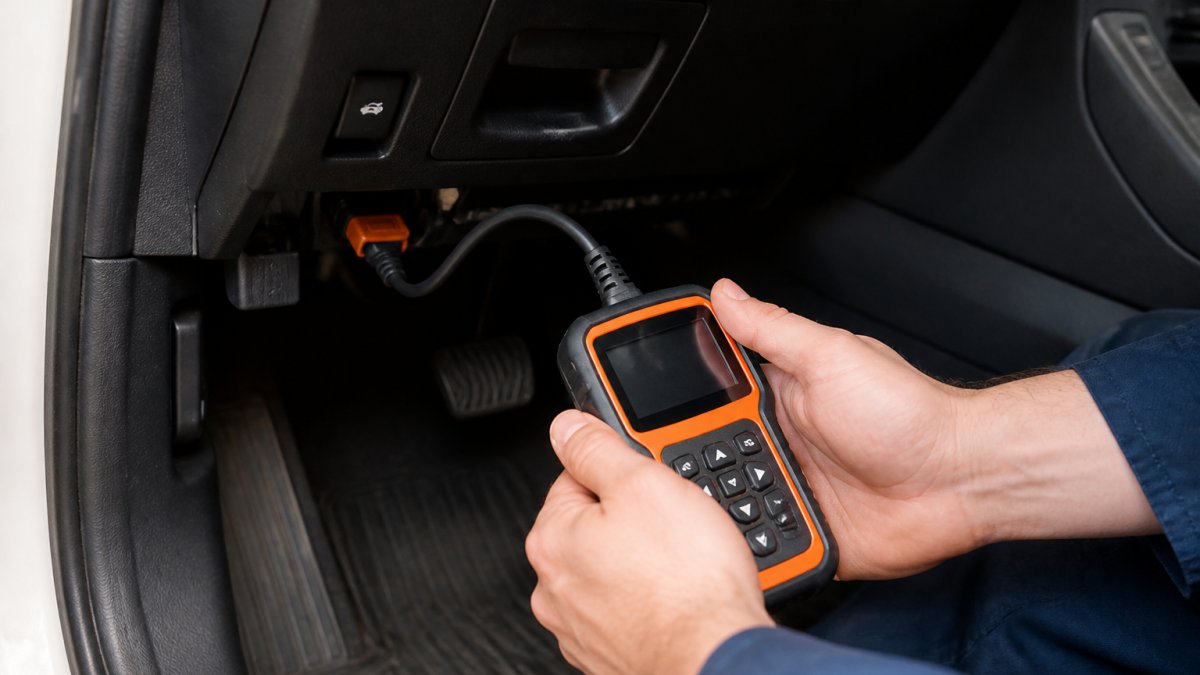
An OBD-II scanner connects to your vehicle’s diagnostic port and reads stored codes. The port is usually a small rectangular connector under the dashboard on the driver’s side.
What you’ll need:
- An OBD-II code reader (basic models are affordable)
- Your vehicle’s manual (helpful but not required)
- A few minutes of your time
How to use it:
-
Locate the diagnostic port, usually below the steering wheel.
-
Plug in the scanner; it should power on.
-
Turn the key to “On” without starting the engine (some scanners require the engine running, check the instructions).
-
Navigate to “Read Codes.”
-
Write down every code and its description, and take a photo with your phone to share with a technician.
If the light is on but no codes appear, you may have an intermittent problem.
Flashing Check Engine Light vs. Steady Light
The difference between a flashing and steady light matters: steady means get a diagnosis soon; flashing means stop driving now.
Steady light: Your vehicle has detected a problem, but it’s safe to drive to a repair shop. Don’t ignore it, but you’re not in emergency mode.
Flashing light: Your engine is misfiring or running rough, and continuing to drive risks serious engine damage.
In cold Colorado weather, a flashing light may indicate a fuel system or ignition problem made worse by freezing temperatures. Either way, stop driving.
Common Check Engine Light Causes and What They Mean
Several problems trigger check engine lights regularly.
Oxygen sensor failure. Your oxygen sensor measures unburnt fuel in your exhaust.
Catalytic converter problems. Your catalytic converter reduces harmful emissions. If it’s clogged or failing, the computer detects it.
Spark plug or ignition coil issues. Worn plugs or failing coils cause misfires, rough running, hesitation, or lost power.
Fuel system leaks or pump failure. A loose gas cap, cracked fuel line, or failing fuel pump triggers codes.
Transmission problems. Some check engine lights point to transmission issues. If you’re seeing transmission-related codes, engine repair in Parker, CO starts with a full diagnostic to understand what’s happening.
Engine misfiring. A misfire means one or more cylinders aren’t firing correctly. This can stem from spark plugs, fuel injectors, compression problems, or ignition coils. Is your engine misfiring? Learn more about symptoms and real solutions.
Fuel pump issues. A failing fuel pump can’t maintain pressure. Your engine starves for fuel, especially under acceleration. Signs of a bad fuel pump include sputtering and stalling.
These problems trigger check engine lights regularly in Parker and surrounding areas.
| Problem | What Happens | Why It Matters |
|---|---|---|
| Oxygen sensor failure | Sends bad data; fuel mixture adjusted incorrectly | Reduces fuel economy |
| Catalytic converter problems | Clogged or failing converter detected by computer | Repairs are expensive |
| Spark plug or ignition coil issues | Misfires, rough running, hesitation, lost power | Cold winters make problems worse |
| Fuel system leaks or pump failure | Engine can’t maintain right fuel pressure | Runs lean or rich |
| Engine misfiring | One or more cylinders not firing correctly | Stems from plugs, injectors, compression, or coils |
| Fuel pump issues | Can’t maintain pressure; engine starves for fuel | Sputtering and stalling under acceleration |
How Long Does Engine Diagnostics Take
“How long will this take?” depends on what kind of diagnosis you need.
Reading codes is not the same as diagnosis. Plugging in a scan tool and reading stored codes takes a few minutes.
What a full diagnosis adds. When the code doesn’t point to an obvious cause, a technician moves into testing:
- Live data review of sensor readings against expected values
- Circuit tests at the sensor and at the control module to rule out wiring and grounds
- Fuel pressure and fuel trim analysis
- Ignition and misfire testing, including coil swap and spark verification
- Vacuum and intake leak testing
- Compression or cylinder balance testing when mechanical causes are possible
- A test drive to reproduce intermittent faults under real load
Each step takes time, and the sequence depends on what earlier tests reveal.
Why the time estimate is a range, not a promise. Intermittent problems are the wildcard.
What affects the time and scope.
- Number of codes, one code is usually faster than five
- Whether the fault is current or history, a stored history code that no longer sets is harder to confirm
- Vehicle age and access, some engines require more disassembly to reach sensors and connectors
- Prior repairs, aftermarket parts or previous guesswork can complicate the picture
- Emissions readiness, if you need an emissions test, monitors must complete a drive cycle before the vehicle is ready, which adds time after the repair
The Colorado context. Cold-start faults and altitude-related fuel trim issues are common here, and both can be slow to reproduce on a warm engine.
A scan tells you what the computer noticed. A diagnosis tells you what to fix. Expect the second to take longer than the first, and expect the time to depend on how easily the fault reproduces.
If you want to know what your vehicle needs before committing to repairs, contact our Parker shop to schedule a diagnosis and we’ll walk you through what we find.
When to Schedule Professional Diagnostics in Parker
You should schedule professional diagnostics if:
- Your check engine light is on and stays on
- You’ve checked the gas cap and obvious issues, but the light hasn’t cleared
- You’ve read codes yourself but aren’t sure what they mean
- Your light is flashing (stop driving and get a tow)
- Your vehicle is running rough, hesitating, or lacking power
- Your fuel economy has dropped noticeably
- You’re experiencing stalling or difficulty starting
Professional diagnostics give you certainty. A technician uses specialized equipment to read computer data, perform electrical tests, and inspect components, identifying problems your code reader can’t detect.
Check engine light diagnosis cost in Parker, CO explains what to expect from a professional diagnostic visit. Why is my check engine light on? covers common causes specific to high-altitude Colorado driving.
Don’t guess about your vehicle’s health. A proper diagnosis takes the guesswork out of repairs, so you know what’s wrong before you decide how to proceed.
Frequently Asked Questions
What should you check when your check engine light is on?
Start with the simplest issues: a loose or missing gas cap (the most common cause), low fuel pressure, or visible engine problems. Check your dashboard for other warning lights that might indicate a specific system failure. If the light is steady and your vehicle runs normally, you have time to investigate. If it’s flashing or the engine runs rough, pull over safely and shut off the engine, this signals a serious problem requiring immediate professional diagnosis.
Can you diagnose a check engine light with an OBD-II scanner?
An OBD-II scanner reads the diagnostic trouble codes your vehicle’s computer stored when it detected a problem. The code tells you which system triggered the warning, like the fuel system, oxygen sensor, or catalytic converter, but it’s a clue to investigate, not a definitive identification of the failed part. A code pointing to an oxygen sensor doesn’t mean the sensor failed; it could indicate a fuel system leak or ignition timing issue. Professional diagnostics go deeper to find the root cause.
What does a flashing check engine light mean?
A flashing check engine light is an emergency warning that unburnt fuel is entering your exhaust system, risking damage to your catalytic converter and engine. This happens when the engine misfires or runs too rich. Do not ignore it or continue driving normally. Pull over safely, shut off the engine, and call for roadside assistance or drive carefully to a repair shop. A steady light allows you to drive cautiously to a mechanic, but a flashing light demands immediate attention.
How long does engine diagnostics take at a shop?
A basic computer diagnostic scan takes 15 to 30 minutes and reads your vehicle’s stored trouble codes. A full diagnostic inspection, where a technician tests components, checks engine performance, and investigates the root cause, typically takes 1 to 2 hours. The time depends on code complexity and how many systems need testing. At Eagle Transmission & Auto Repair, we provide diagnostics so you understand what’s happening before committing to repairs.
Your check engine light is telling you something matters. Whether it’s a simple fix like a loose gas cap or a more complex issue, getting a diagnosis is the smart first step. We’re here to help Parker-area drivers understand their vehicles and make confident repair decisions. Schedule your free diagnostic test with Eagle Transmission & Auto Repair and find out what your check engine light really means.