Last Updated: November 24, 2026
Quick Summary
You can usually drive a short distance with a bad differential, but you should not keep driving on it. A bad differential can lock up, seize, or break a gear, which can leave you stranded or cause a crash. If you notice gear oil leaks, grinding, or a clunk when you accelerate or turn, park safely and call a shop.
- Stop driving and arrange a tow if you notice worsening grinding or a clunk when shifting.
- Watch for a whining sound that rises with vehicle speed, which often points to worn gears or bearings.
- Check around the axles for dark, oily spots, since low fluid makes gears run hot and wear faster.
- Expect a rear differential failure to swing the back of the vehicle sideways, so ease off the gas and steer gently.
- Call Eagle Transmission at (720) 778-1888 to decide whether to drive in or have the vehicle towed.
Table of Contents
- Can You Drive With a Bad Differential?
- Bad Differential Symptoms to Watch For
- Can You Drive With a Noisy Differential?
- What Happens If a Rear Differential Goes Out While Driving
- Can a Bad Differential Cause Transmission Problems?
- Get Your Differential Checked at Eagle Transmission in Parker
- Frequently Asked Questions
Can You Drive With a Bad Differential?
Usually you can drive a short distance with a bad differential, but you should not keep driving on it. Learn more about where differentials leak and what to do next.
Your differential sits between the wheels and takes power from the driveshaft. It lets the wheels turn at different speeds when you go around a corner.
A small differential problem often turns into a much bigger repair when it is left alone for weeks.
Bad Differential Symptoms to Watch For
Most differential problems give off warning signs before they fail. Learning to spot them early helps you decide what to do next.
Common symptoms include:
- A whining or howling sound that changes with speed
- Grinding or humming from the rear or front of the vehicle
- Clunking when you accelerate, decelerate, or change gears
- Vibration or shuddering while driving
- Gear oil dripping or leaving dark spots under the vehicle
- A burnt smell near the axle area
Noises That Signal Trouble
Differential noise is one of the easiest signs to notice. A steady whine that rises with vehicle speed often points to worn gears or bearings. Our rear differential noise diagnosis guide explains how to identify whining, howling, and clunks. A grinding or humming noise can mean the gears are not meshing properly.
Pay attention to when the noise happens. A sound that shows up only while turning may point to a different problem than one that happens at highway speed.
Vibration, Clunking, and Fluid Leaks
Vibration and clunking can come from several parts of the drivetrain, so they do not always point straight to the differential.
Fluid leaks are more direct evidence. Check the area around the axles and the center of the rear or front axle for wet, dark, or oily spots.
Most differential problems give off warning signs before they fail. The table below sums up the symptoms and what each one usually points to.
| Symptom | What it often points to | What to do |
|---|---|---|
| Whining that rises with speed | Worn gears or bearings | Schedule a diagnostic inspection |
| Grinding or humming | Gears not meshing properly | Get it checked soon |
| Clunking on acceleration or shifts | Differential or nearby drivetrain parts | Have the differential inspected |
| Vibration or shuddering | Drivetrain wear | Limit driving and have it looked at |
| Gear oil dripping or dark spots | Low fluid from a leak | Stop driving and have the leak repaired |
| Burnt smell near the axle | Overheating gears or fluid | Stop driving and call a shop |
Can You Drive With a Noisy Differential?
A noisy differential means something inside the housing is already wearing, but the sound alone does not tell you how close it is to failing. That is why the honest answer is: sometimes you can drive a short distance, and sometimes you should not move the vehicle at all. The difference comes down to which symptoms you have.
Stop driving and arrange a tow if you notice any of these
- Grinding that gets noticeably worse within a few miles
- A clunk or bang when you shift into drive or reverse, or when you get on the gas
- Severe vibration or shuddering through the floor or steering wheel
- Smoke, or a hot, burnt smell coming from the axle area
- A wheel that binds, drags, or feels like it is fighting you
- Gear oil actively dripping or spraying under the vehicle
Any one of these points to damage that can progress to a lockup or a broken gear while you are moving. A differential that seizes at speed can lock the rear wheels and put you into a skid, so this is not a situation to test on the road.
Drive cautiously, directly to a shop, only if all of these are true
- The noise is steady and has not gotten worse over the last few drives
- There is no clunk, grinding, smoke, or vibration
- No fluid is actively leaking
- You can stay off highways and keep the drive short
Even then, treat it as a one-way trip to a repair facility, not a temporary fix. Because a differential noise can be difficult to distinguish from other drivetrain trouble, comparing its symptoms with reasons for transmission failure can help keep the diagnosis focused before the next demanding drive.
Watch out: do not talk yourself into ‘just one more trip.’ A differential that is already howling is shedding metal into its oil, and every mile accelerates wear on the gears and bearings.
If you are unsure which category you fall into, call us at (720) 778-1888 before you drive. We can help you decide whether to drive in or have the vehicle brought to our Parker shop.
What Happens If a Rear Differential Goes Out While Driving
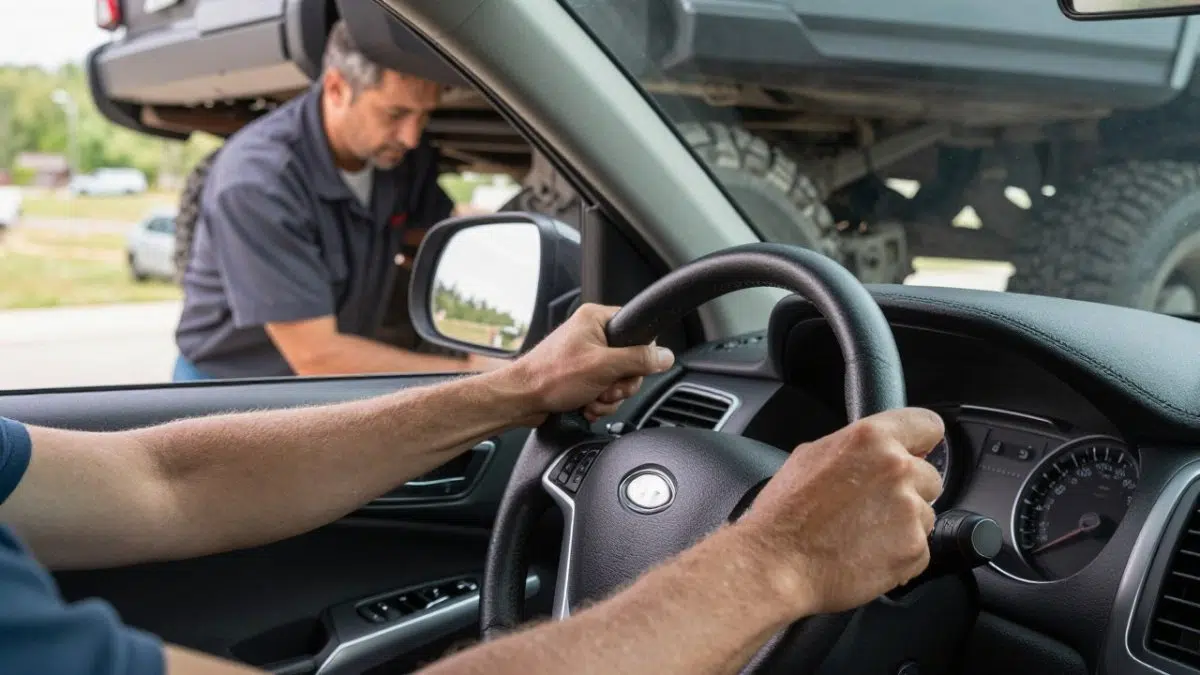
When a rear differential fails while you are moving, the rear wheels can lose power, bind, or lock. Because the rear wheels are not steering, a lockup there tends to swing the back of the vehicle sideways, which is why a failure on wet or icy pavement is especially dangerous. Keep both hands on the wheel, ease off the gas, and steer gently toward the shoulder. Do not slam the brakes unless you have to.
Front, rear, and all-wheel drive are not the same risk
- Rear-wheel drive: A rear differential failure can lock the driven wheels and cause a sudden loss of traction or a spin. This is the scenario most drivers picture, and it is the one that most often ends in a tow.
- Front-wheel drive: The differential is built into the transaxle, so a failure there can affect steering as well as power delivery. A binding front differential can make the vehicle pull or fight the wheel, and debris can contaminate the transmission fluid because the two share a housing.
- All-wheel drive: Front and rear axles are linked through a transfer case, so a failing differential on one end can stress the other. An AWD vehicle with a bad differential should not be driven far, because the mismatch in wheel speed can damage additional driveline parts.
What a professional diagnosis actually involves
A proper differential inspection is more than listening for a noise. A thorough diagnosis generally involves checking the fluid, inspecting for leaks, and road testing to see how the noise changes with speed, turning, or load.
That last step matters. If you are weighing a differential repair against transmission work, our team can walk you through transmission repair in Parker and differential service side by side so you understand what each involves before you authorize anything.
A rear differential that has failed completely usually needs repair or replacement, not just a fluid top-off. Compare your options in our guide to rear differential repair in Parker. Getting it checked early can help keep the repair smaller.
Can a Bad Differential Cause Transmission Problems?
A bad differential does not usually damage the transmission directly, because the two are separate parts of the drivetrain. Still, symptoms can overlap. Learn the key symptoms of a bad torque converter and how diagnostics pinpoint the cause.
Metal debris from a failing differential can also travel through the drivetrain and cause wider damage if the vehicle keeps running. That is one more reason to stop driving once you notice serious symptoms.
If you are not sure which part is causing the problem, a diagnostic inspection can narrow it down before you spend money on repairs.
Get Your Differential Checked at Eagle Transmission in Parker
If you notice any of these signs, schedule a diagnostic inspection with our team. We are located in Parker and serve drivers from Castle Rock, Centennial, Aurora, Lone Tree, Highlands Ranch, Franktown, and Elizabeth.
Call us at (720) 778-1888 or visit us at 10189 Parkglenn Way, Parker, CO 80138. We are open Monday through Friday, 8:00am to 6:00pm, and closed on weekends. You can also book differential repair or diagnostics online.
Frequently Asked Questions
How long can you drive with a bad differential?
There is no safe mileage figure for a failing differential. How far a vehicle can go depends on how much gear oil has leaked, how worn the gears and bearings are, and how hard you drive. Some drivers get a few miles, others get much farther, but damage tends to grow the longer the vehicle is driven. If you notice grinding, clunking, or vibration, stop driving as soon as it is safe and have the vehicle inspected. Continuing to drive can turn a repair that is manageable into a full replacement. Our Parker shop can check the fluid level and diagnose the cause before you decide what to do next.
Can a bad differential ruin your transmission?
A failing differential usually does not destroy a transmission directly, since the two are separate components. However, the symptoms can overlap, and a drivetrain problem can put extra stress on related parts. Shuddering, clunking, or a whine that changes with speed can come from either system, so guessing is unreliable. A proper diagnosis is the only way to tell which component is failing. A proper diagnosis is the best way to identify the actual source of the problem before repairs are recommended.
Is it safe to drive with a bad rear differential?
Driving with a bad rear differential carries real risk. A seized or badly worn unit can lock up the rear wheels, cause loss of traction, or in severe cases stop the wheels from turning freely, which affects handling, especially on wet roads, gravel, or Colorado mountain grades. We recommend avoiding highway speeds, towing, and steep hills until the vehicle is inspected. If the vehicle has significant noise, vibration, or fluid loss, it should be towed rather than driven. Call our Parker shop at (720) 778-1888 to discuss your options.