Have you ever felt a subtle, low-frequency hum beneath your floorboards while climbing a steep mountain grade and wondered if your vehicle was about to leave you stranded? It is a common source of anxiety for many drivers in our community, especially when the weather turns and the roads get slick. If you are currently searching for reliable rear differential repair Parker CO, you likely want more than just a quick fix. You want the peace of mind that comes from knowing your drivetrain can handle Colorado’s demanding terrain. We understand that confusing a gearbox issue with a transmission problem is easy, and the fear of a massive repair bill can be overwhelming.
At Eagle Transmission & Auto Repair, we live by the motto “WE FIX EVERYTHING.” We believe that an informed driver is a safe driver. In this 2026 guide, we will teach you how to identify early warning signs like grinding or clicking, explain the vital role your differential plays in winter safety, and provide actionable maintenance tips to prevent costly breakdowns. We will walk through everything from fluid services to full rebuilds so you can head into the mountains with total confidence in your vehicle’s performance.
Key Takeaways
- Learn to distinguish between normal road noise and the specific whines or clunks that signal a failing rear differential.
- Understand why Colorado’s steep mountain grades and high altitudes require specialized rear differential repair Parker CO to prevent gear overheating.
- Discover how simple preventative measures, like regular fluid flushes, can save your drivetrain from the stress of winter driving.
- Get expert insights into how rear differential health affects your 4×4 transfer case, especially for local Ford F-150 and F-250 owners.
- See how our “WE FIX EVERYTHING” philosophy provides a comprehensive solution for your vehicle’s long-term safety and reliability.
Recognizing Rear Differential Failure Symptoms in Parker, CO
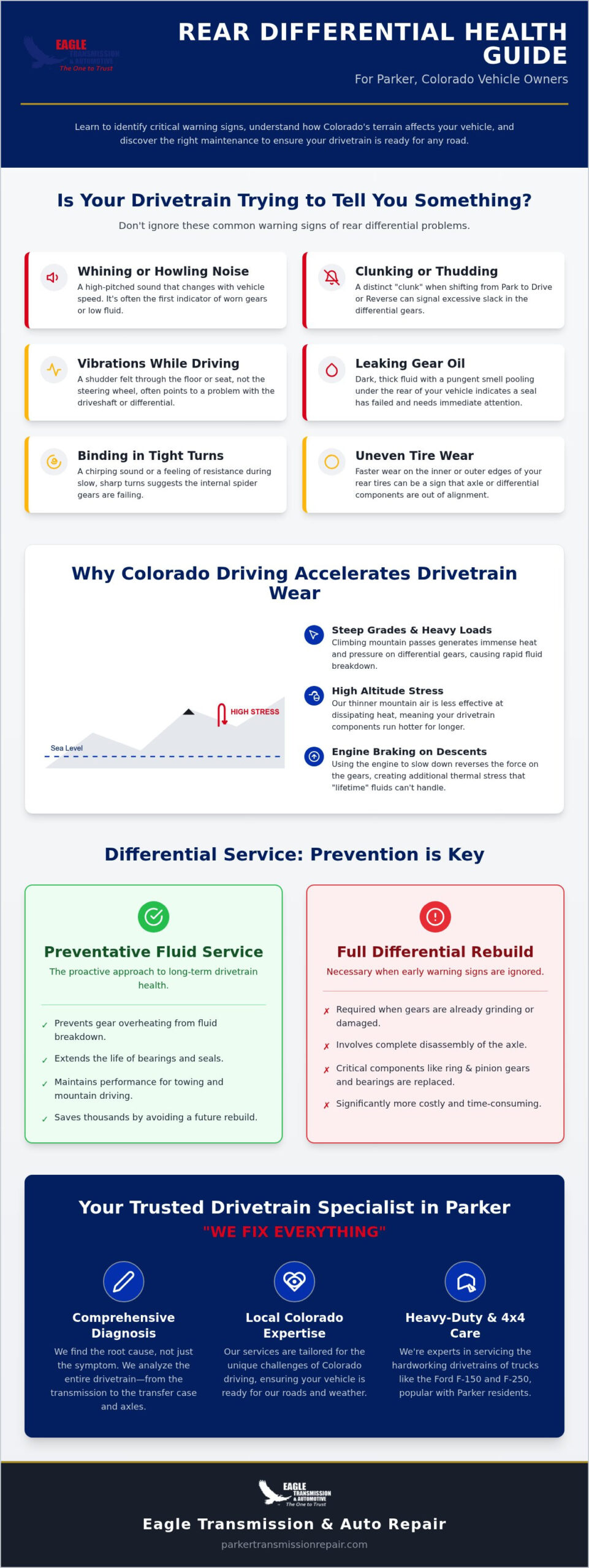
Driving on E-470 at highway speeds often reveals the first signs of drivetrain trouble. If you hear a high-pitched howl or whine that changes pitch as you accelerate or decelerate, your vehicle is trying to tell you something. Understanding the mechanical function of a differential helps clarify why these sounds happen. Essentially, the gears inside are no longer meshing perfectly, often due to worn bearings or low fluid. When you need rear differential repair Parker CO, catching these sounds early can be the difference between a simple service and a full rebuild.
Another common red flag is a distinct “clunk” or “thud” when you shift from Park into Drive or Reverse. This often signals excessive “play” or slack in the ring and pinion gears. While it might feel like a transmission issue, our team at Eagle Transmission & Auto Repair often finds that the culprit lies further back in the axle. We live by the motto “WE FIX EVERYTHING,” which means we look at the whole drivetrain to ensure we aren’t just treating a symptom while the root cause persists.
Decoding Drivetrain Noises by Driving Condition
The timing of a noise is just as important as the sound itself. A steady hum that gets louder as you press the gas usually points toward worn pinion bearings. If the noise is most prominent when you let off the throttle and coast, it likely indicates wear on the gear teeth themselves. If you notice a “chirping” or a binding sensation while making tight turns in a grocery store parking lot, your differential’s internal spider gears may be struggling to let the wheels spin at different speeds. These nuances help our technicians provide a more accurate rear differential repair Parker CO residents can trust.
Vibrations can be tricky. Many drivers assume a shaking steering wheel means they need a tire balance. However, a shudder that feels like it’s coming from the seat or the floor often points toward the differential or the driveshaft. Don’t forget to check your driveway. Gear oil has a very distinct, pungent smell. If you see dark, thick fluid pooling near your rear wheels, you have a leak that needs immediate attention before the gears run dry.
Handling and Performance Warning Signs
A failing differential doesn’t just make noise; it changes how your car feels on the road. You might notice your vehicle feels unsettled or less stable during high-speed cornering. At lower speeds, the steering might feel unusually heavy or resistant during sharp maneuvers. Over time, these mechanical issues lead to uneven tire wear. If you see the inner or outer edges of your tires wearing down faster than the rest of the tread, it is a strong sign that your axle or differential components are out of alignment and require professional diagnosis.
Why Colorado Driving Conditions Accelerate Differential Wear
Living in Parker means our vehicles face unique mechanical challenges that flat-land cars never encounter. When you’re pulling a trailer up I-70 toward the Eisenhower Tunnel, the ring and pinion gears in your rear axle are under immense pressure. This constant heavy load generates significant heat within the gear housing. Understanding how differentials allow wheels to turn is helpful, but it’s even more critical to realize that this mechanical work creates friction. In our thin mountain air, heat doesn’t dissipate as efficiently as it does at sea level. This leads to rapid thermal breakdown of your gear oil, making a professional differential fluid service essential for preventing the need for a full rear differential repair Parker CO.
Thermal Stress and Fluid Longevity
Steep descents are just as hard on your drivetrain as the climbs. Many drivers use engine braking to save their pads, which is smart for brake maintenance, but it transfers that resistance through the differential gears. This reversal of force creates additional thermal stress. Manufacturers often claim their vehicles have “lifetime” fluids, but those ratings rarely account for the heavy-duty cycles found in Douglas County. If you’re towing or frequently driving in the high country, your fluid is likely oxidizing much faster than the manual suggests. Once the oil loses its ability to lubricate, metal-on-metal contact begins, leading to the scary noises we discussed earlier.
Seasonal Challenges for Douglas County Drivers
Colorado’s weather is famous for swinging 40 degrees in a single day. These rapid temperature changes cause condensation to form inside the differential housing. When moisture mixes with gear oil, it creates a milky sludge that lacks the viscosity needed to protect metal surfaces. During winter, road salt and liquid de-icers can eat away at the rubber seals. Once a seal fails, road grit enters the housing and acts like sandpaper on your bearings. This environmental wear is a leading cause for rear differential repair Parker CO, as it slowly grinds down the precision-machined surfaces of your gears.
If you enjoy off-roading or have to plow through deep snow drifts in your neighborhood, don’t forget your breather tubes. These small vents allow the differential to “breathe” as it heats up and cools down. If they get clogged with ice or mud, the internal pressure can blow out your seals. At Eagle Transmission & Auto Repair, our “WE FIX EVERYTHING” approach means we check these small details during every inspection. If you’re worried about your drivetrain’s health after a rough winter, you can stop by our shop on Parkglenn Way for a quick check-up.
Differential Service Options: Fluid Flushes to Full Rebuilds
Hearing a noise from your drivetrain doesn’t always mean you’re looking at a massive bill. There is a wide spectrum of solutions available depending on how early we catch the issue. At Eagle Transmission & Auto Repair, we start with the simplest fix first. Understanding how differentials work is the first step in realizing that these components are precision-engineered but also maintainable. Whether you need a minor seal replacement or a more involved rear differential repair Parker CO, our goal is to get you back on the road safely without unnecessary expenses.
When a Fluid Flush is Enough
A proactive expert differential fluid change in Parker CO is the single best way to avoid the shop in the future. During this service, we don’t just swap the oil; we inspect the old fluid for stories it might tell. If the oil looks burnt, it’s a sign of overheating from those long I-70 climbs. If it’s milky, moisture has found a way in. Seeing small metal shavings is normal, but larger chunks signal that a repair is imminent. For most Colorado SUV and truck owners, we recommend this service every 30,000 to 50,000 miles, especially if you’re towing a camper or boat.
If we find a leak, a seal and gasket replacement is often the next step. These rubber components are the only thing keeping your gears from running dry. Replacing a pinion seal or an axle seal is a relatively quick process that prevents the “starvation” of internal parts. We also offer bearing and race restoration. If that “hum” we discussed earlier is caught early, we can often replace just the worn bearings rather than the entire gear set, which is a much more budget-friendly rear differential repair Parker CO option that restores quiet operation.
Repair vs. Full Differential Rebuild
When gear teeth are compromised, we have to look at a ring and pinion replacement. During our inspection, we look for “pitting” or small craters on the gear surfaces. If the damage is localized, a repair might suffice. However, for high-mileage mountain vehicles, we often recommend a full rebuild. This involves disassembling the unit, cleaning every part, and replacing all internal components that show wear. It provides a “fresh start” for your drivetrain, which is vital for winter safety. Because our motto is “WE FIX EVERYTHING,” we have the specialized tools to set the precise gear “backlash” required for a quiet, long-lasting rebuild that can handle the Rockies.
Heavy-Duty and 4×4 Differential Care for Parker Truck Owners
Trucks are a way of life in Douglas County. From hauling horse trailers to navigating steep, snow-packed driveways, our local pickups work harder than almost anywhere else. This extra workload means your rear axle isn’t just a part of your drivetrain; it’s the foundation of your vehicle’s capability. When you’re managing the massive torque of a modern engine, the stress on your internal gears is constant. If you’ve noticed a change in how your truck handles a heavy load, it might be time for a professional rear differential repair Parker CO to ensure your gears can still handle the pressure.
Specialized Ford Drivetrain Solutions
We see a lot of F-Series trucks at our shop, and they have specific needs. Many owners come to us for Ford F-150 repair in Parker because they’ve noticed a strange “chatter” or shuddering sensation when making sharp turns. This is a common issue with Ford limited-slip differentials. It usually happens when the specialized friction modifier in the gear oil breaks down or was never added during a previous service. Without this additive, the internal clutch packs can’t slip smoothly, leading to vibration and premature wear. We make sure every Ford axle service uses the exact specifications required to keep your limited-slip system quiet and effective on our winding roads.
Drivetrain Health for 4×4 and Diesel Fleets
If you drive a heavy-duty rig, you know that diesel truck repair in Parker CO requires a different level of expertise. Diesel engines produce incredible amounts of low-end torque. This force is transferred directly to the rear differential gears, which can cause “shock-loading” if you lose traction on ice and suddenly regain it on dry pavement. This sudden jolt can chip gear teeth or even crack the housing. For our 4×4 enthusiasts, it’s important to remember that your rear differential and transfer case work in tandem. If the rear diff begins to bind or fail, it places immense strain on the transfer case chain and bearings.
Managing a commercial fleet in the Front Range adds another layer of complexity. Constant stop-and-go driving with heavy payloads accelerates gear wear. We recommend a more frequent inspection schedule for fleet vehicles to catch bearing play before it turns into a roadside breakdown. Because our motto is “WE FIX EVERYTHING,” we don’t just look at the gears. We inspect the entire system, from the U-joints to the axle seals. If your truck is making a noise that has you worried about your next job, bring your rig to our Parker location for a comprehensive drivetrain evaluation.
- Limited Slip vs. Locking Differentials: Limited slip uses clutches to balance power, while locking differentials mechanically bind the axles together for maximum off-road traction. Both require specific lubricants to function correctly in Colorado’s climate.
- Torque Management: Diesel trucks need high-viscosity synthetic fluids to protect gear surfaces from the extreme heat generated by high-torque towing.
- 4WD Synergy: A healthy rear differential ensures your 4×4 system engages smoothly without “binding” the rest of the drivetrain.
Why Eagle Transmission is Parker’s Trusted Drivetrain Specialist
When you bring your vehicle to Eagle Transmission & Auto Repair, you are getting more than just a mechanic; you are getting a partner who cares about your safety on Colorado’s roads. Our “WE FIX EVERYTHING” promise is more than just a motto. It is a philosophy that drives our comprehensive approach to auto repair. We understand that a rear differential issue often ripples through the rest of your vehicle, affecting the transmission, suspension, and even your brakes. By looking at your car or truck as a complete system, we ensure that a rear differential repair Parker CO service addresses the root cause rather than just the symptoms.
Precision Gear Work and Technical Mastery
Our methodical approach to rear differential repair in Parker CO starts with expert diagnostics. We use advanced tools to pinpoint the exact gear failure, whether it is a chipped ring gear or a pitted bearing. This precision prevents the “parts cannon” approach where a shop replaces expensive components hoping to find the fix. We focus on drivetrain synergy. This means we verify that the power flowing from your engine reaches your wheels without any mechanical interruption. Our local roots run deep, and we have spent decades serving our neighbors in Centennial, Castle Rock, and Aurora from our home base here in Parker.
Your Next Steps for a Safe Drivetrain
Transparency is the foundation of trust in the auto industry. Before any wrench is turned, we sit down with you to explain our findings in plain English. We want you to feel comfortable and informed about what is happening under your vehicle. During your initial drivetrain diagnostic appointment, we will perform a thorough road test and a physical inspection of the gear housing and fluid. If we find multiple issues, we help you prioritize repairs based on what is essential for safety and what fits your current budget.
We know that unexpected car repairs can be stressful. Our goal is to reduce that anxiety by being a “Friendly Guide” through the technical details. Don’t ignore that strange sound from the back of your vehicle. A small hum can quickly escalate into a seized axle on a busy highway. It is much better to catch a worn bearing now than to replace an entire housing later. Get a Quote today! and let us show you why your neighbors trust us with their most important vehicles.
Secure Your Drivetrain for the Road Ahead
Your vehicle’s drivetrain is its lifeline, especially when navigating the unpredictable conditions of the Front Range. We’ve explored how identifying early warning signs like gear whines and addressing the thermal stress of mountain driving can prevent major breakdowns. Whether you are driving a family SUV or need specialized care for a Ford F-150 or F-250, staying proactive is the best way to ensure your safety. It’s about more than just gears; it’s about making sure you get home safely every time.
Since 2004, Eagle Transmission & Auto Repair has served our neighbors in Parker, Centennial, and Castle Rock with a commitment to transparency. Our “WE FIX EVERYTHING” approach means we don’t just swap parts; we provide comprehensive solutions for your long-term peace of mind. When you need reliable rear differential repair Parker CO, you can count on our team to treat your vehicle like it belongs to our own family. Don’t let a small drivetrain noise turn into a major headache before your next mountain trip. We are here to help you stay on the road with confidence.
Schedule Your Drivetrain Inspection in Parker Today!
Frequently Asked Questions
How much does rear differential repair cost in Parker, CO?
The cost of rear differential repair Parker CO varies significantly based on the specific failure. A minor fix like a pinion seal replacement is much less intensive than a full gear set rebuild. Factors like parts availability and the complexity of your vehicle’s axle also play a role. We recommend a professional diagnostic to give you an accurate estimate. Our goal is to provide a clear explanation; we don’t believe in unnecessary work.
Can I drive my truck if the rear differential is making a whining noise?
You shouldn’t ignore a whining noise, as it usually signals that internal bearings or gears are losing their precision fit. While your truck might still move, driving with this sound can lead to a catastrophic failure where the axle seized. This often happens at the most inconvenient times, like on a mountain pass. It’s much safer and more cost-effective to have us inspect the drivetrain before a small whine becomes a major tow bill.
How often should I change my differential fluid for Colorado driving?
For most vehicles in the Front Range, we recommend a fluid change every 30,000 to 50,000 miles. However, if you frequently tow a trailer through the mountains, you might need it sooner. Colorado’s high altitude and steep grades cause gear oil to break down faster due to extreme heat. It’s vital to maintain these intervals to ensure your gears stay lubricated and protected against the thermal stress of high-country driving.
What is the difference between a differential service and a repair?
A service is a preventative measure, like a fluid flush, designed to keep your drivetrain healthy. During a service, we drain the old oil, inspect for metal shavings, and refill it with high-quality gear lubricant. A repair, on the other hand, involves fixing a mechanical failure. This could mean replacing a leaking seal or installing a new gear set. When you need rear differential repair Parker CO, Eagle Transmission & Auto Repair focuses on restoring your vehicle’s safety.
Why is my rear differential leaking oil?
Leaks usually happen because of worn rubber seals or a damaged gasket on the differential cover. Over time, heat and road salt from Colorado winters can cause these components to crack or shrink. If you see dark, pungent fluid pooling under your rear axle, it’s a sign that the oil is escaping. This is a critical issue because low fluid levels lead to metal-on-metal friction, which quickly destroys the internal gears.
Does a bad rear differential affect my 4WD or transfer case?
Yes, your drivetrain components are all interconnected. If your rear differential begins to bind or fail, it creates shock-loading that can damage your 4×4 transfer case. This is especially true if you’re driving on slick surfaces where power is being shifted between the front and rear axles. Because “WE FIX EVERYTHING,” we look at the synergy between your transmission, transfer case, and differentials to ensure the entire system is working correctly.
What are the most common signs of a failing rear differential in a Ford truck?
Ford trucks, like the F-150 and F-250, often show failure through a distinct chatter or vibration during sharp turns. This usually points to a breakdown of the friction modifier in limited-slip differentials. You might also hear a loud clunk when shifting into gear or a high-pitched howl at highway speeds. Since these trucks are built for heavy-duty work, these symptoms are often accelerated by towing or carrying heavy payloads across the Front Range.