Last Updated: November 25, 2026
Quick Summary
Clutch replacement labor usually runs about 4 to 6 hours for a straightforward job and 8 to 10 hours or longer for more complex vehicles. That range covers labor only, so your car may sit in the shop longer while parts arrive or a flywheel is machined.
- Drivetrain layout matters: front-wheel-drive cars pack the transaxle and axles tighter than rear-wheel-drive vehicles.
- Rusted or snapped fasteners are a common reason a quoted labor time runs long on older vehicles.
- A dual-mass flywheel may need resurfacing or replacement and can add significant time to the job.
- An internal slave cylinder sits inside the bell housing and is only reachable with the transmission out.
- Billed labor hours and shop downtime are not the same, so ask for an honest window.
Table of Contents
- How long does a clutch replacement take?
- What affects clutch replacement time
- Clutch replacement inspection checklist
- Questions to ask about a clutch replacement estimate
- Book clutch service at our Parker shop
- Frequently Asked Questions
How long does a clutch replacement take?
A clutch replacement usually takes about 4 to 6 hours of labor for a straightforward job, and 8 to 10 hours or longer for more complex vehicles, according to Parker Transmission Repair’s 2026 clutch replacement cost guide. That range covers labor only. Your car may also sit in the shop longer while parts arrive or while the flywheel is machined.
At Eagle Transmission & Auto Repair in Parker, CO, we want you to understand what goes into a clutch job before you approve anything.
Here is the labor time range the article cites, plus what can push a job beyond it.
| Item | Value | Note |
|---|---|---|
| Straightforward clutch job | 4 to 6 hours of labor | Labor only |
| More complex vehicles | 8 to 10 hours or longer | Labor only |
| Shop downtime | Longer than billed labor | Parts arrival or flywheel machining |
| Dual-mass flywheel work | Can add significant time | Heavier, more expensive, may need new bolts |
| Internal slave cylinder | Only reachable with transmission out | Adds hydraulic work on top of clutch job |
What affects clutch replacement time
On most vehicles, the transmission has to come out to reach the clutch assembly. Several factors can make that job shorter or longer.
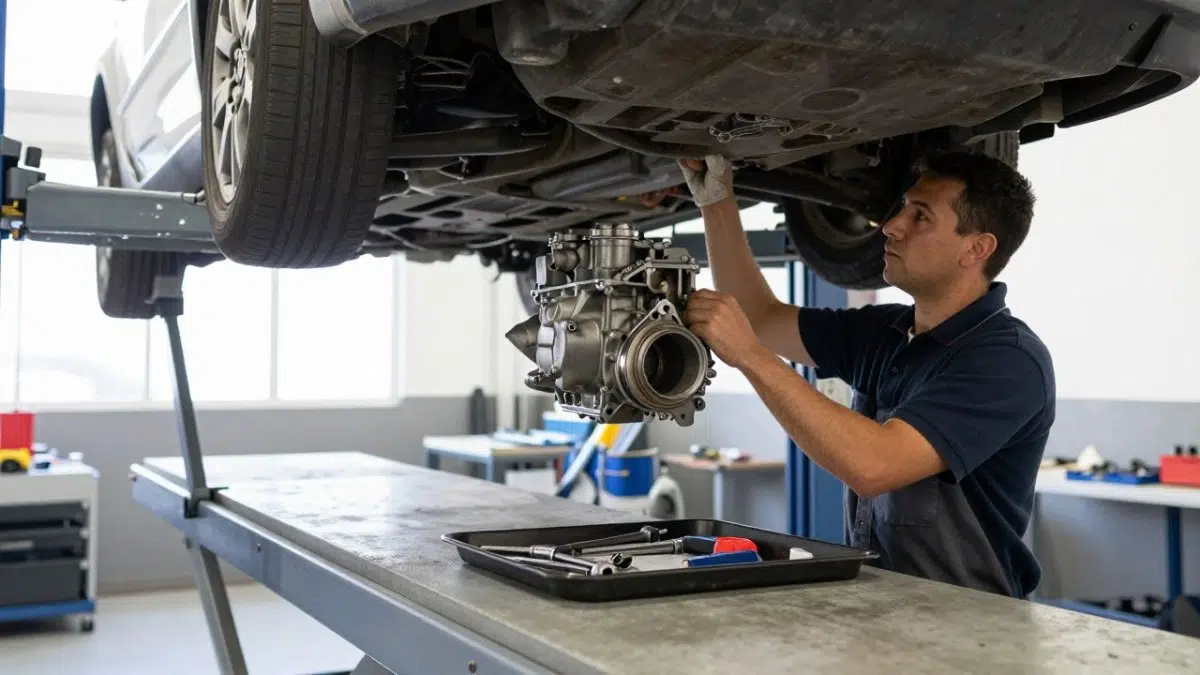
Every car is different. A rear-wheel-drive truck and a front-wheel-drive sedan are not the same job under the vehicle.
Here is what moves the number up or down, and why:
- Drivetrain layout. A rear-wheel-drive vehicle usually has the transmission sitting behind the engine with a straight shot at the bell housing. A front-wheel-drive car packs the transaxle, axles, and steering components into a tighter space, so more has to be disconnected and moved aside before the clutch is reachable.
- Transmission type and access. Some models have a removable inspection cover or a bell housing that comes off cleanly. Others require dropping a subframe, removing a crossmember, or pulling exhaust components just to get clearance.
- Rust and corrosion. Colorado road salt and winter grime can seize bolts, fittings, and the clutch fork pivot. A fastener that will not budge has to be heated, soaked, or cut, and that time is real.
- Fastener condition. A bolt that snaps adds time to drill out, extract, and replace. On older vehicles, this is one of the most common reasons a quoted labor time runs long.
- While-you’re-in-there parts. A rear main seal, clutch fork, or pilot bearing may need attention once things are apart. Replacing them now costs far less labor than coming back later, because the transmission is already out.
- Flywheel condition. A dual-mass flywheel may need resurfacing or replacement, and a worn dual-mass unit can add significant time because it is heavier, more expensive, and sometimes requires different fasteners or a new set of bolts.
- Hydraulic system condition. A leaking slave cylinder or a soft pedal can mean hydraulic work on top of the clutch job, and on some vehicles the slave cylinder sits inside the bell housing, which means it is only reachable with the transmission out.
A practical way to think about your own vehicle: the job is driven mostly by how much has to come off before the clutch is exposed. For a closer look at how these factors shape the overall bill, see our clutch replacement cost in Parker, CO guide.
Cold starts and mountain driving also wear a clutch faster. If you tow or drive steep grades west of Parker, your clutch works harder and may need service sooner.
If you are not sure what your vehicle needs, bring it in. We can look at the layout, the condition of the fasteners, and the flywheel before we give you an estimate.
Clutch replacement inspection checklist
Before you approve any clutch job, confirm the diagnosis. A worn clutch has clear signs, and a good shop will show you them.
Approving a clutch replacement without a proper inspection can mean paying for the wrong repair, since some symptoms that feel like a clutch can come from hydraulics or the release bearing instead.
Use this checklist:
- Does the clutch slip under acceleration or on hills?
- Is there a chatter or shudder when you let out the pedal?
- Does the pedal feel soft, spongy, or slow to return?
- Are there new noises when you press or release the clutch?
- Is there a burning smell after normal driving?
- Has the clutch fluid level dropped or looked dark?
- Did a road test confirm the symptom?
Our team performs a free road test and computer diagnostics before recommending work.
For a deeper look at the signs, read our guide on when to replace a slipping clutch.
Questions to ask about a clutch replacement estimate
A written estimate should tell you what is included, not just a total. The questions below are the ones that separate a clear quote from a vague one, and each one has a reason behind it.
- Is this a labor-only quote or parts and labor together? Labor-only quotes are common in phone conversations and rare on a real estimate. Ask for the breakdown so you can see what the hours cover and what the parts add.
- What is the hourly labor rate, and how many hours are billed? The billed hours usually come from a published labor guide, not from how long the technician happens to stand next to the car. Ask whether the shop uses book time or actual time, because the two can differ.
- Are the clutch disc, pressure plate, release bearing, and pilot bearing all included? A clutch kit normally covers these. If a quote lists only a disc and pressure plate, ask what happens to the bearing.
- Is flywheel resurfacing or replacement part of this quote? This is the single most common surprise on a clutch estimate. A dual-mass flywheel may not be resurfaceable at all, and a replacement adds both parts and labor.
- What happens if extra repairs turn up once the transmission is out? A worn rear main seal, a bad clutch fork, or a leaking input shaft seal is easy to spot with the transmission out and expensive to reach later. Ask whether the shop calls you before adding anything, and get that in writing.
- Does the estimate list fluid replacement for the hydraulic system? Brake fluid or clutch fluid that has gone dark should be replaced while the system is open. Ask whether that is included or billed separately.
- Is there a warranty, and what does it cover? Ask how long the warranty runs, whether it covers parts, labor, or both, and whether it applies if you decline a recommended related repair.
- How long will the car actually be at the shop? Billed labor hours and shop downtime are not the same thing. A 5-hour clutch job can still mean the car is with us overnight if a flywheel has to be ordered or the schedule is full. Ask for an honest window, not just the labor number.
It also helps to know what a labor estimate typically excludes. Seeing those exclusions alongside the labor figure makes it easier to understand mechanic repair estimates as a whole rather than judging the clutch job by one number.
If you want a full list of questions in one place, our team put together clutch replacement estimate questions to ask you can bring to any shop.
Book clutch service at our Parker shop
Eagle Transmission & Auto Repair is located at 10189 Parkglenn Way, Parker, CO 80138.
We have over 40 years of experience, and we work on all makes and models. Our shop offers a free road test and computer diagnostics.
Call us at (720) 778-1888. Our hours are Monday through Friday, 8:00am to 6:00pm, and we are closed Saturday and Sunday.
If you are comparing timelines, our guide on how long a transmission rebuild takes gives useful context for related drivetrain work. And when you are ready to schedule, you can book expert clutch replacement in Parker with our team.
A clutch that slips or shudders will not fix itself, and driving on it can wear the flywheel too.
Frequently Asked Questions
Does the transmission have to be removed to replace a clutch?
On most rear-wheel-drive vehicles, yes. The clutch sits between the engine and the transmission, so the transmission has to come out to reach the clutch assembly, and that remove-and-reinstall work is a large share of the labor hours on a clutch job. On some front-wheel-drive cars the transmission or transaxle still has to be separated from the engine. Because access differs so much by drivetrain, two cars with the same engine can carry very different labor times.
How many hours of labor is a clutch replacement?
There is no single number. Labor time varies with the vehicle, its drivetrain, and what the inspection finds. For a figure that applies to your car, ask for an estimate based on your vehicle.
What should I ask before approving a clutch replacement estimate?
Ask whether the quoted labor is book time or an open-ended hourly charge, what exactly is included (clutch disc, pressure plate, release bearing, flywheel work, fluid), and what is excluded. Ask whether the flywheel will be inspected or replaced, and whether the rear main seal or hydraulic components are being addressed while the transmission is out. A written estimate that separates parts and labor, and that names the additional repairs, is easier to compare than a single lump sum.
Can driving habits make a clutch job take longer?
Driving habits affect how worn the clutch is, and heavy wear can mean more related parts need attention once the transmission is out. A clutch that has been slipping for a while can heat and score the flywheel, and that changes the scope of the job. The labor time itself is driven mostly by the vehicle and drivetrain, but the condition found during inspection is what decides whether the repair stays a straight clutch replacement or grows.