Last Updated: November 27, 2026
Quick Summary
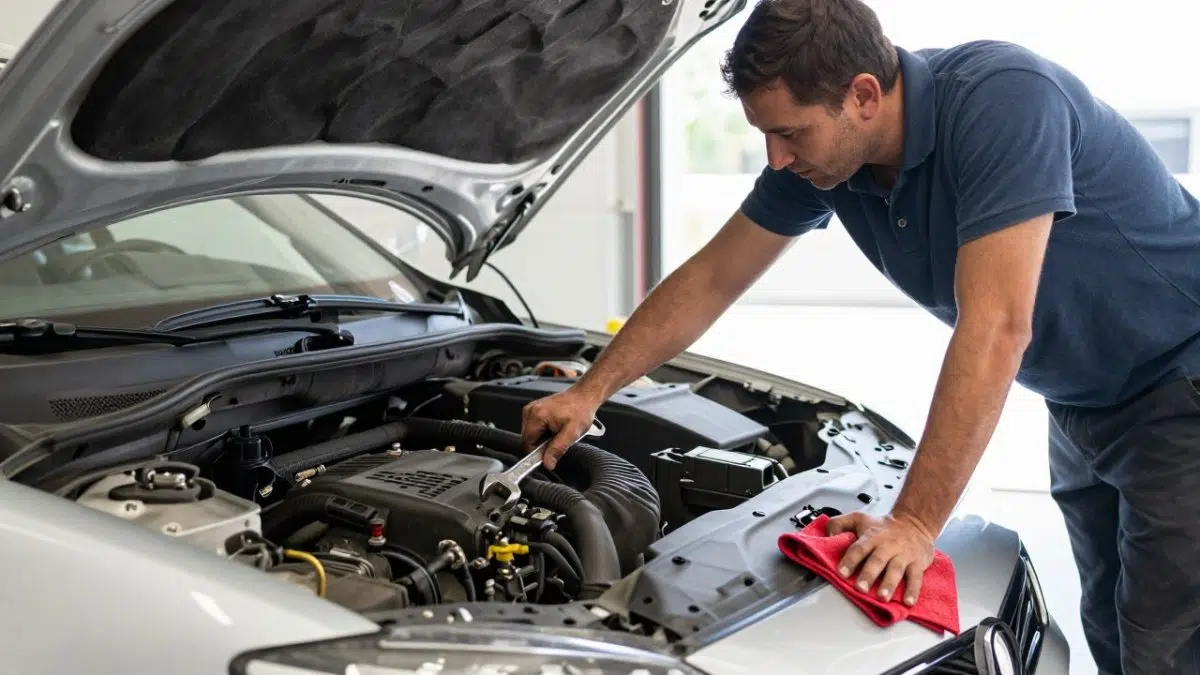
A car A/C expansion valve replacement cost depends on the vehicle, the valve design, and the labor involved, so we quote each car after diagnosis. Valve location is the biggest driver: firewall-mounted valves are quick, while dash-mounted valves add hours of labor, plus recovery, evacuation, and recharge.
- Warm vents, cooling that cycles, and a frosted low-side line point to a failing expansion valve.
- If low-side and high-side readings are both low, look for a leak before replacing anything.
- Never jump a pressure switch for more than a few seconds or leave a jumper in place.
- The system must be recovered, evacuated, and recharged by weight after the new valve goes in.
- Electrical checks like the clutch and switch circuit are DIY-friendly, but refrigerant work is not.
Table of Contents
- How much does a car A/C expansion valve replacement cost?
- Car A/C expansion valve symptoms you should not ignore
- Car A/C pressure troubleshooting: switch, clutch, and refrigerant
- Reading the gauges before you touch the switch
- Checking whether the compressor clutch engages
- Low-pressure versus high-pressure switches
- Testing the pressure switch circuit with a multimeter
- Distinguishing a bad switch from low refrigerant
- Other causes of a compressor that will not engage
- Safe limits of bypassing the switch for diagnosis
- A short decision tree
- A/C system evacuation and recharge after valve replacement
- A/C expansion valve replacement labor time and what affects it
- Schedule your A/C diagnosis at our Parker shop
- Frequently Asked Questions
How much does a car A/C expansion valve replacement cost?
A car A/C expansion valve replacement cost depends on the vehicle, the valve design, and the labor involved, so we quote each car after diagnosis.
The expansion valve is the small metering device that controls how much refrigerant enters your evaporator. When it sticks open or clogs, your air conditioning stops cooling properly.
Car A/C expansion valve symptoms you should not ignore
Warm air from the vents is the classic sign, but it is not the only one. A failing expansion valve usually announces itself in a few predictable ways:
- The A/C blows cool, then warm, in cycles. A sticking valve sends too much or too little refrigerant, so cooling comes and goes.
- The low-side line frosts over or sweats heavily. A valve stuck open can cause frost on the suction line.
- The compressor short-cycles. System pressure swings, and the clutch kicks on and off rapidly.
If your vents are blowing warm and you want a step-by-step walkthrough of the whole diagnosis, our guide on vehicle A/C repair and how to diagnose warm air covers the checks in order.
Refrigerant does not get used up. If the system is low, it leaked somewhere, and finding that leak matters more than adding gas.
Car A/C pressure troubleshooting: switch, clutch, and refrigerant
Pressure is where the diagnosis starts, and it separates a valve problem from a switch fault, a clutch fault, or a low charge.
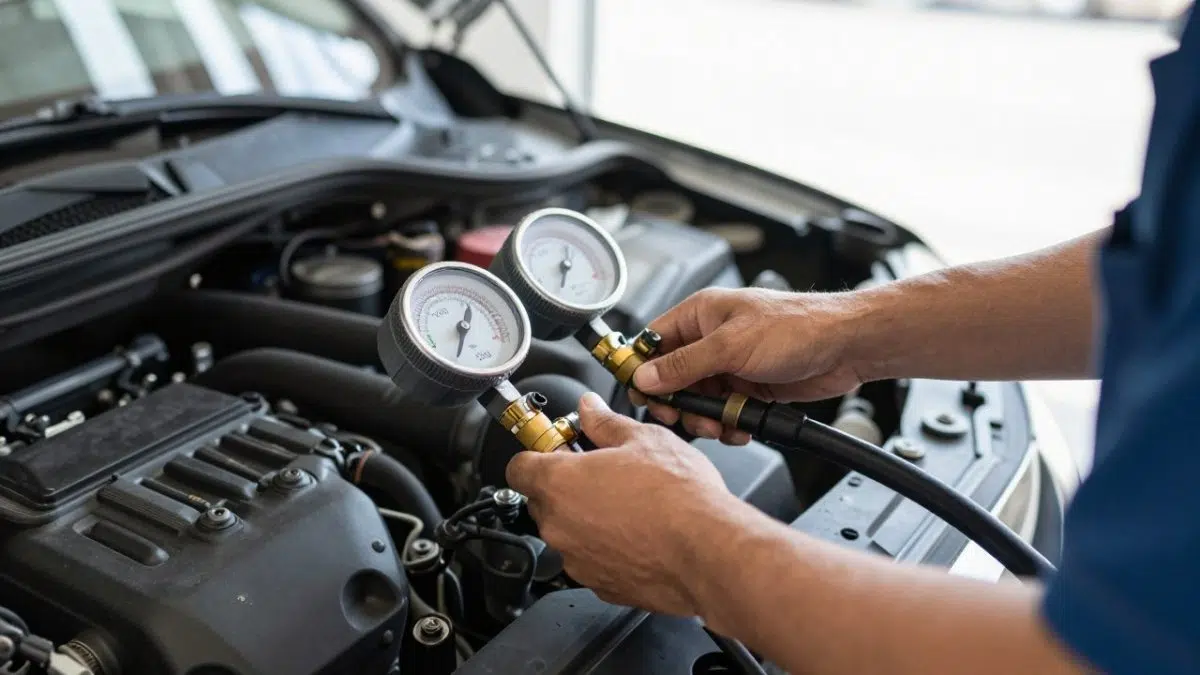
Reading the gauges before you touch the switch
A low-side reading that is too low with a high-side reading that is also low usually points to a low charge, not a failed switch. If the low side is low but the high side is normal or high, the restriction is more likely at the expansion valve or a clogged receiver-dryer.
Checking whether the compressor clutch engages
With the engine running and A/C on, look at the compressor pulley. The outer plate should spin with the pulley when the clutch engages. If the pulley spins but the center plate does not, the clutch is not being commanded on, which points to an electrical cause, not a refrigerant one.
Low-pressure versus high-pressure switches
A low-pressure switch protects the compressor from running with too little refrigerant; it opens when pressure drops too low. A high-pressure switch protects the system when pressure climbs too high, typically from a blocked condenser or an overcharge. Some vehicles use a combined trinary switch that handles both functions plus a fan request.
Testing the pressure switch circuit with a multimeter
The pressure switch, also called a pressure sensor, tells the control unit whether system pressure is safe for compressor operation. To test the circuit:
- Locate the switch on the high-side line, the receiver-dryer, or the compressor discharge line, depending on the vehicle.
- Unplug the connector and inspect the pins for corrosion, pushed-back terminals, or a loose fit.
- Set your multimeter to continuity or resistance for a simple switch, or to DC volts for a three-wire sensor.
- Test the switch contacts. On a simple low-pressure switch, you should see continuity within its normal range and an open circuit outside it. On a three-wire sensor, you are checking a reference voltage and a signal return, not continuity.
- Check for voltage at the connector with the key on. No voltage points to wiring, a fuse, or the control unit, not the switch.
A switch that reads open when it should be closed, or closed when it should be open, is faulty. A switch that tests fine but sees no voltage points to wiring or the control unit.
Distinguishing a bad switch from low refrigerant
This is a common misdiagnosis. A system low on refrigerant will often show a low-side pressure low enough to keep the low-pressure switch open, so the compressor never engages. Replacing the switch does nothing, because the switch was doing its job. The tell is the gauge reading: if static pressure with the compressor off is low for the ambient temperature, the system is undercharged and has a leak.
Other causes of a compressor that will not engage
A pressure switch is only one of several reasons the clutch stays off. Others include a blown fuse, a failed relay, a bad clutch coil, a wiring fault, an engine coolant temperature signal out of range, and a control module that has set a fault and disabled the compressor.
Safe limits of bypassing the switch for diagnosis
Watch out: never jump the switch contacts to “test” the compressor for more than a few seconds, and never leave a jumper in place. Bypassing a pressure switch defeats the compressor’s protection. If the system is low on refrigerant, the compressor can run without enough oil circulation and seize.
A short decision tree
Start with the clutch: does it engage? If no, check the fuse, relay, and whether the control head is requesting A/C.
If your vents are blowing warm and you want a step-by-step walkthrough of the whole diagnosis, our guide on vehicle A/C repair and how to diagnose warm air covers the checks in order.
A/C system evacuation and recharge after valve replacement
You cannot simply unscrew the old valve and bolt in a new one. The system must be recovered first, because releasing refrigerant into the air is regulated and dangerous.
Skipping the evacuation is a common shortcut, and it is the reason some repairs fail. Because trapped moisture and air can undermine cooling even after a repair, diagnosing the underlying cause is essential to fix a car AC that stops blowing cold.
Because A/C performance ties directly into engine cooling, an overheating gauge or coolant on the driveway deserves attention too. Our cooling system and overheating repair in Parker, CO page explains what we check when temperatures climb.
A/C expansion valve replacement labor time and what affects it
Labor time for an expansion valve replacement varies widely because the valve is buried in different places on different vehicles. On some cars it sits at the firewall, reachable in under an hour. On others it is behind the dashboard, and the dash has to come apart. That difference is the single biggest driver of what the job costs, which is why we quote after we know the layout.
What moves the labor estimate:
| Factor | Why it matters |
|---|---|
| Valve location | Firewall-mounted valves are quick; dash-mounted valves add hours |
| Vehicle design | Some engines and dash layouts require removing more parts |
| Refrigerant type | R-134a and R-1234yf require different service equipment |
| System condition | Leaks, a failing compressor, or a clogged receiver-dryer add work |
| Rust and age | Colorado road conditions and age can seize fittings |
What a firewall-mounted valve job involves
On vehicles where the valve is at the firewall or on the evaporator case in the engine bay, the job is contained. This type of job involves recovering the refrigerant, removing the lines and valve, replacing the O-rings, installing the new valve, evacuating the system, and recharging it by weight.
What a dash-out valve job involves
On vehicles where the valve is inside the evaporator case behind the dashboard, the dash has to come out. That means disconnecting the battery, removing trim panels, the center console, the airbag components in some cases, and the HVAC case fasteners. The layout affects both the time and whether related parts should be replaced while the dash is apart.
Why we look at the receiver-dryer and the compressor at the same time
The expansion valve does not fail in isolation. A clogged receiver-dryer can send debris to the valve, and a compressor that is shedding material can clog a new valve quickly. If the system has debris, replacing only the valve is a short-lived repair. A thorough diagnosis considers the receiver-dryer and compressor performance before the valve is recommended.
Colorado context: why A/C work here is not the same as in a mild climate
Parker sits in a swing climate. A July morning can be in the 60s and the afternoon in the 90s, and the system cycles hard across that range. Winter cold starts and spring temperature swings are hard on seals and O-rings, and mountain driving with long grades raises underhood temperatures and system pressures.
DIY versus professional: what you can and cannot do safely
You can check the clutch, inspect the connector, and test the switch circuit with a multimeter.
A valve replacement on an accessible layout can often be completed the same day, while a dash-out job takes longer.
Because A/C performance ties directly into engine cooling, an overheating gauge or coolant on the driveway deserves attention too.
Schedule your A/C diagnosis at our Parker shop
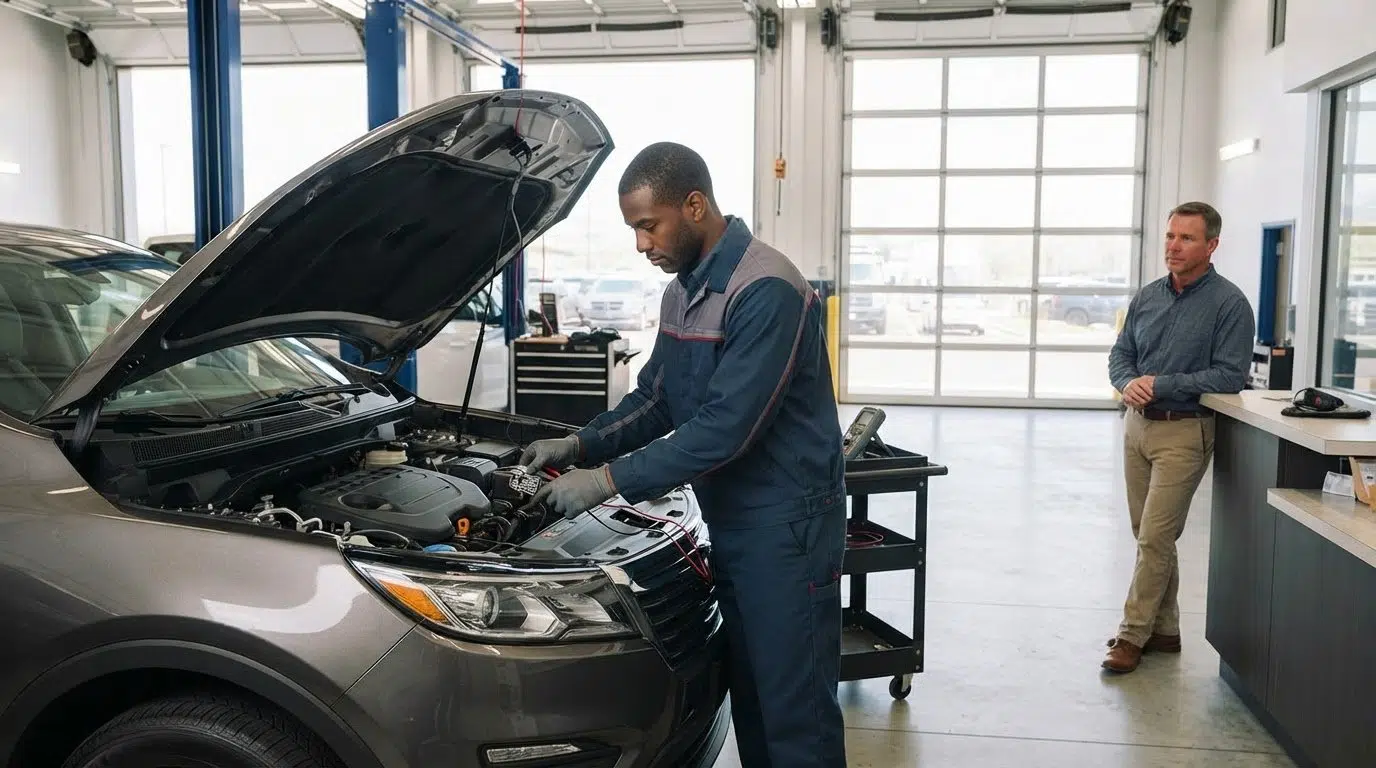
If your air conditioning is blowing warm, cycling, or frosting a line, the next step is a proper diagnosis, not a guess.
Colorado summers swing hard from cool mornings to hot afternoons, and that cycle is tough on A/C systems.
Warm air from your vents does not have to mean a major repair.
Frequently Asked Questions
What does it cost to replace a car A/C expansion valve?
The total depends on the valve itself, how accessible it is on your vehicle, and whether the system also needs evacuation and recharge. Some valves sit behind the dash and take hours to reach; others are under the hood and come out quickly. Because pricing varies that much by vehicle, we quote after inspecting your car rather than guessing over the phone. Call our Parker shop at (720) 778-1888 to schedule a diagnosis and get an accurate estimate for your specific make and model.
Can a clogged expansion valve cause car A/C to blow warm air?
Yes. The expansion valve meters refrigerant into the evaporator. When it clogs or sticks, refrigerant flow drops and the evaporator cannot absorb heat, so the vents blow warm or only slightly cool air. That said, low refrigerant from a leak produces nearly the same symptom, which is why pressure troubleshooting comes before parts replacement. A technician compares high-side and low-side readings to tell a restricted valve apart from a charge problem before recommending any repair.
Does replacing an A/C expansion valve require recharging the system?
Yes. Any repair that opens the refrigerant circuit, including expansion valve replacement, requires evacuation and recharge. The system is emptied, air and moisture are pulled out with a vacuum pump, and refrigerant is weighed back in to the manufacturer’s spec. Skipping the evacuation traps moisture that damages components and leaves the charge inaccurate. This step is part of the job, not an optional add-on, so expect it in any honest quote for the repair.
How long does A/C expansion valve replacement take?
Labor time ranges widely by vehicle. On some cars the valve is reachable under the hood and the job finishes in a couple of hours; on others it sits behind the dashboard and takes most of a day. Evacuation and recharge add time on top. Colorado temperature swings and stop-and-go commuting in Parker and Castle Rock work the system hard, so a careful diagnosis checks the system before the vehicle is returned. Ask us for a time estimate when you book.