Imagine you are halfway up a steep Colorado incline when you notice your engine revving high, but your car isn’t gaining any speed. That sudden disconnect between your foot and the road is more than just annoying; it is a safety risk that can leave you stranded far from home. We understand the anxiety that comes with transmission troubles, especially when you are trying to figure out how to know if clutch needs replacing without worrying about massive repair bills.
It is perfectly normal to feel uncertain about whether you are facing a minor hydraulic adjustment or a total system failure. We believe in providing clear, honest answers so you can make the best decision for your family’s safety. Our team lives by a simple motto: WE FIX EVERYTHING. That means we don’t just swap parts; we diagnose the root cause to ensure your vehicle stays reliable on every hill and highway in Parker.
In this guide, we will give you a straightforward “yes or no” framework to evaluate your clutch health. You will learn the specific performance red flags to watch for and the difference between a worn disc and a simple fluid issue. We are going to demystify the repair process so you can move forward with total confidence.
Key Takeaways
- Identify physical red flags like a spongy pedal or a distinct burning smell before they turn into a roadside emergency.
- Learn how to know if clutch needs replacing by spotting “slipping,” which happens when your engine revs but your car doesn’t gain speed.
- Master two simple DIY driveway tests that help you verify your transmission health without needing any special tools.
- Understand why we recommend replacing the flywheel and pressure plate as a complete set to ensure your vehicle stays reliable.
- Gain a clear “yes or no” framework to help you decide if it’s time for professional manual transmission repair in Parker.
Understanding Your Clutch: Why It Wears and When to Worry
Think of your clutch as the ultimate handshake between your engine and your wheels. It’s the critical bridge that allows power to flow so you can actually move. If you’ve ever wondered what is a car clutch?, it’s essentially the mechanical component that manages the connection between the rotating engine and the transmission. Because it relies on friction to do its job, it’s a consumable part with a finite lifespan. Most drivers can expect a high-quality clutch to last between 50,000 and 100,000 miles, but local driving conditions change that math quickly.
In Parker, our environment is particularly tough on manual transmissions. Between the stop-and-go traffic during the morning rush and the constant elevation changes, your clutch is working overtime. Every time you shift gears or hold your car on a hill, a small amount of friction material wears away. It’s very similar to how brake pads eventually wear down to the metal through normal use. Understanding this natural wear is the first step in learning how to know if clutch needs replacing before you find yourself stuck at a green light with a car that won’t move.
The Anatomy of Clutch Wear
The system is a team effort involving the pressure plate, the clutch disc, and the throw-out bearing. The clutch disc sits between the engine’s flywheel and the pressure plate, acting as the primary friction partner. When you press the pedal, the throw-out bearing pushes on the pressure plate to release the disc and disconnect the engine. Heat is the primary enemy of these components. Clutch glazing occurs when the friction material becomes scorched and smooth from excessive heat, causing it to lose its ability to grab the flywheel effectively.
Why Colorado Drivers Face Unique Challenges
Driving in Douglas County presents hurdles that flat-land drivers never have to worry about. Our steep grades and high altitude mean your engine has to work harder, and your clutch follows suit. If you are towing a camper or a trailer up toward the mountains, you are adding significant stress to the friction disc every time you engage the gear. You might have noticed a sharp, acrid burning smell when starting on a steep incline; that’s the smell of your clutch material overheating under pressure. We see this often in local trucks and SUVs, but don’t worry. WE FIX EVERYTHING. We ensure your vehicle is ready for the specific demands of Colorado roads and give you peace of mind during your commute. Learning how to know if clutch needs replacing is simply part of being a prepared mountain driver.
The 5 Physical Signs of a Failing Clutch System
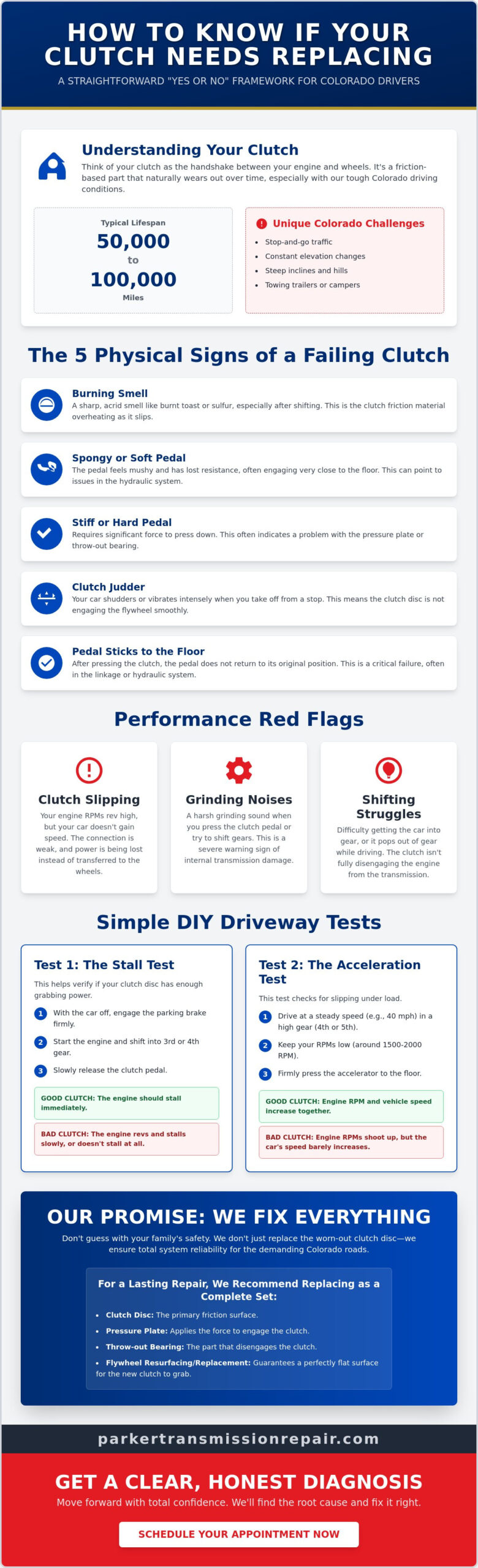
Your car communicates through your senses. When something goes wrong with the transmission, you will feel it in your foot or smell it in the cabin long before a dashboard light flickers. Understanding these physical signals is essential for how to know if clutch needs replacing before a minor annoyance becomes a major breakdown. We believe that a well-informed driver is a safer driver. We are here to help you translate those mechanical whispers into a clear plan of action.
- Burning Smell: A distinct scent like burnt toast or sulfur.
- Spongy or Soft Pedal: A loss of resistance when you press down.
- Stiff or Hard Pedal: Requiring significant muscle to engage.
- Clutch Judder: Intense vibrations or shuddering when taking off.
- Pedal Stick: The pedal remains on the floor after being pressed.
One of the most obvious red flags is a sharp, acrid burning smell. It is often compared to burnt toast or sulfur. This happens when the friction material on the clutch disc is slipping and overheating against the flywheel. The official auto repair advice from the FTC notes that unusual smells are frequently the first indicator of mechanical trouble. If you catch this scent after shifting or while accelerating, your clutch is likely crying out for help.
Sensory Warning Signs: Smell and Feel
Beyond the smell, pay attention to the feedback through the sole of your shoe. A healthy clutch should feel smooth and consistent. If you experience “clutch judder,” which is a distinct shuddering or vibrating sensation when taking off from a stop, it usually means the friction disc is worn unevenly or contaminated with oil. You might also notice the pedal feels “notched” or gritty as you press it down, rather than moving in one fluid motion. Resistance levels tell a story too; a “stiff” or “hard” pedal that requires extra muscle suggests a failing pressure plate or a binding linkage.
The Hydraulic Connection
Sometimes, the problem isn’t the clutch disc itself. Air in the fluid lines or a leaking master cylinder can mimic the symptoms of a worn-out clutch. A “spongy” or “soft” pedal that offers almost no resistance is a hydraulic red flag. In extreme cases, you might deal with “pedal stick,” where the clutch stays flat on the floor after you press it. We believe in transparency, which is why at Eagle Transmission & Auto Repair, we perform a deep diagnosis and repair to find the exact culprit. WE FIX EVERYTHING, and that starts with making sure we aren’t recommending a major job when a smaller fix will get you back on the road safely.
Performance Red Flags: Slipping, Grinding, and Shifting Struggles
Merging onto E-470 requires confidence in your vehicle’s power. If you hit the accelerator and notice a hesitation that wasn’t there before, your transmission system is likely struggling to bridge the gap between the engine and the road. This performance mismatch is a classic sign of a slipping clutch. We believe that knowing how to know if clutch needs replacing is the best way to prevent a stressful breakdown in the middle of your commute. Our team is dedicated to keeping you moving, and we approach every diagnosis with the same “we fix everything” attitude that has made us a local fixture.
When a clutch starts to fail, it loses the ability to hold the engine’s power against the transmission. This leads to “clutch slipping,” where the engine revs up, but the car doesn’t accelerate accordingly. It feels like your car is stuck in a state of indecision. We often see this problem manifest as a lack of “zip” when you’re trying to pass another vehicle or maintain speed on a steep Douglas County grade. We include these performance evaluations in our standard vehicle safety checks because your ability to accelerate predictably is a core safety requirement.
The RPM Mismatch: The Most Common Symptom
Watch your tachometer closely. If you see the needle jump up while your actual speed remains constant, the clutch disc is losing its grip on the flywheel. This “tachometer jump” is the most frequent red flag we see in our shop. Slipping is usually most noticeable when you are in a high gear at low speeds, such as trying to accelerate from 40 mph while already in fifth gear. While it might start as a subtle flutter on highway on-ramps, it will eventually progress until the car can no longer move under its own power.
Difficulty Shifting and Gear Grinding
Have you noticed a painful “crunch” when you try to shift into reverse or first gear? This grinding often points to a clutch that won’t disengage fully. If the engine is still partially connected to the transmission, the gears will fight you as you try to select them. A simple way to verify this is to try shifting gears while the engine is off versus when it is running. If the shifter moves easily when the car is off but feels blocked or “notchy” when the engine is running, the clutch is almost certainly the issue. While this might feel like a major gearbox failure, it often just requires Professional Transmission Repair in Parker, CO to address the clutch components. We handle these complexities every day, ensuring that no matter how difficult the shift feels, we have the solution to get you back into gear.
DIY Diagnostic Checklist: Simple Tests to Run in Your Driveway
You don’t need a lift or a toolbox full of professional wrenches to get a better sense of your vehicle’s health. While we are always ready to handle the heavy lifting, these simple driveway tests provide a great starting point for how to know if clutch needs replacing. Before you begin, find a flat, open area like an empty parking lot here in Parker to ensure you have plenty of room and no obstacles in your path. Safety is our top priority, and we want you to feel confident before you even turn the key.
The High-Gear Stall Test
This is a classic way to verify the “grab” of your friction disc without moving an inch. It is an effective method to see if the connection between your engine and transmission is still solid. Follow these steps carefully:
- Step 1: Start your engine and set the parking brake as firmly as it will go. Make sure there is nothing in front of the vehicle just in case.
- Step 2: Press the clutch pedal and shift the transmission into a high gear, such as 4th or 5th.
- Step 3: Slowly release the clutch pedal as if you were trying to pull away normally.
Analyze your results immediately. If your car stalls the moment the pedal reaches the engagement point, your clutch is likely still grabbing the flywheel with enough force. However, if the engine continues to run or takes a long time to stall while the pedal is fully released, the disc is slipping badly. This indicates the friction material is too thin to hold the engine’s power.
The Neutral Noise Test
Sometimes the most telling signs are the ones you hear rather than feel. Sit in your car with the engine idling in neutral and your foot off the pedal. Listen for any unusual chirping, whirring, or rattling noises coming from the floorboard area. If you hear a distinct sound that disappears the moment you press the clutch pedal down, you are likely hearing a worn throw-out bearing. This small component is vital for smooth engagement, and a failure here can eventually lead to a stuck pedal. You might also feel a slight pulsing or vibration through the sole of your shoe when you hold the pedal at a steady RPM. These are early warning signs that the mechanical components are reaching their limit.
If your vehicle failed any of these simple checks, it is time to get a professional opinion. We provide expert clutch replacement in Parker, CO to ensure your car remains a reliable partner on the road. We fix everything, and we do it with the precision and care your family deserves to stay safe on every Colorado incline.
Expert Clutch Replacement in Parker: Why We Fix Everything
You have run the driveway tests and spotted the red flags. Now you face the most important part of the process: taking action. Knowing how to know if clutch needs replacing is a great first step, but restoring your vehicle’s performance requires a team with a “can-do” attitude. We don’t just swap out parts and send you on your way. We provide total solutions for every mechanical challenge. Our motto is clear and confident: WE FIX EVERYTHING. Whether you are driving a compact commuter car or a heavy duty work truck, we have the technical mastery to handle the job with precision. This commitment to mechanical reliability is also vital for your property’s infrastructure, where experts like E.R.S. Heating & Cooling ensure that HVAC and refrigeration systems operate at peak efficiency.
When we perform a clutch replacement Parker CO drivers can count on, we believe in doing the job right the first time. This means looking beyond the friction disc. Replacing only the disc while leaving a worn pressure plate or a heat-cracked flywheel is a recipe for future failure. We treat these components as a matched set. By replacing the flywheel and pressure plate together, we ensure a perfectly smooth mating surface and consistent pedal feel. This comprehensive approach is how we guarantee the long term reliability that Parker families depend on every day.
The Eagle Advantage: Beyond Just a Disc
Our diagnostic process is thorough and honest. Before we ever turn a wrench, we perform a deep dive into your vehicle’s drivetrain. We inspect the pilot bearing, the throw-out bearing, and the rear main seals to ensure no hidden leaks will contaminate your new clutch. Our expertise spans a wide range of vehicles, including specialized Ford repair for F-150 and F-250 models, as well as complex import manual systems. If you are looking for specialized care for European makes, you might visit Eurotech Automotive to see how dedicated specialists handle these precision machines. We see ourselves as your neighborly partners. We want to reduce your anxiety by providing a transparent look at your car’s health and offering solutions that keep your loved ones safe on the road.
Next Steps for Your Vehicle
If your car is hesitating on inclines or grinding through gears, it is time for a professional eyes-on inspection. We are proud to serve our local community, including providing robust fleet repair and services for Parker businesses that rely on their manual trucks to get the job done. We handle everything from standard car repair to diesel engine repair with the same commitment to excellence. Don’t let a slipping clutch leave you stranded on a Colorado hillside. We are ready to provide the definitive “yes or no” answers you need to drive with total confidence again.
Ready to get back on the road with a transmission you can trust? Schedule your clutch inspection with Eagle Transmission & Auto Repair today and experience the peace of mind that comes with expert service.
Take Control of Your Vehicle’s Future
Driving with a failing clutch is a gamble you don’t have to take. We have explored the critical physical red flags like spongy pedals and acrid smells, along with the performance struggles that make merging onto Colorado highways a challenge. Now that you understand how to know if clutch needs replacing, you can move forward with total confidence. We believe in providing the clarity you need to keep your family safe on every steep incline and mountain pass.
As a locally owned and operated shop in Parker, we take pride in our technical mastery. We specialize in manual transmission and clutch replacement, offering expert diagnostics for Ford, Chevy, and import trucks. We approach every vehicle with a bold promise: WE FIX EVERYTHING. Whether you are dealing with a minor hydraulic leak or a total system failure, we have the tools and experience to resolve the issue correctly the first time.
Don’t wait for a roadside emergency to find a partner you can trust. Get Your Clutch Inspected by the Experts Who Fix Everything and let us handle the heavy lifting. We are here to support you and ensure your vehicle remains a reliable part of your daily life.
Frequently Asked Questions
Can I drive with a slipping clutch?
You should not continue driving once you notice your clutch is slipping. While the car might still move for a short distance, the slipping generates intense heat that can quickly warp your flywheel or damage the pressure plate. Eventually, the slip will become so severe that your vehicle won’t accelerate at all, which could leave you stranded in a dangerous spot on a busy Parker road.
How much does a clutch replacement cost in Parker, CO?
The cost for a clutch replacement depends on your specific vehicle and the condition of the related components. Every job is different, which is why we prioritize an honest, physical diagnosis before we provide a quote. We believe in total transparency and will give you a clear breakdown of the necessary repairs so you can feel confident in the value of the work being performed.
What is the average lifespan of a manual clutch?
Most manual clutches are designed to last between 50,000 and 100,000 miles under normal driving conditions. However, your environment and driving habits change this timeline significantly. Navigating the steep hills and stop and go traffic in Douglas County often accelerates wear. Regular inspections are the best way for how to know if clutch needs replacing before you reach a critical failure point.
Does a burning smell always mean I need a new clutch?
A burning smell is a major warning sign, but it doesn’t always mean a full replacement is required immediately. It often indicates that the friction material is overheating, which can happen if you ride the clutch on a steep incline. If the smell persists or you notice a change in how the car accelerates, it is time for a professional inspection to ensure the disc isn’t glazed or burnt.
What happens if my clutch fails completely while driving?
If your clutch fails completely, you will lose the ability to transfer power from the engine to the wheels. You might find yourself unable to shift into gear or stuck in neutral while the engine revs without moving the car. This is a serious safety hazard that can happen without much warning if you ignore the early signs of wear. We fix everything, so we recommend addressing symptoms early.
Is it better to repair or replace a clutch?
We almost always recommend a full replacement because the clutch is a consumable part. Replacing only one component, like the disc, while leaving a worn pressure plate often leads to another failure shortly after. By replacing the entire set, including the throw-out bearing and pilot bearing, we ensure your transmission system remains reliable for years to come rather than just providing a temporary fix.
How long does a clutch replacement take at your shop?
A professional clutch replacement typically takes between 4 and 8 hours to complete. It is a labor intensive process that requires our team to remove the transmission to reach the internal components. We work with an energetic and logical flow to get you back on the road as quickly as possible, but we always take the necessary time to ensure every seal and bolt is perfect.
Can cold Colorado weather affect my clutch pedal feel?
Yes, freezing temperatures in Parker can make your clutch pedal feel stiff or sluggish, especially first thing in the morning. The hydraulic fluid in the master and slave cylinders can thicken in the cold, which affects the responsiveness of the pedal. If the stiff feeling doesn’t go away once the engine warms up, it may indicate air in the lines or a failing hydraulic component that needs attention.