If you see reddish or dark fluid under the middle of your 4×4 or all wheel drive vehicle, the transfer case may be leaking, but the drip is not always coming from where it looks. The transfer case is the gearbox that sends power from the transmission to your front and rear axles. It holds a small amount of fluid, so even a slow leak matters. At Eagle Transmission & Auto Repair in Parker, every job starts with a free diagnostic that includes a road test and a computer scan, so you learn where the fluid is really coming from before you spend anything.
Key Takeaways
- A transfer case sits between the transmission and the axles, and a leak there is usually a worn seal, a loose or damaged plug, or a seam that has aged.
- Engine oil, transmission fluid and transfer case fluid can all end up in the same spot, so the color and the location of a drip do not prove the source on their own.
- A small, slow leak is worth getting checked soon. Grinding, binding or a vehicle that feels like it is fighting itself is a reason to stop driving and call.
- Topping off the fluid is not a repair. The leak has to be found and fixed first, and then the case is refilled with the right fluid.
- We offer free diagnostics and can tow your vehicle to our shop in the Parker area as part of a repair.
Table of Contents
- What the transfer case does and why leaks matter
- How to tell if the fluid is from the transfer case
- Why a transfer case leaks
- Can you keep driving with a leaking transfer case?
- Can you just add more fluid?
- Transfer case fluid change versus leak repair
- How a shop finds the real source of the leak
- What we do at Eagle Transmission & Auto Repair
- Fleet vehicles and work trucks
- Who we serve
- FAQ
- Talk to us about your leak
- Sources
What the transfer case does and why leaks matter
On a four wheel drive truck or SUV, power leaves the transmission and goes into the transfer case. From there, one driveshaft runs to the rear axle and another to the front. Many all wheel drive cars and crossovers have a similar unit that does the same job. Inside are gears or a chain, bearings and shafts, all of which depend on a thin film of fluid.
That fluid is a gear oil or automatic transmission fluid (ATF), depending on the vehicle. Seals keep it inside where the shafts come out of the case. When one of those seals wears, the case loses fluid a little at a time. The parts inside run hotter and wear faster as the level drops, which is why a small drip is cheaper to deal with than a case that has run low for months.
Colorado makes this more relevant. Long highway climbs on I-25 toward Castle Rock and Monument heat up drivetrains. Winter snow, slush and gravel roads in Elizabeth and Franktown put 4×4 systems to work more often. Mud and water crossings can also clog the small vent that lets the case breathe, and that can push fluid past seals that were otherwise fine.
How to tell if the fluid is from the transfer case
Start with what you can see without touching anything under the vehicle. Slide a piece of cardboard under the middle of the vehicle overnight, then look at the spot in the morning.
- Reddish or light brown, thin: often ATF. It can come from the transmission, from a transfer case that uses ATF, or from a power steering system.
- Dark brown or black, thicker, with a strong sulfur smell: usually gear oil. That points toward the transfer case, a differential or an axle.
- Black and thin: often engine oil, which can run back along the underside from a valve cover, oil pan or rear main seal.
Location helps too. The transfer case sits roughly in the center of the vehicle, between the transmission and the rear differential, with seals at the front and rear where the driveshafts connect. But a 4×4 has an engine, a transmission and a transfer case all dripping into the same area, and air moving under the vehicle blows fluid backward. A transfer case that looks wet may be wearing someone else’s leak. If you also notice fluid near the transmission, our guide on where a transmission fluid leak is coming from walks through those signs.
A clear read on fluid color is useful to bring to a shop. It does not replace a proper inspection, because fluids look different once they are hot, old or mixed with road dirt.
Why a transfer case leaks
Most leaks come down to a handful of places.
Output shaft seals
The rear output seal and the front output seal wrap around the shafts that send power to the axles. They are the most common leak points. A seal wears out from age and heat, and it also fails early if the shaft or yoke it rides on is grooved, out of line or loose. Replacing only the seal when the part behind it is damaged can mean the new seal leaks again.
Input shaft seal and the joint with the transmission
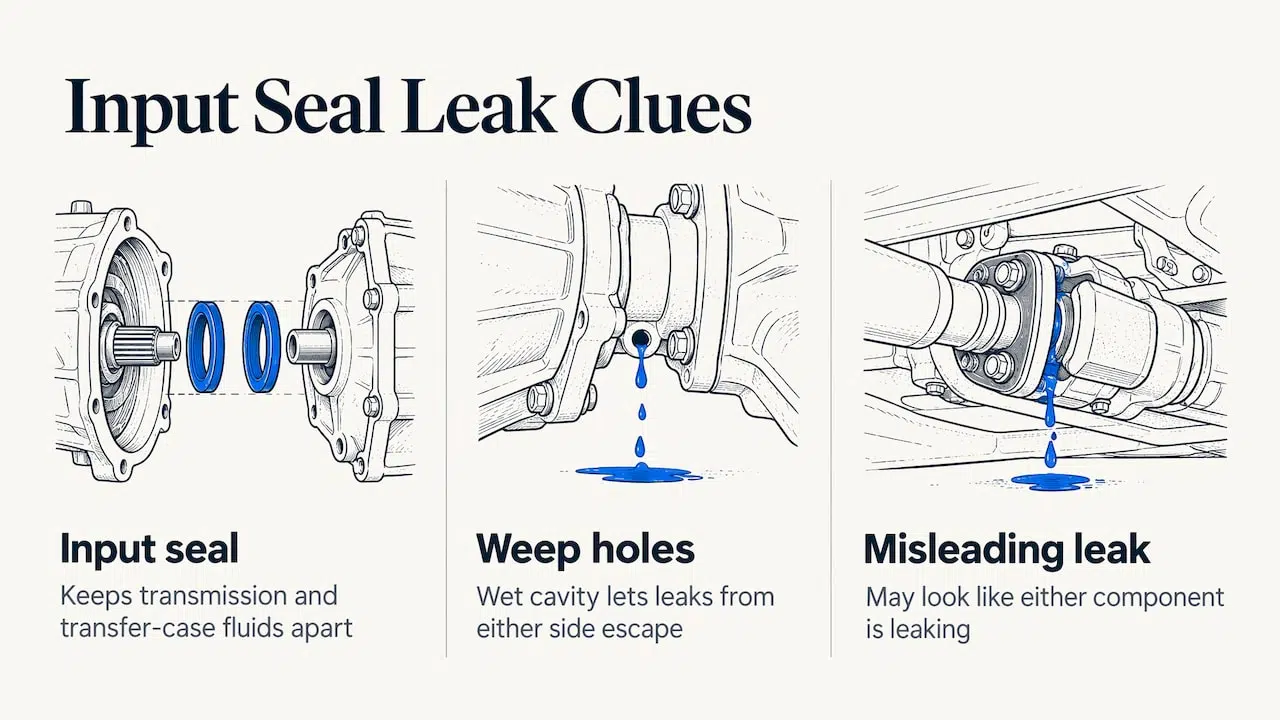
Where the transmission meets the transfer case, an input seal keeps the two fluids apart. On many vehicles that area is built with a small cavity and weep holes, which are tiny openings that let fluid escape on purpose so that two fluids never mix. NHTSA’s published manufacturer information explains that this cavity is designed to be wet, with a double seal, and that a leak on either side shows up at the weep holes. That is why a leak here can look like it comes from the transmission when it is the transfer case, or the other way around.
Other manufacturers describe the same trap. A GM bulletin tells technicians to clean the area and confirm whether ATF is coming from the slip yoke plug or the output seal before replacing anything. An Audi bulletin warns that a leak that looks like a transmission pan gasket can actually be coming from the weep hole between the transmission and transfer case. GM’s own service information adds that on some adapters, the weep hole leak is either the transmission output seal or the transfer case input seal, not the gasket.
The takeaway for you: guessing is how people replace the wrong part.
Drain and fill plugs
The plugs that let a technician drain and refill the case use small gaskets or washers. If a plug was over tightened, has damaged threads or lost its washer, it can weep. This is usually a simple fix once found.
Case seam and gaskets
The case is built in two halves joined with sealant or a gasket. After many heat cycles, that seam can start to seep. A seam leak often shows as a damp film around the middle of the case rather than a drip at one shaft.
A clogged vent
The vent is a small tube or fitting that lets pressure out as the case heats up. If mud, a kinked hose or water crossing blocks it, pressure builds inside and pushes fluid past the seals. If a seal was replaced and the leak came back, the vent is one of the things a careful technician checks.
Can you keep driving with a leaking transfer case?
It depends on what you are seeing and feeling.
A few spots on your driveway after a night, with no change in how the vehicle drives, is a reason to book a check soon and keep trips short and gentle until then. Do not wait for the next long drive up to the mountains.
Stop driving and call for a tow if you notice any of these:
- Grinding, whining or clunking from the middle of the vehicle
- The vehicle binding or hopping in tight turns
- Trouble shifting into or out of 4 high or 4 low
- A 4WD or AWD warning light
- A large puddle or a trail of fluid behind you
Those signs can mean the parts inside are no longer getting enough lubrication, and continuing to drive can turn a seal job into a much bigger repair. We offer complimentary local towing with repair, so you do not have to risk the drive to get your vehicle to us.
Can you just add more fluid?
It is tempting to top off the case and carry on. Adding fluid does not stop the leak, and the fluid you lose is the fluid your gears depend on. Using the wrong type can also cause trouble. Some cases take gear oil, some take ATF and some take a specialty fluid, and mixing them up can cause noise or poor shifting between 2WD and 4WD.
There is one more reason to leave this to a technician. If the transfer case level seems to keep rising, transmission fluid may be crossing over into it through a worn input seal. That can overfill the case and leave the transmission short. Only an inspection tells you which situation you are in.
The usual order of work is: find the exact source, repair it, then refill the case with the fluid your vehicle calls for.

Transfer case fluid change versus leak repair
They are different jobs. A fluid change is routine maintenance: the old fluid is drained and fresh fluid goes in, so the gears and bearings stay protected. A leak repair fixes the reason fluid is escaping, such as a seal, a plug gasket, a seam or a vent. A leak repair always ends with fresh fluid, but a fluid change by itself will not stop a leak.
Dark, gritty or metallic looking fluid is a sign it is due for service, and many owners have the level and condition checked at their regular oil changes. If you are not sure when yours was last done, our guide to transfer case service for 4WD and AWD owners explains what the service covers and how often owners usually schedule it.
How a shop finds the real source of the leak
Professional diagnosis is about removing guesswork. The methods in manufacturer service information are consistent:
- Clean the suspected area so old fluid is not mistaken for a new leak.
- Add a fluorescent dye to the fluid, or apply a leak tracing powder.
- Drive the vehicle under normal conditions for a set time.
- Inspect with a black light or look at the powder to trace the path back to the source.
GM’s service information describes both approaches, with dye and a black light kit or tracing powder after a drive of 15 to 20 minutes. It also lists the usual repairs: sealing plugs, correcting vent hoses, replacing output or input seals and resealing the case halves.
Your vehicle’s maker may call for a specific method. Audi’s bulletin, for example, calls for tracing powder rather than dye in its transmissions. Knowing which applies to your make is part of why a shop that works on all makes and models is useful here.
One detail separates a lasting repair from a repeat leak: installing the seal correctly. Manufacturers specify how deep a new seal sits in its bore, and a seal set too deep or too shallow can leak straight away. That is a measurement job done with the right tools, not a guess.
What we do at Eagle Transmission & Auto Repair
We handle transfer case repair and service, along with transmission repair, rebuilds and replacement, transmission fluid service, manual transmission and clutch work, differential repair, engine repair, brakes, A/C and heating, shocks and struts, preventative maintenance and fleet service. Because we work across the whole drivetrain, we can follow a leak from the transmission through the transfer case to the driveshafts and differentials instead of stopping at the first wet spot.
Here is how we approach a suspected transfer case leak:
- Free diagnostic. We start with a road test and a computer scan before you spend anything.
- A clear explanation. We explain what we find, where the fluid is coming from and what the repair involves, with transparent quoting and no surprise charges.
- Your approval first. Repairs happen only after you say yes.
- ASE certified technicians. The work is done by ASE certified technicians and is backed by warranty.
- Convenience. We offer complimentary local towing with repair and ride service while your vehicle is with us.
You can see how we handle 4×4 systems on our 4×4 transfer case service page, and read about solving 4WD transfer case problems before they leave you stranded. If the fluid on your driveway looks more like it came from the differential, our page on a differential fluid leak covers that case.
When you are ready, our free transmission diagnostics are the place to start.

Fleet vehicles and work trucks
If you run work trucks or vans for a local business, a leaking transfer case can sideline a vehicle at the worst time. Catching a seal leak during a routine check is far easier on your schedule than a breakdown on a job site. We offer fleet service and preventative maintenance, so the fluid level and condition of your drivetrain components can be looked at alongside brakes, fluids and other regular upkeep.
Who we serve
Our shop is at 10189 Parkglenn Way, Parker, CO 80138. We serve drivers in Parker, Lone Tree, Castle Rock, Castle Pines, Highlands Ranch, Centennial, Aurora, Franktown and Elizabeth. Whether your 4×4 is a daily commuter or a weekend vehicle for the mountains, the first step is the same: tell us what you have seen and let us look.
FAQ
Why is my transfer case leaking transmission fluid?
Often the cause is the seal where the transmission connects to the transfer case, or a seal at one of the shafts, letting ATF escape. On some vehicles that joint is built with weep holes, so fluid from either side can appear in the same place. A diagnosis that uses dye or tracing powder shows which fluid and which seal are involved.
Can I still drive with a bad transfer case?
A small leak with no change in how the vehicle drives usually means you should book an inspection soon and keep driving to a minimum. Grinding, binding, trouble engaging 4WD or a large leak means you should stop driving and have the vehicle towed. We offer complimentary local towing with repair.
What is a transfer case fluid change?
It is routine maintenance where old fluid is drained and replaced with fresh fluid of the type your vehicle needs. It protects the gears and bearings, but it does not fix a leak. A leak repair addresses the failing part, then finishes with new fluid.
Can I just add more transmission fluid to the transfer case?
It is not a good idea. Not every case uses ATF, and the wrong fluid can cause noise or poor performance. Adding fluid also leaves the leak in place. The better path is to find the leak, repair it and refill with the correct fluid.
Talk to us about your leak
If you have seen fluid under your truck or SUV, there is no pressure to decide anything today. Call Eagle Transmission & Auto Repair at (720) 778-1888 or schedule a visit. We are open Mon to Fri 8am to 6pm and closed weekends, and we will take a look and explain what is going on.
Sources
- NHTSA preliminary information on the wet cavity between transmission and transfer case
- GM service bulletin on ATF leaks at the slip yoke plug and output seal
- Audi technical background on the transmission to transfer case weep hole
- GMC diagnostic document on transfer case leaks