
Could synthetic transmission fluid be an upgrade, or could the wrong bottle create problems? The benefits of synthetic transmission fluid can include more stable performance across temperature changes and resistance to fluid breakdown, but the label alone doesn’t tell you whether it’s right for your vehicle.
It’s reasonable to wonder whether switching from conventional fluid could harm a transmission. In most cases, the key question isn’t simply synthetic versus conventional. It’s whether the fluid meets the exact specification required for your vehicle. A mismatch can affect shifting and transmission operation, even if the fluid is marketed as a premium or multi vehicle option.
This guide explains the potential advantages of synthetic fluid, what it may and may not do, and how to find your vehicle’s fluid requirement in the owner’s manual or reliable vehicle specific service information. You’ll also learn when fluid service may be appropriate and why ongoing slipping, shuddering, or other shifting changes call for diagnosis rather than a fluid change alone. The goal is straightforward: understand the options, follow the specification, and make an informed decision for your transmission.
Key Takeaways
- The benefits of synthetic transmission fluid depend on using a fluid suited to the transmission, not simply choosing the synthetic label.
- Transmission fluid helps lubricate moving parts, support hydraulic operation, and carry heat away.
- Use your vehicle details and owner’s manual to identify the required fluid specification before selecting a product.
- Driving conditions can help inform maintenance decisions, but follow vehicle specific service information rather than a generic interval.
- Dark fluid, an unusual odor, leaks, or shifting changes deserve evaluation. One clue alone can’t confirm the cause.
What are the benefits of synthetic transmission fluid?
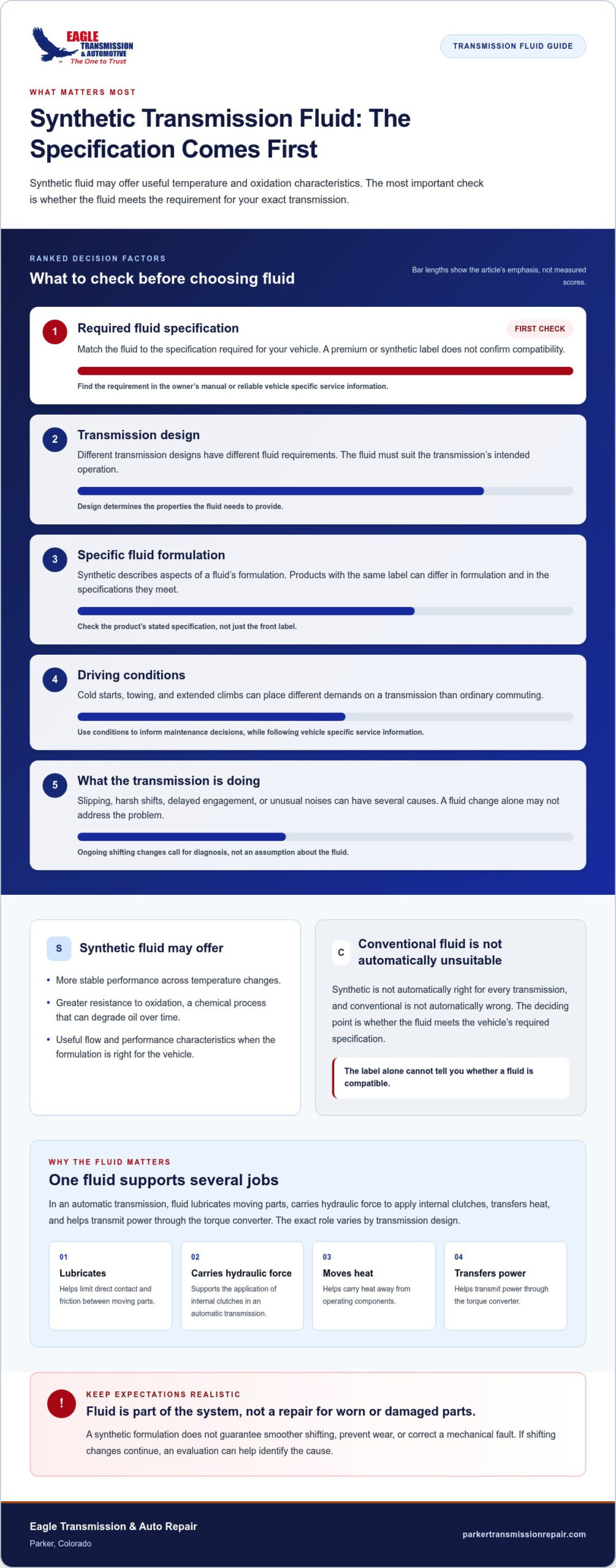
Synthetic transmission fluid is made with a synthetic base oil and a package of additives designed to give it particular working characteristics. The potential benefits of synthetic transmission fluid can include more stable performance across temperature changes and greater resistance to oxidation, a chemical process that can degrade oil over time. Those properties may help fluid perform consistently, but they don’t guarantee smoother shifting or longer transmission life in every vehicle.
The actual result depends on the fluid’s formulation, the transmission’s design, how the vehicle is used, and whether the fluid meets the required specification. A car that regularly starts in cold Colorado weather faces different conditions than one used mainly for steady, mild weather driving. Towing and extended climbs can also put different demands on a transmission than ordinary commuting. These conditions matter, but they don’t make a particular fluid type automatically right for every vehicle.
What makes transmission fluid synthetic?
Base oils form the main body of a lubricant. Additives are blended into them to support functions such as resisting wear, managing deposits, and controlling how the fluid behaves in use. Synthetic describes aspects of the fluid’s formulation, not a universal performance guarantee. Products bearing the same label can differ in their formulations and in the specifications they meet. For a general overview of automatic transmission fluid, including its roles and types, see the linked reference.
Which benefits may matter in everyday driving?
Temperature behavior is one potential advantage. Some synthetic formulations are designed to maintain useful flow in colder conditions and resist changes associated with heat. That can matter during cold starts or demanding driving, but it doesn’t mean every synthetic fluid performs alike, or that a driver will notice a difference in every transmission.
Consistent fluid behavior can support reliable operation as the transmission works through changing conditions. Think of fluid as part of the system’s working environment, not a repair for worn or damaged parts. Results depend on the individual vehicle and the correct specification.
The specification matters more than the synthetic label: use a fluid that meets the requirement for your exact transmission. Check the owner’s manual or reliable vehicle specific service information before choosing fluid or changing types. If shifting changes continue, seek an evaluation rather than assuming a fluid change will address the cause.
In short, synthetic fluid may offer useful temperature and oxidation characteristics, but those possible advantages only matter when the formulation suits the transmission and meets its required specification.
How synthetic transmission fluid can support transmission operation
Transmission fluid does more than lubricate. In an automatic transmission, it reduces friction between moving parts, carries hydraulic force that applies internal clutches, transfers heat, and helps transmit power through the torque converter. The exact role varies by transmission design, so the fluid must suit the vehicle’s requirements.
These jobs work together. If fluid can’t flow or maintain its intended friction characteristics, transmission operation may be affected. A synthetic formulation may be designed for stable performance across changing conditions, but that alone can’t prevent wear, correct a mechanical fault, or guarantee trouble free shifting.
How fluid properties relate to heat and lubrication
Gears, bearings, and other moving parts need lubrication to limit direct contact and friction. Fluid also helps carry heat away from operating components. Heat can change how fluid behaves, while its ability to flow affects circulation through the system. Synthetic products may be formulated to handle temperature changes, but actual performance depends on the formulation approved for the vehicle.
Why smooth operation depends on the right fluid
In an automatic transmission, hydraulic pressure directs components to engage or release as the vehicle changes gears. Fluid also works with friction surfaces, so its properties help determine how those parts apply. That’s why fluid selection matters, but a synthetic label alone doesn’t mean every product will make every transmission shift more smoothly.
Slipping, harsh shifts, delayed engagement, or unusual noises can have several possible causes. Fluid condition or level may be relevant, but symptoms can also point to worn parts or another transmission concern. Routine fluid service and diagnosis are different tasks. Diagnosis helps identify why a symptom is occurring. Replacing fluid won’t repair damaged components, and one symptom can’t confirm that fluid is the cause.
If you’re unsure whether your vehicle needs fluid service or an evaluation for a shifting concern, Eagle Transmission & Auto Repair provides transmission service and repair. For directions to the Parker repair shop, view the route to the shop.
Synthetic versus conventional fluid: why compatibility comes first
Synthetic fluid isn’t automatically the right choice for every transmission, and conventional fluid isn’t automatically unsuitable. The first question is whether a fluid meets the specification required for the vehicle. A transmission’s design determines the properties its fluid must provide, so a product’s label alone can’t establish compatibility.
Use the owner’s manual or reliable vehicle specific service information to identify the required fluid. Then compare that requirement with the product’s stated specification. A “multi vehicle” label is not a substitute for confirming a match. The table below shows why the useful comparison is about formulation and application, not simply which type sounds more advanced.
| Comparison point | Synthetic fluid | Conventional fluid |
|---|---|---|
| Formulation | Uses a synthetic base oil and additives. Formulations vary by product. | Uses a refined petroleum base oil and additives. Formulations vary by product. |
| Specification match | Must meet the vehicle’s required specification. | Must meet the vehicle’s required specification. |
| Potential properties | Some formulations are designed for particular flow or temperature characteristics. | Properties depend on the specific formulation and its intended application. |
| Vehicle application | Suitable only when the product is approved for the transmission’s requirements. | Suitable only when the product is approved for the transmission’s requirements. |
Can you switch from conventional to synthetic fluid?
Possibly, but don’t assume a switch is safe, necessary, or beneficial just because both products are transmission fluids. Check the vehicle’s required specification and the product’s stated compliance. If the information is unclear, use reliable vehicle specific service information before making a choice. The fluid type by itself doesn’t tell you whether two products are interchangeable.
What happens when the wrong fluid is used?
A fluid that doesn’t meet the transmission’s requirements may affect shifting or operation. That possibility doesn’t mean every symptom after a fluid change proves the fluid caused it. Record the vehicle’s make, model, and transmission details, then check the manual for the specified fluid before service. If shifting changes persist, diagnosis can help identify the cause rather than relying on a fluid change alone.
Service method is another separate decision. A flush and a drain and fill are different procedures, and the appropriate approach depends on the vehicle and service need. The article on transmission flush versus drain and fill explains that distinction. For fluid service or a transmission concern, Eagle Transmission & Auto Repair provides transmission service and repair. Choose fluid by the exact required specification, not by assuming synthetic is always an upgrade.
How to decide whether synthetic transmission fluid is appropriate
Choosing fluid is a vehicle specific decision, not a simple upgrade based on a label. Use this order: identify the vehicle, find its required fluid specification, then consider its service history and how it’s driven. That approach helps separate a sensible maintenance choice from a guess based on another driver’s experience.
- Identify the vehicle. Note its make, model, and other details needed to find accurate service information. If you’re unsure which transmission it has, avoid choosing a fluid based on the vehicle name alone.
- Check the specification. Look in the owner’s manual or reliable vehicle specific service information for the exact fluid requirement. Match that requirement to the product information, rather than relying only on the words synthetic or multi vehicle.
- Consider its service needs. Review available maintenance records and the vehicle’s use. Follow the service guidance for that vehicle, and treat unusual shifting or other symptoms as a reason to consider diagnosis, not just a fluid change.
Check the fluid requirement before choosing a product
The word synthetic describes a type of formulation, but it may not identify the specification a transmission requires. Service information can provide a more precise requirement than a broad fluid category. Check the details for the exact vehicle before buying or adding fluid. Don’t assume a product suitable for one car, truck, or transmission will suit another.
Consider service history and driving symptoms
Records can show what fluid service has been done and when, helping clarify the next maintenance question. If the history is incomplete, avoid guessing at a service interval. Check the vehicle specific guidance and consider how the vehicle is used. Slipping, harsh shifts, or delayed engagement are different from a routine service question because several mechanical causes can create similar symptoms.
Driving patterns can add useful context. Frequent towing, extended climbs, stop and go use, or repeated cold starts may place different demands on a transmission than steady, moderate driving. Colorado’s changing seasons and varied driving conditions can be part of that discussion, but they don’t establish a universal interval or prove synthetic fluid is necessary. Use the owner’s manual or vehicle specific service information to guide maintenance decisions.
For broader context on scheduled care and transmission maintenance, Eagle’s transmission service guide can help frame the questions to consider. Fluid service and diagnosis serve different purposes, so persistent symptoms deserve attention beyond simply choosing another fluid.
If you’re weighing fluid service against a transmission concern, schedule an evaluation with Eagle Transmission & Auto Repair. Get directions to Eagle Transmission & Auto Repair and bring any available service records or vehicle information.
When fluid service or transmission diagnosis may be the next step
Dark fluid, an unusual odor, a visible leak, or a change in shifting is a reason to pay attention, not an automatic signal to replace the fluid. These clues can help guide an evaluation, but no single observation confirms what is happening inside a transmission. A leak, for example, makes it useful to identify where fluid is escaping and whether the fluid level or operation has been affected.
When to ask about transmission fluid service
If you’re reviewing maintenance records or planning routine care, compare the available service history with the schedule in your owner’s manual or reliable vehicle specific information. The right service method depends on the vehicle and its condition, so don’t select a procedure or fluid based on appearance alone. Eagle’s transmission fluid service information offers context for considering maintenance needs.
Fluid color can change with use, but appearance by itself doesn’t establish whether fluid is due for service or whether a transmission has a fault. An unusual or burnt odor also deserves context. Note when you first noticed it, whether it’s getting stronger, and whether other changes have appeared. Those details can help distinguish a maintenance question from a concern that needs diagnosis.
When shifting symptoms need diagnosis
Slipping, delayed engagement, harsh or inconsistent shifting, and new noises are reasons to have the concern assessed. They aren’t proof of transmission failure or proof that fluid is the cause. Similar symptoms can arise from different mechanical or operating issues. An evaluation may consider vehicle information, service history, fluid condition, leaks, and how the transmission is behaving. The findings, rather than one clue, help determine an appropriate next step.
- Dark fluid: Treat it as an observation to share, not a diagnosis.
- Unusual odor: Note when it occurs and whether shifting changes accompany it.
- Visible leakage: Have the source and related fluid concerns evaluated.
- Shifting changes: Describe what the vehicle does and under what conditions.
The benefits of synthetic transmission fluid don’t change this basic distinction: choosing a suitable fluid is a maintenance decision, while diagnosing a symptom means finding its cause. A fluid change may be appropriate in some situations, but it can’t be assumed to correct worn or damaged parts. If you’re unsure whether the concern calls for service or diagnosis, vehicle details and available maintenance records can help inform the evaluation.
For a fluid question, leak, or change in shifting, Eagle Transmission & Auto Repair provides transmission service and diagnosis in Parker.
Make your next fluid decision with confidence
Use what you’ve learned to make fluid selection part of a clear maintenance plan, not a last minute guess at the parts counter. Keeping your vehicle’s fluid requirement with its service records can make future maintenance conversations more straightforward, especially if the vehicle changes hands or its history is incomplete. The benefits of synthetic transmission fluid are worth considering, but the choice should always fit the vehicle rather than a general claim on a container.
If you have questions about the right next step, Eagle Transmission & Auto Repair offers transmission service and fluid services, as well as transmission diagnostics and repair. Whether you’re planning maintenance or want a shifting concern assessed, you can start with a conversation about your vehicle’s needs.
Ready to discuss transmission fluid service or a concern with shifting? Get directions to Eagle Transmission & Auto Repair in Parker, and take the next step with information that fits your vehicle.
Frequently Asked Questions
Can I use synthetic transmission fluid in any vehicle?
No. Check the fluid requirement for your specific vehicle and transmission before choosing a product. The owner’s manual or reliable vehicle specific service information can help you identify it. Don’t rely on a familiar vehicle name alone: different configurations may use different transmissions. The phrase “synthetic transmission fluid” describes a formulation, but it doesn’t confirm that a particular fluid is compatible with your vehicle.
Is synthetic transmission fluid better than conventional fluid?
There isn’t one choice that’s best for every vehicle. Some synthetic formulations may offer useful properties, but the right comparison starts with whether each fluid meets your transmission’s requirement. The benefits of synthetic transmission fluid depend on the specific formulation and application, not just the label. Compare the product information with your vehicle’s service requirements instead of assuming synthetic automatically means better performance.
How often should transmission fluid be changed?
Use the interval in your owner’s manual or reliable vehicle specific service information, since schedules vary between vehicles. Check whether the guidance accounts for how the vehicle is driven, such as frequent towing or other demanding use. If you have service records, note the date and type of previous work. New leaks or shifting changes call for an assessment, even if you believe service isn’t due yet.
Will synthetic transmission fluid fix slipping or rough shifting?
Not necessarily. Fluid condition or an incorrect specification could be relevant, but slipping and rough shifting can also have other causes. A fluid change isn’t a guaranteed repair for worn or damaged components. If the symptom continues, note when it happens, such as during acceleration or after starting, and arrange vehicle specific transmission diagnosis. Eagle Transmission & Auto Repair provides transmission diagnostics and repair in Parker.