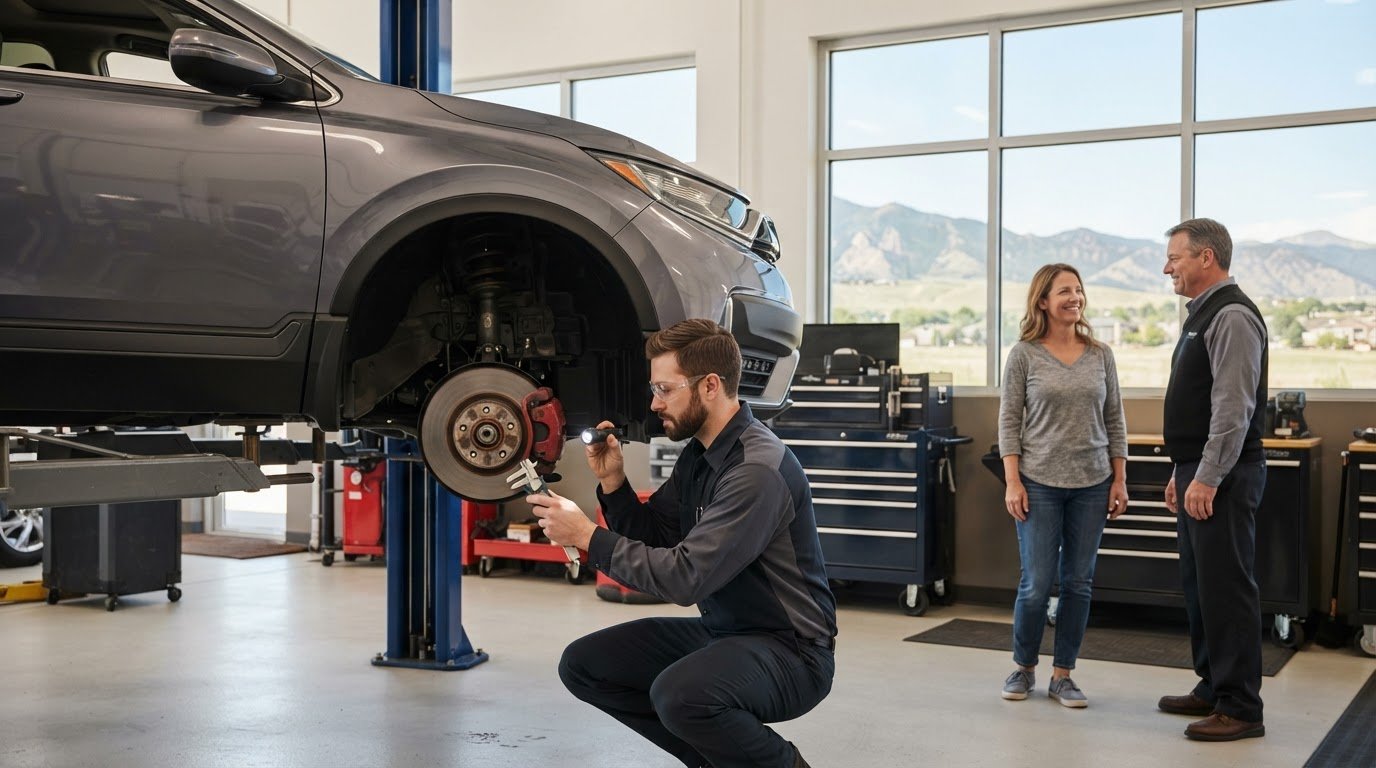
Replacing brake pads doesn’t automatically mean replacing the rotors, too. This guide to brake pad and rotor replacement Colorado drivers can use explains why the right repair depends on each part’s condition, not a blanket rule.
A noise, vibration, or change in braking feel is a reason to arrange an inspection, but it does not identify the cause by itself. An inspection helps determine whether the pads, rotors, or another part of the braking system needs attention.
Here, you’ll learn how technicians assess brake symptoms and component condition, when pads alone may be an option, and what to consider if rotors are also recommended for service. You’ll also find practical ways to describe what you’re noticing so the assessment can focus on your vehicle’s specific symptoms.
Key Takeaways
- Brake pad and rotor replacement Colorado drivers may need depends on the condition of each part. Replacing both is not automatically necessary.
- Describe when a change in braking occurs, such as while slowing down or turning, to help guide an evaluation.
- Inspection findings can help determine whether to replace pads alone, replace pads and rotors together, or investigate further.
- Visible wear and braking symptoms both matter when considering which components may need attention.
- Eagle Transmission & Auto Repair in Parker provides brake repair and replacement, with recommendations based on the vehicle’s condition.
Brake Pad and Rotor Replacement in Colorado: What Each Part Does
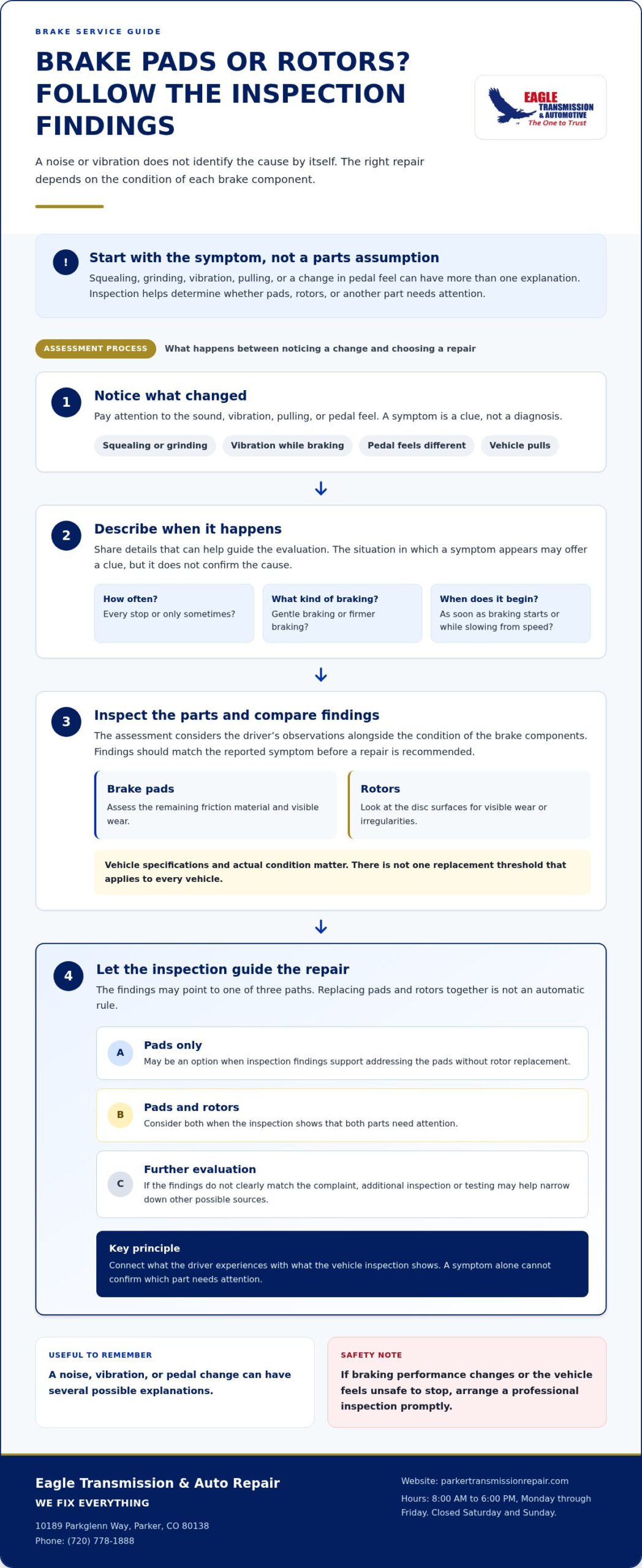
Brake pads and rotors may need different repairs. An inspection determines whether the pads, rotors, or both need attention, so a noise or vibration alone is not enough to decide what to replace. Understanding how these parts work can help you follow the findings and ask clear questions about the recommended repair.
What brake pads and rotors do during a stop
Brake pads are blocks of friction material that press against the rotors when you apply the brakes. Rotors are metal discs attached to the wheels, so they turn as the vehicle moves. When the pads press against the discs, friction helps slow the rotating wheels and creates heat. Over time, pad material wears down, and rotor surfaces can wear or develop irregularities.
If the contact between the two parts changes, you may notice a different sound or feel during braking. A symptom can point to a concern, but it does not confirm which part is responsible. For a basic overview of pad materials and their role in a disc brake system, see Brake Pad.
Brake pad and rotor replacement means replacing worn or unsuitable brake pads, rotors, or both so the parts can work together as intended. Whether a vehicle needs paired replacement depends on inspection findings, not an automatic rule.
Which symptoms should prompt a brake inspection?
Pay attention to changes, especially if they happen repeatedly or get worse. Squealing can be a clue that the pads or another part of the braking system needs attention. Grinding may point to more severe contact or wear, but the sound alone cannot identify the cause. Vibration during braking can also have more than one explanation.
Notice how the brake pedal feels, too. A pedal that feels unusually soft, firm, or different from its normal response deserves attention. Other brake or vehicle conditions can create similar noises and sensations, so avoid treating one symptom as a definite diagnosis.
- Note whether a sound occurs every time you brake or only in particular situations.
- Pay attention to vibration, pulling, or a change in pedal feel.
- Describe when the symptom appears, such as during gentle braking or slowing from speed.
If braking performance changes or the vehicle feels unsafe to stop, arrange a professional inspection promptly. Eagle Transmission & Auto Repair provides brake repair and replacement in Parker. Drivers can read more about brake replacement in Parker. For brake pad and rotor replacement Colorado drivers should rely on an assessment of both the symptoms and the parts, rather than assuming every brake job needs new rotors.
How Colorado Technicians Assess Pads, Rotors, and Braking Symptoms
A brake inspection considers the driver’s description alongside the condition of the parts. A technician may ask when the concern occurs, examine the relevant brake components, and carry out checks to narrow down the cause. This helps distinguish a worn pad or rotor concern from another issue without treating one sound or sensation as a diagnosis.
Useful details include whether a noise happens with every stop or only occasionally, whether vibration starts as soon as braking begins, and whether the pedal feels different than usual. A symptom that appears only under certain conditions can offer a clue, but it still needs to be considered alongside the vehicle’s condition.
What helps distinguish pad wear from rotor concerns?
An inspection can assess the remaining friction material on the pads and look for visible changes to the rotor surfaces. The technician considers whether the parts appear worn or uneven and whether those findings match the driver’s description. There is not one replacement threshold that applies to every vehicle in every situation. The vehicle’s specifications and actual condition matter.
Vibration during braking may be associated with rotor condition, but it can have other causes. That is why a careful assessment considers more than the sensation alone.
A typical assessment may involve several kinds of information:
- Driver observations: When does the noise, vibration, or pedal change happen? Does it occur during light braking, firmer braking, or slowing from speed?
- Visible condition: What do the pads and rotor surfaces show? Do the observed wear patterns help explain the reported symptom?
- Additional evaluation: If the findings do not clearly match the complaint, further inspection or testing may help narrow down other possible sources.
A diagnosis cannot be made from a description alone. A sound that seems to come from the brakes can overlap with other vehicle noises, while vibration can involve more than one component or system. The goal is to connect what the driver experiences with findings on the vehicle, rather than assume the first likely explanation is the only one.
Why symptoms alone cannot confirm the repair
Squealing, grinding, vibration, and changes in pedal feel can each have several possible explanations. Even similar symptoms may come from different conditions, and one issue can affect how braking feels. Vehicle inspection and, where appropriate, testing help determine which possibility fits the evidence. Until the vehicle is examined, it is not possible to say whether pads, rotors, or another part needs attention.
Inspection findings, not assumptions, should determine whether a brake repair involves pads, rotors, or both. That distinction keeps the recommended work tied to the vehicle’s condition. If braking feels unsafe or performance has changed, arrange an inspection. For brake pad and rotor replacement Colorado, Eagle Transmission & Auto Repair provides brake repair and replacement in Parker. Find Eagle Transmission & Auto Repair in Parker.
Replace Brake Pads Only or Replace Pads and Rotors Together?
New pads do not automatically mean new rotors. The right choice depends on what an inspection finds, including the condition of the rotor surfaces and how the parts are working together. A clear recommendation should connect each proposed repair to an observed condition, rather than treating every brake job the same way.
| Option | When it may fit | What to understand |
|---|---|---|
| Replace pads only | The pads need replacement, and inspection findings support keeping the rotors in service. | Rotor condition still needs to be assessed for that vehicle. |
| Replace pads and rotors | Inspection finds concerns with both the friction material and rotor condition. | The recommendation should explain why each part needs attention. |
| Further inspection | The symptoms and visible condition do not point to a clear cause, or another component may be involved. | More evaluation may be needed before repair scope is decided. |
When might pad replacement alone be considered?
Replacing pads alone may be appropriate if the pads need service and the rotors are found suitable for continued use. That decision depends on the rotor’s condition and the vehicle’s specific findings. It is not safe to assume every rotor can be reused, just as it is not necessary to assume every rotor must be replaced with the pads. Ask what the inspection shows about the parts involved.
When might pads and rotors both need attention?
Both parts may need service if an inspection reveals wear or damage affecting the rotors as well as the pads. A noise or vibration by itself does not prove that both need replacement. The technician should explain how the observed condition relates to the recommended work and whether further assessment is needed.
Questions can help make the recommendation easier to understand:
- Which part or parts show a condition that needs repair?
- What inspection finding supports replacing the rotors, if that work is recommended?
- Is the symptom consistent with the condition found, or are other causes still being considered?
Repair cost depends on factors such as the vehicle, parts, labor, extent of wear, and diagnostic findings. Those details vary, so an accurate quote requires an inspection. Eagle’s brake replacement guidance explains the service without treating paired replacement as a rule for every vehicle.
For brake pad and rotor replacement Colorado drivers should base the decision on the condition of their specific vehicle. Eagle Transmission & Auto Repair provides brake repair and replacement in Parker. Find Eagle Transmission & Auto Repair in Parker.
Preparing for Brake Pad and Rotor Service in Colorado
A little preparation can make a brake service conversation more useful. Before bringing in your vehicle, think about what you have noticed and when it happens. Clear observations help a technician compare your experience with the vehicle’s condition, while an inspection determines whether the concern involves pads, rotors, or another part.
What information should drivers share about brake symptoms?
Describe the symptom in your own words. Note whether you hear a squeal, feel a vibration, or notice a pedal change, and whether it happens during braking, turning, or slowing from speed. Mention if it recurs and whether the braking feel has changed. You do not need to identify the faulty part yourself. A straightforward description is more useful than a guess.
If you can, jot down a few details before the appointment:
- What you notice: A sound, shake, pull, or change in pedal response.
- When it happens: For example, while braking gently, slowing more firmly, or turning.
- What has changed: Whether the concern is new, recurring, or different from the vehicle’s usual feel.
- Driving context: Whether it appeared during regular trips or after driving on steep roads.
These details do not establish a diagnosis, but they give useful context for an inspection. If braking performance has changed or the vehicle feels unsafe, arrange professional attention promptly rather than trying to identify or repair the components yourself.
How Colorado driving context can inform the conversation
Repeated braking on a long downhill stretch can place more workload on the brakes than ordinary level driving. If you have recently driven steep roads, mention that alongside any change in sound or feel. On a descent, selecting a lower gear when appropriate can let the engine help control speed and reduce reliance on the brakes. For more general guidance, see this overview of brake replacement for Colorado drivers.
Service cost depends on the vehicle, parts, labor, extent of wear or damage, and inspection findings. These factors can vary, so an accurate quote requires an inspection. A recommendation should explain which findings support the work being discussed, whether that means pads, rotors, or further evaluation.
For brake pad and rotor replacement Colorado drivers can prepare by sharing specific symptoms and relevant driving conditions, then reviewing the inspection findings before deciding on repair scope. Eagle Transmission & Auto Repair serves drivers in Parker, Centennial, Castle Rock, Douglas County, Lone Tree, and Aurora. If your braking feel has changed, schedule a brake inspection. Get directions to Eagle Transmission & Auto Repair.
Book Brake Pad and Rotor Replacement in Colorado at Eagle
The decision to replace pads, rotors, or both should follow an inspection of the vehicle, not a rule that every brake job requires paired replacement. Findings help explain which components need attention and why. Eagle Transmission & Auto Repair in Parker provides brake repair and replacement for drivers who want to discuss a braking concern and its repair options.
What to expect from a brake repair consultation
A repair recommendation requires an inspection. Before deciding on the work, share the symptoms you have noticed and any concerns about how the vehicle stops. For example, explain if a noise happens during braking, whether the steering wheel or vehicle vibrates, or if the pedal feels different than usual. These details help frame the concern, but symptoms alone do not establish which part needs service.
As you review a recommendation, ask what the inspection found and how that finding relates to the proposed work. If both pads and rotors are included, ask what condition was observed on each. If the recommendation is for pads only, ask how rotor condition was considered. Clear explanations help you understand the repair scope without having to guess which parts are involved.
You can also ask whether the inspection identified a concern beyond pads and rotors or whether further evaluation is needed. A repair plan should reflect the condition of your vehicle. There is no need to arrive with a diagnosis already in mind. Describing what you have experienced is a helpful place to start.
- Share when the symptom occurs and whether it has changed.
- Ask which inspection findings support the recommended repair.
- Make sure you understand whether the recommendation covers pads, rotors, or another concern.
Take the next step with a local Parker shop
Brake noise, vibration, or a changed braking feel can be unsettling, especially if it is new. A professional inspection can help clarify what needs attention and which repair options fit the vehicle’s condition. For brake pad and rotor replacement Colorado drivers should expect the recommended scope to be based on inspection findings, rather than an assumption that both parts always need replacement.
If you have a braking concern, contact Eagle Transmission & Auto Repair to schedule a brake inspection or discuss repair options. Visit parkertransmissionrepair.com or get directions to Eagle Transmission & Auto Repair.
Take the next step toward a clear brake plan
Use what you have learned to approach the repair conversation with a clear goal: understand the reason for each recommended item and how it relates to your vehicle. You do not need to arrive knowing which parts are worn. Describe the concern in plain language, review the assessment, and ask for clarification if any part of the recommendation is unclear.
For brake pad and rotor replacement Colorado drivers can keep the decision grounded in the vehicle’s individual findings. Before approving work, make sure you understand the proposed scope, what the inspection supports, and whether the quote reflects that scope. This helps you compare the recommendation with your original concern without trying to diagnose the vehicle yourself.
Brake questions are reasonable, especially when the symptom affects how your vehicle feels on the road. Take the time to understand the information you need, then choose the next step that fits the inspection findings. A clear explanation of the repair can make the decision easier to follow.
Frequently Asked Questions
Can brake pads be replaced without replacing rotors?
Sometimes. The decision depends on whether the rotor can provide a suitable surface for the replacement pad, which is assessed for the specific vehicle. Ask what the rotor surface looks like and whether any visible scoring or unevenness matters to the repair recommendation. That helps clarify why pads alone are being considered instead of relying on a general rule.
How do I know if my brake rotors need replacement?
Vibration, noise, or a change in braking may be a clue, but none identifies rotor replacement as the answer by itself. Note where you feel the vibration, such as in the steering wheel, pedal, or vehicle body, and whether it occurs consistently or only in certain situations. Those details help frame an assessment of the rotor surfaces and other possible sources.
Is it necessary to replace brake pads and rotors at the same time?
No, not automatically. The repair scope should reflect the condition of the parts on your vehicle. If both pads and rotors need attention, replacing both may be recommended. If not, the proposed work may differ. Ask which components are included and what finding supports each one.
What can cause a steering wheel to shake when braking?
A brake related concern is one possibility, but a shaking steering wheel can also be associated with other vehicle conditions. Note whether the shake begins only when you apply the brakes, whether it changes with braking pressure, and whether you feel it elsewhere in the vehicle. Sharing those observations gives an inspection useful context without assuming the movement proves a specific brake part has failed.
How much does brake pad and rotor replacement cost in Colorado?
There is no one accurate figure for every vehicle. A quote can vary with the vehicle, parts, labor, extent of wear or damage, and what an inspection finds. Ask what work the quote covers and whether it includes pads, rotors, or any additional repair supported by the findings. An accurate quote requires an inspection because the necessary parts and scope can differ from vehicle to vehicle.
For brake pad and rotor replacement Colorado drivers can get a vehicle specific assessment from Eagle Transmission & Auto Repair in Parker. Call or visit parkertransmissionrepair.com to schedule a brake inspection or discuss repair options.
Eagle Transmission & Auto Repair
10189 Parkglenn Way, Parker, CO 80138
Phone: (720) 778-1888
Website: parkertransmissionrepair.com
Hours: 8:00 AM to 6:00 PM, Monday through Friday. Closed Saturday and Sunday.