
Could a hard shift mean your transmission control module has failed, or is another part sending the wrong signal? Shifting trouble can have several causes, so a fault in the vehicle’s computer should not be assumed. For drivers researching transmission control module replacement Centennial, the right starting point is a diagnosis that connects the symptoms to test findings.
The TCM helps coordinate gear changes using information from other vehicle systems. Delayed, rough, or unpredictable shifting can also involve a sensor, wiring, or another transmission problem. Replacing the module without identifying the cause may leave the original concern unresolved.
This guide explains what the TCM does, how diagnostic testing can help distinguish a module fault from other causes, and what to consider when comparing repair options. You’ll also learn why programming may matter for some vehicles and how Eagle Transmission & Auto Repair, in nearby Parker, serves drivers in Centennial with transmission diagnostics and repair. With a clearer picture of the evidence, you can make an informed decision about the next step.
Key Takeaways
- The transmission control module helps manage transmission operation, but shifting trouble alone doesn’t prove it has failed.
- Fault codes provide clues. Technicians interpret them alongside symptoms and inspection findings to identify likely causes.
- Wiring, sensors, and other transmission-related faults may call for a different repair than module replacement.
- For transmission control module replacement Centennial, look for a diagnosis that explains the evidence and proposed repair scope.
- Compare repair options and find transmission diagnostics and repair near Centennial, served from Parker.
Transmission control module replacement in Centennial: what the module does
A transmission control module is an electronic component involved in how your vehicle’s transmission operates. Rough shifts, delayed gear changes, or a warning light don’t prove the module has failed. For drivers considering transmission control module replacement Centennial, diagnosis is the sensible first step because different faults can produce similar symptoms.
What does a transmission control module control?
Think of the TCM as a coordinator. It uses information from the vehicle to help manage transmission operation, including when and how gear changes happen. Because it works with other systems, a problem elsewhere can affect the information it receives or the way the transmission behaves. The Transmission Control Unit (TCU) overview explains the general function of this type of control unit and how it interacts with a vehicle.
The design depends on the vehicle. Some models use a separate module, while others integrate transmission controls with other electronics. Terminology can vary, too. A technician needs the vehicle’s make, model, and configuration to identify the relevant component and understand how it works in that vehicle.
Which symptoms may lead drivers to suspect a module?
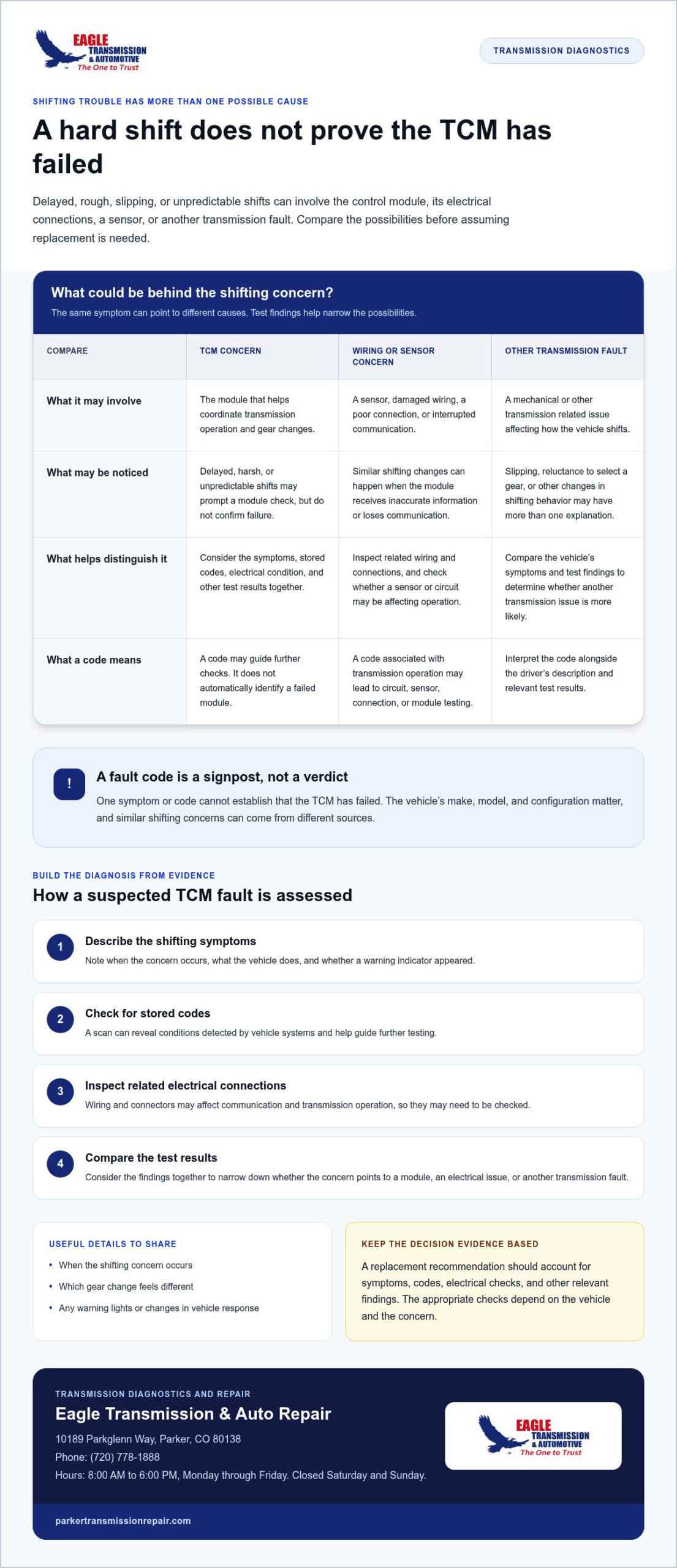
A driver may notice that the transmission shifts later than usual, changes gears harshly, slips, or seems reluctant to select a gear. A warning indicator or a change in how the vehicle responds can also prompt concern. These signs deserve attention, but none identifies a failed TCM by itself. They are clues to guide an inspection, not a verdict.
The same symptom can have different causes. A sensor may send inaccurate information, or damaged wiring or a poor electrical connection may interrupt communication. A mechanical or other transmission-related fault can also affect shifting. Even a warning light may relate to a system beyond the module. If a warning indicator is part of the concern, check engine light diagnosis can help identify what the vehicle is reporting. The code still needs to be interpreted in context.
- Notice when the concern occurs, such as during acceleration, after the vehicle warms up, or during a particular gear change.
- Pay attention to warning lights and changes in driving behavior, and share those details during diagnosis.
- Don’t treat a single code or symptom as proof that the module needs replacement.
Diagnosis should come before replacement. Test the control system and consider other possible causes before deciding the module is at fault. This evidence-based approach helps distinguish a module concern from a wiring, sensor, or transmission issue, so the proposed repair can match the vehicle’s actual needs.
How technicians assess a suspected transmission control module fault
Finding a transmission fault is a bit like tracing a message that got lost on its way to its destination. The module may be involved, but symptoms, stored codes, electrical condition, and other system findings help tell the story. A careful assessment brings those clues together before a replacement is recommended, so the repair addresses a supported cause rather than an assumption.
A general diagnostic sequence may include:
- Discussing the symptoms. When the shifting changes occur and whether warning indicators appeared can help focus the evaluation.
- Checking for stored codes. A scan can reveal conditions detected by the vehicle’s systems and help guide further testing.
- Inspecting related electrical connections. Wiring and connectors can affect communication and operation, so they may need to be checked.
- Comparing test results. Findings from the vehicle and transmission are considered together to narrow down possible causes.
This is a general way to think about diagnosis, not a fixed checklist for every vehicle. The appropriate checks depend on the vehicle and the concern. If a warning light is part of the problem, check engine light diagnostics can help identify what the vehicle is reporting. Further interpretation helps determine how that information relates to the shifting symptoms.
What can diagnostic codes tell you?
A fault code points to a condition the vehicle has detected. It doesn’t automatically identify the failed part. For example, a code associated with transmission operation may lead a technician to examine a circuit, sensor, connection, or module, depending on the other findings. Codes are most useful when considered alongside the driver’s symptoms and relevant test results.
Think of a code as a signpost, not a verdict. Further investigation may be needed before anyone can determine whether the module itself is at fault.
Why check wiring and related components?
A module depends on electrical connections and information from other components to support transmission operation. A damaged wire, loose connection, or sensor issue may interfere with that communication. Other transmission-related faults can also produce concerns that seem electronic at first. Checking these possibilities helps distinguish a module problem from an issue affecting its inputs or the transmission itself.
Comparing findings narrows down the possibilities. If a code suggests a circuit concern, for instance, checking the circuit and its connections can help determine whether the issue lies there or whether other evidence points toward the module. The vehicle’s specific findings matter, so no general example can settle the diagnosis for every car.
For anyone considering transmission control module replacement Centennial, the useful question is not only “What code appeared?” but also “What findings support the proposed repair?” A clear explanation should connect the symptoms and test results to the recommended next step. Drivers looking for a local starting point can get directions to Eagle Transmission & Auto Repair in Parker, serving Centennial drivers with transmission diagnostics and repair.
Module replacement or another repair: how to compare the possibilities
Choosing between module replacement and another repair starts with the evidence, not the name of the symptom. Shifting trouble could trace to the module, but wiring, connectors, sensors, or another transmission-related fault may also be involved. The goal is to match the repair to the cause found during inspection, rather than swap a part in the hope that it solves the problem.
For a driver weighing transmission control module replacement Centennial, compare what each possible repair would address:
- Module replacement may be considered when testing supports a fault within the module itself. The replacement must also be compatible with the vehicle.
- Wiring or connector repair may be the better fit if an electrical connection or circuit is disrupting communication or operation.
- Sensor diagnosis or repair may be appropriate if the module is receiving inaccurate information from a related component.
- Transmission repair may be needed when findings point to a mechanical or other transmission concern rather than a control module problem.
These options are not interchangeable. Replacing a module won’t necessarily correct a damaged wire or a separate transmission fault, just as repairing a connection won’t resolve a confirmed internal module failure. A sound recommendation should explain how the inspection findings connect to the proposed work. Eagle Transmission & Auto Repair provides transmission repair services for concerns that call for transmission diagnosis and repair.
When does the evidence support considering replacement?
Replacement becomes a reasonable option when diagnostic findings point to a module fault after related causes have been considered. The part must suit the vehicle’s specific configuration; a component that looks similar may not be compatible. Any setup or programming needs also depend on the vehicle. These details should be verified for the specific make, model, and replacement part, rather than assumed to apply universally.
When might the module not be the cause?
A faulty sensor, damaged wiring, a poor connection, or another transmission concern can produce symptoms that resemble a module problem. If the actual fault lies elsewhere, installing a module may leave the shifting concern unchanged. The diagnosis should connect the reported symptoms to test results and explain why the proposed repair addresses the cause, not just a clue.
Inspection also shapes the estimate. The vehicle, selected part, labor involved, extent of any related damage, and diagnostic findings all affect the proposed repair scope. An accurate quote requires inspection and diagnostic information, so a number offered before the cause and required work are understood may not reflect the actual repair. Ask for the estimate to distinguish the recommended repair from related work and explain which findings support each item. That makes it easier to compare options without treating every shifting symptom as proof that the module must be replaced.
Choosing a transmission control module service in Centennial
A clear diagnosis should leave you understanding why a particular repair is recommended, not just which part might be replaced. Before approving transmission control module replacement Centennial, make sure the evidence, alternatives considered, and proposed repair scope make sense for your vehicle. A straightforward conversation can help you compare options without needing to speak fluent mechanic.
Questions to ask before approving module replacement
Use these questions to understand how the recommendation connects to the diagnostic findings:
- What findings point to the module itself? Ask how the test results support that conclusion, rather than relying on a symptom or code alone.
- What other causes were considered? Find out whether wiring, connections, sensors, or transmission-related concerns could account for the same behavior.
- Does this vehicle need a specific setup after replacement? Requirements vary by vehicle, so verify any programming or setup details for its make, model, and configuration.
- What does the proposed repair include? A clear scope helps you understand which work is recommended and whether the estimate includes related repairs.
An accurate quote depends on inspection and diagnostic findings. Until the vehicle and the cause of the concern are evaluated, the necessary parts and work may not be clear. A useful estimate should reflect the findings and describe the recommended scope, rather than assume every shifting issue calls for the same repair.
What information should you bring to a diagnostic visit?
Your observations can help describe the concern. Note when it began, whether it happens every time or only in certain conditions, and what the vehicle does when shifting. Record any dashboard warnings and when they appeared. Mention recent repairs or electrical work, too. These details may help the technician understand how the concern developed and relate it to test results.
Centennial drivers can explore Centennial transmission repair from Eagle Transmission & Auto Repair, located in Parker, Colorado and serving the Centennial area. For broader context on evaluating transmission concerns, the transmission repair guide explains how repair decisions depend on the issue and the vehicle’s findings.
Bring your notes and ask for the diagnosis and recommendation to be explained in plain language. That gives you a practical basis for comparing the proposed repair with the evidence. For transmission diagnostics and repair near Centennial, get directions to Eagle Transmission & Auto Repair in Parker.
Get transmission control module help near Centennial
If shifting concerns or warning indicators keep appearing, an inspection can help clarify what may be behind them. It doesn’t automatically mean your vehicle needs a new transmission control module. Start by having the concern evaluated, then use the findings to decide what repair, if any, makes sense.
Start with diagnosis, not assumptions
Symptoms can be unsettling, especially when you’re unsure whether the issue is electronic or inside the transmission. You don’t need to identify the failed part before arranging a diagnostic visit. Bring a clear account of what you’ve noticed and let the assessment establish which possibilities the evidence supports. A technician can explain the findings in everyday language, so you understand why a repair is recommended and what it is intended to address.
For transmission control module replacement Centennial questions, Eagle Transmission & Auto Repair provides transmission diagnostics and repair for local drivers. The shop is in Parker, Colorado and serves Centennial. Its diagnostic and repair services can help you choose a next step based on your vehicle’s specific concern, rather than assume every shifting symptom calls for module replacement.
Arrange a local diagnostic visit
Before your visit, jot down when the concern began, what changes you notice, and whether a warning indicator has appeared. If the symptom comes and goes, describe the circumstances you’ve observed. Mention recent repairs or electrical work if they might be relevant. These details provide useful context, while diagnostic findings and inspection guide the repair discussion.
As you review the recommendation, make sure you understand what the proposed work includes and how it relates to the findings. If replacement is being considered, ask how the diagnosis supports that option and whether any vehicle-specific setup applies. The goal is a clear, informed decision. Diagnosis may point toward module replacement, another repair, or further evaluation, depending on the vehicle and evidence.
For a local starting point, Get directions to Eagle Transmission & Auto Repair in Parker. The shop serves drivers from Centennial and provides transmission diagnostics and repair.
Eagle Transmission & Auto Repair
Parker, Colorado
Monday through Friday, 8:00 AM to 6:00 PM
Closed Saturday and Sunday
Move forward with a clear diagnosis
Your next step doesn’t have to be choosing a part. It can simply be understanding what your vehicle is telling you. If you’re weighing transmission control module replacement Centennial, focus on what the inspection and diagnostic findings show. That gives you a sounder basis for deciding what to do next, without needing to arrive with the answer already figured out.
Eagle Transmission & Auto Repair provides transmission diagnostics and repair for Centennial drivers from its Parker, Colorado location. Bring your questions, describe what you’ve noticed, and take the repair discussion one step at a time. A clear explanation can make an uncertain situation easier to manage.
Get directions to Eagle Transmission & Auto Repair and take a practical next step toward understanding your vehicle’s transmission concern. You deserve to feel informed and comfortable as you decide what comes next.
Frequently Asked Questions
Can a bad transmission control module cause shifting problems?
Yes, a faulty transmission control module can contribute to delayed, harsh, or inconsistent shifting. But those symptoms don’t establish that the module is the cause. A vehicle that shifts roughly only under certain conditions, for example, may have another issue that needs investigation. If you’re considering transmission control module replacement Centennial, use the symptoms to describe the concern, then rely on vehicle-specific test findings to guide the repair decision.
Is a transmission control module the same as an engine control module?
No. They refer to different control functions: the transmission control module manages transmission operation, while the engine control module manages engine functions. Vehicle designs differ, and some integrate control functions rather than use separate standalone units. Labels in a diagnostic report may also vary by vehicle. If a scan mentions a control module, identify which system the term refers to before assuming the transmission computer needs replacement.
Can a weak battery or electrical issue trigger transmission control module codes?
Yes, low voltage or an electrical problem can sometimes affect communication between vehicle systems and contribute to stored codes. That doesn’t mean the battery is always responsible or that a TCM code can be ignored. If a warning appears after a battery problem or electrical work, share that timing during diagnosis. Checking the power supply and related connections can help clarify whether the code reflects an ongoing module concern or another electrical issue.
Will clearing a transmission code fix a control module problem?
Clearing a code removes its stored record, but it doesn’t repair the condition that caused it. A warning may return if the underlying issue remains, and clearing codes before diagnosis can remove useful information about what the vehicle detected. If a code has been cleared, tell the technician and describe any symptoms or warning lights you noticed beforehand. That context can help make sense of what appears during a later evaluation.
Does every vehicle have a separate transmission control module?
No. Some vehicles use a dedicated transmission module, while others integrate transmission controls with other electronic systems. The layout can vary by make, model, and configuration, so don’t assume the module’s location or design based on another vehicle. Eagle Transmission & Auto Repair is in Parker and serves drivers in Centennial, Castle Rock, Douglas County, Lone Tree, and Aurora. A vehicle-specific inspection can clarify which control arrangement applies to your car.